On this page
Last updated September 10, 2026. Opening days, booking rules and site status checked against official sources the same week.
The best things to do in Naples, Italy are walking Spaccanapoli and Via dei Tribunali, seeing the Veiled Christ in the Sansevero Chapel, going underground at Napoli Sotterranea or the San Gennaro catacombs, spending a morning in the Archaeological Museum, riding up to Castel Sant’Elmo for the view, and eating pizza where it was invented. Book Sansevero before you fly.
That is the short answer. The long one is this page, and it is long for a reason: Naples, the Napoli on the bay under Vesuvius in southern Italy (not the one in Florida, which Google sometimes hands you instead), is a city where the difference between a great day and a frustrating one is almost always operational. Which sights close on a Tuesday. Which ones you cannot walk into without a reservation. Which “must-see” is currently shut behind scaffolding. Which famous pizzeria has a ninety-minute line and which one two streets away doesn’t.
Most lists of things to do in Naples give you thirty numbered sights at equal weight and let you find out the rest on the day. I’d rather tell you which ones earn their place, which ones I’d skip on a short trip, and how to string them together so you are not crossing the city three times to find locked doors. Everything below is ranked with an honest verdict, the city-wide closed-day table sits near the top, and there is a section at the end on what to leave out.
The best things to do in Naples, Italy: the dozen that matter most
If you only read one section, read this one. These are the sights and experiences I would put ahead of everything else for a first visit, in rough order of how much they give back for the time they take.
- Walk Spaccanapoli and Via dei Tribunali. Free, always open, and the single best introduction to how Naples actually works. Half a day at a slow pace.
- See the Veiled Christ at the Sansevero Chapel. A marble shroud so thin it looks wet. Compulsory advance booking, closed Tuesdays. Worth every minute of the planning.
- Go under the city. Napoli Sotterranea for Greek quarries and wartime shelters, or the San Gennaro catacombs for early Christian Naples. Pick one on a short trip, both if you have three days.
- Spend a morning at MANN, the National Archaeological Museum. The mosaics and frescoes lifted out of Pompeii and Herculaneum. Go before you visit the ruins, not after. Closed Tuesdays.
- Eat a margherita in the centro storico. Not a sight, but not optional either. Around the price of a sandwich, and it will ruin pizza at home for you.
- Ride the funicular up to Castel Sant’Elmo. The whole bay, Vesuvius and the old city grid in one sweep. Cheap, rarely crowded, closed Tuesdays.
- Sit in the majolica cloister of Santa Chiara. Hand-painted tiles, orange trees, and the quietest half hour you will find in the old city.
- Walk the seafront from Castel dell’Ovo to Mergellina. The Lungomare at golden hour is what Naples looks like on postcards, and it’s free.
- See Caravaggio’s Seven Works of Mercy at the Pio Monte della Misericordia. One painting, in the church it was painted for, a few feet from your face.
- Stand in Piazza del Plebiscito, then walk through Galleria Umberto I and past the San Carlo opera house. Royal Naples in twenty minutes, all free from the outside.
- Get lost in the Quartieri Spagnoli and the Sanità. Laundry lines, street shrines, the Maradona mural, and the double staircase of Palazzo dello Spagnolo.
- Take the metro to Toledo station and look up. The deepest, bluest, most photographed metro station in Europe costs you a single ticket.
After those, the list keeps going for a long time: Capodimonte’s Caravaggio and Titians, the Certosa di San Martino, the Galleria Borbonica tunnels, the Fontanelle ossuary, the San Carlo backstage tour, the Chiaia aperitivo lanes, Posillipo’s coves. And then there is everything outside the city: Pompeii, Herculaneum, Vesuvius, Capri, the Amalfi Coast. All of it is covered below.
Naples, Italy attractions at a glance: closed days, booking and cost
This is the table I wish someone had handed me before my first trip. Naples’ big sights cluster their weekly closures on Tuesday and Wednesday, so a careless itinerary can hit three locked doors in one day. Cost bands are for a standard adult ticket; EU citizens aged 18 to 25 and under-18s get big discounts at the state museums.
| Sight | Area | Weekly closure | Book ahead? | Cost band | Time needed | Verdict |
|---|---|---|---|---|---|---|
| Spaccanapoli & Via dei Tribunali | Centro storico | Never | No | Free | 2–4 hrs | Essential |
| Sansevero Chapel (Veiled Christ) | Centro storico | Tuesday | Yes, compulsory | €10–15 | 45 min | Essential |
| MANN (Archaeological Museum) | Museo / Piazza Cavour | Tuesday | No | €15–20 | 2–3 hrs | Essential |
| Napoli Sotterranea | Piazza San Gaetano | Never | No (under 10 people) | €10–15 | 1.5 hrs | Excellent |
| Catacombs of San Gennaro | Capodimonte / Sanità | Wednesday | Yes | €10–15 | 1 hr | Excellent |
| Santa Chiara cloister | Centro storico | Never (short Sunday hours) | No | Under €10 | 45 min | Excellent |
| Pio Monte della Misericordia | Via dei Tribunali | Never | No | €10–15 | 30–45 min | Excellent |
| Duomo & San Gennaro chapel | Via Duomo | Never | No | Free (museum extra) | 30 min | Worth it |
| Castel Sant’Elmo | Vomero | Tuesday | No | Under €10 | 1 hr | Excellent |
| Certosa e Museo di San Martino | Vomero | Wednesday | No | Under €10 | 1.5 hrs | Excellent |
| Capodimonte museum & park | Capodimonte | Wednesday | No | €10–15 | 2–3 hrs | Worth it (art lovers: essential) |
| Palazzo Reale | Plebiscito | Wednesday | No | €10–15 | 1.5 hrs | Worth it |
| Teatro di San Carlo tour | Plebiscito | Depends on rehearsals | Advisable | Under €10 | 30 min | Worth it |
| Gallerie d’Italia (last Caravaggio) | Via Toledo | Monday | No | Under €10 | 45 min | Worth it |
| Castel Nuovo | Municipio | Sunday | No | Under €10 | 45 min | Optional |
| Castel dell’Ovo | Borgo Marinari | Closed for works (see below) | — | Free when open | 30 min | Walk out anyway |
| Galleria Borbonica | Monte di Dio | Runs Fri–Sun & holidays | Yes | €10–15 | 1 hr | Excellent |
| Cimitero delle Fontanelle | Sanità | Wednesday | Yes | Under €10 | 40 min | Remarkable, if bones don’t bother you |
| San Lorenzo Maggiore excavations | Via dei Tribunali | Never | No | Under €10 | 1 hr | Worth it |
| Toledo metro station | Via Toledo | Never | No | One metro ticket | 15 min | Essential, and cheap |
Closures and booking rules checked September 2026 against each operator’s own site where it was reachable (museosansevero.it, museoarcheologiconapoli.it, catacombedinapoli.it, napolisotterranea.org, palazzorealedinapoli.org, gallerieditalia.com, the Comune di Napoli). Palazzo Reale’s Wednesday closure and Santa Chiara’s cost come from recent secondary sources because the official pages were silent or down. Two sources disagree on whether the Certosa di San Martino closes Wednesday or Tuesday; the museum’s own listing says Wednesday.
The practical upshot: make Tuesday your Capodimonte, catacombs and Sanità day, and Wednesday your MANN, Sansevero and centro storico day. Flip that and you lose half of each.
Before you start: how Naples fits together
Naples is easier than it looks once you see the shape of it. The old Greek city, Neapolis, is a tight grid of three parallel streets (the decumani) on flat ground a short walk from the main station. Spaccanapoli is the lower one, Via dei Tribunali the middle one. Almost every church, underground site and pizzeria people come for sits inside a rectangle you can cross on foot in twenty minutes.
West of that, Via Toledo runs downhill from the Archaeological Museum to Piazza del Plebiscito, the royal quarter, with the Spanish Quarter’s steep grid climbing off it to the right. Below the palace is the sea: Castel Nuovo and the ferry port to the east, Castel dell’Ovo and the long seafront promenade to the west, curving on through Chiaia to Mergellina and the hill of Posillipo. Above everything sits Vomero, the hill with Castel Sant’Elmo on top, reached by three funiculars.
Two things surprise first-time visitors. The first is how compact the sightseeing core is: most of what you want is within a forty-minute walk of Piazza del Gesù Nuovo. The second is how much the city asks of you on day one. It is loud, dense, scooters come through alleys you thought were pedestrian, and the station area is nobody’s idea of a welcome. Give it a day. By the second evening, most people who arrive nervous have started to enjoy themselves, and by the third they are planning a return trip.
The historic center: what to do in Naples’ old city
If you have one day in Naples, spend most of it here. The centro storico is a UNESCO World Heritage Site, and unlike a lot of historic centers it is not a preserved showpiece. People live in it, work in it, hang laundry across it and park scooters in its church doorways. That is the whole appeal.
1. Walk Spaccanapoli and Via dei Tribunali
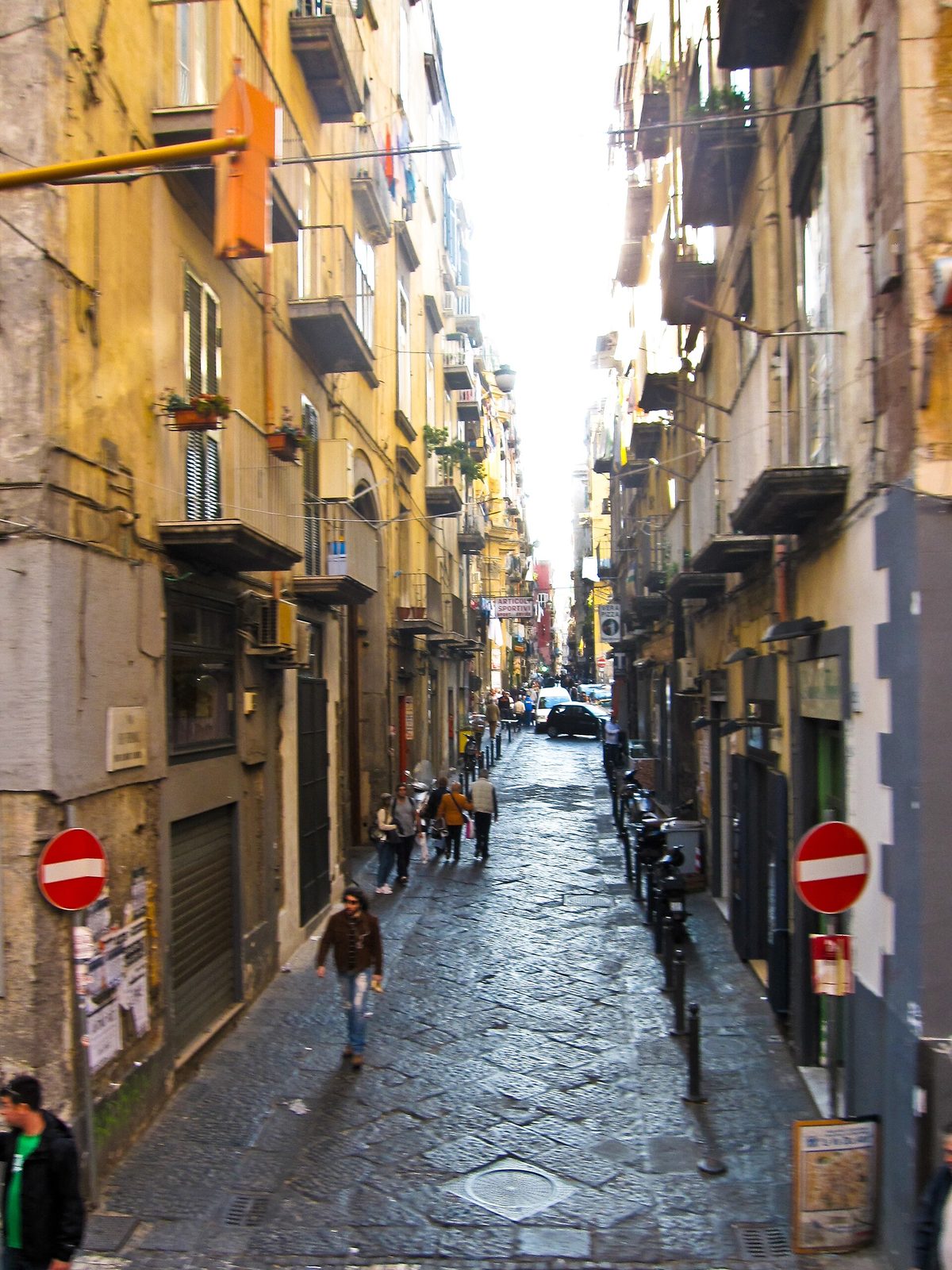
Spaccanapoli means “Naples-splitter,” and from the hill of Vomero you can see why: it is a dead-straight cut through the old city, running under a series of different street names (Via Benedetto Croce, Via San Biagio dei Librai) from the Gesù Nuovo toward the Forcella district. Walk it east from Piazza del Gesù Nuovo, then loop back west along Via dei Tribunali, the parallel street one block north. That loop is roughly two kilometers and takes as long as you let it. On a first visit, budget three hours including stops.
What you are looking for is not one monument but the density of them: a baroque church every hundred yards, an obelisk, a shrine with fresh flowers to a saint or a footballer, a friggitoria frying pizza dough in a hole in the wall, a bookbinder, a workshop making nativity figures. Via dei Tribunali is the more atmospheric of the two and has the covered porticoes near Castel Capuano at its eastern end. It is also where most of the famous pizzerias are, so time the walk to end there around lunch.
Verdict essential, free and always open. Go early (before 10:00) if you want photographs without a crowd, or after dark when the stone glows under the streetlamps and the street is all locals.
2. The Veiled Christ at the Sansevero Chapel
Giuseppe Sanmartino finished the Cristo Velato in 1753, and people have been standing in front of it trying to work out how a veil carved out of solid marble can look translucent ever since. The legend that the prince who commissioned it, Raimondo di Sangro, used alchemy to turn a real cloth to stone is nonsense, but after five minutes in the room you understand why it stuck. It is one of the most extraordinary pieces of sculpture in Italy.
The chapel has two other showstoppers that people forget to mention: Francesco Queirolo’s Disinganno (Disillusion), a man struggling out of a marble fishing net carved free of the stone, and Antonio Corradini’s Pudicizia (Modesty), another veiled figure. Down in the basement are the two “anatomical machines,” real human skeletons with their circulatory systems reconstructed in wire and wax. They are genuinely unsettling.
The operational part, which matters more here than anywhere else in Naples: advance booking is compulsory. Timed tickets go on sale online 60 days ahead, with a small second release two days before each date. The chapel is tiny, and in summer and around holidays the slots sell out well ahead. The official site does not literally say there are no door sales for individuals, but don’t plan on walking in; if you arrive without a booking you are relying on luck. The chapel is open daily from 9:00 to 19:00 except Tuesdays, and since February 2026 the ticket office has been temporarily at Via Raimondo di Sangro 12, a few steps from the entrance. Photography is not allowed inside. Book at museosansevero.it and ignore resellers charging double.
Verdict essential. If you book one thing before you fly, make it this.
3. Santa Chiara and the majolica cloister
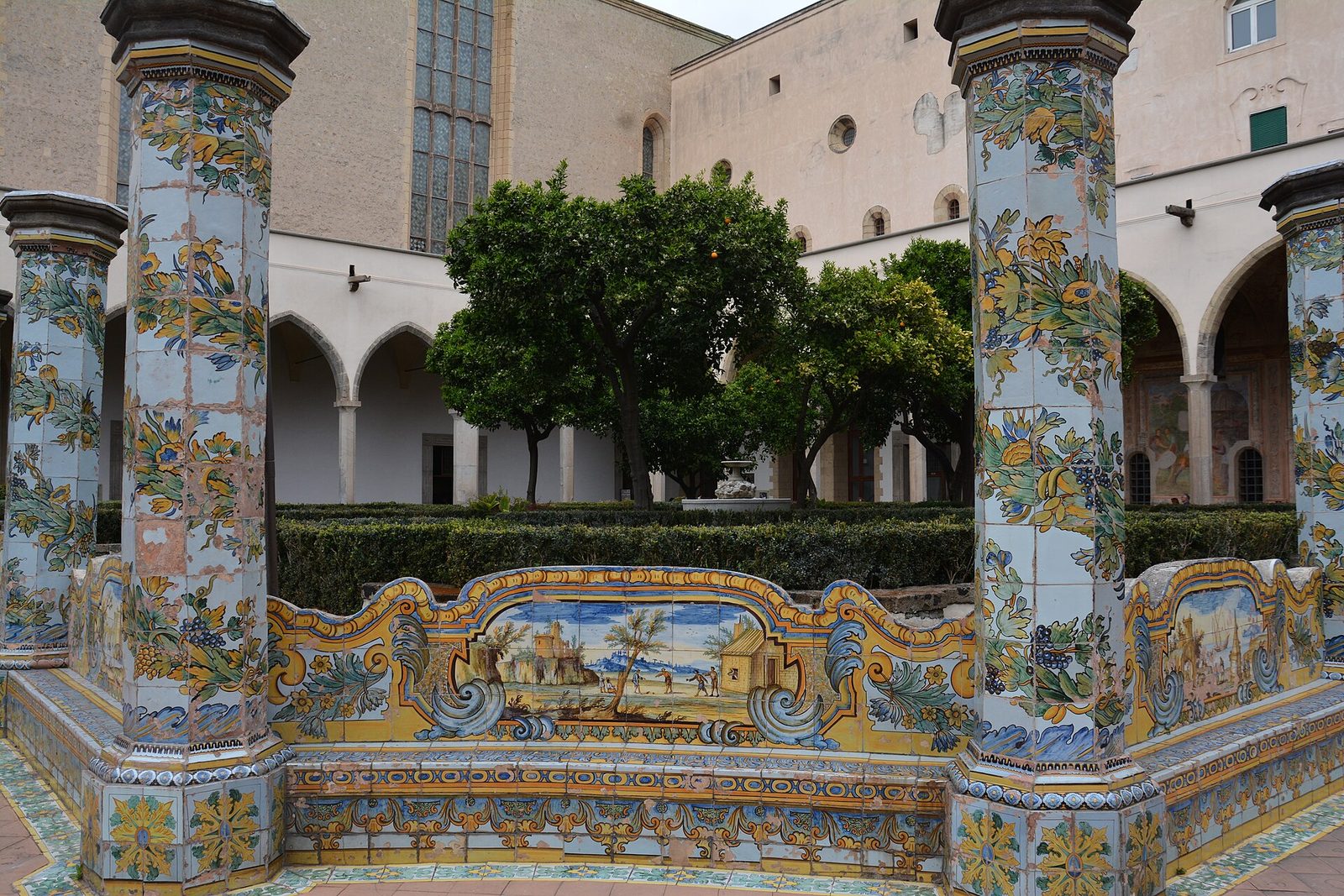
The Basilica of Santa Chiara is a vast, plain Gothic church, rebuilt after Allied bombing in 1943 destroyed its baroque interior. Entry to the church is free. The reason to pay is behind it: the nuns’ cloister, remodeled in the 1740s with octagonal columns and long benches covered entirely in hand-painted majolica tiles: vines, lemons, country scenes, masked figures. It is the calmest place in the old city, and on a hot afternoon it is as close as Naples gets to a garden you can sit in.
The ticket also covers a small museum and an excavated Roman bath complex. The cloister keeps shorter hours than most sights: roughly 9:30 to 17:00 or 17:30 Monday to Saturday and a morning-only session on Sunday, depending on which source you read, so do not leave it until the end of the day.
Verdict excellent, and a perfect reset between busier sights.
4. Gesù Nuovo and San Domenico Maggiore
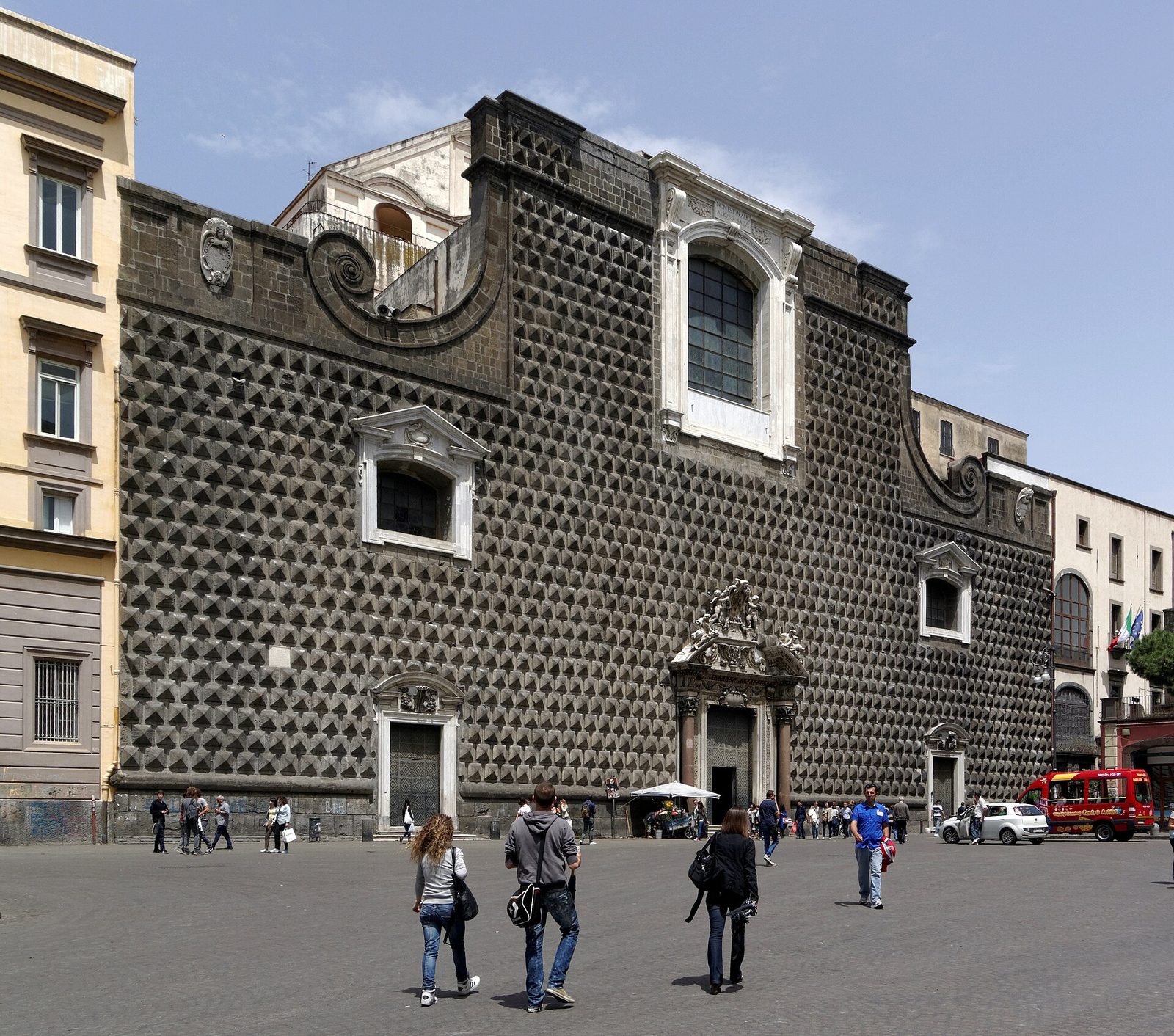
Piazza del Gesù Nuovo is where most people start the old city, and the church that gives it its name has the strangest façade in Naples: a wall of pyramid-shaped piperno stones, left over from the 15th-century palace the Jesuits converted. Inside it is the opposite, a blaze of colored marble and gilding. There are also rooms devoted to Saint Giuseppe Moscati, the doctor-saint, full of silver ex-votos left by the grateful. Entry is free.
A few minutes east along Spaccanapoli, San Domenico Maggiore is where Thomas Aquinas taught, and its sacristy holds a row of coffins of Aragonese royals. The main church is free; the guided DOMA routes through the sacristy, treasury and monastic rooms run all day and are worth it if you like your churches with a side of dynastic intrigue.
Verdict both worth the ten minutes it takes to step inside; San Domenico’s paid tour only if you’re staying three days or more.
5. Caravaggio at the Pio Monte della Misericordia
Caravaggio painted The Seven Works of Mercy in 1607 for this charitable brotherhood, which still exists and still owns it. The painting hangs over the high altar of the small octagonal church it was made for, which is a completely different experience from seeing a Caravaggio across a museum room. Upstairs, the brotherhood’s picture gallery has a good collection of Neapolitan baroque painting, and a balcony from which you can look down at the altarpiece.
It’s on Via dei Tribunali opposite the Guglia di San Gennaro, open daily (mornings only on Sunday), and the ticket now includes an audio guide. Many guides still quote the old, lower price; the brotherhood raised it.
Verdict excellent. One of the best 40-minute stops in the city.
6. The Duomo and the Treasure of San Gennaro
Naples Cathedral looks unremarkable from Via Duomo, but it contains two things that matter enormously to the city. The Royal Chapel of the Treasure of San Gennaro holds the saint’s relics, including two vials of his dried blood, which is expected to liquefy three times a year. If it does not, Neapolitans take it badly. The next date is Saturday, September 19, 2026, the saint’s feast day, when the cathedral fills from early morning; the other two are the Saturday before the first Sunday in May and December 16. Also inside is the Basilica of Santa Restituta, the oldest church in Naples, with a 4th-century baptistery whose mosaics are among the earliest in the Western world.
The cathedral is free. The separate Museo del Tesoro di San Gennaro next door charges admission and holds the jewel-encrusted miter and necklace given to the saint over the centuries, a collection its fans compare to the English crown jewels.
Verdict the cathedral is worth a free half hour; the treasury museum is for jewelry and devotional-art fans.
7. Via San Gregorio Armeno, the nativity street
This short lane running between Spaccanapoli and Via dei Tribunali is lined with workshops making presepi, the elaborate Neapolitan nativity scenes, and has been since the later 18th century. Alongside the shepherds and angels you’ll find hand-painted figures of footballers, popes, politicians and whoever has been in the news that year. Open all year, it becomes a shoulder-to-shoulder crush from mid-November to Christmas. Go on a weekday morning.
Verdict worth a stroll any time of year; don’t buy the first cheap figure you see, since the hand-sculpted terracotta pieces a few doors on are a different thing entirely.
8. San Lorenzo Maggiore and the Roman city underneath
At the corner of Via dei Tribunali and San Gregorio Armeno, the Gothic church of San Lorenzo sits on top of the ancient city’s forum and market. The excavations underneath, sold as Neapolis Sotterrata, let you walk a real Roman street with shop fronts, a bakery and a laundry still in place, the same level of the city you are standing above on the rest of this walk. It’s open daily and never feels crowded.
Verdict worth it, and the best quick answer to “what did Naples look like 2,000 years ago?” if Napoli Sotterranea’s tour times don’t suit you.
9. Piazza Bellini and Port’Alba
At the western end of the decumani, Piazza Bellini is the old city’s living room: café tables, students, a sunken patch of the Greek city walls in the middle, and noise late into the night. Just beyond it, the arch of Port’Alba leads out to Piazza Dante, lined with secondhand bookstalls that have been there for generations. It’s the natural place to end an old-city day with a spritz.
Underground Naples: tunnels, catacombs and bones
The ground Naples is built on is tuff, a volcanic stone soft enough to cut with hand tools and strong enough to hold up a city. The Greeks quarried it from underneath their houses, the Romans turned the quarries into aqueduct cisterns, and Neapolitans have been digging, burying and sheltering down there ever since. There are more underground sites here than anywhere else in Italy, and at least one belongs on every itinerary.
10. Napoli Sotterranea
The best-known tour starts from Piazza San Gaetano on Via dei Tribunali and takes you about 40 meters down into the Greco-Roman water system: huge cisterns, carved channels, graffiti left by the families who sheltered here during the bombing raids of the Second World War, and a small underground garden experiment. At one point you can squeeze sideways through a passage lit only by candle, less than a shoulder-width across. If that sounds like your nightmare, tell the guide and you can bypass it. The tour then comes back to street level and enters an ordinary ground-floor apartment, where the owners once pulled back a bed and found the remains of the Roman theater Nero performed in.
Tours leave roughly every hour from 10:00 to 18:00 and last about an hour and a half. The official site says each slot runs in Italian and English; some recent visitor guides say English runs only at certain hours, so check the day’s schedule at the entrance or online. Individuals and groups under ten do not need to book, but at peak times you may wait for the next slot. It’s chilly underground year-round, so bring a layer in summer.
Verdict excellent, and the best single introduction to what lies beneath the city.
11. The Catacombs of San Gennaro
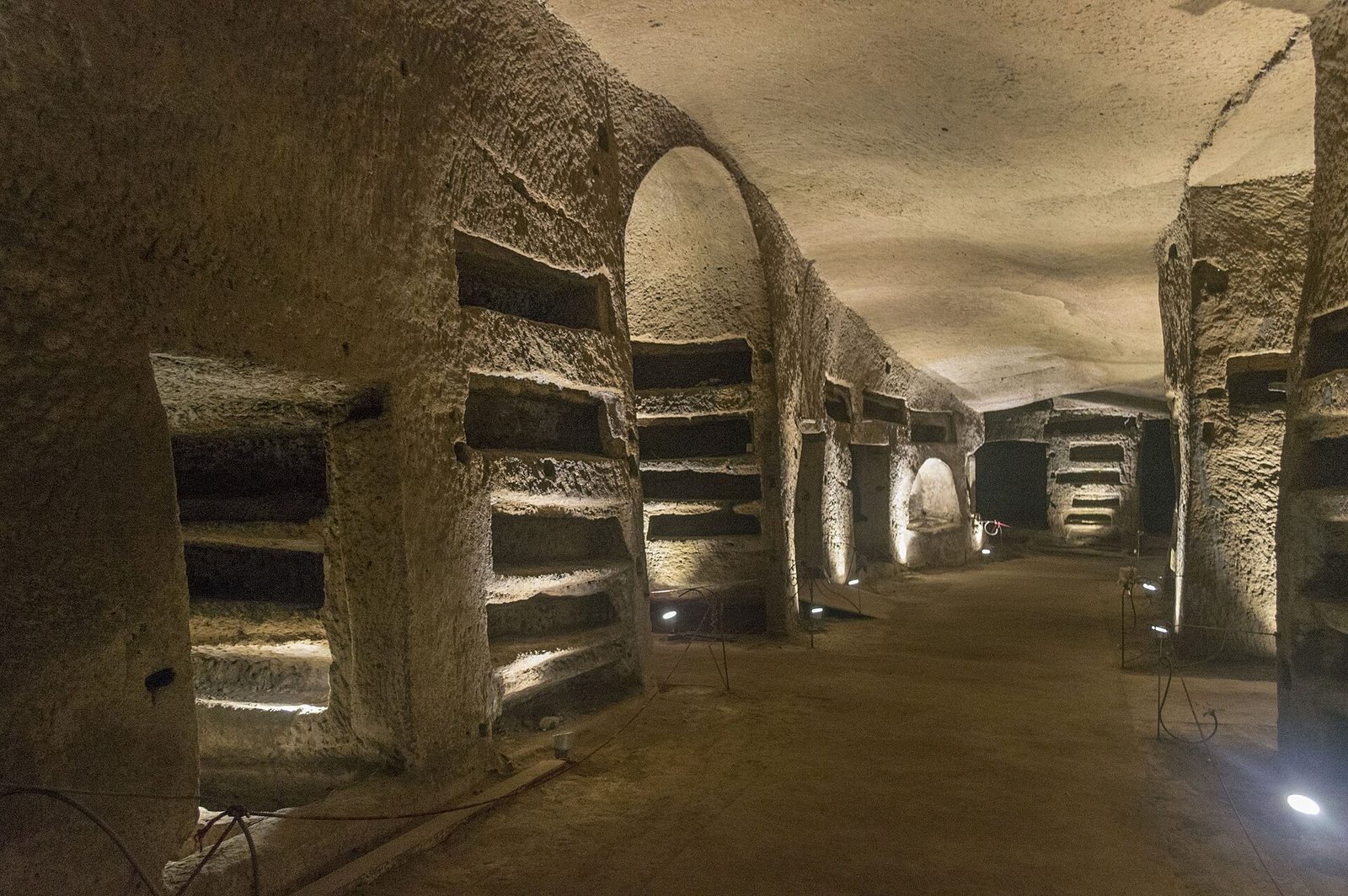
Up the hill toward Capodimonte, the Catacombs of San Gennaro are two levels of early Christian burial galleries, larger and airier than the Roman catacombs, with some of the oldest known images of San Gennaro painted on the walls. They are run by La Paranza, a cooperative of young people from the Sanità neighborhood who reopened the site and now use the ticket income to fund jobs and projects in one of the city’s poorest districts. That backstory is part of the visit; the guides are from the neighborhood and it shows.
Visits are guided only, leave hourly from 10:00 to 17:00 and take about an hour. The site is closed on Wednesdays. Booking is compulsory through catacombedinapoli.it. The same cooperative runs the smaller Catacombs of San Gaudioso under the church of Santa Maria della Sanità; older guides say one ticket covers both, but the current price list treats them separately, so ask when you book.
Verdict excellent. Pair it with a walk down through the Sanità afterward, which is the easiest way into that neighborhood.
12. Galleria Borbonica
The Bourbon Tunnel was dug in the 1850s for King Ferdinand II as a military escape route from the Royal Palace to the barracks by the sea. It was never finished, reused as a Second World War air-raid shelter, then used as an impound lot, and rediscovered in the 2000s. You walk through the shelter’s cisterns, past the belongings people left behind, and into caverns still holding rusted vintage cars and scooters that were towed down there and forgotten.
The standard tour runs on Friday, Saturday, Sunday and public holidays at 10:00, 12:00, 15:00 and 17:00, lasts about an hour, and must be booked. There are also more adventurous routes, one with a stretch on a raft across a flooded cistern and a speleological one with helmets. It’s in the Monte di Dio area above Piazza del Plebiscito.
Verdict excellent, and the one to pick if you have already done Napoli Sotterranea or want something more modern-history than Greek.
13. Cimitero delle Fontanelle
An old tuff quarry in the Sanità, the Fontanelle holds the bones of tens of thousands of people, largely victims of the plague of 1656 and the cholera of 1836, stacked in orderly rows under a vast cave ceiling. In the 19th and 20th centuries it became the center of a remarkable popular cult: Neapolitans “adopted” a skull, cleaned it, built it a little box or house, and prayed to the soul it once held, the anima pezzentella, for favors in return. The Church tried to shut the practice down in 1969. Many of the skull shrines are still there.
The Fontanelle has had a stop-start history of closures. It reopened on April 18, 2026, under new rules: it is no longer free, visits must be booked online at cimiterodellefontanelle.it, there’s a cap on how many people can be inside at once, and it’s closed on Wednesdays. Visits take about 40 minutes.
Verdict one of the strangest and most moving places in Europe. Not for young children or anyone uncomfortable around human remains.
Which underground tour should you choose?
| Napoli Sotterranea | San Gennaro catacombs | Galleria Borbonica | Fontanelle | |
|---|---|---|---|---|
| What you see | Greek quarries, Roman cisterns, WWII shelter, Roman theater | Early Christian tombs and frescoes | Bourbon tunnel, WWII shelter, abandoned cars | Ossuary and skull cult |
| Location | Via dei Tribunali | Capodimonte / Sanità | Above Plebiscito | Sanità |
| Booking | Not for small groups | Compulsory | Compulsory | Compulsory |
| Closed | Never | Wednesday | Runs Fri–Sun & holidays only | Wednesday |
| Claustrophobia risk | One narrow passage (optional) | Low | Low (standard route) | None, it’s a huge cave |
| Best for | First-timers | History, and supporting the Sanità | Second visits, older kids | The morbidly curious |
Museums worth your afternoon
Naples has a museum problem, in the sense that it has several world-class ones and most visitors see none of them because the city outside is so distracting. If you do only one, make it MANN. If it rains, you are in luck.
14. MANN, the National Archaeological Museum
The Museo Archeologico Nazionale di Napoli holds most of what was carried out of Pompeii and Herculaneum in the 18th and 19th centuries: the mosaics from the House of the Faun, including the Alexander Mosaic; room after room of wall paintings cut from Pompeian villas; the carbonized food; the bronzes from the Villa of the Papyri. Downstairs is the Farnese collection of ancient sculpture, with the Farnese Hercules and the Farnese Bull, the largest single sculptural group to survive from antiquity. Then there is the Gabinetto Segreto, the Secret Cabinet, where the Bourbons locked away the ancient erotic art they thought unsuitable for women and children.
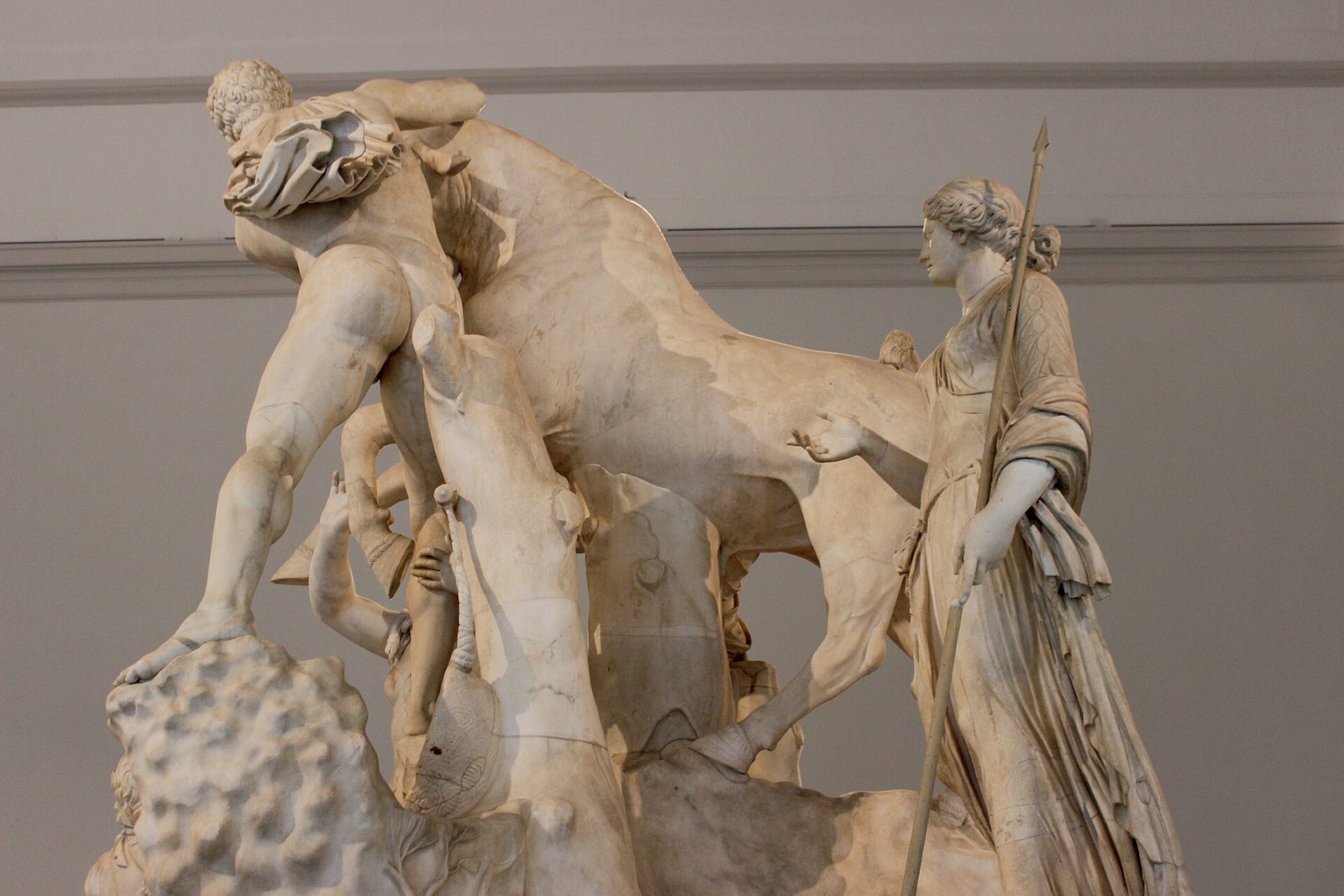
My strongest single tip for Naples: see MANN before Pompeii, not after. The frescoes and mosaics here were lifted out of the houses you’ll later walk through, and the ruins make far more sense once you have seen what used to hang on their walls.
MANN opens 9:00 to 19:30 (last entry 18:30) and is closed on Tuesdays; when a Tuesday is a public holiday it opens and closes on Wednesday instead. You don’t need to book as an individual. Two caveats: the Secret Cabinet, the Egyptian collection and the Magna Graecia rooms close on the free first-Sunday days, and in 2026 several sections (including the Villa of the Papyri rooms and part of the Farnese galleries) were listed as closed for renovation. If one of those is the reason you are going, check the notices at museoarcheologiconapoli.it the week you travel. The museum’s own Metro Line 1 station, Museo, is at the door.
Verdict essential. Allow at least two and a half hours.
15. Capodimonte
The Bourbon hunting palace on the hill above the Sanità holds one of Italy’s great painting collections, much of it inherited from the Farnese family: Caravaggio’s Flagellation, Titian’s Danaë and his portrait of Pope Paul III, Parmigianino’s Antea, Bruegel’s Parable of the Blind, Masaccio, Botticelli, Artemisia Gentileschi’s Judith Slaying Holofernes. There is also a porcelain parlor made entirely of Capodimonte porcelain, and royal apartments. Around it is the Real Bosco, a huge wooded park that is free to enter.
The museum is closed on Wednesdays. The ticket is a few euros cheaper if you go in during the first or last opening hour, and the upper floors keep shorter hours than the rest, so arrive by mid-afternoon at the latest if the top floors are your target. It’s the least crowded major museum in Naples, often almost empty on a weekday.
Verdict worth it for anyone; essential for anyone who travels for paintings. Combine it with the catacombs just down the hill, on a Tuesday.
16. Gallerie d’Italia on Via Toledo
A bank-run gallery in a grand former bank building at Via Toledo 177, the Gallerie d’Italia holds Caravaggio’s Martyrdom of Saint Ursula, painted in 1610 and generally considered his last work, finished weeks before he died. It’s a dark, raw painting, and there is something about seeing it in a quiet modern gallery with nobody jostling you. Entry is cheap, free for under-26s and over-65s, and free for everyone on the first Sunday of the month. It’s closed on Mondays.
Verdict worth it, especially since it is right on the main shopping street and takes 45 minutes.
17. The Certosa e Museo di San Martino
Next to Castel Sant’Elmo on top of Vomero, this former Carthusian monastery is one of the most beautiful buildings in southern Italy, and the museum inside it is the least visited of the big ones. The church is a riot of marble inlay and frescoes; the Great Cloister is serene; and the museum has the Cuciniello presepe, the finest Neapolitan nativity scene anywhere, with hundreds of figures. The terraced gardens have a view over the bay that competes with the castle’s next door.
The museum is listed as closed on Wednesdays, although one reputable guide says Tuesday, and its closing time has been cut to late afternoon in some recent notices, so check before you go up.
Verdict excellent, and my favorite hour in Naples for anyone who likes quiet. See it with Sant’Elmo, but not on a Tuesday or Wednesday, when one of the pair is shut.
Royal Naples: the palace, the opera house and the seafront castles
For six centuries Naples was a capital, of the Angevin and Aragonese kings, the Spanish viceroys, and finally the Bourbon Kingdom of the Two Sicilies, and the seafront quarter around Piazza del Plebiscito is where that shows. It’s all walkable in a loop from Via Toledo, and most of it is free from the outside.
18. Piazza del Plebiscito and the Palazzo Reale
The biggest square in Naples is a great semicircle of colonnades closed off by the domed church of San Francesco di Paola, modeled on the Pantheon in Rome, with equestrian statues of two Bourbon kings in front. It was a car park until the 1990s. Now it’s where the city gathers for concerts, New Year’s Eve and football celebrations, and where kids play football against the palace wall the rest of the time.
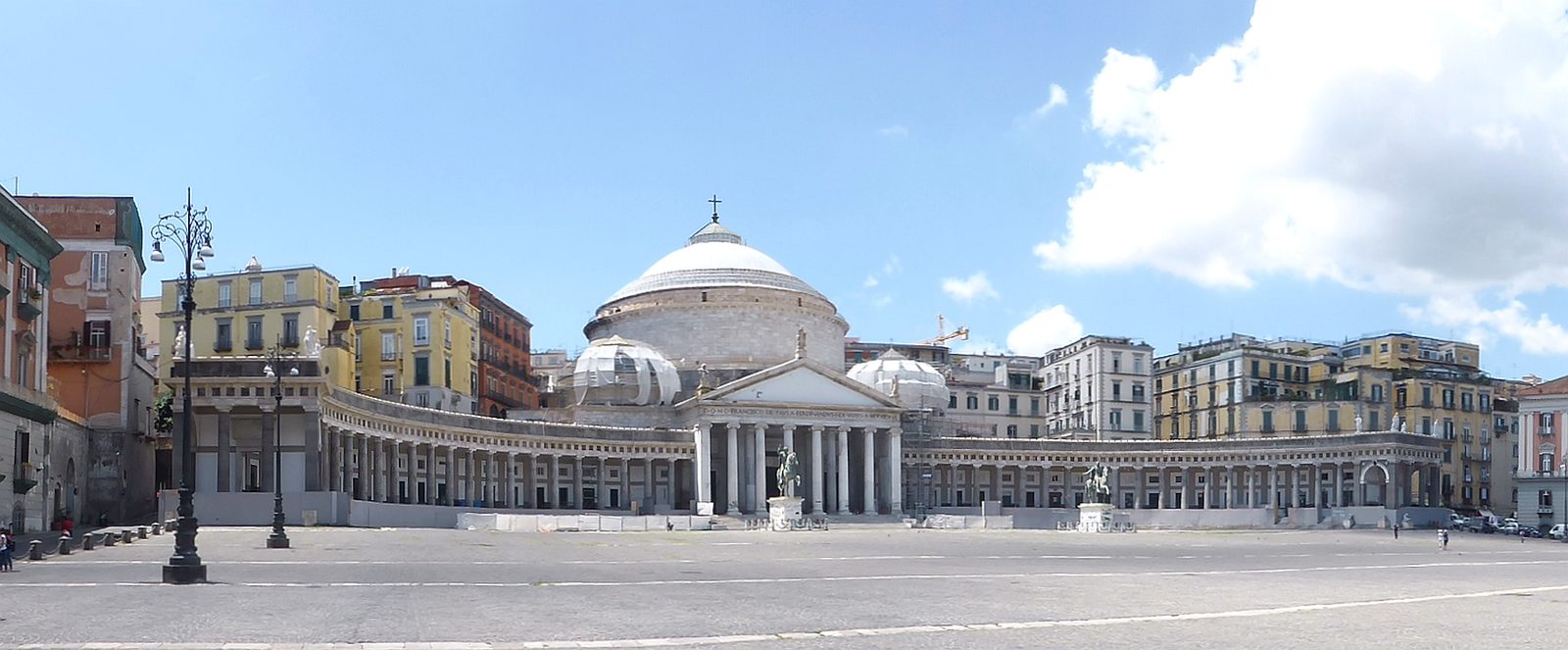
Opposite the church, the Palazzo Reale was the Bourbon royal residence. The façade has statues of eight kings of Naples in niches; inside are a monumental double staircase, the royal apartments, a small court theater, and the National Library, which holds carbonized papyri from Herculaneum. The palace is open daily except Wednesday (the official site doesn’t list the closure; recent guides do), and you don’t need to book. One 2026 detail: tours of the hanging garden, roof and attics were suspended from mid-June to mid-September because of the heat, so from mid-September they should be running again.
Verdict the square is essential and free. The palace interior is worth it if you like royal apartments, otherwise optional; I would put Capodimonte ahead of it for a short trip.
19. Teatro di San Carlo
Opened in 1737, the San Carlo is the oldest opera house in Europe still in continuous use, predating La Scala by four decades. The auditorium is red, gold and six tiers high. The best way in is to see a performance; the season runs roughly from autumn to spring, and seats in the upper tiers are much cheaper than you’d expect. Otherwise, guided tours of about half an hour run through the day, with English-language tours at set times (usually late morning and mid-afternoon). They depend on what’s happening on stage, so an afternoon rehearsal can cancel yours.
Verdict worth it. A performance is a highlight of any trip; the tour is a good 30 minutes if you can’t make an evening.
20. Galleria Umberto I
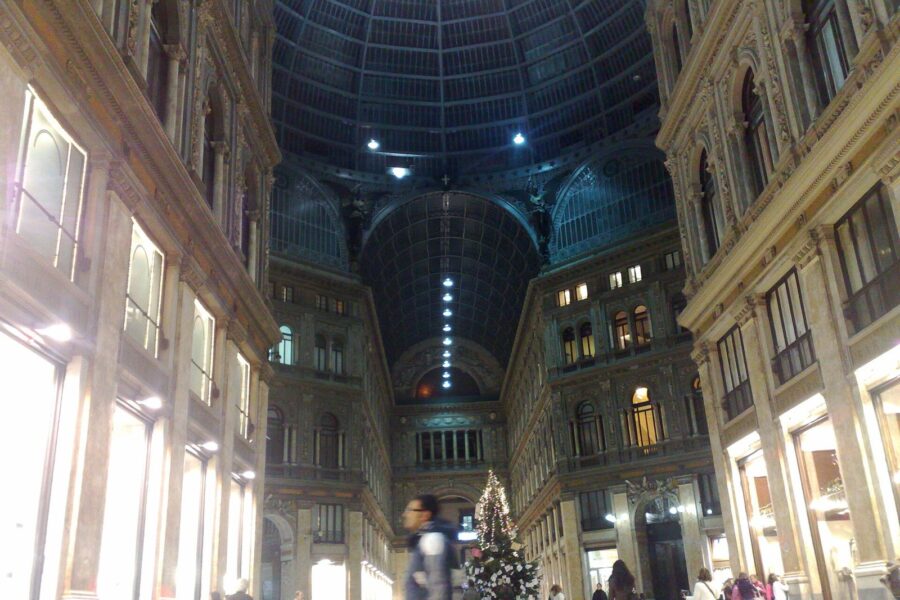
Across the street from the opera house, this 1890 shopping arcade has a glass-and-iron dome 56 meters high and a marble floor with the zodiac inlaid in it. The floor restoration was finished at the end of 2025. It’s a cut-through you will use constantly between Via Toledo and the San Carlo, and it’s at its best early in the morning before the shops open, when the light comes down through the dome.
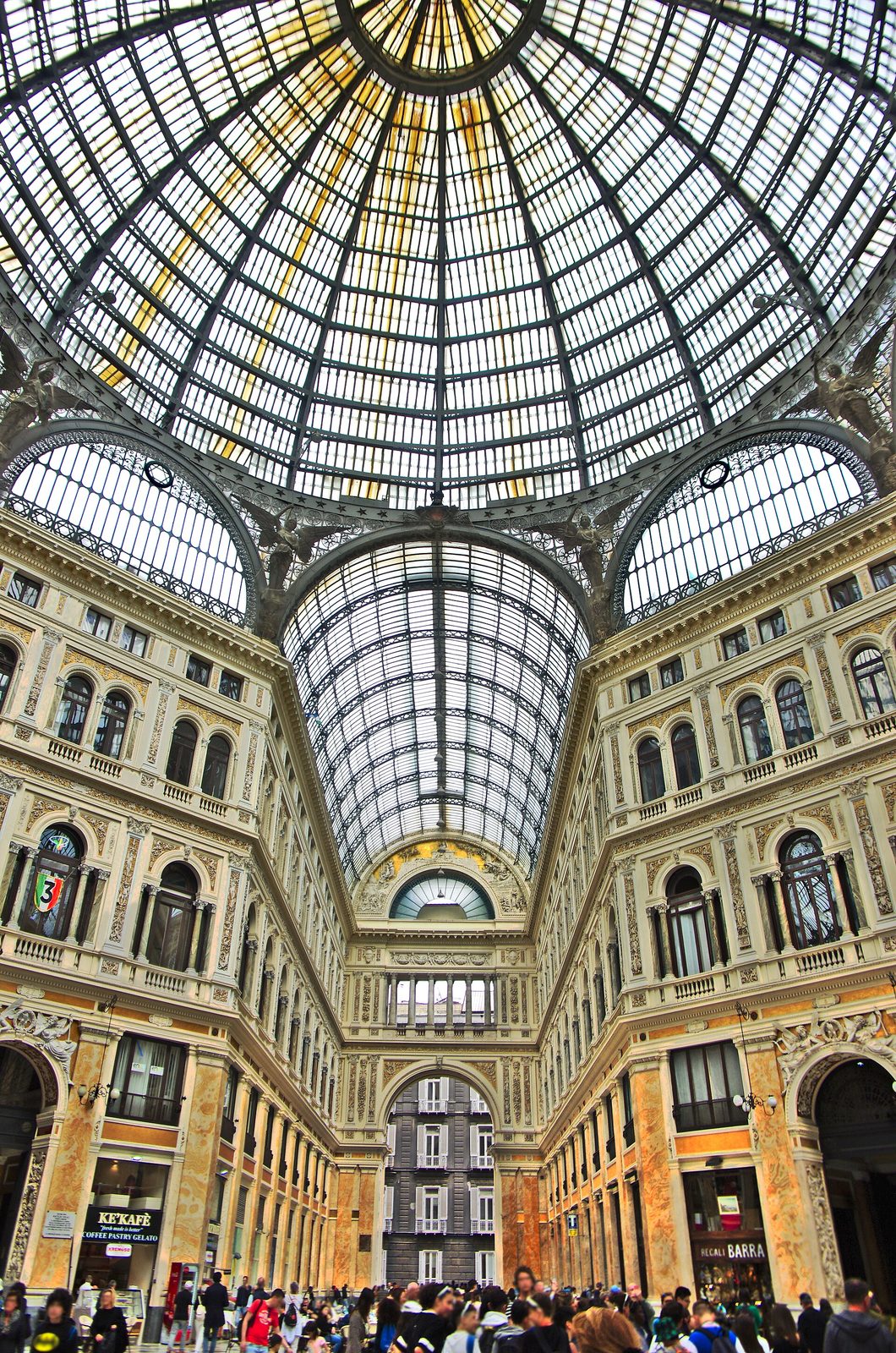
Just outside at the corner of the piazza is Gran Caffè Gambrinus, open since 1860 and the grandest coffee house in the city. Have your espresso standing at the bar like everyone else. Sitting at a table, especially outside, costs several times more. That’s normal in Italy, but Gambrinus is where it catches people out most.
21. Castel Nuovo (Maschio Angioino)
The squat, five-towered castle overlooking the port was built by the Angevins in the 1280s and rebuilt by the Aragonese, who added the white marble triumphal arch squeezed between two of its towers. That arch is the reason to come. Inside are the Palatine Chapel, the vaulted Sala dei Baroni (where the city council still meets), a glass floor over Roman remains, and the Civic Museum’s collection of Neapolitan painting.
It’s open Monday to Saturday and closed on Sundays and public holidays, and access is sometimes suspended at short notice for maintenance; it was shut for works as recently as September 7, 2026.
Verdict optional. The arch and the exterior, seen from Piazza Municipio on your way to the ferries, give you most of it. The interior is fine but not in the same league as the Certosa or Capodimonte.
22. Castel dell’Ovo and Borgo Marinari
The oldest castle in Naples sits on a tiny island joined to the seafront by a causeway. Legend says the poet Virgil hid a magic egg in its foundations and that the city will fall if it breaks. Castel dell’Ovo has been closed to the public for restoration since January 2023. The city announced an Easter 2026 reopening with free entry, but as of September 2026 the Comune’s own page still listed it as closed until further notice, and I couldn’t confirm it had reopened. Check the Comune di Napoli site before you count on getting inside.
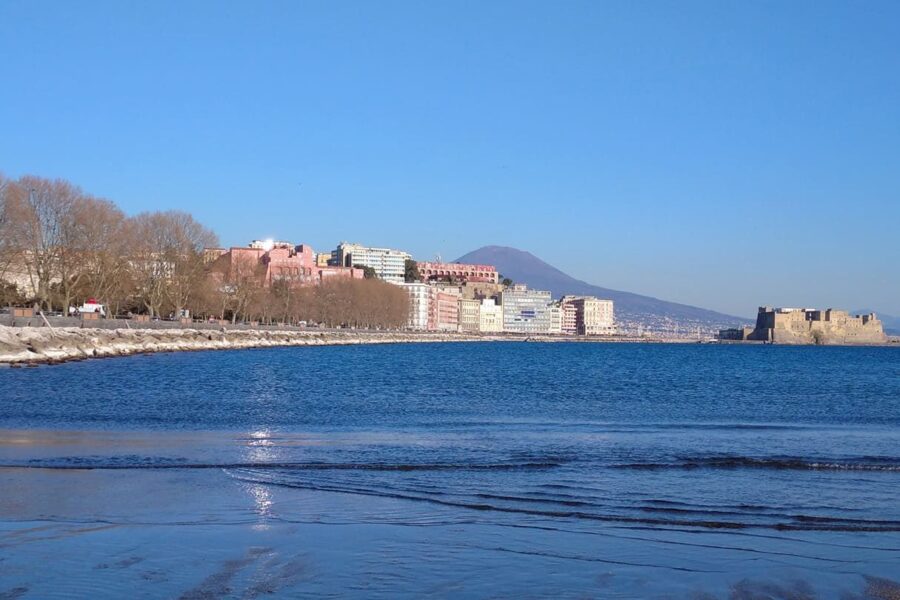
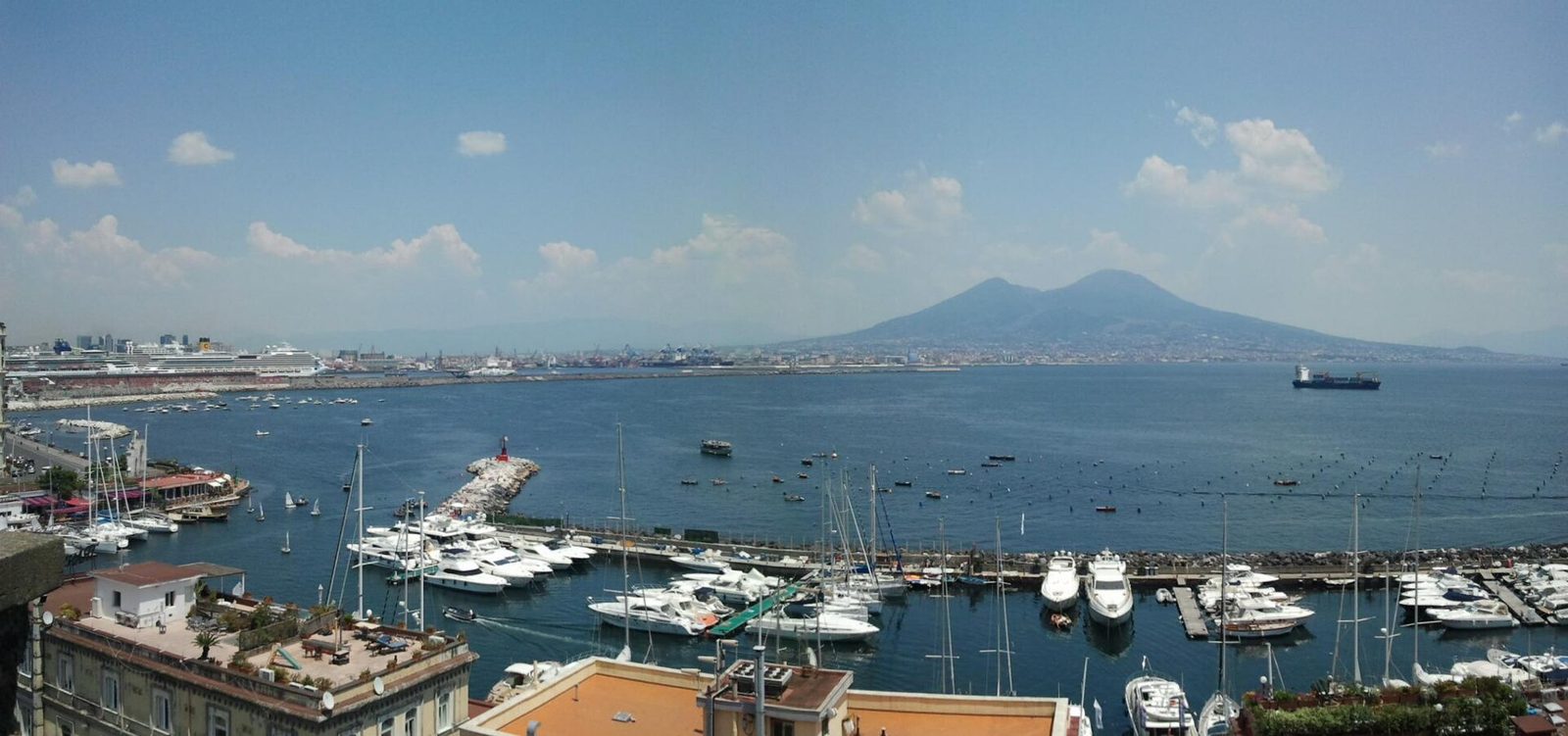
Walk out anyway. The causeway, the little harbor of Borgo Marinari with its fishing boats and seafood restaurants, and the view back to Vesuvius across the water are the real reasons to come, and none of that is behind a gate.
Verdict the walk is essential; the castle interior (when it reopens) is a nice bonus with the best rooftop view on the waterfront.
23. The Lungomare: Via Partenope to Mergellina
From Castel dell’Ovo, the seafront runs west along Via Partenope and then Via Caracciolo, which has been closed to cars since 2012 and is now a wide promenade shared by joggers, couples, families, and teenagers jumping off the rocks into the sea. Behind it is the Villa Comunale park; ahead, the curve of the bay toward Posillipo, with Vesuvius over your shoulder. Walk it at sunset, all the way to Mergellina, where the chalets on the waterfront sell ice cream and pastries late into the night, and take Metro Line 6 or a bus back.
If you’re in town in late September 2026, the America’s Cup preliminary regatta is being sailed in the bay from September 24 to 27, with a free race village at Rotonda Diaz on this stretch of seafront. Expect crowds and closed roads around it.
Verdict essential and free. The best evening walk in the city.
Up the hill: Vomero, Castel Sant’Elmo and the best views in Naples
Vomero is the hilltop neighborhood above the old city, mostly residential, built up in the late 19th and 20th centuries. It’s calmer, greener and more middle-class than anywhere below it, and it has the two things that make the climb worthwhile: the Certosa di San Martino (above) and Castel Sant’Elmo.
Getting up is part of the fun. Three funiculars climb the hill: the Centrale from Via Toledo, the Chiaia from Parco Margherita, and the Montesanto from the Pignasecca market, while a fourth runs up Posillipo from Mergellina. Metro Line 1 also stops at Vanvitelli in the middle of Vomero. The funiculars are cheap, ordinary city transport; locals ride them to work.
24. Castel Sant’Elmo
The star-shaped fortress on the summit was rebuilt by the Spanish in the 1530s and 1540s to keep an eye on (and, if necessary, fire on) the city below. The inside is mostly empty ramparts and a small modern-art museum, the Museo del Novecento. What you come for is the walk around the top of the walls: a complete, 360-degree view of the whole Bay of Naples, Vesuvius, the Sorrento peninsula, Capri on a clear day, and straight down into the grid of the old city, where you can pick out the line of Spaccanapoli cutting through it.
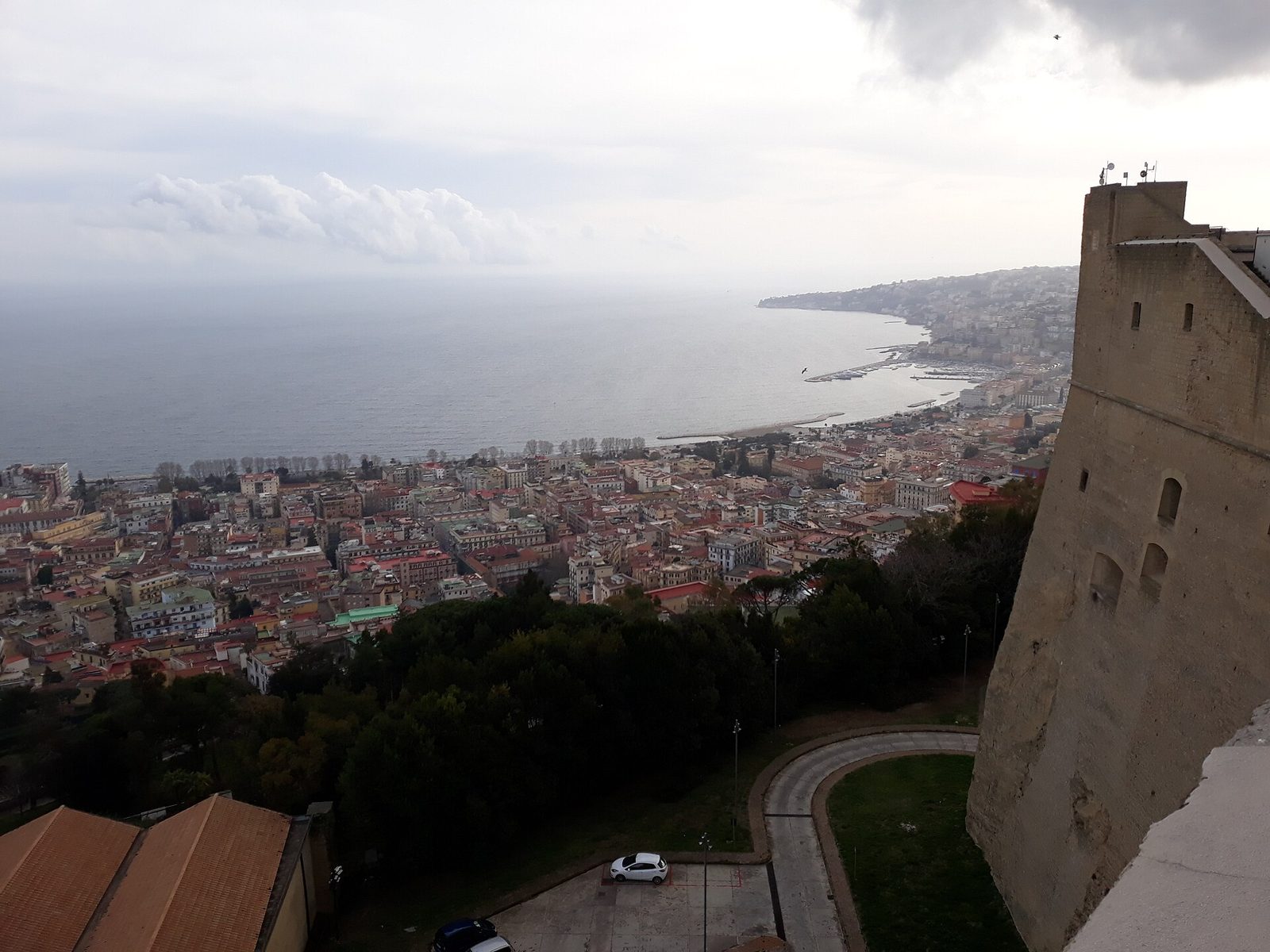
Entry is cheap and it’s closed on Tuesdays. One recent change: a rockfall at the main gate on August 22, 2026 closed the castle for a week; it reopened on August 29 with visitors now entering through the moat and a new lift. The entry routine may look different from older guides and photos.
Verdict excellent. Go in the late afternoon for the light, then walk down.
25. Walk down the Pedamentina
The best way off the hill is on foot. The Pedamentina di San Martino is a stepped path of roughly 400 steps that zigzags down from the Certosa, past gardens and houses, to Corso Vittorio Emanuele and on into Montesanto. The view is in front of you the whole way, and gravity does the work. Don’t do it in the other direction in August.
26. Villa Floridiana
A neoclassical villa in an English-style park in the middle of Vomero, built for the morganatic wife of King Ferdinand I. The park has shade, benches and a terrace view over the bay; the villa houses the Duca di Martina museum of ceramics and decorative arts. It’s a lovely hour on a hot day and almost no tourists find it.
Verdict worth it if you have three or more days, or if you’re traveling with children who need grass.
Neighborhoods to wander: Naples sightseeing beyond the monuments
Some of the best things to do in Naples don’t have a ticket office. The city’s character is in its neighborhoods, and three or four of them are worth an unhurried couple of hours with no plan beyond following the most interesting-looking street.
27. The Quartieri Spagnoli and the Maradona mural
The Spanish Quarter is the steep grid of narrow streets rising west of Via Toledo, laid out in the 16th century to house the Spanish viceroy’s garrison. For decades it had a bad reputation. Today it’s densely residential, with laundry strung between balconies, bassi (one-room ground-floor homes opening straight onto the street), tiny shrines, and a rapidly growing number of B&Bs and trattorias.
It’s also where you’ll find the most visited piece of street art in the city: the mural of Diego Maradona on Via Emanuele De Deo, first painted by Mario Filardi in 1990 after Napoli’s second league title, and repainted in 2017 by Francisco Bosoletti. Since Maradona’s death in 2020, the little square below it has become a shrine, and on weekends it’s so packed you’ll queue for a photo. Go early in the day.
Verdict worth an hour of wandering. The mural is free and always there; the streets around it are the real experience.
28. The Rione Sanità
Just north of the old city, beyond the walls, the Sanità is a valley neighborhood of 18th-century palaces, churches and street markets. Outdated guidebooks describe it as a no-go area. It isn’t: the catacombs cooperative, local churches and residents have spent years opening it up, and it’s now one of the most rewarding parts of Naples to explore on foot. Totò, the great Neapolitan comic actor, was born here, and the neighborhood’s murals celebrate him.
Look for the Palazzo dello Spagnolo on Via Vergini, whose open double staircase, designed by Ferdinando Sanfelice in the 1730s, rises in “hawk’s wings” around a courtyard. The Basilica of Santa Maria della Sanità sits over the San Gaudioso catacombs. On your way through, try a fried pizza at Concettina ai Tre Santi.
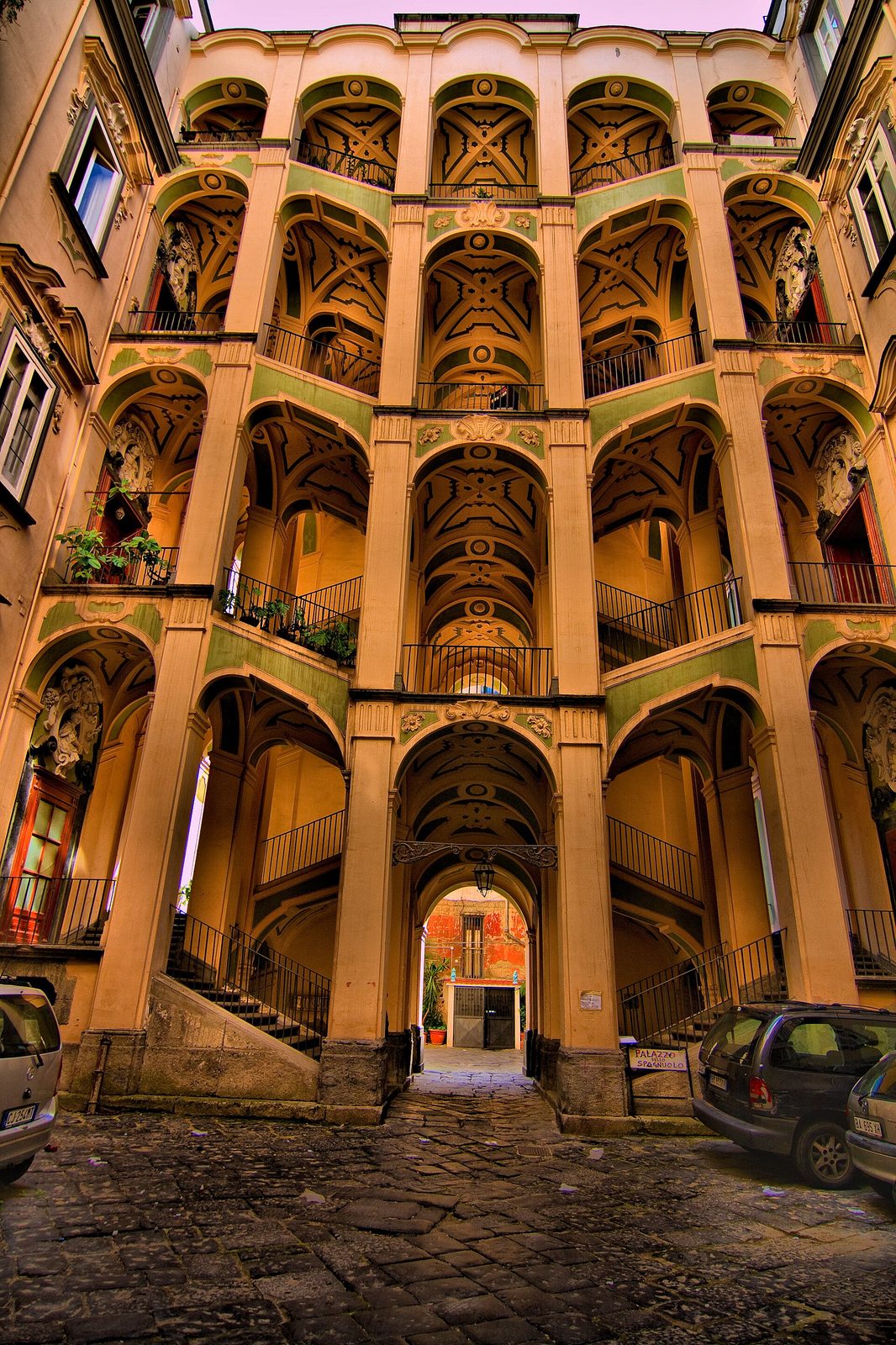
Verdict excellent. Combine it with the San Gennaro catacombs and the Fontanelle, and you have one of the most memorable half-days in the city.
29. Chiaia and the baretti
West of Plebiscito, Chiaia is the city’s smart district: designer shops on Via Chiaia and Via dei Mille, elegant apartment blocks, and Piazza dei Martiri at its heart. Come early evening for the ritual of aperitivo. In the lanes off the square, especially Via Bisignano and Vico Belledonne a Chiaia, small bars known as the baretti put their tables out and the crowd spills into the street from around 18:00. For a serious cocktail, L’Antiquario is regularly listed among the world’s best bars.
Verdict worth an evening. Chiaia is also one of the calmest places to stay if the old city sounds too intense.
30. Posillipo, Marechiaro and the Gaiola
Beyond Mergellina, the coast road climbs the Posillipo hill, lined with villas and gardens. At the far end, the Parco Sommerso di Gaiola is an underwater marine reserve around two small islets, with Roman ruins underwater you can see from a glass-bottom boat or while snorkeling. Nearby, the Parco Virgiliano on the ridge has one of the best free viewpoints in the city, looking west over Nisida island and the Campi Flegrei. Marechiaro, a fishing hamlet at the bottom of a steep lane, has waterfront restaurants and a famous window celebrated in a Neapolitan song.
In summer, the Gaiola’s small beach has had capped numbers and advance booking, so check before you go if swimming is the plan.
Verdict worth a half day in warm weather, especially if you want to swim without leaving the city.
31. The Toledo metro station and the Stazioni dell’Arte
Naples commissioned artists and architects to design its newer metro stations, the Art Stations, and Toledo on Line 1 is the showpiece: designed by Óscar Tusquets Blanca, roughly 50 meters below Via Toledo, lined with blue mosaic tiles, with a light well that looks like a crater opening toward the sky from the bottom of the escalators. It’s regularly called the most beautiful metro station in Europe, and the price of seeing it is a single ticket. Università (Karim Rashid, bright pink and green), Dante, Museo and Garibaldi are also worth a look as you pass through.
Verdict essential, and the best value experience in the city.
Eating: one of the best things to do in Naples
Food is a big reason people come to Naples, and it’s the one thing on this list you can’t overdo. Naples food deserves a guide of its own; this is the short version, for building your days around.
32. Eat pizza where it was invented
The Neapolitan pizzaiuolo’s craft is on UNESCO’s intangible heritage list, and pizza here is not like pizza elsewhere. It is soft, charred at the edges, with a puffy rim (the cornicione), baked in about 60 to 90 seconds in a wood oven at around 450°C, and yes, it is wet in the middle. That’s not a mistake. The dough is thin and the mozzarella and tomato are fresh, so the center is soupy. Eat it with a knife and fork, or fold it.
The famous names: L’Antica Pizzeria da Michele near the station, open since 1870, which serves only marinara and margherita (take a number and wait); Gino Sorbillo on Via dei Tribunali, whose seafront branch on the Lungomare usually has a shorter line; Di Matteo, also on Via dei Tribunali, which does excellent fried pizza at its street counter; Starita in Materdei, which is where to try the montanara, a pizza whose dough is fried before baking; Concettina ai Tre Santi in the Sanità; 50 Kalò in Mergellina. They are all good. The lines at Da Michele and the Tribunali Sorbillo are the only ones long enough to plan around.
A good margherita here costs less than a cocktail back home, and you can happily eat pizza every day without ever hitting a bad one if you avoid the places with touts outside and laminated picture menus.
33. Street food: cuoppo, frittatina and pizza a portafoglio
Naples eats on the move. Try a cuoppo, a paper cone of fried things (seafood in a cuoppo di mare, or croquettes, zucchini flowers and dough balls in a cuoppo di terra). A frittatina di pasta is a fried disc of bucatini bound with béchamel, peas and ham, stodgy and wonderful. Pizza a portafoglio (“wallet pizza”) is a small pizza folded in four and eaten walking, sold for very little from street counters along Via dei Tribunali. And pizza fritta, deep-fried and stuffed with ricotta, provola and cracklings, is the working-class original that some Neapolitans prefer to the baked kind.
34. Coffee and pastry, standing at the bar
Neapolitan espresso is short, strong, and often sweetened unless you ask for it amaro (unsweetened). You drink it in two sips standing at the counter, pay at the register (sometimes before, sometimes after, watch the locals), and leave. Order it with a sfogliatella, the shell-shaped pastry filled with ricotta, semolina and candied orange, in its flaky riccia version or the soft, shortcrust frolla. Or a babà, a mushroom-shaped cake soaked in rum syrup. Leave a caffè sospeso if you like the idea: paying for an extra coffee for someone who can’t afford one, a Neapolitan tradition some bars still honor.
35. Walk through the Pignasecca market
The oldest street market in Naples runs uphill from Via Toledo to the Montesanto funicular: fish on ice, huge lemons, buffalo mozzarella, fried snacks, kitchenware and lingerie, all to the sound of vendors shouting prices. Go in the morning, when it’s busiest. The fish market at Porta Nolana, near the station, is even more theatrical, but the streets around the station aren’t where you want to linger.
Things to do near Naples once you’ve seen the city
Naples is the best base in southern Italy. Pompeii, Herculaneum, Vesuvius, Capri, Sorrento and the Amalfi Coast are all within a train or boat ride, and they’re why many people come in the first place. Each one deserves a guide of its own; here’s how they compare as days out.
| Day trip | How from Naples | Travel time | Book ahead? | Verdict |
|---|---|---|---|---|
| Pompeii | Circumvesuviana train to Pompei Scavi | 30–40 min | Yes: named tickets, daily cap | Essential |
| Herculaneum | Circumvesuviana to Ercolano Scavi | Under 20 min | Not usually | Essential if you like ruins; better preserved than Pompeii |
| Mount Vesuvius | Train to Ercolano, then shuttle bus; or a tour | 1.5 hrs to the crater path | Yes: online only, timed slots | Worth it on a clear, calm day |
| Capri | Hydrofoil from Molo Beverello | About 50 min | In summer, yes | Worth it, but go early and skip the Blue Grotto on a swell |
| Amalfi Coast | Seasonal ferry, or train to Sorrento plus bus | 1.5–2.5 hrs | Ferries in summer | Better as an overnight than a day |
| Sorrento | Circumvesuviana to the end of the line, or ferry | About 70 min by train | No | Pleasant; mostly a gateway |
| Procida | Hydrofoil or ferry | 40–70 min | No | The easiest, calmest island day |
| Campi Flegrei (Pozzuoli, Baia, Cuma) | Cumana train or Metro Line 2 | 20–45 min | No | Fascinating, but check current seismic news first |
| Reggia di Caserta | Regional train to Caserta | 40–60 min | No | Worth it for palace and garden lovers |
Pompeii and Herculaneum
Pompeii needs little introduction, but its rules have tightened. Tickets are now named and non-transferable, so bring the ID of the person on the ticket. There’s a daily cap of 20,000 visitors, and from mid-March to mid-October entry is split into a morning window and a smaller afternoon one. Book at pompeiisites.org, the park’s own site, rather than a reseller. On the Circumvesuviana, make sure your train is signed for Sorrento: trains for Sarno and Poggiomarino use the same platforms and won’t take you to the Pompei Scavi stop. Keep a hand on your bag on this line; it’s the worst for pickpockets in the region.
Herculaneum, one short stop from the city, is smaller, less crowded, shadier and far better preserved, with upper floors, wooden beams and furniture still in place. It’s open every day. If you’re only doing one site in July or August, I’d honestly pick Herculaneum.
Vesuvius
You can walk to the rim of the crater on a gravel path from the car park at about 1,000 meters, roughly half an hour to 45 minutes up. Tickets are sold online only, through the national park’s official booking page, in timed slots released 30 days ahead; there’s no ticket office on the mountain, just a small number of last-minute slots sold on site. The path closes automatically in bad weather. The hard part is getting to the car park without a car or a tour, so sort out the shuttle before you book the slot.
The Campi Flegrei: go, but check the news
West of the city, the Campi Flegrei (“burning fields”) is a vast, low volcanic caldera holding Pozzuoli’s Roman amphitheater, the underwater ruins at Baia, the Sibyl’s cave at Cuma and the Piscina Mirabilis cistern. The area is going through bradyseism, the ground slowly rising and shaking. Civil protection keeps it at a yellow (attention) alert, and on July 31, 2026 it had its strongest earthquake of the current crisis, magnitude 4.7, which damaged buildings around Pozzuoli. The Cumana railway reopens on September 11, 2026 with a new Pozzuoli station, but Metro Line 2 to Pozzuoli was still suspended at the time of writing. The famous Solfatara crater has been closed to visitors since 2017. Check the civil protection updates before you go.
What to skip in Naples (and what to do instead)
Every list of things to do in Naples tells you what to add. Here is what I’d leave out, or at least think twice about.
- Renting a car for the city. Much of the center is a limited-traffic zone (ZTL) with camera fines, parking is scarce and expensive, and the driving is a contact sport. Walk, take the metro and the funiculars, and rent a car only if you’re heading into the countryside.
- The hop-on hop-off bus. The best of Naples is in pedestrian lanes that no bus can enter. You’ll spend your money looking at the seafront from a road you could have walked, while missing Spaccanapoli entirely.
- A 90-minute queue for one pizzeria. Da Michele and the Tribunali Sorbillo are great, but so are a dozen others with no line at all. If you want the famous name, arrive at opening time; otherwise, eat at Di Matteo, Starita or Concettina and get back to sightseeing.
- Sitting down at Gambrinus for a quick coffee. Drink it standing at the bar, where the price is a fraction of the table price and the experience is more Neapolitan.
- Reseller “skip-the-line” tickets for the big museums. MANN, Capodimonte and Palazzo Reale sell at the door, and a reseller markup buys you nothing there. For Sansevero, the official site is the cheapest source and the only one I’d use.
- The inside of Castel Nuovo on a short trip. The arch and the exterior give you most of it. Spend the hour at the Certosa di San Martino instead.
- The Solfatara. It has been closed since 2017. Tours and old blog posts that still sell it as a stop are out of date.
- Staying around Piazza Garibaldi. It’s cheap and near the station for a reason. You’ll have a much better time in the centro storico, Chiaia or near Toledo.
- Doing Naples in a day as a stopover. People who give it one hurried afternoon between Rome and the Amalfi Coast usually leave with an impression of traffic and noise. Give it at least two nights and it becomes a completely different city.
Planning tips: booking, free Sundays, passes and getting around
Book these before you travel
- Sansevero Chapel: tickets go on sale 60 days ahead, with a small extra release two days before.
- Pompeii: named tickets, with a daily cap.
- Vesuvius: online only, timed slots released 30 days ahead.
- Catacombs of San Gennaro, Galleria Borbonica and the Fontanelle: booking is compulsory for all three.
- An evening at the San Carlo, if there’s a performance while you’re in town.
Everything else, including MANN, Capodimonte, the castles and Napoli Sotterranea, you can decide on the day.
Free first Sundays
On the first Sunday of every month, Italy’s state museums and archaeological sites are free under the Domenica al museo scheme, which is still running in 2026. In and around Naples that includes MANN, Capodimonte, the Palazzo Reale, Castel Sant’Elmo, the Certosa di San Martino, Pompeii and Herculaneum; the Gallerie d’Italia joins in too. It’s a real saving for a family, but expect big crowds. At MANN the Secret Cabinet and some sections close on free days, and at Pompeii the daily cap still applies even without a named ticket.
Is the Campania Artecard worth it?
The Artecard is the regional sightseeing pass: free entry to the first few sites, discounts on the rest, and on the three-day versions only, public transport included. It pays for itself if you’ll visit three or more paid state sites in three days, say MANN, Capodimonte and Pompeii, and use the metro a lot. It’s not worth it if you’re spending most of your time on Capri, Ischia or the Amalfi Coast, or if your days are mostly churches, neighborhoods and food. Do the maths with the current prices on campaniartecard.it before you buy.
Getting around the city
Walk. The old city, Toledo, Plebiscito and the seafront are all close together, and walking between them is the sightseeing. For longer hops, Metro Line 1 links the station (Garibaldi), the Duomo, the university, Toledo, Municipio and the port, the Museum and Vomero; Line 6 runs along the western seafront; and the funiculars take you up to Vomero. Buy tickets at tobacconists and newsstands, or tap a contactless card where the gates accept it. For taxis, ask for the tariffa predeterminata (the fixed fare) on routes that have one, before you set off. Don’t drive in the city.
Staying safe
Naples’ reputation is worse than the reality for visitors. Violent crime against tourists is rare, and the centro storico, Chiaia, Vomero and the seafront are fine to walk in the evening. The genuine risk is petty theft: pickpockets on the Circumvesuviana, around the station and Piazza Garibaldi, and in the crowds on Via Toledo, and occasionally a bag or phone snatched by someone on a scooter. Keep your phone in your hand rather than on a café table, wear your bag on the side away from the road, and don’t leave anything in a car.
What’s on in September and October 2026
- September 11: the Cumana railway to Pozzuoli reopens, with a new Pozzuoli station.
- September 19 (Saturday): the feast of San Gennaro and the liquefaction of his blood in the Duomo. Arrive very early.
- September 24–27: the America’s Cup preliminary regatta in the bay, with a free race village at Rotonda Diaz.
- October 1: the Campania Express tourist train to Pompeii and Sorrento is suspended until further notice. Use the regular Circumvesuviana.
- First Sunday of October and November: free entry to the state museums and sites.
Hotels also charge the city’s tourist tax per person per night, which went up on May 1, 2026, so it’s worth checking whether your booking price includes it.
Pompeii is the day trip almost everyone takes, and the one most often done badly: wrong train, wrong gate, wrong ticket. My guide to visiting Pompeii from Naples covers the Circumvesuviana, the three entrances, the new timed tickets and a route that finds the houses worth your time.
Knowing what to see is half the job. The other half is fitting it around the closing days. MANN and the Sansevero Chapel both shut on Tuesdays, and Capodimonte and the catacombs on Wednesdays. My day-by-day Naples itinerary covers one to seven days, with what to book first.
Before you book a room, pick the neighborhood. The cheap hotels around Piazza Garibaldi are convenient on paper and a poor base in practice, and the historic center is wonderful and very loud at night. I’ve laid out the best areas to stay in Naples, Italy by traveler type, with the trade-offs booking sites don’t mention.
The Amalfi Coast is the day trip everyone asks about, and it’s the one where the route matters most. Ferry, train plus bus, coach tour or car each fail in their own way. I’ve compared them side by side, with real costs, in my guide to the Amalfi Coast from Naples.
Capri is the island most people add to a Naples trip, and the one where a bad plan costs the most: the wrong pier, a Blue Grotto that turns out to be closed for the day, and prices that shock even seasoned travelers. My guide to visiting Capri from Naples covers the boats, the grotto and a realistic budget for the day.
Vesuvius dominates every view from the Naples seafront, and walking its crater rim is easier than most people expect, if you’ve booked. The hard parts are the online-only tickets and getting to the car park 1,000 meters up without a car. I explain both in my guide to visiting Mount Vesuvius.
Timing matters in Naples more than people expect. The city is a very different place in the heat and shutdowns of August than in a mild, festival-filled May or during the nativity season before Christmas. I compare every month, weather, crowds and events included, in when to visit Naples, Italy.
Most of the sights on this list sit inside a single square mile of the old city, on a street grid the Greeks laid out 2,500 years ago. If you’d like to know which ancient street is which, and what’s on each one, my guide to the Centro Storico of Naples is the map that ties it all together.
Naples may be the best base for day trips in Italy. Pompeii, Herculaneum, Vesuvius, three islands, the Amalfi Coast, a Bourbon palace and Greek temples are all within reach by train or boat. I’ve ranked every option by whether it’s worth the day in my guide to day trips from Naples, Italy.
You can’t leave Naples without eating pizza where it was invented. But the famous names come with queue systems, house rules and a soft, soupy center that surprises almost every first-timer. My guide to the best pizza in Naples, Italy explains where to go and how it works.
You’ll walk to most of these sights, but Metro Line 1 and the funiculars save your legs for the hills of Vomero and the long hop from the station to the port. Here’s how the metro, funiculars and tickets work, with the fares checked for 2026.
Eating deserves a place on this list of its own. Naples has the deepest street-food tradition in Italy, from the cuoppo of fried fish to Sunday ragù and the onion-rich genovese, and most of it costs a few euros. Here’s what to eat in Naples, dish by dish.
Before you set out, a word on the city’s reputation. Naples is safe for visitors who take normal big-city precautions, and the risks are specific: the Circumvesuviana doors, Piazza Garibaldi, phones left on café tables. Here are my Naples travel tips on staying safe and avoiding the common scams.
At the far end of the Circumvesuviana line, about 70 minutes away, Sorrento makes a relaxed day out of lemon groves, clifftop views across the bay and seafood at Marina Grande. Here’s what’s actually worth seeing in Sorrento, and what isn’t.
Naples holds the world’s greatest collection of Roman art and one of Italy’s finest painting galleries, and both are quieter than their equivalents in Rome or Florence. Watch the closing days, though: several major museums shut on Tuesdays or Wednesdays. Here’s my rundown of the Naples museums worth your time.
Where you sleep shapes how much of this list you’ll see on foot. If you’re still choosing, my rundown of the best Naples hotels for every budget explains who each one suits and what to ask before you book.
The airport is only about 6 km from the historic center, so you can be walking Spaccanapoli within an hour of landing. Here’s how to get from Naples airport into town, with the current Alibus fare and fixed taxi prices.
Eating well is one of the great pleasures of a trip here, and it’s cheap if you know where to go. My rundown of the best restaurants in Naples covers trattorias, seafood, fine dining and the traps to avoid.
Less than 20 minutes from Naples by train, Herculaneum is the best-preserved Roman town on the bay and far quieter than Pompeii. I’d put it on any first trip. My guide to visiting Herculaneum from Naples has the tickets, a route through the best houses and how it compares with Pompeii.
If you have a few extra days, spend them on Ischia, the green, volcanic island at the edge of the bay, where you can move between outdoor hot pools with the sea a few steps away and swim in natural hot springs at Sorgeto. Here’s my guide to visiting Ischia.
Some of the best of Naples is below street level. Greek quarries became Roman cisterns and then wartime shelters, the early Christian catacombs of the Sanità hold the city’s oldest art, and the Fontanelle quarry is stacked with the bones of plague victims. Several rival operators sell tours with near-identical names, though, and one of the best only runs at weekends. Before you book, read my guide to the Naples underground, which covers every site and who each one suits.
Half the pleasure of a stay in Naples is how easily you can leave it by sea. Capri, Ischia and Procida are all an hour or less away by fast boat. The one trap is that the city has two ferry terminals a kilometer apart, and they serve different boats. My Naples ferry guide explains which pier is which, hydrofoil versus car ferry, and what to do when the sea gets rough.
Naples is still one of the best-value big cities in Italy, but not in the way the old clichés suggest. Pizza, coffee, the metro and most museums are cheap, while a sit-down dinner in the tourist center costs about what it does in Rome. For daily budgets and real 2026 prices, see what Naples costs.
Naples has been called the city of five hundred domes. Most of its churches are free, many are extraordinary, and they’re cool on a hot afternoon. The one you have to plan for is the Sansevero Chapel and its Veiled Christ, where timed tickets sell out weeks ahead. My guide to the churches of Naples sorts the essential ones from the lesser-known ones worth finding and shows how to see them on foot.
It helps to think of Naples as a set of villages rather than one city. There’s the loud Greek grid of the old town, the steep lanes of the Quartieri Spagnoli, the polished streets of Chiaia, the calm Vomero on its hill and the reviving Sanità in its valley. Each has its own sights and its own rhythm. My guide to the Naples neighborhoods maps how they fit together and what each is really like.
A few Naples sights now sell out: the Sansevero Chapel releases timed tickets 60 days ahead, Vesuvius sells online-only slots 30 days out, and Pompeii’s tickets are named and capped. Before you book anything through a reseller, read my guide to Naples tours, tickets and passes. It covers what to book first, which tours are worth paying for, and whether the Artecard pays off for your trip.
If you only have time for one island, consider Procida before Capri. It’s the smallest and closest island in the bay, about 40 minutes by fast boat, with the pastel fishing harbor of Marina Corricella, a walled medieval village on the hill and a fraction of Capri’s crowds. My Procida guide covers the island and how to do it as a day trip.
West of the city, the Campi Flegrei is a volcanic caldera full of Roman wonders. There’s the underground of Pozzuoli’s great amphitheater, the half-sunken imperial resort of Baia, the Sibyl’s cave at Cuma and the colossal Piscina Mirabilis cistern. The area has been in the news for its earthquakes, so read my Campi Flegrei guide first. It covers the current alert level, what’s open and how to get there on the Cumana railway.
Naples was once the city of seven castles, and four still stand. There’s Castel Nuovo by the port with its Renaissance arch, Castel Sant’Elmo on the Vomero with the best view in the city, Castel dell’Ovo on its islet off the seafront, and the Norman Castel Capuano. Add the Palazzo Reale on Piazza del Plebiscito and you have two excellent half-days. My guide to the Naples castles covers what’s open, including the truth about Castel dell’Ovo’s reopening.
Behind the coast lies a Campania most visitors never see. The Reggia di Caserta, the Bourbon kings’ answer to Versailles, is under an hour away by train, with a grand staircase, royal apartments and a three-kilometer avenue of fountains. South of Salerno, Paestum’s three Greek temples are among the finest anywhere. My guide to Caserta, Paestum and inland Campania has the tickets, trains and a plan for each.
Naples is on the sea but has almost no beach of its own, which catches a lot of summer visitors out. Neapolitans swim off the rocks and lidos of Posillipo, or take the train west to the sandy beaches at Miliscola and Miseno, or a hydrofoil to Procida and Ischia. My guide to the beaches near Naples sorts out where to swim, what the lidos charge and how to get there without a car.
If you can, time your trip for a feast. Naples celebrates in the street: San Gennaro’s blood liquefying in the Duomo, the nativity workshops of Via San Gregorio Armeno at Christmas, a bell tower set “on fire” with fireworks in July. My guide to Naples festivals and events runs through the whole year and says which dates are worth planning around.
Traveling with children? Naples is better for families than its reputation suggests. Kids love the candlelit tunnels of the underground city, the castle ramparts, Pompeii and the walk up Vesuvius, and the pizza needs no selling. The hard part is the terrain, with cobbles, stairs and scooters everywhere. My guide to Naples with kids covers all of it, along with honest advice for couples, solo travelers and visitors with limited mobility.
Don’t go to bed early. Naples comes alive after dark, and its nightlife happens outdoors: aperitivo in the little bars of Chiaia, a crowd of hundreds drinking in Piazza Bellini at midnight, and the whole city strolling the seafront on a summer night. My guide to Naples nightlife explains the rhythm of the night, the best areas, the late-night rules and how to get home.
Arriving by cruise ship? You’re in luck: ships berth at the Stazione Marittima, right opposite Castel Nuovo, so most of this list is within walking distance of the gangway. My guide to the Naples cruise port sets out how to spend a port day in the city, or at Pompeii, Herculaneum or Capri, with the time each one really takes and when a ship excursion is worth paying for.
Things to do in Naples, Italy: frequently asked questions
Is Naples, Italy worth visiting?
Yes. It has one of the richest historic centers in Europe, world-class museums, the ruins of Pompeii and Herculaneum on its doorstep, the best pizza in the world and the Bay of Naples as a backdrop. It is chaotic, and the first day can be a shock, but most people who give it two or three days leave wanting to come back.
Is Naples safe for tourists?
Generally, yes. Violent crime against visitors is rare, and the main tourist areas are fine to walk at night. The real risk is pickpocketing and bag snatching around the central station, on the Circumvesuviana to Pompeii and on crowded Via Toledo. Keep your phone and valuables close, and you’re unlikely to have a problem.
How many days do you need in Naples?
Three days is a comfortable minimum for the city itself: one for the old city, one for the museums and the seafront, and one for Vomero, the underground and the neighborhoods. Add a day for each trip to Pompeii and Herculaneum, Capri or the Amalfi Coast.
Can you see Naples in one day?
You can see the highlights, but only just. Walk Spaccanapoli and Via dei Tribunali, see the Veiled Christ (booked ahead), have pizza for lunch, spend the afternoon at MANN, and end with a sunset walk along the seafront. Just avoid Tuesday, when both Sansevero and MANN are closed.
What is Naples famous for?
Pizza, above all, along with its UNESCO-listed historic center, Mount Vesuvius and the nearby ruins of Pompeii and Herculaneum, its nativity-figure craft, its passion for football and Diego Maradona, strong espresso, and a street life louder and more theatrical than anywhere else in Italy.
Is Naples walkable?
Very. The historic center, Via Toledo, Piazza del Plebiscito and the seafront are all within a 30- to 40-minute walk of each other, and the streets of the old city are best explored on foot. The one real climb is up to Vomero, and the funiculars take care of that.
What should I book in advance in Naples?
The Sansevero Chapel is the most important, since tickets are timed and sell out. Also book the Catacombs of San Gennaro, the Galleria Borbonica, the Fontanelle cemetery, Pompeii (named tickets, daily cap) and Vesuvius (timed online slots). The big museums sell tickets at the door.
What is closed on Tuesdays in Naples?
MANN (the Archaeological Museum), the Sansevero Chapel and Castel Sant’Elmo all close on Tuesdays. On Wednesdays it’s Capodimonte, the Palazzo Reale, the Certosa di San Martino, the San Gennaro catacombs and the Fontanelle. Castel Nuovo closes on Sundays and the Gallerie d’Italia on Mondays.
Is Napoli Sotterranea worth it?
Yes, especially on a first visit. The 90-minute tour through Greek quarries, Roman cisterns and wartime shelters, plus the Roman theater hidden under an apartment, is the best introduction to underground Naples. Skip the optional narrow candlelit passage if you’re claustrophobic.
Where is the best area to stay in Naples for sightseeing?
The centro storico puts you within walking distance of almost everything, though it’s noisy. The area around Via Toledo and Piazza del Plebiscito is a good middle ground, and Chiaia is calmer and more upscale, a little farther from the old city. Avoid the streets right around Piazza Garibaldi and the central station.
Photo credits
- Borgo Marinari harbor and Mount Vesuvius (featured image): photo by Poiesia, Wikimedia Commons, CC BY-SA 4.0.
- Via dei Tribunali: photo by Armando Mancini, Wikimedia Commons, CC BY-SA 2.0.
- Santa Chiara majolica cloister: photo by MentNFG, Wikimedia Commons, CC BY-SA 4.0.
- Gesù Nuovo façade: photo by Berthold Werner, Wikimedia Commons, CC BY-SA 3.0.
- Catacombs of San Gennaro: photo by Dominik Matus, Wikimedia Commons, CC BY-SA 4.0.
- Farnese Bull at MANN: photo by Miguel Hermoso Cuesta, Wikimedia Commons, CC BY-SA 4.0.
- Piazza del Plebiscito and San Francesco di Paola: photo by Wolfgang Pehlemann, Wikimedia Commons, CC BY-SA 3.0 DE.
- Galleria Umberto I: photo by Paolo Villa, Wikimedia Commons, CC BY-SA 4.0.
- View from Castel Sant’Elmo: photo by Simon Burchell, Wikimedia Commons, CC BY-SA 4.0.
- Palazzo dello Spagnolo: photo by alterdimaggio1957, Wikimedia Commons, CC BY-SA 2.0.
Images resized for the web. Opening days, booking rules and site status checked in September 2026 against the operators’ own sites where they were reachable, and against recent local reporting where they weren’t; where sources disagreed, this guide says so. Naples changes its hours, prices and rules often, so confirm on the official site the week you travel. If you find something here out of date, tell us and we’ll fix it.