On this page
Last updated September 25, 2026. Visiting arrangements for Palazzo d’Avalos, the Abbey of San Michele and the Vivara nature reserve, the island’s bus lines and the ferry situation checked against official and 2026 local sources. Opening days on Procida change often, so I flag the ones to double-check.
Procida, Italy is the smallest and least touristy island in the Bay of Naples, about 40 minutes from Naples by hydrofoil. Come for Marina Corricella’s pastel fishing harbor, the walled village of Terra Murata and quiet volcanic beaches. It’s easily done as a day trip from Naples, Italy, and even better with a night.
Procida is what people hope Capri will be, before they get to Capri. It’s a small, lived-in island of fishermen and sea captains, with houses painted pink, yellow and lemon, boats pulled up on the quays, and lanes too narrow for anything but scooters and three-wheeled microtaxis. It covers about four square kilometers and is home to around ten thousand people, and it has none of the designer shops, day-trip crowds or resort prices of its famous neighbors. What it has instead is atmosphere, and in 2022 it became the first island ever named Italian Capital of Culture, under the motto La cultura non isola, “culture doesn’t isolate.”
You may already know it without realizing. Marina Corricella’s harbor appears in Il Postino, Massimo Troisi’s much-loved film about Pablo Neruda’s exile, and the island stood in for the fictional Mongibello in The Talented Mr. Ripley. Elsa Morante set her novel L’isola di Arturo (Arturo’s Island) here. Those associations bring visitors, but Procida remains overwhelmingly a place where people live and work, and that’s the best thing about it.
This is the complete guide. It covers the harbor, the walled village and its former prison, the beaches, the nature reserve of Vivara, getting around, where to eat, how to do it as a day trip or an overnight, and the honest verdict on how it compares with Capri and Ischia.
Procida, Italy at a glance
The island is small enough to see the main sights in a day, but it rewards slowing down. Here’s what’s where, and how long each deserves.
| Place | What it is | Time to give it | My verdict |
|---|---|---|---|
| Marina Grande | The port where the ferries arrive, with a colorful waterfront of cafés | Half an hour on arrival | A cheerful first impression; don’t stop here |
| Terra Murata | The medieval walled village on the island’s highest point | One to two hours | The best views on the island; essential |
| Palazzo d’Avalos | A Renaissance palace that became a prison until 1988 | A guided visit, by reservation | Haunting and fascinating; book ahead |
| Abbey of San Michele Arcangelo | The island’s great church, at the top of Terra Murata | Half an hour to an hour | Worth it, especially in its millennium year |
| Marina Corricella | The pastel fishing harbor from every photo of Procida | Lunch, and a slow wander | The heart of the island; unmissable |
| Beaches | Small volcanic-sand beaches: Chiaia, Pozzo Vecchio, Ciraccio and others | An afternoon | Pleasant rather than spectacular |
| Marina Chiaiolella | A marina and beach on the southwest tip | An evening | The island’s best sunset |
| Vivara | An uninhabited nature reserve, joined by a footbridge | A guided visit | Lovely when open; check first |
A short history of Procida
Procida’s story starts with fire. The island is built from the rims of several old volcanic craters, part of the same Campi Flegrei system as Pozzuoli and Ischia, and its bays at Chiaiolella and Pozzo Vecchio are flooded craters. Its name is usually traced to a Greek word for “poured out,” a nod to that volcanic origin.
People came early. On Vivara, archaeologists have found the remains of a Bronze Age settlement with pottery brought by Mycenaean traders from Greece, more than three thousand years ago. Later the Greeks of Cumae and then the Romans used the island, and wealthy Romans built villas along its shores, as they did all around the bay.
For much of the Middle Ages, life was shaped by fear of pirates. Raids from the sea were so frequent that the islanders withdrew behind the walls of Terra Murata, on the highest and most defensible point, and the island’s most famous son of that era is a man of politics rather than the sea. John of Procida, a 13th-century physician and diplomat, is remembered as one of the plotters behind the Sicilian Vespers, the revolt that drove the French out of Sicily in 1282.
From the 16th century the island belonged to the d’Avalos family, who built the great palace on Terra Murata. Later the Bourbon kings used Procida and Vivara as a royal hunting reserve. As the threat from pirates faded, the islanders came down from the hill and built the harbors of Corricella, Marina Grande and Chiaiolella. Procida became an island of sailors, and in the 18th and 19th centuries its captains and crews sailed merchant ships across the Mediterranean and beyond, bringing prosperity to the island.
The 20th century brought the prison on Terra Murata, which closed in 1988, a quieter economy of fishing and seafaring, and in 2022 the title of Italian Capital of Culture, which put the island on the map for a new generation of travelers.
Getting to Procida
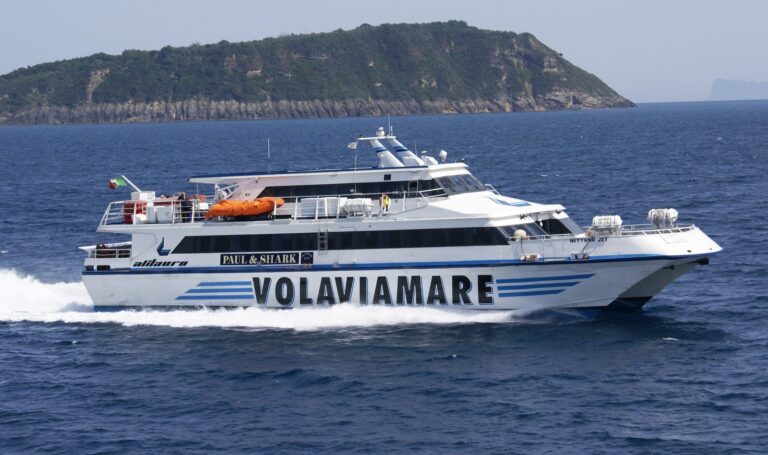
Procida lies between the Campi Flegrei coast and Ischia, and it’s the closest of the three islands to Naples. From the city, fast boats run from Molo Beverello in about 40 minutes, and slower car ferries from Calata Porta di Massa take about an hour and cost less. The shortest crossing of all is from Pozzuoli, west of Naples, at around half an hour. That port has been disrupted by the Campi Flegrei earthquakes in 2026, though passenger services have resumed. Procida is also a short hop from Ischia, 20 to 30 minutes by boat, so the two combine easily.
All the practical detail on terminals, fares, luggage rules, weather cancellations and the Pozzuoli situation is in the Naples ferry guide. One thing worth knowing before you book: Procida restricts non-resident vehicles for most of the warmer part of the year, so arrive on foot. You won’t need a car.
Marina Grande: arriving on Procida
Every boat docks at Marina Grande, also called Sancio Cattolico, on the north side of the island. It’s a working port with a bright row of pastel houses along the waterfront, cafés, fishmongers, the ticket offices of the ferry companies, and the church of Santa Maria della Pietà. Buses and microtaxis wait at the quay.
From here, the island’s main street, Via Vittorio Emanuele, runs south toward Chiaiolella, while Via Principe Umberto climbs east toward Terra Murata. If you’ve arrived on a day trip, the classic plan is to head straight uphill to Terra Murata while it’s cool, then drop down to Corricella for lunch. Grab a coffee at the port first if you like, but don’t settle in. Procida’s best places are all elsewhere.
Terra Murata: the walled village on the hill
Terra Murata (“walled land”) is the oldest part of Procida, a fortified village on the island’s highest point. For centuries, when pirates raided the Bay of Naples, the islanders lived up here behind its walls. It’s a wonderful place to wander: a handful of quiet lanes, old houses, small churches, the abbey, the vast bulk of the former prison, and views in every direction. On one side you look down over the pastel houses of Marina Corricella; on another, across the water to Ischia, Vesuvius and the Campi Flegrei.
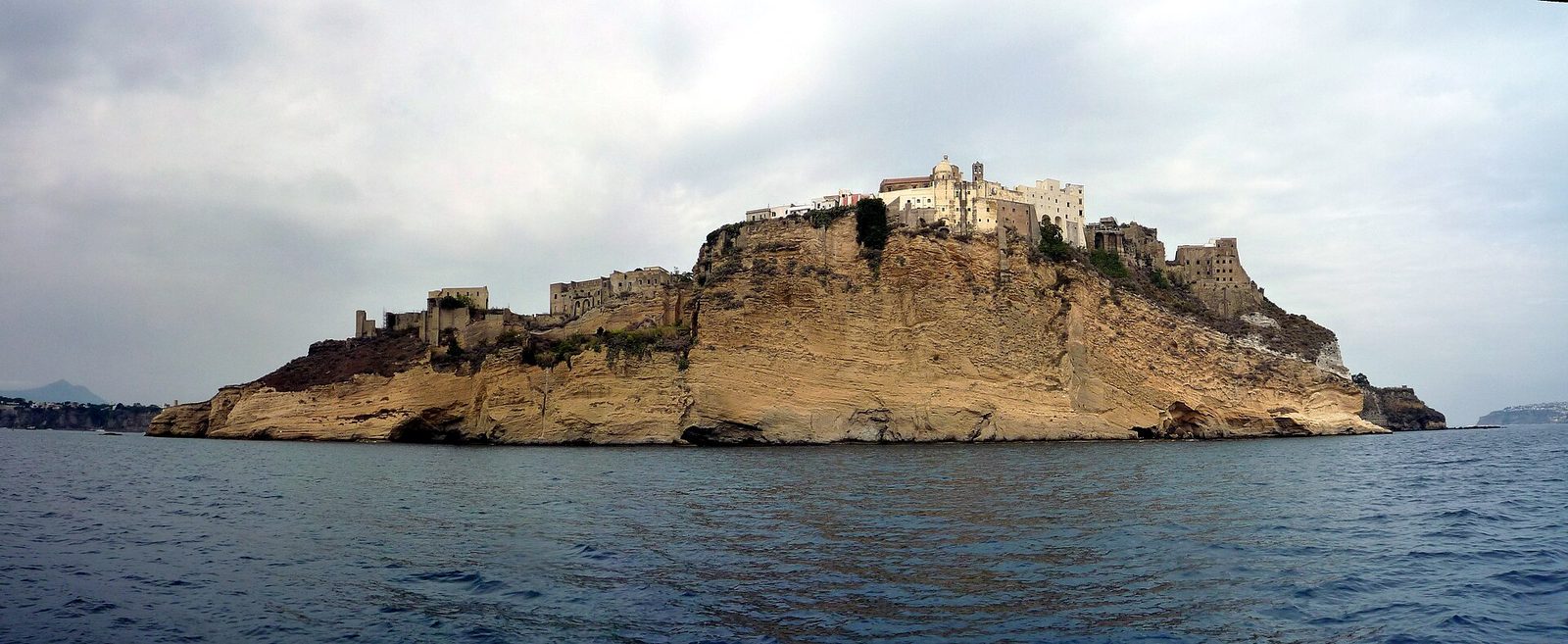
The walk up from Marina Grande takes about twenty minutes and is steep in places. On the way, stop at the little Piazza dei Martiri, named for islanders executed after the failed revolution of 1799, whose belvedere looks straight down onto Corricella’s harbor. It’s one of the most photographed views in southern Italy, and for good reason. Then continue up through the old gate into Terra Murata. The C2 bus goes up too, if the heat or the gradient is too much.
Palazzo d’Avalos: the palace that became a prison
The huge building dominating Terra Murata began life in the late 16th century as the palace of Cardinal Innico d’Avalos, whose family held the island. Under the Bourbons it became a military school and then a prison. It stayed a prison until 1988, with a grim reputation to match its setting. Since closing, it has stood half-empty, with its cells, courtyards and workshops frozen in time, peeling and extraordinary.
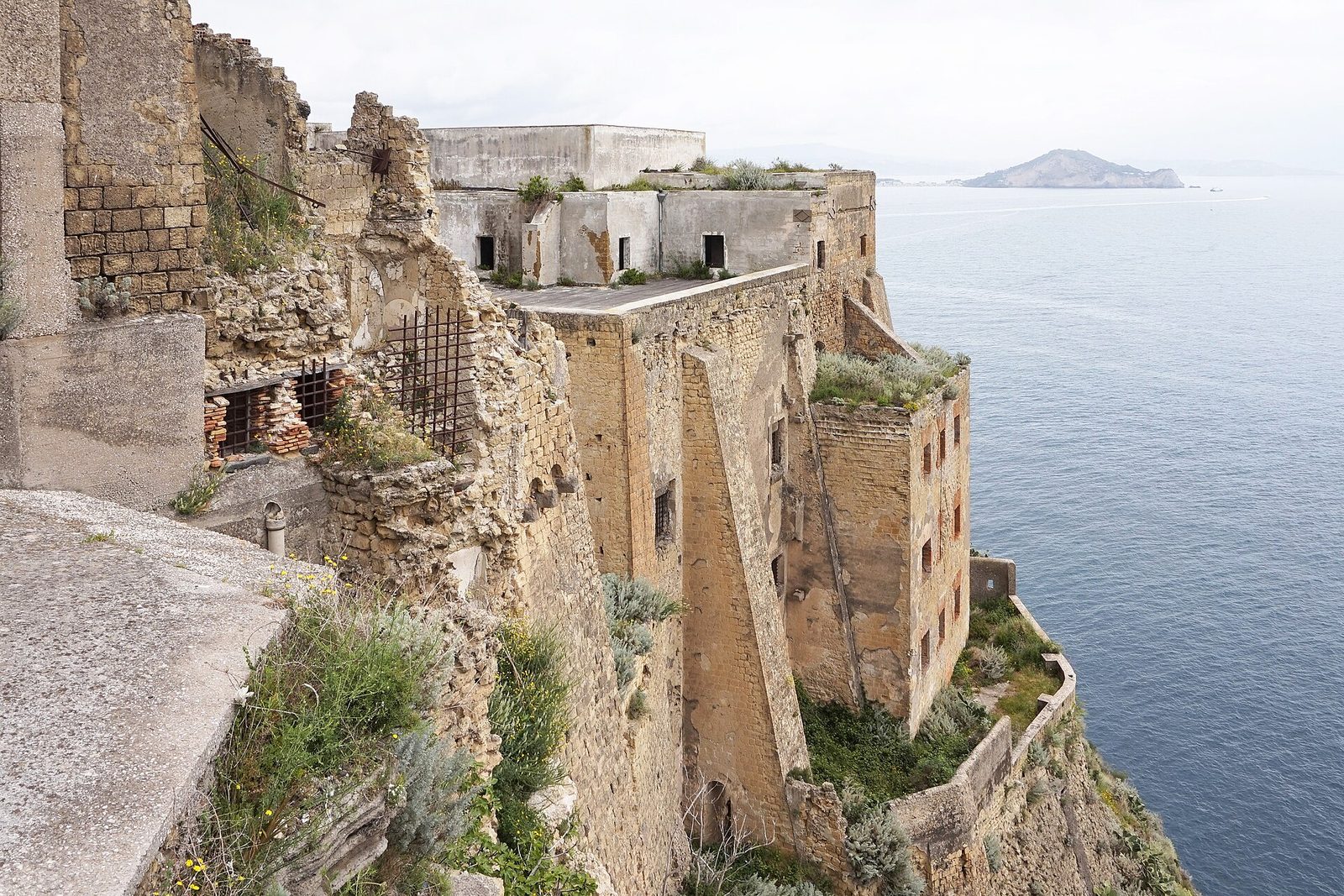
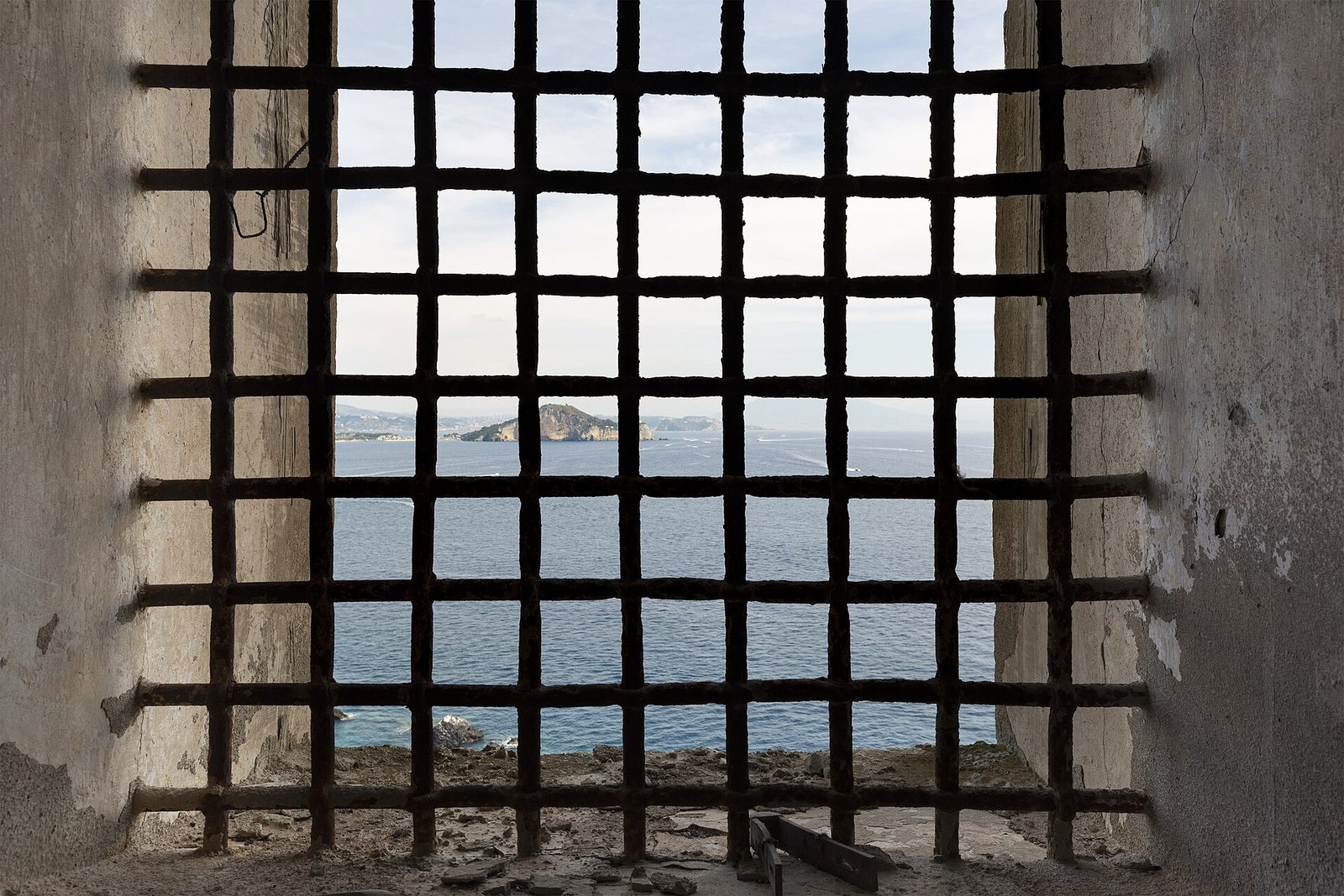
Visits are by reservation, usually guided, and run from the morning into the early afternoon. Tickets are in the €5–10 band depending on whether you take a guide, according to 2026 listings. Contact the municipality or the visitor service before you go, since the schedule varies through the year. It’s one of the most unusual visits in the Bay of Naples, and the view from a cell window across the sea to the mainland tells you more about imprisonment than any exhibit could.
The Abbey of San Michele Arcangelo
At the top of Terra Murata stands the island’s great church, the Abbey of San Michele Arcangelo. It was founded by Benedictine monks in the 11th century, rebuilt many times, and given its present form in the 16th century. Inside, look up at the gilded wooden ceiling and the images of Saint Michael, the island’s patron. The abbey also keeps a permanent nativity scene with 18th-century Neapolitan figures. In 2026 the abbey is marking the thousandth anniversary of its foundation, with special events through the year.
The church is open for services on Sundays and feast days. Guided visits of the church and its museum, run by a local association, operate from around Easter to All Saints’ Day, on a calendar that changes, so check before you climb up for them. Even if the abbey is closed, the square outside and the views from the walls are reason enough to come.
Marina Corricella: the harbor from the postcards
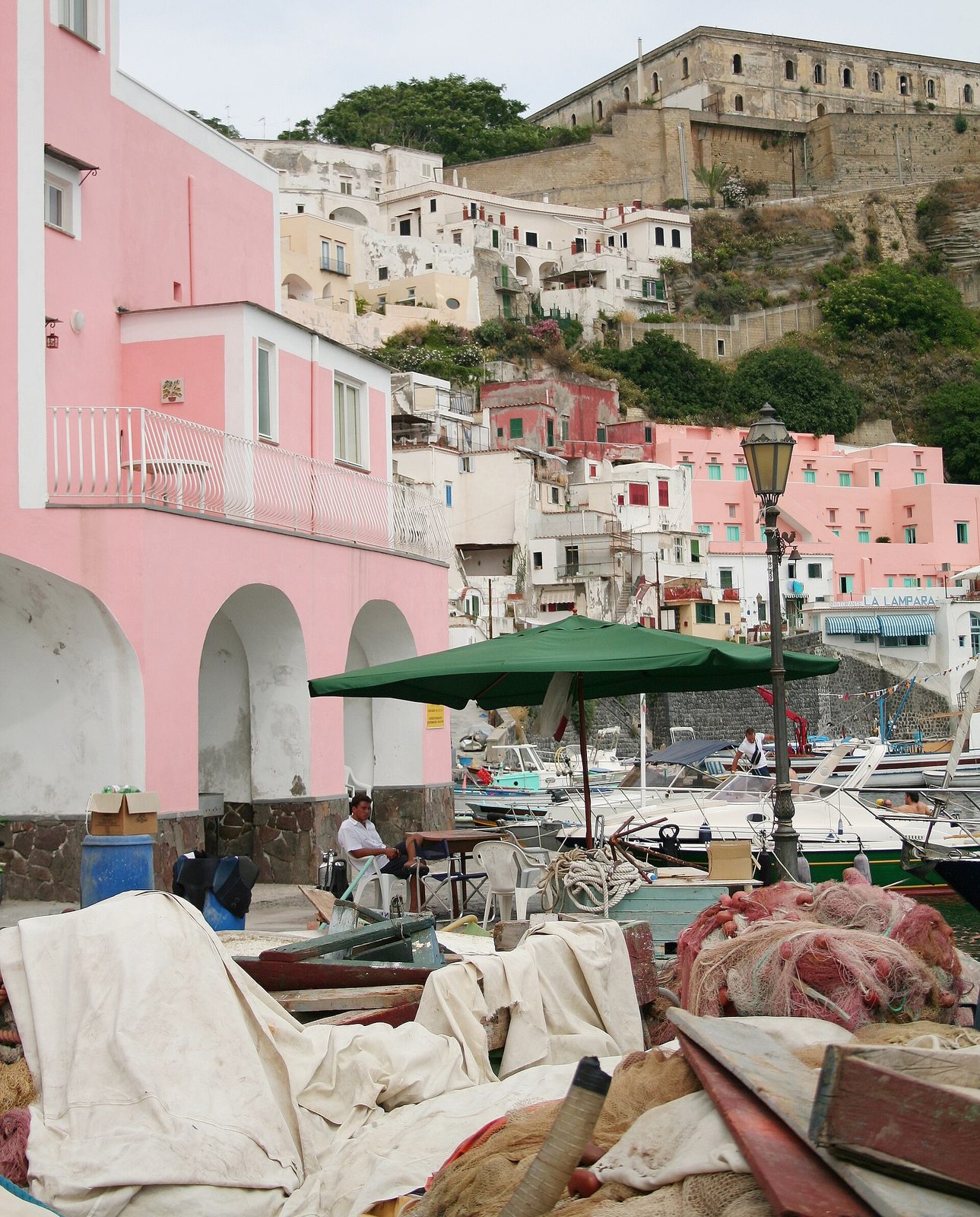
Below Terra Murata, on the island’s southeast side, lies Marina Corricella, the oldest fishing village on Procida and the image most people have of the island. It’s a single curving quay lined with houses in faded pink, yellow, blue and white, stacked up the cliff with outside staircases, arches and little balconies, all built so tightly together that the village has no road at all. Fishing boats are pulled up along the waterfront, nets are laid out to dry, and cats sleep on the warm stones.
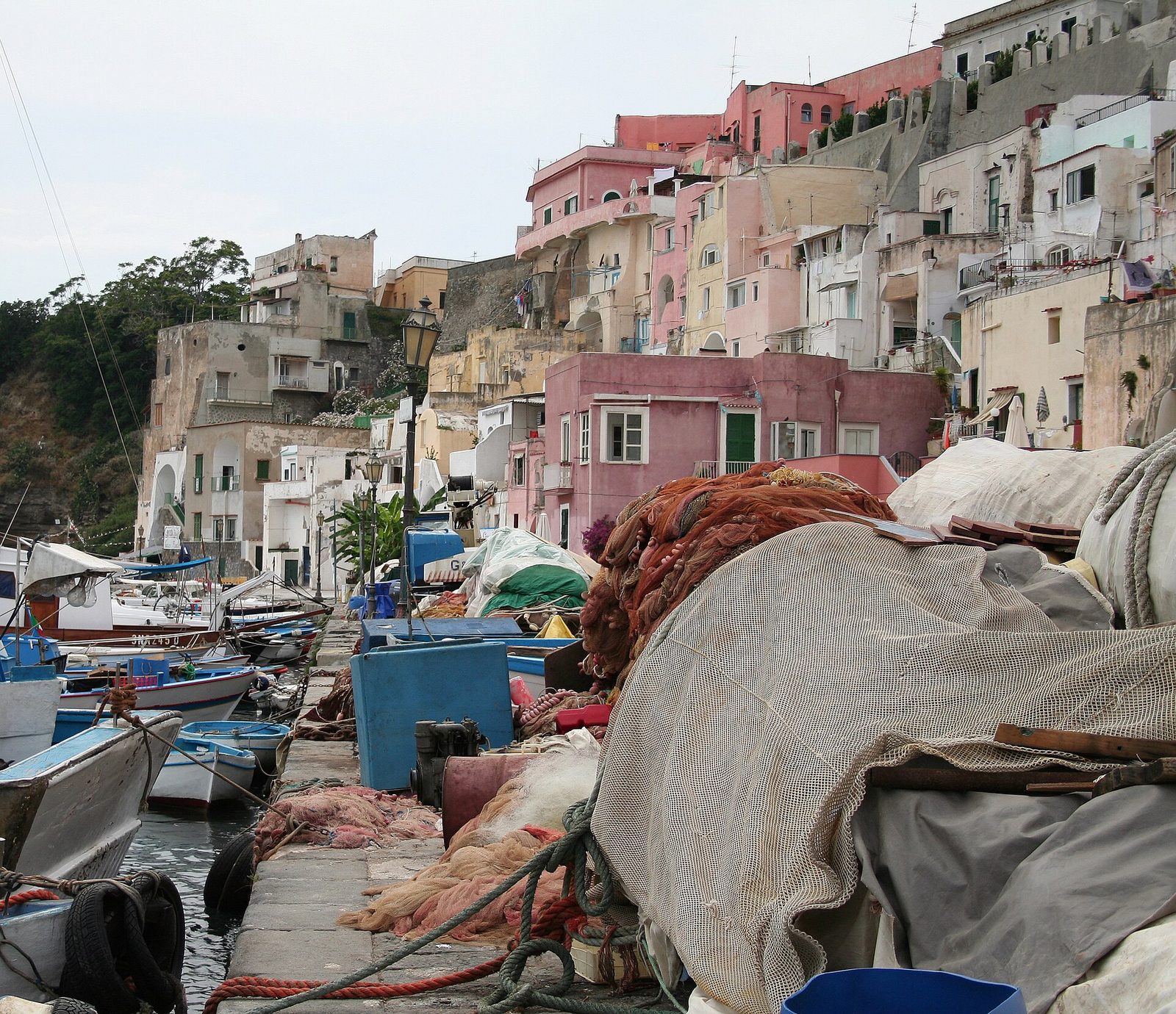
The houses were painted in different colors, so the story goes, so that fishermen could pick out their own homes from the sea. Whether that’s true or not, the effect is magical, especially in the late afternoon, when the light turns the whole cliff gold. This is where Il Postino was partly filmed. Much of the film was shot on the Aeolian island of Salina, but the harbor scenes and the village’s little bar belong to Procida. The quay has a string of restaurants and cafés with tables by the water, and a couple of bars that trade on the film connection.
You reach Corricella on foot, by stepped lanes down from the road above; the most scenic way in drops from the belvedere by Piazza dei Martiri. Coming down is easy; going back up in the heat of the afternoon is a workout. A microtaxi can meet you at the top.
How to see it: arrive late in the morning, walk the whole quay slowly, have lunch at a table by the water, and then stay on for a coffee as the fishermen work on their nets. Or come back for the evening, when the day visitors have gone and the lights come on around the harbor. The restaurants here charge a little more for the view, but they’re usually still good value by Capri standards, and the fish is as fresh as it gets.
Beaches on Procida
Procida is a volcanic island, formed from several craters, and its beaches are mostly small coves of dark volcanic sand. None are wide sweeping strands, but several are lovely, the water is clean, and outside the height of summer they’re rarely crowded. Most have a section with sunbeds and umbrellas to rent, run by a beach club, and a free section.
- Chiaia, below the cliffs just south of Corricella, is a curving beach reached by a long flight of steps, with a couple of restaurants and some of the clearest water on the island. The climb back up is serious, so budget your energy.
- Pozzo Vecchio, on the north coast, sits in an old crater and is known locally as the Il Postino beach, from the scenes filmed there. It’s sheltered and quiet, next to the island’s cemetery, and the C1 bus runs to it.
- Ciraccio and Ciracciello, along the southwest coast toward Chiaiolella, together form the island’s longest beach, with views of Ischia and Vivara and the best sunsets.
- Chiaiolella, by the marina of the same name at the southwest tip, is sheltered and good for families, with plenty of places to eat nearby.
- Silurenza and Lingua, close to Marina Grande, are handy if you’re waiting for a boat.
Verdict: you don’t go to Procida for the beaches, but an afternoon on one of them is a very good way to end a day. For more beach options around Naples, see the day trips from Naples guide.
Marina Chiaiolella and the sunset
At the far southwestern end of the island, Marina Chiaiolella is Procida’s second harbor, a round bay that was once a crater, now full of yachts and small boats and lined with restaurants and bars. It’s quieter and more modern than Corricella, with a relaxed, seaside-resort feel. It’s also the place to be at the end of the day. The sun sets behind Ischia, directly across the water, and on a clear evening the view from the beach or a waterfront table is one of the best on the island. The L1 and L2 buses run here from the port.
Boat trips, swimming and snorkeling
Procida looks its best from the water, and a boat is the only way to see much of its coast, where cliffs of layered volcanic rock drop straight into the sea between the beaches. In the warmer months, small boats can be hired at Chiaiolella and Corricella, with or without a skipper. In Italy you can drive a small boat with a low-powered engine without a license, so renting a little gozzo for a few hours is an option even for beginners, if the sea is calm and you stay close to shore. Skippered trips around the island typically stop for swims in coves you can’t reach on foot, pass under the cliffs of Terra Murata, and circle Vivara.
The water around Procida is clear and clean, and the rocky shores around the headlands and the Vivara reserve are good for snorkeling, with fish, sea urchins and rocky seabeds close to the surface. Dive centers on the island run trips to nearby sites in season. Be careful of boat traffic near the harbors, and of the currents off the points on windy days.
Verdict: if you’re staying the night, a few hours on a boat is the best way to spend a summer afternoon. On a day trip, the beaches and the villages are the better use of limited time.
Vivara: the island next door
Just off Chiaiolella, joined to Procida by a long pedestrian footbridge, lies the little crescent-shaped island of Vivara, the remains of an ancient crater rim. It’s uninhabited, covered in Mediterranean scrub, and protected as a state nature reserve, home to rare plants, nesting seabirds and archaeological remains from the Bronze Age, when Mycenaean traders stopped here. In the 17th century it was a hunting reserve of the d’Avalos family, and later of the Bourbon kings.
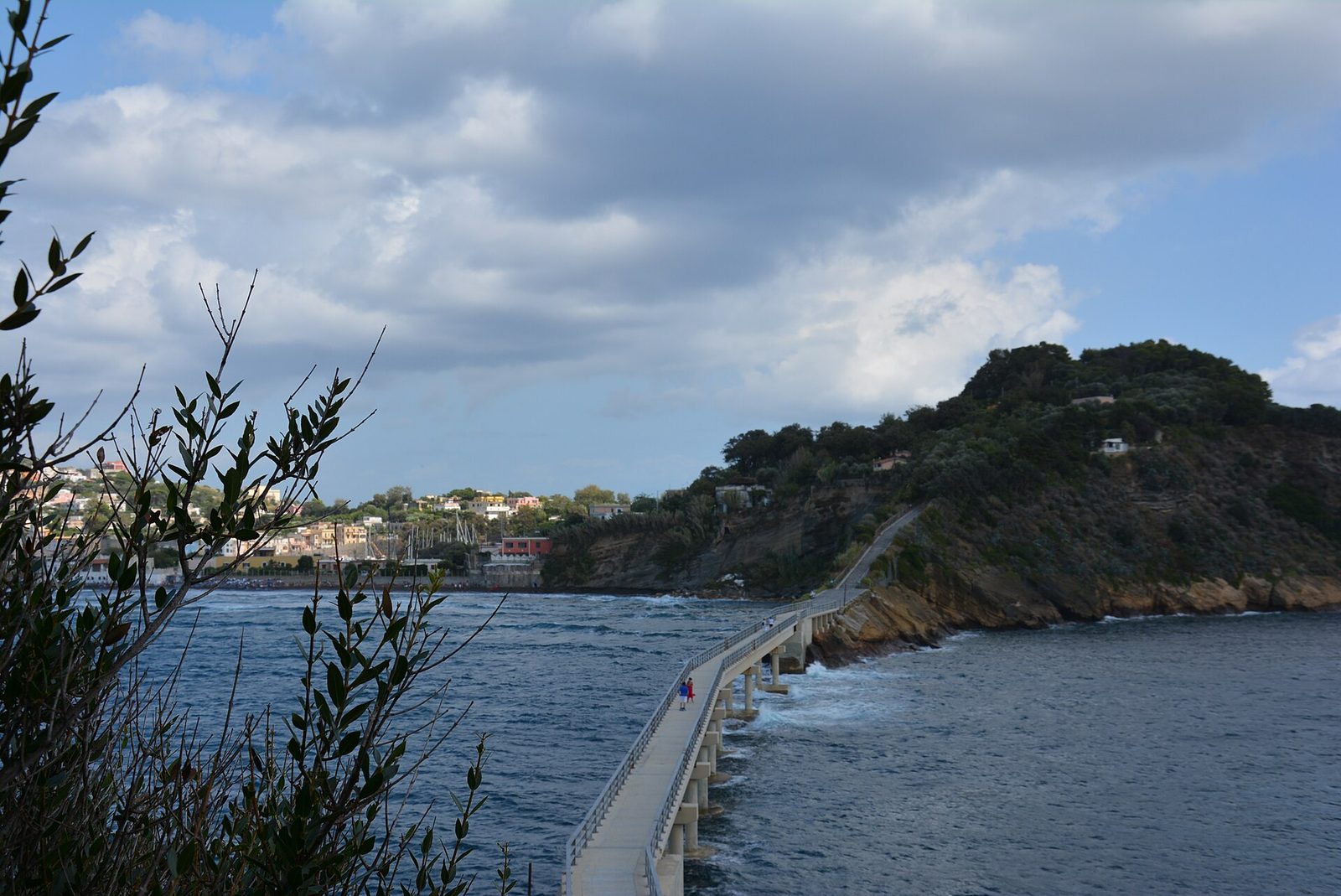
Access is by guided visit only, with compulsory booking through the reserve’s official website. Visits have run from Tuesday to Sunday with two departures a day, starting from the meeting point at the Procida end of the footbridge, on Via Santa Margherita. However, access was reported suspended for maintenance work in 2026, and the reserve has had long closures in the past. Check the official site before you plan around it. When it’s open, a walk across to Vivara, with the whole of Procida behind you and Ischia ahead, is one of the most peaceful things you can do in the Bay of Naples.
A walk across Procida
If you like to explore on foot, you can cross most of the island in a long morning or afternoon, with stops. This is the route I’d follow, from the port to the sunset.
- Marina Grande. Start at the port, with its row of colored houses and the church of Santa Maria della Pietà.
- Up to Piazza dei Martiri. Climb Via Principe Umberto, the road rising east from the port, to the little square and its belvedere over Marina Corricella.
- Terra Murata. Continue up through the old gate into the walled village. Visit the abbey, walk around the outside of Palazzo d’Avalos (or join a booked visit), and take in the views from the walls.
- Down to Corricella. Retrace your steps to the belvedere and take the stepped lanes down to the harbor for lunch.
- Across the island. Climb back to the main road and follow it southwest, through the island’s residential heart, past small churches, walled lemon gardens and the entrances of old courtyard houses. It’s pleasant but busy with traffic, so a bus for part of the way is no shame.
- Chiaiolella. Finish at the southwest tip, with a swim at Ciraccio or Chiaiolella beach, a look across the footbridge to Vivara, and the sunset over Ischia.
From Chiaiolella, the L1 and L2 buses take you back to Marina Grande for the boat. Allow plenty of time, since the last boats fill up and the buses run to island time.
Getting around Procida
Procida is small, and walking is the best way to see it. The distance from Marina Grande to Chiaiolella at the far end is only a few kilometers, but the main road is narrow, busy with scooters and without much in the way of pavements, so walk with care. For longer hops, there are three options.
- Buses. Run by EAV, they’re small and frequent, and fit through the narrow streets. There are four lines. The L1 runs from the port to Chiaiolella and back; the L2 also serves Chiaiolella, via Solchiaro; the C1 goes to Pozzo Vecchio beach; and the C2 climbs to Terra Murata and Corricella. Buy tickets at the ferry ticket counter at the port, or at bars and tobacconists.
- Microtaxis. These are three-wheeled Ape vehicles converted into little open taxis, often painted and decorated, which carry up to six people. They wait at Marina Grande and are perfect with luggage or for reaching the far end of the island. Agree the fare before you set off.
- Bikes and e-bikes can be rented near the port. The hills are short but steep, so an e-bike makes life much easier.
Cars are restricted for non-residents for most of the warmer half of the year, and there’s nowhere to park anyway. Scooters can be rented, but the traffic in the narrow lanes makes them more stressful than they’re worth for a short stay.
Eating on Procida
Procida eats from the sea and from its gardens, and the island’s lemons are its signature. They’re huge, thick-skinned, fragrant and much sweeter than the lemons you know, and they turn up everywhere.
- Insalata di limoni, lemon salad, is the island’s classic dish: slices of the whole lemon, pith and all, dressed with olive oil, garlic, chili and fresh mint. It sounds strange and tastes wonderful, especially with fried fish.
- La lingua (“the tongue”) is Procida’s pastry, a long, tongue-shaped piece of puff pastry filled with lemon cream and dusted with sugar. Pastry shops near Marina Grande sell them fresh in the morning.
- Seafood is the main event: fried calamari and anchovies, pasta with clams or with the catch of the day, octopus, and whole grilled fish sold by weight. Ask the price per portion before you order a whole fish.
Where to eat depends on what you want. Corricella’s waterfront restaurants are about the setting. The food is generally good, and you pay a little extra for the view. Chiaiolella has a string of relaxed places facing the marina and the sunset. Some of the best-value meals are in the small trattorie along the main road and near Marina Grande, where islanders eat. Wherever you go, lunch is long and dinner is late, and nobody will rush you. For the wider food culture of the region, see the Naples food guide.
Procida as a day trip from Naples
Procida is the best island day trip from Naples for most people. It’s close, the boats are frequent, it’s small enough to see the essentials in a few hours, and it’s far calmer and cheaper than Capri. Here’s how I’d shape the day.
- Take an early fast boat from Molo Beverello. You’ll be on the island in about 40 minutes.
- Walk straight up to Terra Murata while it’s cool, stopping at the Piazza dei Martiri belvedere for the view down to Corricella. Book a visit to Palazzo d’Avalos in advance if you want to see the prison.
- Drop down to Marina Corricella for a long lunch at a table by the water.
- Spend the afternoon on a beach, at Chiaia below Corricella or at Ciraccio toward Chiaiolella, or simply wander the lanes.
- Catch the sunset at Chiaiolella if the boat timetable allows. Otherwise, head back to Marina Grande for a late-afternoon boat.
Check the time of the last boat back before you set out, especially outside the summer season, when services thin out and the last departures are earlier. And keep an eye on the forecast, since rough seas cancel the fast boats first. The ferry guide covers both. For how Procida compares with the region’s other day trips, see day trips from Naples.
Combining Procida with Ischia
Procida and Ischia are close neighbors, 20 to 30 minutes apart by boat, and they make a natural pair. If you’re staying on Ischia, Procida is an easy day out. If you’re staying on Procida, Ischia’s thermal parks and bigger beaches are a short hop away. The Ischia guide covers the bigger island.
Staying on Procida overnight
A day trip shows you Procida. A night lets you feel it. Once the last day visitors leave, the island goes quiet, the harbors light up, and you get Corricella in the evening and early morning, when it belongs to the people who live there. If you have the time, I’d give it at least one night.
Accommodation is mostly small: B&Bs, guesthouses, rooms in family homes, apartments, and a handful of small hotels. There are no big resort hotels, which is part of the island’s charm. Three areas make good bases.
- Corricella and the hill around Terra Murata: the most atmospheric, with the harbor on your doorstep, but lots of steps and limited access for luggage.
- Chiaiolella: relaxed, close to the beaches and the sunset, and handy for Vivara. It’s a bus ride from the port.
- Marina Grande: the most practical, with the ferries, shops and cafés right there. It’s livelier, and good for a short stay or an early boat.
Evenings on Procida are simple pleasures. After dinner, islanders and visitors drift along the waterfront at Marina Grande, where the bars stay open late and the last boats come in, or linger over a drink by the marina at Chiaiolella. Corricella turns quiet and romantic once the day visitors leave, with its restaurants lit up along the quay. There are no clubs to speak of, and that’s rather the point.
Book well ahead for summer weekends. Procida has far fewer rooms than Ischia or Capri, and the best ones fill early.
Culture, films and festivals
Procida punches far above its size culturally. Its year as Italian Capital of Culture in 2022 brought exhibitions, performances and restoration projects, and some of that energy has stayed. The island has a long seafaring tradition. Generations of Procida men went to sea as sailors and captains, and the island’s nautical school is one of the oldest in Italy.
The Good Friday procession of the Misteri is the island’s great festival. Islanders spend months building misteri, floats depicting scenes from the Bible, which are carried in procession from Terra Murata down through the island. It’s one of the most striking Easter processions in southern Italy. For how the Easter season fits into the calendar, see the best time to visit Naples.
For readers, Elsa Morante’s Arturo’s Island, which won Italy’s leading literary prize, the Strega, is the novel to bring. For film lovers, Il Postino and The Talented Mr. Ripley both show the island off, and it’s fun to find the locations at Corricella and Pozzo Vecchio.
Morante wasn’t the first writer to fall for the island. The French Romantic poet Alphonse de Lamartine stayed on Procida as a young man, and his novel Graziella, published in 1852, tells of his love for a Procida fisherman’s daughter. The book made the island briefly famous across Europe, and its heroine gave her name to the island’s traditional festival of the sea. In summer, young women of Procida parade in the island’s traditional costume, and one is chosen as that year’s Graziella. It’s a small, proud, very local celebration, and a lovely thing to stumble on if your dates line up.
If you’re interested in the island’s culture beyond the sights, look out for exhibitions and concerts in Terra Murata and Palazzo d’Avalos, which have become the island’s main cultural venues since the Capital of Culture year. Ask at your guesthouse what’s on during your stay.
Procida vs Capri vs Ischia
| Procida | Capri | Ischia | |
|---|---|---|---|
| Character | Small, lived-in fishing island | Glamorous, dramatic, busy | Big, green, thermal-spa island |
| Size | About 4 sq km | About 10 sq km | About 46 sq km |
| Crowds | Light, except summer weekends | Heavy from mid-morning in season | Busy in summer, but spread out |
| Prices | Moderate | High | Moderate |
| Best for | Atmosphere, photos, slow days | Views, boat trips, a famous day out | Thermal parks, beaches, longer stays |
| Day trip from Naples? | Yes, easily | Yes, but busy | Possible, but better for a stay |
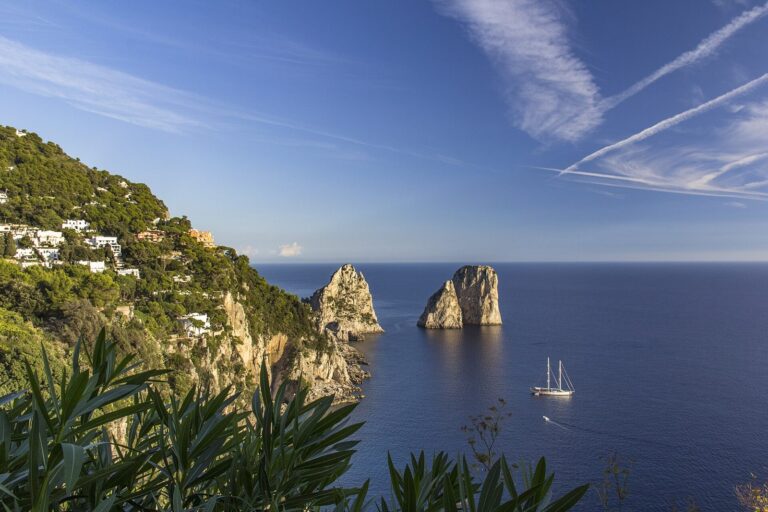
My honest take: if you want a single island day from Naples and you’re not set on the famous sights, choose Procida. If you want the Faraglioni, the Blue Grotto and the drama, choose Capri, and see the Capri from Naples guide. If you want to stay a few days, swim and soak in thermal pools, choose Ischia.
Photo spots on Procida
Procida is one of the most photogenic places in Italy, and a few spots stand out.
- The belvedere by Piazza dei Martiri, looking down on Marina Corricella’s harbor. This is the classic shot, best in the late afternoon when the houses glow.
- The walls of Terra Murata, with views across to Ischia, Vesuvius and the mainland.
- Corricella’s quay itself, with nets, boats and staircases at eye level. Early morning is the quietest time.
- Marina Grande from the boat, as you arrive, when the whole colored waterfront lines up in front of you.
- Chiaiolella and Vivara at sunset, with Ischia silhouetted across the water.
A courtesy note: Corricella and Terra Murata are people’s homes. Photograph the views, but don’t treat front doors, staircases and washing lines as a set, and ask before photographing people.
Procida with children
Procida is a good island for families. It’s small, calm and friendly, and there’s plenty to keep children happy: microtaxi rides, harbors full of boats, the old prison on the hill, and sheltered beaches. Chiaiolella’s beach is the easiest for small children, with calm, shallow water and cafés close by. The main drawbacks are the steps and the narrow main road. Strollers are hard work on the stepped lanes of Corricella and Terra Murata, and the road has little room for walkers, so buses and microtaxis are your friends. If Vivara is open, a guided visit across the footbridge is a great outing for older children.
Practical tips for Procida
- Carry some cash. Cards are widely accepted, but small cafés, bakeries and microtaxis often prefer cash.
- Expect a midday pause. Many shops close for a few hours in the early afternoon and reopen in the evening. Restaurants stay open for lunch.
- Bring water and sun protection. There’s little shade on the walk up to Terra Murata or on the beaches, and the stepped lanes are hot work in summer.
- Wear proper shoes. Steps, cobbles and steep lanes are everywhere. Save the sandals for the beach.
- Book Palazzo d’Avalos and Vivara ahead, and check they’re open on your date.
- Mind the scooters on the main road, which has almost no pavement in places.
- Accessibility is limited. Marina Grande and Chiaiolella are flat, but Corricella and Terra Murata involve steep slopes and steps. A microtaxi can get you close to the top of Terra Murata.
Procida out of season
Most visitors come in summer, but Procida has a very different appeal in the quieter months. With the day-trippers gone, it’s simply a fishing island going about its life. Fishermen mend nets on the quay at Corricella, locals fill the bars at Marina Grande, and you may have Terra Murata’s walls to yourself. The light is softer, the walks are cooler, and the prices are lower.
The trade-offs are real, though. Some restaurants, beach clubs and guesthouses close for the winter, boat services are less frequent and end earlier, and rough seas cancel the fast boats more often, so leave slack in your plans and check the last boat back. The beaches are for walking rather than swimming for part of the year, and the visits to Palazzo d’Avalos, the abbey and Vivara run on thinner schedules. For how the seasons compare, see the best time to visit Naples.
My view: out of season, Procida is at its most authentic, and a winter day trip on a calm, clear day can be the best island day in the bay.
Is Procida safe?
Very. Procida is a small, close-knit community with very little crime, and visitors are welcome. The real hazards are practical ones: scooters and buses on the narrow main road, steep steps in the heat, the sun on the beaches, and the sea on windy days. Take care on the road, drink plenty of water, and ask locally before swimming off the rocks if the sea is up.
What to skip
- Staying at Marina Grande all day. It’s the port, not the point. Head up to Terra Murata and down to Corricella.
- Walking the main road at midday in summer. It’s narrow, hot and full of scooters. Take the bus or a microtaxi.
- Bringing a car. Non-resident vehicles are restricted for much of the year, and you won’t need one.
- Planning around Vivara without checking. It’s been closed for long periods, including for maintenance in 2026.
- Expecting big sandy beaches. Procida’s are small volcanic coves. For a proper beach day, Ischia has more choice.
- Missing the last boat. Especially outside the summer season, when the last departures are early.
Procida frequently asked questions
Is Procida worth visiting?
Yes. Procida is the most authentic of the Bay of Naples islands: a small, lived-in fishing island with pastel harbors, a walled medieval village and quiet beaches, far less crowded and cheaper than Capri. It was named Italian Capital of Culture in 2022. It’s ideal for a relaxed day trip from Naples or a quiet overnight stay.
Can you do Procida as a day trip from Naples?
Easily. Fast boats from Naples’s Molo Beverello reach Procida in about 40 minutes, and the island is small enough to see Terra Murata, Marina Corricella and a beach in one day. Take an early boat, check the time of the last boat back before you set out, and watch the forecast, since rough seas can cancel the fast boats.
How do you get from Naples to Procida?
By sea. Fast boats leave Molo Beverello and take about 40 minutes, while slower car ferries from Calata Porta di Massa take about an hour and cost less. The shortest crossing is from Pozzuoli, at around half an hour, though that port has been disrupted by earthquakes in 2026. Procida is also 20 to 30 minutes from Ischia.
Where was Il Postino filmed on Procida?
Mainly at Marina Corricella, the pastel fishing harbor on the island’s southeast side, where the village scenes and the bar were filmed, and at Pozzo Vecchio beach on the north coast, now known locally as the Il Postino beach. Much of the rest of the film, including Neruda’s house, was shot on the Aeolian island of Salina.
Can you visit Vivara?
Only on guided visits booked through the nature reserve’s official website, crossing the footbridge from the Santa Margherita promontory near Chiaiolella. Visits have run from Tuesday to Sunday with two departures a day, but access was reported suspended for maintenance in 2026, and the reserve has had long closures before. Check the official site before you go.
Does Procida have good beaches?
It has several pleasant small beaches of dark volcanic sand, with clean water: Chiaia below Corricella, Pozzo Vecchio on the north coast, Ciraccio and Ciracciello toward Chiaiolella, and Chiaiolella itself. They’re coves rather than big sandy beaches, most with a mix of beach clubs and free sections.
Can you take a car to Procida?
For most of the warmer part of the year, non-resident vehicles are restricted on Procida, and only residents and authorized visitors can bring cars across. You won’t need one. The island is small, and its buses, microtaxis and rental e-bikes cover everything, while its narrow streets have almost nowhere to park.
Is Procida better than Capri?
It depends what you want. Procida is quieter, cheaper and more authentic, and better for atmosphere, photography and slow days. Capri has the more famous sights, like the Faraglioni and the Blue Grotto, and more dramatic scenery, but it’s much busier and more expensive. For a first island day from Naples without the crowds, I’d choose Procida.
Procida is also the easiest beach day you can have from Naples: a short crossing, buses that run to every beach, and sand at the Chiaiolella, Ciraccio and Pozzo Vecchio. For how it compares with Ischia, Capri, the Campi Flegrei and the Posillipo rocks, see my guide to swimming and beaches near Naples.
Photo credits
- Marina Corricella and Terra Murata: photo by Rudolfo Kithera, Wikimedia Commons, CC0.
- Terra Murata from the sea: photo by Michael Karavanov, Wikimedia Commons, CC BY-SA 3.0.
- Palazzo d’Avalos: photo by Bernard Gagnon, Wikimedia Commons, CC BY 4.0.
- Cell window, Palazzo d’Avalos: photo by Giuseppe Albano, Wikimedia Commons, CC BY-SA 4.0.
- Marina Corricella quay: photo by Rudolfo Kithera, Wikimedia Commons, CC0.
- Footbridge to Vivara: photo by Mentnafunangann, Wikimedia Commons, CC BY-SA 4.0.
Sources: Vivara visits from the Riserva Naturale Statale Isola di Vivara and 2026 reporting; Palazzo d’Avalos and Abbey visits from 2026 island listings and the Visit Procida site; bus lines from EAV information via Visit Procida; ferry times from the operators’ 2026 schedules. All checked September 2026.