On this page
Last updated September 10, 2026. Ferry, bus and train details checked against operator timetables and 2026 fare listings; driving restrictions checked against the 2026 ANAS ordinance for the Amalfi Coast road. Where I could only confirm a figure through secondary sources, I say so.
You can reach the Amalfi Coast from Naples, Italy four ways. There’s a direct ferry from Molo Beverello (about 1½–2 hours, around €30 one way, roughly April to October only). There’s the Circumvesuviana train to Sorrento plus a SITA bus, the cheapest option at 2½–3 hours. And there’s a coach tour, or driving, which I’d avoid. A day trip works, but a night or two is far better.
Search for this and you’ll find a wall of tour companies, each explaining why their minibus is the only sensible way to go. It isn’t. The Amalfi Coast is one of the most beautiful stretches of coastline on earth, and it’s also one of the most awkward to reach. Every route has a failure mode that nobody selling you a ticket mentions: the ferry that doesn’t sail when the sea is rough, the bus queue in Sorrento that leaves you on the curb for an hour, the coach tour that gives you 90 minutes in Positano, the rental car with nowhere to park and the wrong number plate for today’s date.
This guide lays out every route side by side, with what it really costs, how long it really takes and how it goes wrong, and then an honest answer to the question that matters most: is a day trip from Naples enough, or should you sleep on the coast?
First, a bit of geography that confuses a lot of people. The Amalfi Coast is the south side of the Sorrento peninsula, the mountainous finger of land that separates the Bay of Naples from the Gulf of Salerno. It runs from Positano in the west through Praiano, Amalfi, Atrani, Ravello (up on the hill), Minori, Maiori and Cetara to Vietri sul Mare in the east. Sorrento is not on the Amalfi Coast. It’s on the north side of the peninsula, facing Naples and Vesuvius, and it’s the gateway to the coast rather than part of it. That matters, because from Naples you’re always crossing the peninsula, by sea round the end of it or by road over the top.
The Amalfi Coast from Naples: every route compared
| Route | How it works | Time, Naples to Positano / Amalfi | Cost one way (checked September 2026) | When it runs | How it goes wrong | My verdict |
|---|---|---|---|---|---|---|
| Direct ferry | Fast ferry from Molo Beverello in central Naples straight to Positano and Amalfi | About 1½ hours to Positano; 1¾–2 hours or more to Amalfi | Around €30 to Positano, from around €32 to Amalfi | Roughly April to October; very little or nothing out of season | Cancelled in rough seas; few departures; last boat back is early | The best way to arrive, and the best day trip, in season. |
| Train + SITA bus via Sorrento | Circumvesuviana to Sorrento, then a SITA bus along the coast road | About 2½ hours to Positano; 3 or more to Amalfi | Train €4–5 (sources disagree) plus bus from €2.60, or a €10 24-hour bus pass | All year | Crowded trains, long bus queues, full buses skipping stops, traffic | Cheapest and year-round, but hard work in high season. |
| Train + ferry or bus via Salerno | Trenitalia to Salerno, then a ferry or SITA bus west along the coast | Around 2 hours to Amalfi; longer to Positano | Train fare plus ferry or bus | Train all year; ferries in season | More changes; the Positano end is far | The smart route for Amalfi, Ravello, Minori and Maiori. |
| Coach tour or private driver | Door-to-door minibus or car from your Naples hotel | About 1½–2 hours each way, traffic-dependent | Varies widely: tours per person, drivers per car | All year | Rushed stops, traffic, parking waits; drivers are expensive | A driver is great for groups; tours rarely are. |
| Driving yourself | Motorway to Castellammare or Vietri, then the SS163 coast road | From about an hour to Positano off-peak; far longer in traffic | Fuel, tolls and very expensive parking | All year, with odd/even plate restrictions on many days | Narrow road, buses, no parking, plate bans, ZTLs | Don’t, unless you’re staying on the coast with parking. |
If I were going from Naples for the day in season, I’d take the morning ferry to Positano, move on to Amalfi by ferry or bus in the afternoon, and take the ferry back to Naples from Amalfi, which means checking the last departure before I go. Out of season, or on a rough-sea day, I’d take the train to Salerno and the bus to Amalfi and Ravello, and leave Positano for another trip.
Route 1: the direct ferry from Naples
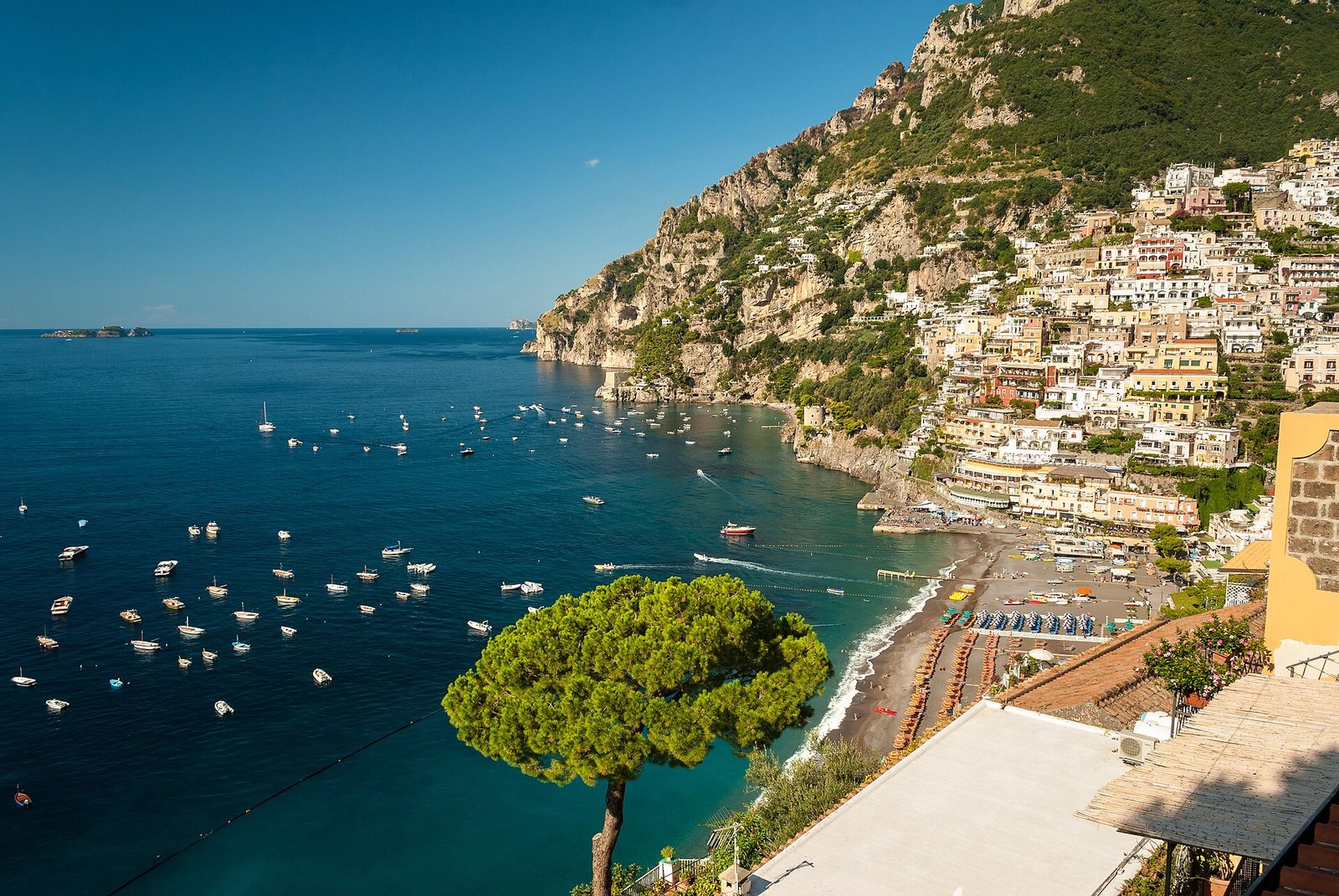
This is the way to arrive on the Amalfi Coast. You leave from Molo Beverello, the hydrofoil pier in central Naples beside Castel Nuovo, and within an hour you’re rounding the tip of the Sorrento peninsula, past Capri, with the cliffs of the coast rising straight out of the sea. Arriving in Positano by water, with the town piled up the hillside in front of you, is one of the great arrivals in Italy. It also skips every problem on the road: no traffic, no queues for the bus, no bends to make you queasy.
Several companies run the route in 2026, including NLG, Alilauro, Alicost, Travelmar and Positano Jet. Some go direct and others call at Sorrento or Capri first. Expect about an hour and a half to Positano and roughly an hour and three quarters to two hours or more to Amalfi, depending on the stops. Fares from Naples start at around €30 to Positano and around €32 to Amalfi one way, based on 2026 listings from operators and booking sites. Treat these as a guide and check the operator’s own site before you travel, because prices vary by company and by boat.
What goes wrong:
- It’s seasonal. Direct boats between Naples and the Amalfi Coast run roughly from April to October, with one or two operators continuing into early November. Outside that window, there’s very little or nothing on this route, and even in season timetables thin out at the edges.
- The sea decides. Ferries are cancelled or delayed when the sea is rough, sometimes at short notice. If you’re on a tight schedule, especially on the day you fly home, don’t rely on a boat.
- There aren’t many departures. Unlike the Capri hydrofoils, the Amalfi Coast boats from Naples run only a handful of times a day. Miss the one you planned on and you might be waiting hours.
- The last boat back is early. The last direct sailing back to Naples typically leaves in the late afternoon. Check it before you commit to a day trip, and plan your day backwards from it.
- Peak days sell out. On summer weekends and holidays, book ahead online, especially for the return.
A practical tip: ferries between the towns on the coast itself (Positano to Amalfi, for example) run more often than the ones from Naples, take 15–30 minutes and cost from around €10. That makes a one-way combination easy. Take the ferry from Naples to Positano, the coastal ferry on to Amalfi, and the ferry or the train-and-bus route back.
Route 2: the Circumvesuviana to Sorrento, then the SITA bus
This is the cheapest way to reach the coast, the only public route that runs every day of the year, and the one most budget guides recommend. It works. It’s also the most tiring in high season, and it’s worth knowing exactly how it goes before you set off.
Step 1: Naples to Sorrento by train
The Circumvesuviana’s Naples–Sorrento line starts at Porta Nolana and calls at Napoli Garibaldi, on the lower level beneath the main station (Napoli Centrale), then runs round the bay past Herculaneum and Pompeii to Sorrento, the end of the line. The journey takes just over an hour. Board at Porta Nolana if you want a seat. By Garibaldi, summer trains are often standing-room only, full of suitcases and day-trippers.
The fare is where sources disagree: travel sites quote anything from €4 to €5 one way from Naples to Sorrento, and EAV’s own tariff page was unavailable when I checked. Confirm at the machine. Make sure the train says Sorrento on the front, since several branch lines share the tracks out of Naples.
EAV also runs the Campania Express, a tourist train with reserved seats and fewer stops, at €15 one way or €25 return. It’s a genuinely more comfortable way to reach Sorrento with luggage, but EAV has suspended the service from October 1, 2026 “until further notice,” so it’s only an option before then.
Step 2: Sorrento to Positano and Amalfi by SITA bus
SITA SUD runs the blue buses along the coast road from Sorrento to Positano, Praiano and Amalfi. The stop is just outside Sorrento’s train station. The ride to Positano takes roughly an hour in normal traffic, and Amalfi is well over an hour and a half away, much longer when the road is busy.
Tickets. Buses on the coast use the Unico Costiera fare system, and tickets are priced by distance band. According to 2026 listings, a short hop between neighboring towns (the AC1 band) costs €1.80, and a longer ride such as Positano to Amalfi or Positano to Sorrento (AC2) costs €2.60. For a day trip, the simplest option is the 24-hour COSTIERASITA pass at €10, which covers unlimited SITA rides along the coast, or €12 with Positano’s local bus included. You can’t buy tickets on board. Get them from a tabaccheria (tobacconist), a newsstand or a bar near the stop, and buy your return at the same time, because some coastal stops have nowhere to buy one. If you buy through the Unico Campania app, activate the ticket before you board, since just showing it on screen doesn’t count.
What goes wrong:
- The queue in Sorrento. In high season, the line for the Amalfi bus outside Sorrento station can be long enough that you watch one or two full buses leave before you get on. Arrive early in the morning.
- Full buses skip stops. Once a bus is full, it may drive past the intermediate stops, which is a real problem on the way back from Positano, where buses often arrive from Amalfi already packed.
- Traffic. The coast road is narrow, twisting and shared with coaches, delivery vans, scooters and rental cars. A single bus meeting a coach on a hairpin can hold everything up for 20 minutes.
- Motion sickness. The road has hundreds of bends. If you’re prone to it, sit near the front and take something before you board.
Where to sit. Heading from Sorrento toward Positano and Amalfi, sit on the right-hand side of the bus for the sea views. The drop to the water is spectacular, and occasionally alarming.
In Positano, the SITA bus stops up on the main road at the top of the town, not by the beach. The town is essentially one long staircase down to the sea, so it’s about a 15–20 minute walk down (easy) and the same back up (hard), or you can take Positano’s local shuttle bus.
Route 3: the Salerno approach for Amalfi and Ravello
This is the route almost nobody publishes as a direct comparison, and for the eastern half of the coast it’s often the best one. Instead of going round via Sorrento, you take a Trenitalia train from Napoli Centrale to Salerno, a short, easy ride on regional or high-speed trains, and approach the Amalfi Coast from the other end.
From Salerno, in season, ferries run west along the coast to Cetara, Maiori, Minori, Amalfi and Positano, and they’re usually less crowded than the boats from Naples. All year, SITA buses run from Salerno along the coast to Amalfi through Vietri sul Mare, Cetara, Maiori and Minori, and from Amalfi another bus climbs up to Ravello.
Why take it? If your priority is Amalfi, Ravello, Atrani, Minori or Maiori rather than Positano, Salerno is simply closer. You also avoid the Sorrento bus queue, and the train from Naples to Salerno is far more comfortable than the Circumvesuviana. Salerno itself has a pleasant seafront and a fine cathedral if you have time to spare. The drawback is that Positano, at the far western end, becomes a long way off, so this is a route for an Amalfi-and-Ravello day rather than a whole-coast day.
Route 4: coach tours and private drivers
The easiest way to see the Amalfi Coast from Naples is to let someone else deal with it, and there are two very different ways to do that.
Coach and minibus tours pick you up in Naples, drive you down to the coast, usually stop in Positano and Amalfi (sometimes Ravello), and bring you back. Some add Sorrento or a boat leg. They remove all the logistics, and for travelers who hate planning, that’s worth a lot. But be clear about what you’re buying. A typical full-day tour spends a big share of the day on the road. Stops are often 60–90 minutes per town. And you’ll arrive at the same time as every other coach, at the same bottleneck in Positano. Prices vary widely between operators, so compare what’s included: lunch, a boat leg, and time in each town. Choose the smallest group you can find, and one that includes a boat, which frees you from the road for at least part of the day.
A private driver is a different experience altogether. You set the pace, stop at viewpoints, and a driver who knows the road handles the bends and the parking. Crucially, licensed taxis and hire-with-driver cars (noleggio con conducente, NCC) are exempt from the odd/even number plate restrictions on the coast road. It’s expensive, since you’re paying for a car and a driver for the full day. But split between four people, it can cost less per head than you’d expect, and it’s by far the most comfortable way to see the whole coast in a day. Book a licensed NCC service in advance, and agree the itinerary and the full price before the day.
Route 5: driving the Amalfi Coast road yourself
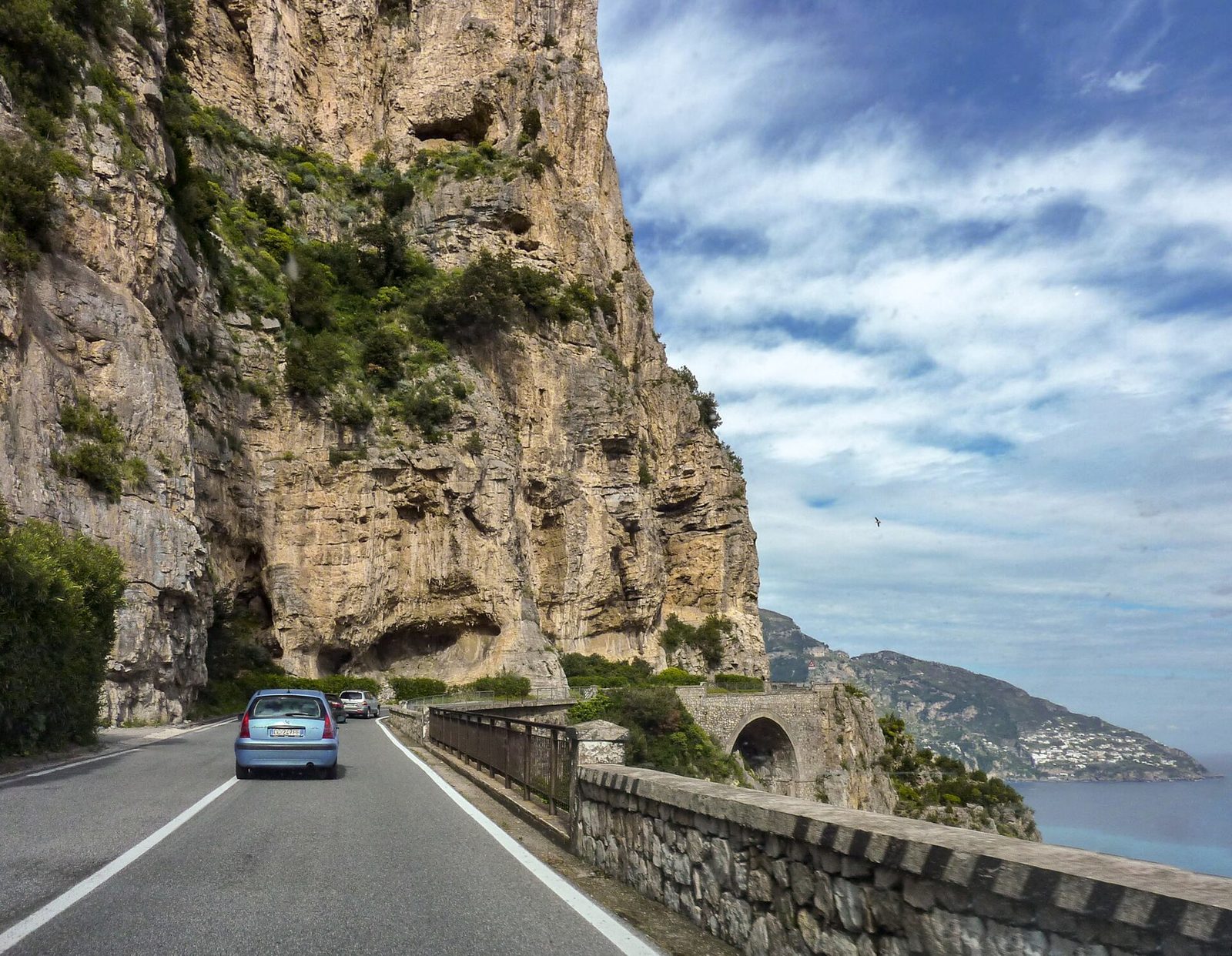
The Amalfi Drive, the SS163 coast road, is one of the most famous roads in the world, and I’d strongly suggest you don’t drive it on a day trip from Naples. Here’s why.
- The road. It’s narrow, carved into the cliff, with hundreds of blind bends, sheer drops and almost nowhere to stop. Full-size SITA buses and tour coaches use it all day, and when two meet on a bend, somebody reverses. It’s much less fun as the driver than as a passenger.
- Parking. There’s very little, and what there is in Positano and Amalfi is among the most expensive in Italy. Garages fill up early in high season.
- Restricted traffic zones. The town centers have ZTLs (zone a traffico limitato), camera-enforced zones closed to non-resident traffic. Fines follow you home through the rental company.
- The odd/even plate rule. On many days of the year, the coast road operates a targhe alterne (alternate plates) scheme, explained below.
The 2026 odd/even plate rule on the coast road
To cut traffic, ANAS, the national roads authority, restricts non-resident cars on the SS163 between Vietri sul Mare and Positano between 10:00 and 18:00 on set days. On odd-numbered dates, cars whose number plate ends in an odd digit can’t use the road during those hours. On even-numbered dates, it’s cars ending in an even digit. The 2026 calendar:
| 2026 period | When the odd/even rule applies (10:00–18:00) |
|---|---|
| March 30 – April 6, and April 24 – May 2 | Every day (spring holiday periods) |
| June 1 – July 31 | Saturdays, Sundays and public holidays |
| August 1 – September 30 | Every day |
| October | Weekends and public holidays only |
Exemptions include motorcycles and scooters, residents of the coast’s towns, vehicles carrying a disabled badge, taxis and licensed hire-with-driver cars, and hotel and rental guests traveling to or from their accommodation on arrival and departure days with a booking. That last exemption is why driving can make sense if you’re staying on the coast: you drive in, park at your hotel, and leave the car there. For a day trip from Naples in a rental car, though, there’s no exemption. Check the date against your plate before you set off.
If you do drive to the coast, the practical approach is to go early, park once, and use buses and boats between the towns. Driving from town to town and hunting for parking in each one is how people end up spending half their day in the car.
Is a day trip from Naples enough?
Honestly? A day trip to the Amalfi Coast from Naples is worth doing if it’s your only chance, and I’d never tell someone to skip the coast rather than do it in a day. But it’s a compromise, and it helps to know exactly what you’re giving up.
On a day trip, you’ll spend three to five hours of your day getting there and back, depending on the route. That leaves you realistically five or six hours on the coast, enough for two towns, or one town and a walk, but not for the whole thing. You’ll see the coast at its busiest, between the arrival of the first ferries and buses and the departure of the last ones. You’ll miss the evenings, which is when Positano and Amalfi empty of day-trippers and become the places you’ve seen in photographs. And you’re at the mercy of the sea and the road for getting home.
With even one night on the coast, all of that changes. You can take the ferry out in the morning, see two towns, and watch the sun go down from a terrace instead of from a bus queue. With two or three nights you can see Positano, Amalfi, Ravello and the Path of the Gods without rushing any of them. If your trip allows it, split your nights between Naples and the coast rather than doing the coast from Naples.
If you are doing it in a day, here are the plans that work.
Plan A: Positano and Amalfi by boat (in ferry season)
Take the first direct ferry from Molo Beverello to Positano. Spend the morning walking up through the town from the beach, see the church of Santa Maria Assunta with its majolica-tiled dome, and walk round to Fornillo beach if you want a quieter swim. Early afternoon, take a coastal ferry to Amalfi (15–30 minutes), see the cathedral and the Cloister of Paradise, have a late lunch, and walk the few minutes to Atrani, the tiny village just around the headland. Take the last direct ferry back to Naples from Amalfi, or the bus to Sorrento and the train, if you’ve missed it. This is the best Amalfi Coast day from Naples, with the least time on the road.
Plan B: Amalfi and Ravello via Salerno (any time of year)
Take a Trenitalia train from Napoli Centrale to Salerno, then the SITA bus or a ferry west along the coast to Amalfi. See Amalfi in the morning, then take the bus up the mountain to Ravello, the hilltop town above the coast, for Villa Rufolo and Villa Cimbrone and the most beautiful views on the coast. Come back down to Amalfi and retrace your route to Salerno and Naples. This plan works out of ferry season, avoids the Sorrento bus queue, and gives you the two most rewarding towns on the eastern half of the coast.
Plan C: the Path of the Gods and Positano (for walkers)
If you’re a reasonably fit walker, the Path of the Gods is the best day on the whole coast, and it can be done from Naples if you start early. The logistics are explained in the section below: get to Amalfi, take the bus up to Agerola, walk the path to Nocelle, descend to Positano and take the ferry home. It’s a long, tiring day, and the one people talk about most when they get home. Do it in cool, dry weather, and not in the midday heat of high summer.
Plan D: out of season
From late autumn to early spring, direct boats from Naples stop, some hotels and restaurants in Positano close, and the coast becomes a much quieter, more local place. The buses still run, so take the train to Salerno and the bus to Amalfi (Plan B), or the Circumvesuviana to Sorrento and the bus to Positano. Out of season the bus is less crowded and the road less congested, which makes the bus route far more pleasant than in summer.
The towns: which ones to see
There are more than a dozen towns and villages along the coast, and you can’t see them all in a day. These are the ones most worth your time, from west to east.
Positano
The most photographed town on the coast: pastel houses stacked up a near-vertical hillside above a gray-sand beach, with the church dome at the bottom and the mountains behind. It’s beautiful, it’s expensive, and in high season it’s very crowded between late morning and late afternoon. The town is essentially one long staircase, so wear good shoes. See the church of Santa Maria Assunta, walk the lanes of boutiques selling linen and sandals, swim at the Spiaggia Grande or the quieter Fornillo beach, and have a drink with a view before the ferry. If you only see one town on the coast, most people choose Positano. I’d argue for Amalfi and Ravello, but you won’t regret it.
Praiano and Furore
Praiano, just east of Positano, is quieter and cheaper, stretched along the cliffs, with lovely sunsets and a local feel. A little further, the Fiordo di Furore is a narrow gorge where a stream meets the sea under a high road bridge, with a tiny beach and a cluster of old fishermen’s houses. It’s a quick stop from the bus, and memorable.
Amalfi
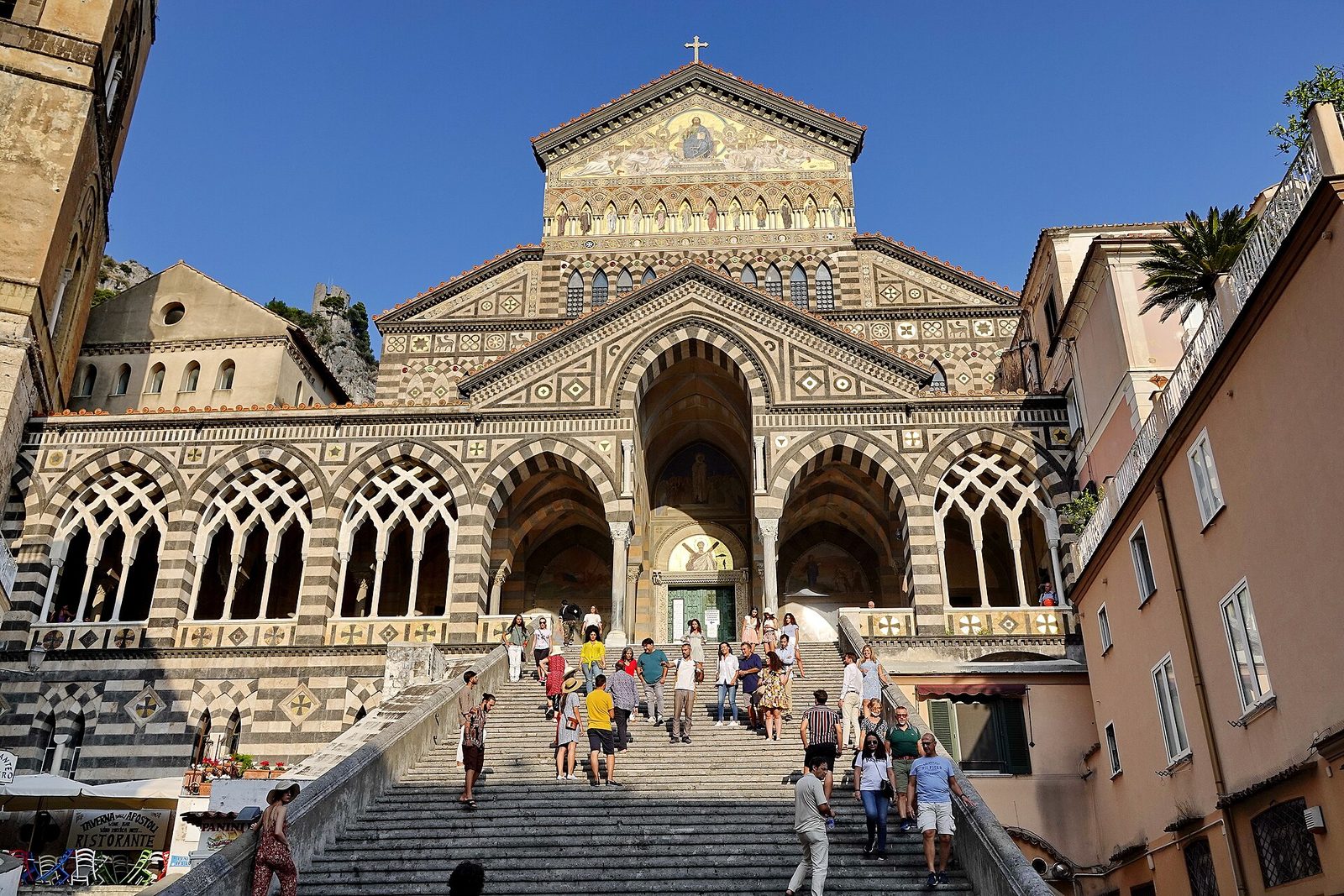
The town that gave the coast its name was once the capital of a powerful medieval maritime republic that rivaled Venice and Genoa. It’s still the hub of the coast: the main bus terminus and ferry port are here, which makes it a natural base for a day. Its great sight is the cathedral of Sant’Andrea, with its striped Arab-Norman facade and its steep stairway, and the adjoining Cloister of Paradise. Behind the town, the Valle delle Ferriere, a green valley with streams, waterfalls and the ruins of old paper mills, is a lovely short walk out of the crowds. Amalfi’s handmade paper, and its museum of paper-making, are a reminder of how old and important the town was.
Atrani
Atrani is the smallest town in southern Italy, just around the headland from Amalfi: a tiny piazza, a church, a beach and a warren of vaulted alleys and staircases. It’s five minutes’ walk from Amalfi through a pedestrian tunnel, and it feels a world away from the crowds. Have a coffee in the square.
Ravello
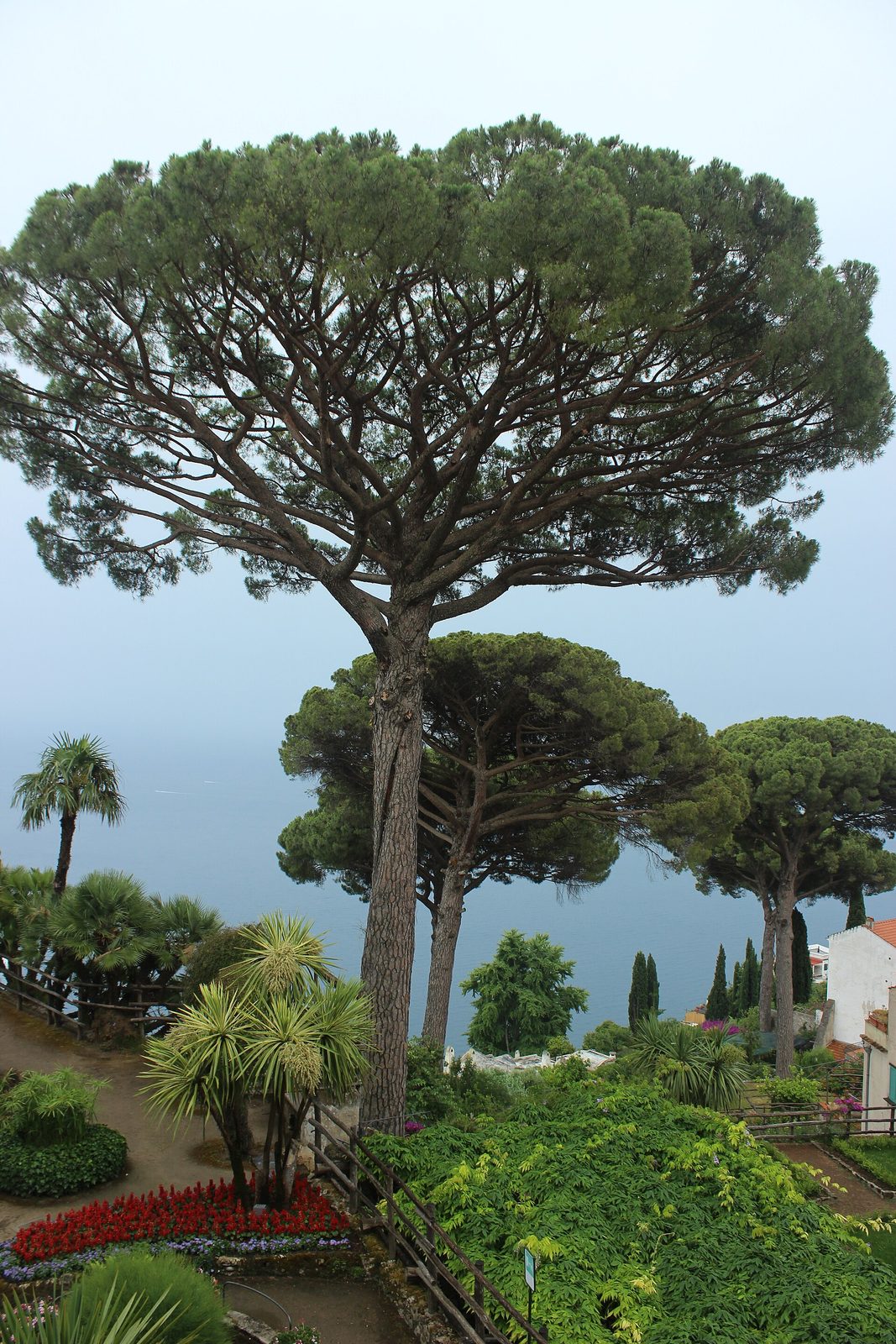
Ravello sits on a ridge some 350 meters above the sea, reached by a winding road from Amalfi, and it’s the most elegant place on the coast. Its gardens are the reason to come. Villa Rufolo, whose terraces inspired Wagner and now host the Ravello Festival’s summer concerts, looks down over the coast. Villa Cimbrone ends at the famous Terrace of Infinity, a belvedere lined with marble busts hanging over a sheer drop to the sea. Ravello is quieter than Positano or Amalfi and noticeably cooler in summer. For me, it’s the highlight of the coast.
Minori, Maiori, Cetara and Vietri sul Mare
The eastern end of the coast is less famous and more relaxed. Minori is a small, friendly town with a Roman villa and some of the best pastry on the coast. Maiori has the longest beach on the Amalfi Coast and is a practical, less expensive place to stay. Cetara is a fishing village famous for its tuna and its colatura di alici, an ancient anchovy sauce descended from the Roman garum. Vietri sul Mare, at the eastern gateway near Salerno, is the ceramics capital of the coast, with majolica tiles on every facade. All four are easy to reach from Salerno, and any of them makes a lovely lunch stop on Plan B.
Sorrento: not on the coast, but the gateway to it
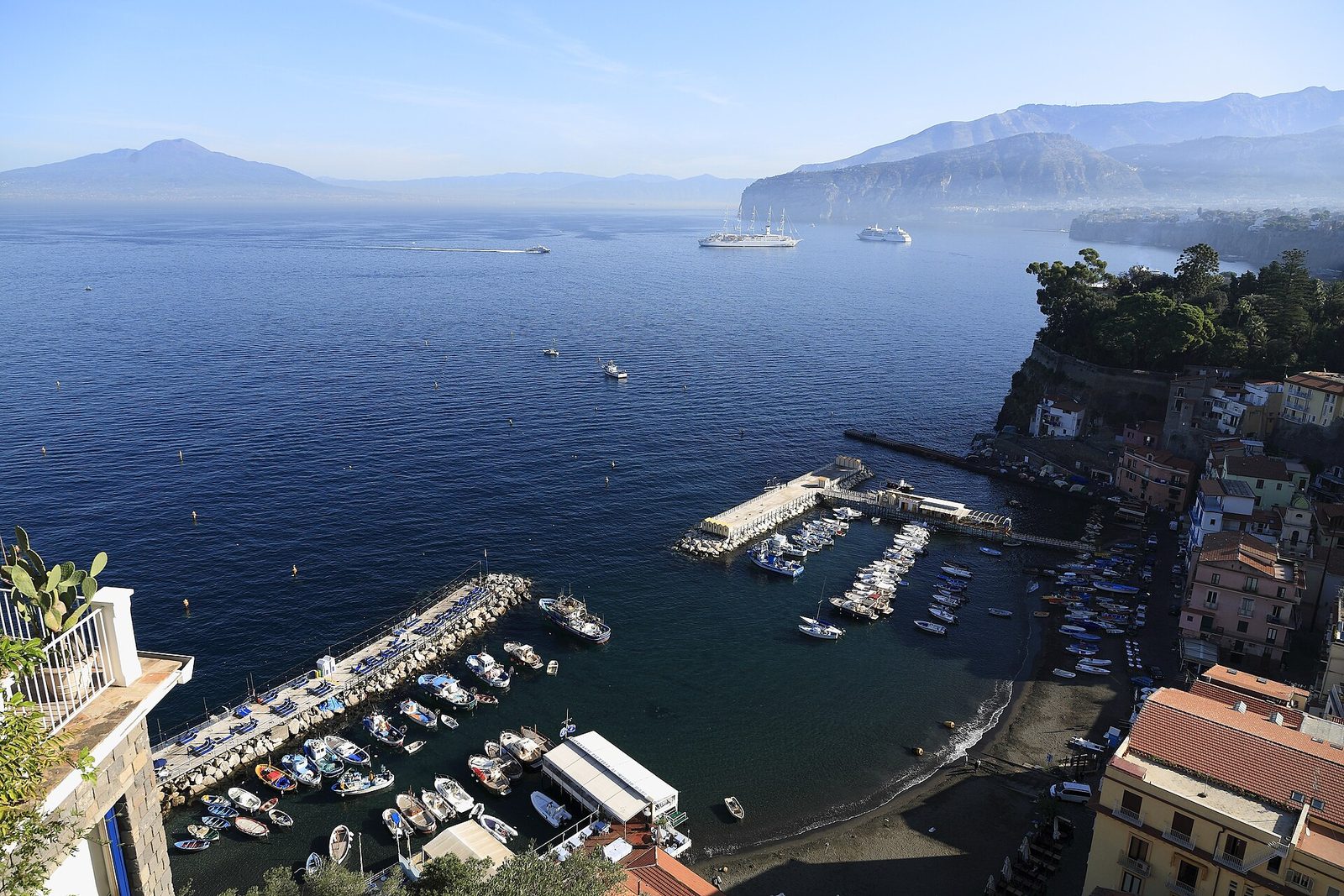
Sorrento sits on cliffs facing the Bay of Naples, on the north side of the peninsula, and the Amalfi Coast is on the other side of the mountains. But it’s the end of the Circumvesuviana line, the start of the SITA bus to Positano, and a port for ferries to Capri and the coast. Many travelers use it as a base for the whole region. It’s a pleasant, busy resort town with a lovely old center, and a very practical base if you want both the Amalfi Coast and Capri without the day-trip commute from Naples.
The Path of the Gods from Naples
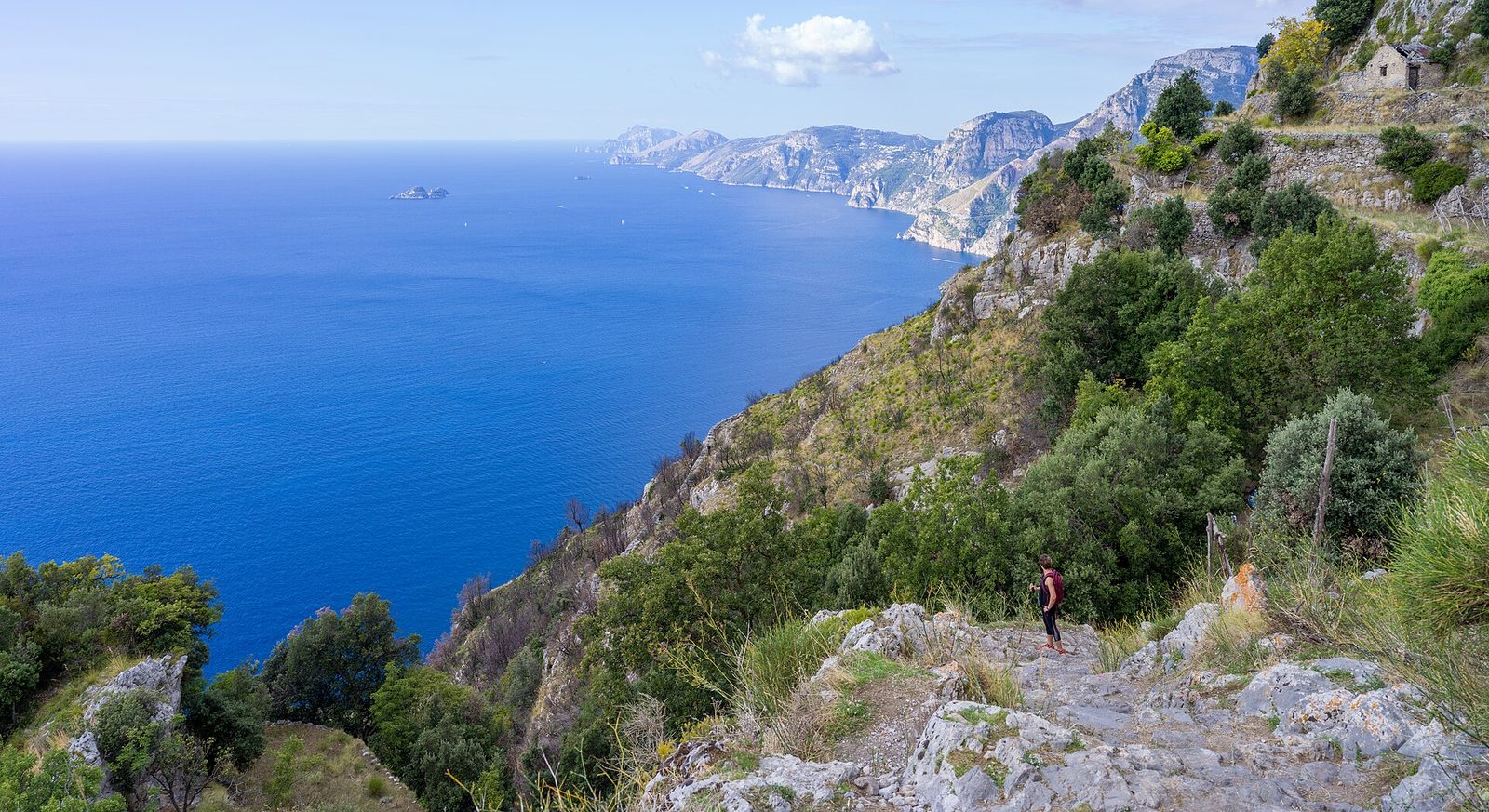
The Sentiero degli Dei (Path of the Gods) is the most famous walk on the Amalfi Coast, a high trail along the cliffs between Agerola and Positano with views over the whole coast and out to Capri. It’s not technically difficult, but it is long, rocky and exposed, and it ends with a very long staircase down to Positano. You need proper walking shoes, water, sun protection and a reasonable level of fitness.
How it works from Naples. The usual direction is east to west, starting from Bomerano, a village in the commune of Agerola, and ending in Positano. It’s mostly downhill that way, with the views ahead of you. From Naples, the easiest way to reach Bomerano is to get to Amalfi (by ferry in season, or via Salerno or Sorrento) and take the SITA bus up the mountain to Agerola. From Bomerano, the path runs along the cliffs to the hamlet of Nocelle, above Positano. Most people take between two and a half and four hours, depending on how often they stop for photos. From Nocelle, either walk down the long flight of steps to Positano, or take the local bus down. Then take the ferry back to Naples from Positano, if it’s still running, or the bus to Sorrento and the train.
It’s a big day from Naples, and a much easier one if you stay a night on the coast. Avoid it in rain, when the rocks are slippery, and in the heat of a summer afternoon, when there’s very little shade. Start as early as you can.

What it really costs
Here’s what a day trip to the Amalfi Coast from Naples costs one person, by route, based on 2026 fares checked in September 2026. Where I only have secondary sources, I’ve said so.
| Route | Getting there and back | Moving between towns | Rough day total, transport only |
|---|---|---|---|
| Ferry both ways | Around €30–32 each way from 2026 listings, so €60 or more return | Coastal ferries from around €10 a hop, or a €10 SITA 24-hour pass | About €70–85 |
| Ferry out, train and bus back | Around €30 out; bus plus Circumvesuviana back | €10 SITA 24-hour pass covers the bus legs | About €45–50 |
| Circumvesuviana + SITA both ways | €4–5 each way on the train (sources disagree) | €10 SITA 24-hour pass covers everything on the coast | About €18–20, the cheapest option |
| Campania Express + SITA (until October 1, 2026) | €25 return on the Campania Express | €10 SITA 24-hour pass | About €35 |
| Coach tour | Included | Included, usually with a boat leg on better tours | Varies widely by operator: compare what’s included |
| Private driver | A day rate per car, not per person | Included | Expensive for two, far more reasonable split among four |
| Driving yourself | Fuel and motorway tolls | Parking, which on the coast is scarce and among the priciest in Italy | Rarely cheaper, and far more stressful |
Then there are the costs that aren’t about transport. Food and drink on the Amalfi Coast, especially in Positano and on the main squares of Amalfi, cost noticeably more than in Naples. Sunbeds and umbrellas at the beach clubs are a real line item in high season. Positano’s local shuttle bus and the Ravello villas’ entry tickets add up too. Budget for a more expensive day than you’d spend in Naples, and bring cash for bus tickets and small purchases.
How to time the day
- Start early. The first ferry or the first bus from Sorrento gets you to the coast ahead of the day-trip wave, which peaks from late morning to mid-afternoon.
- Plan backwards from the last boat. If you’re relying on a ferry home, find the last direct departure from Positano or Amalfi to Naples before you leave, and aim to be at the pier half an hour early.
- Stay off the road in the middle of the day. Traffic on the SS163 is at its worst from late morning to late afternoon. If you’re traveling by bus, going early and coming back late is easier than traveling at midday.
- Check the sea and the date. Look at the forecast and the ferry company’s notices the evening before. If you’re driving, check whether the odd/even plate rule applies on your date.
- Keep a backup route home. If the ferry is cancelled, you can always get back by bus to Sorrento and the Circumvesuviana, or by bus to Salerno and the train. It just takes longer.
Staying on the coast instead
If you have the time, sleep on the coast. Positano is the most beautiful and most expensive base, and best for a romantic stay. Amalfi is the most practical, as the hub for buses and ferries. Ravello is the most peaceful and elegant, though it’s up the hill from the sea. Praiano, Minori and Maiori give you better value and a more local feel. Sorrento, just off the coast, is the easiest for combining the coast with Capri, Pompeii and Naples. For a week in the region, three or four nights in Naples and three on the coast is the split I’d recommend. My guide to where to stay in Naples, Italy covers the city half of that plan, and the Naples itinerary shows how the days fit together.
What to skip
- Driving the coast road on a day trip from Naples. Parking, traffic and plate restrictions make it the worst way to see the coast.
- Coach tours that promise Positano, Amalfi and Ravello in one day with no boat. You’ll see the road more than the towns.
- Combining Pompeii and the Amalfi Coast in a single day. Each deserves a day of its own. The Pompeii guide explains why even Pompeii alone fills one.
- Trying to see every town. Two towns, or one town and a walk, is the most a day allows.
- The Sorrento bus queue at midday in high season. Go early, take the ferry, or approach from Salerno.
- Relying on the last ferry on the day you fly home. The sea can cancel it.
- Assuming Sorrento is on the Amalfi Coast. It isn’t, and “Amalfi Coast” hotels in Sorrento are an hour or more by bus from Amalfi itself.
Frequently asked questions about the Amalfi Coast from Naples
Can you do the Amalfi Coast as a day trip from Naples?
Yes. In ferry season, a direct boat from Molo Beverello to Positano, then a coastal ferry to Amalfi and a boat back, makes an excellent day. Out of season, take the train to Salerno and the bus to Amalfi and Ravello. Expect three to five hours of travel in total, so choose two towns rather than trying to see the whole coast.
How do I get from Naples to Positano?
The easiest way is the direct ferry from Molo Beverello, about an hour and a half, running roughly April to October. All year, you can take the Circumvesuviana train to Sorrento (just over an hour), then the SITA bus to Positano, roughly another hour, depending on traffic.
Is the ferry or the bus better for the Amalfi Coast?
The ferry, when it’s running. It’s faster, more comfortable and far more beautiful, and it avoids the traffic and queues on the coast road. The bus is cheaper and runs all year, and it’s much more pleasant out of season, when it’s less crowded.
How much does it cost to get from Naples to the Amalfi Coast?
From 2026 listings, a direct ferry costs around €30 to Positano and from around €32 to Amalfi, one way. The cheapest route, the Circumvesuviana to Sorrento plus the SITA bus, costs about €18–20 return including a €10 24-hour bus pass. Coach tours and private drivers vary widely.
Is Sorrento on the Amalfi Coast?
No. Sorrento is on the north side of the Sorrento peninsula, facing the Bay of Naples. The Amalfi Coast is the south side, from Positano to Vietri sul Mare. Sorrento is the gateway, with buses and ferries to the coast, and a popular base, but it’s an hour or more from Amalfi by bus.
Should I rent a car for the Amalfi Coast?
Not for a day trip from Naples. The coast road is narrow and busy, parking is scarce and expensive, and on many days an odd/even number plate rule bars half of all non-resident cars between 10:00 and 18:00. A car only makes sense if you’re staying on the coast at a hotel with parking, and even then you’ll use buses and boats between towns.
Do ferries from Naples to the Amalfi Coast run in winter?
Direct ferries from Naples to Positano and Amalfi run roughly from April to October, with one or two operators continuing into early November. In winter, there’s very little or no direct service, so use the Circumvesuviana to Sorrento and the SITA bus, or the train to Salerno and the bus along the coast.
Can you visit Pompeii and the Amalfi Coast in one day?
You can, with a private driver or a tour, but I wouldn’t. Pompeii needs three to four hours at least, and the coast needs a full day to be enjoyed. Doing both in one day means rushing both. Give each its own day.
Which Amalfi Coast town is best for a day trip from Naples?
Positano is the most photogenic and the easiest to reach by direct ferry. Amalfi is the most practical, with Atrani and Ravello close by. If you only have one day and it’s ferry season, do Positano in the morning and Amalfi in the afternoon.
If you’re choosing between the coast and the island for a single day out, they’re very different trips. Capri is one short boat ride from Naples with no road involved, while the coast takes more planning. My Capri from Naples guide covers the island half of that decision.
If the coast feels like too much for one day, there are easier options. Sorrento, Procida, Herculaneum and the Reggia di Caserta are all simpler trips from the city. I compare every option side by side in my guide to day trips from Naples.
If the coast is the heart of your trip, it’s worth considering a few nights in Sorrento rather than commuting from Naples every day. The SITA buses to Positano leave from outside its station, and in season the boats go from its marina. My guide to Sorrento, Italy weighs up the town as a base, including the truth about its beaches.
The direct boats from Naples to Positano and Amalfi only run in season, roughly April to October, and they leave from Molo Beverello. The Naples ferry guide has the terminals, what happens when rough seas cancel the fast boats, and how to hop from Capri to the coast without going back through Naples.
Photo credits
- Positano above the Spiaggia Grande (featured image): photo by Mihael Grmek, Wikimedia Commons, CC BY-SA 4.0.
- Amalfi, Duomo di Sant’Andrea: photo by Luciano Tronati, Wikimedia Commons, CC BY-SA 4.0.
- The SS163 Amalfi Coast road: photo by Xocolatl, Wikimedia Commons, CC BY-SA 3.0.
- Path of the Gods panorama: photo by Wolfgang Moroder, Wikimedia Commons, CC BY-SA 3.0.
- Villa Rufolo, Ravello: photo by Miguel Hermoso Cuesta, Wikimedia Commons, CC BY-SA 3.0.
- Sorrento waterfront and Vesuvius: photo by Falk2, Wikimedia Commons, CC BY-SA 4.0.
- Hikers on the Path of the Gods: photo by Stiflele, Wikimedia Commons, CC BY-SA 4.0.
Sources: ferry routes and fares from 2026 operator timetables and booking listings (NLG, Alilauro, Travelmar, Positano Jet via ravello.com, positano.com and Ferryhopper); SITA SUD and Unico Costiera fares from 2026 listings; Circumvesuviana and Campania Express from EAV; odd/even plate rules from the 2026 ANAS ordinance as reported by the Distretto Turistico Costa d’Amalfi. All checked September 10, 2026. Ferry fares and timetables change through the season: confirm with the operator before you travel.