On this page
Last updated September 10, 2026. Ticket prices, opening hours, entry windows, gate names and bag rules checked against the Pompeii Archaeological Park’s official site; train details checked against EAV and Trenitalia. Where sources disagree, I say so below.
Getting to Pompeii from Naples, Italy is easy: take a Sorrento-bound Circumvesuviana train from Napoli Garibaldi to Pompei Scavi–Villa dei Misteri (about 35 minutes), walk a few minutes to the Porta Marina gate, and carry a named ticket booked on Vivaticket: €20 for Express, €25 for Pompeii+.
That’s the short version, and for most people it works. The long version is why this page exists. Pompeii is the reason a huge share of travelers come to this corner of Campania at all, and it’s also where a lot of them lose the most money and time. They buy a reseller ticket at close to double the official price. They board the wrong branch of the Circumvesuviana. They get off at the wrong station with “Pompei” in its name. They queue at the busiest gate at half past ten, just as three cruise groups arrive. And then they wander the ruins for four hours in the sun without finding the houses that make the place extraordinary.
What follows is how Pompeii actually works as of September 2026: which ticket, which train, which platform, which gate, what order to walk it in and what to leave out. Prices are dated and checked against the park’s own pages. Where sources genuinely conflict (the Circumvesuviana fare is the live example right now), I tell you that rather than pick a number and hope.
If Pompeii is one day of a longer stay, my overview of things to do in Naples, Italy puts it in context with the city itself, which deserves more of your time than most itineraries give it.
Pompeii from Naples at a glance: every way there, compared
Pompeii sits roughly 25 kilometers southeast of central Naples, on the far side of Vesuvius, between the volcano and the sea. There are really only two sensible ways to cover that distance on your own: the Circumvesuviana commuter railway, which runs from Naples to Sorrento and stops right outside the ruins, and a Trenitalia regional train to the modern town. Everything else is a variation on paying someone to drive you.
| Option | Journey time | Cost (checked September 2026) | Drops you at | My verdict |
|---|---|---|---|---|
| Circumvesuviana, Naples–Sorrento line | About 35–40 minutes | €3.30 one way per EAV’s app listings; some sources still quote €2.60 | Pompei Scavi–Villa dei Misteri, a few minutes from Porta Marina | The default. Cheap and frequent, but old and often crowded. |
| Campania Express (EAV tourist train) | About 30 minutes | €15 one way, €25 return | Pompei Scavi–Villa dei Misteri | A guaranteed seat on a handful of daily runs. Suspended from October 1, 2026. |
| Trenitalia regional train | Similar to the Circumvesuviana, fewer departures | A few euros; check trenitalia.com | Pompei station in the modern town, a 10–15 minute walk to Piazza Anfiteatro | Useful if you’re coming from Salerno or want the quiet east gate. |
| Organized tour from Naples | Half day to full day with transfers | Varies widely; check what the entry ticket inside it costs | Usually Porta Marina or Piazza Esedra | Worth it for a good guide, never just for the bus. |
| Taxi or private driver | 30–60 minutes, traffic-dependent | Expect a three-figure bill each way | Any gate | Only makes sense for a group sharing the cost, or for limited mobility. |
| Driving yourself | 30–60 minutes on the A3 | Motorway toll plus paid parking | Paid lots near Porta Marina and Piazza Anfiteatro | Not worth the stress if you’re starting in the city center. |
If you only read one line of this section: take the Circumvesuviana, buy a ticket to “Pompei Scavi,” make sure the train says Sorrento on the front, and get off after roughly 35 minutes. The rest of this page is detail that saves you from the mistakes people make around that one simple journey.
Pompeii tickets: which one to buy
The Pompeii Archaeological Park overhauled its ticketing in 2026. Two things changed that matter to you. First, official sales moved to Vivaticket in March 2026, and that’s the only online seller the park itself names. Second, tickets for Pompeii are now personal. Your name goes on the ticket and you may be asked for ID at the gate, so you can’t buy a stack of tickets and hand them out to strangers, and neither can a reseller.
Here are the current options, with prices as published by the park (in force since January 12, 2026):
| Ticket | Price (checked September 2026) | What it covers | Who it’s for |
|---|---|---|---|
| Pompeii Express | €20 | The ancient walled city only. The suburban villas are not included. | First-timers with three or four hours and no interest in the Villa of the Mysteries |
| Pompeii+ | €25 | The ancient city plus the suburban villas (Villa of the Mysteries, Villa of Diomedes) and Villa Regina at Boscoreale | Almost everyone. This is the one I’d buy. |
| 3-day pass | €30 | Pompeii+ plus Oplontis, Villa Arianna and Villa San Marco at Stabiae, the Stabiae archaeological museum, Boscoreale and the shuttle bus between sites, valid three days | Archaeology enthusiasts, and anyone based in Sorrento who’ll pass these sites anyway |
| Annual pass | €45 | All the park’s sites plus the shuttle bus for a year | Residents and serious repeat visitors |
| Under 18 | Free | Italy’s national rule for state museums and sites | Families: kids still need a ticket issued, just at zero cost |
| EU citizens aged 18–24 | €2 | Same access as the full ticket | Young EU travelers; bring ID |
| First Sunday of the month | Free | General admission | Budget travelers who can tolerate the busiest day of the month |
My honest take: buy Pompeii+. The extra €5 over Express gets you the Villa of the Mysteries, whose room of life-size red-ground frescoes is the single most memorable interior at Pompeii. I’d argue it’s the most striking painted room to survive from the ancient Roman world anywhere. It sits just outside the city walls, and it’s the one thing people most often regret missing because they bought the cheaper ticket without reading the small print. If you’re genuinely short on time and will only do the core of the city, Express is fine. Otherwise the upgrade is the best €5 you’ll spend in Campania.
The 20,000-a-day cap and the two entry windows
Pompeii now limits entries to 20,000 people a day. During the long-hours season (March 16 to October 14) that cap is split into two windows: a maximum of 15,000 admissions between 9:00 and 13:00, and a maximum of 5,000 between 13:00 and the 17:30 last entry. Your ticket is tied to a window, so pick the one you can actually make.
Two practical consequences. On busy days, particularly weekends, holidays and days when several cruise ships are in Naples and Sorrento, the morning window can sell out, so book as soon as your date is fixed. And the afternoon window, with only a third of the morning’s capacity, is noticeably calmer. If you’re in Naples in the warmer months and can stand a later start, entering around 14:00 and staying until closing gives you the ruins at their emptiest and the light at its best. The catch is heat: in high summer, early afternoon on the exposed streets of Pompeii is punishing, so bring more water than you think you need.
Opening hours
The park runs two timetables. From March 16 to October 14, Pompeii opens at 9:00, last entry is 17:30 and the site closes at 19:00. From October 15 to March 14, it opens at 9:00, last entry is 15:30 and closing is at 17:00. It’s closed on December 25 and January 1. The park has also started reducing access to some buildings from 18:00 in the long-hours season, so if there’s a specific house you care about, see it before then.
Because this page is published in September, note the switch: if your visit falls on or after October 15, you lose two hours at the end of the day. On a winter visit with a late arrival from Naples, that can squeeze a Pompeii+ itinerary uncomfortably, so aim to be through the gate by 10:00.
Is the free first Sunday worth it?
Entry is free on the first Sunday of every month. I’d skip it unless the saving genuinely matters to your budget. Free Sundays draw the biggest crowds of the month, including a lot of local families and school groups. The daily cap still applies, and the details of how free-Sunday entry is allocated have changed more than once in recent years, so check pompeiisites.org the week before rather than trusting an old blog post. For €25 on another day, you get a markedly better visit.
Where to buy, and where not to
Buy from Vivaticket’s official Pompeii page, or at the ticket offices and self-service kiosks at the gates. That’s it. Search results for “Pompeii tickets” are dominated by resellers, some of which quote three different prices on the same page and bundle “skip-the-line” access that means nothing when you already hold a timed ticket. Some are legitimate tour operators with a guide included, which can be worth it (more on that below). But if a page is selling you a bare entry ticket for more than the park charges, close the tab.
You’ll also meet men at Pompei Scavi station, sometimes with lanyards and official-looking badges, offering tickets, tours or directions to a “better entrance.” Politely ignore them. The real ticket offices are at the gates themselves, a few minutes’ walk away.
Does the Artecard make sense for Pompeii?
The Campania Artecard is the regional sightseeing pass, and the Campania 3 Days version (€41, checked September 2026) is one of only two Artecard options that include public transport, which covers the Circumvesuviana. Whether it beats paying separately depends entirely on how many paid sites you’ll actually enter in those three days. If Pompeii, Herculaneum and a couple of big Naples museums are on the list, it can pay off. If Pompeii is your only paid sight, it won’t. The current rules on which sites are free and which are discounted are on campaniartecard.it. Read them before you buy, because they change from year to year.
How to get to Pompeii from Naples by train
The train is how most people do it, and it’s how I’d do it. You need to know three things: where the Circumvesuviana actually leaves from, which train to board, and which station to get off at. Get those right and the whole trip is effortless.
The Circumvesuviana, step by step
The Circumvesuviana is the commuter railway run by EAV (Ente Autonomo Volturno, Campania’s regional transport company) that loops around the base of Vesuvius. It is not part of the national Trenitalia network, it doesn’t share its stations, and it doesn’t take Trenitalia tickets. This is the first place people go wrong.
1. Find the right station. In central Naples, the line calls at Napoli Garibaldi, which sits on the lower level beneath Napoli Centrale, the main railway station on Piazza Garibaldi. Follow the signs for the Circumvesuviana down from the main concourse. There’s no lift down to the platforms, only stairs and escalators, which matters if you’re hauling luggage. The line actually starts one stop earlier at Porta Nolana, a short walk away. Boarding there improves your odds of a seat considerably in high season.
2. Buy the right ticket. Ask for “Pompei Scavi” at the ticket office or select it on the machine. The fare is where sources disagree right now: EAV’s own app lists €3.30 one way from Naples, while several travel sites still quote €2.60 from an older tariff. EAV’s online tariff page was unreachable when I checked, so treat €3.30 as the working figure and confirm at the machine. EAV has also been introducing contactless ticket gates in 2026. If the gate reader accepts your bank card, that’s the easiest option, but keep a paper ticket as a fallback until the system beds in. Hold on to your ticket until you exit, because inspections do happen.
3. Board a train to Sorrento. This is the classic mistake. Several Circumvesuviana branches share the same tracks out of Naples, running to Sarno, Poggiomarino, Baiano and Sorrento, and only the Sorrento line stops at Pompei Scavi. Sorrento trains usually leave from platform 3 at Garibaldi, but check the departure board and the destination on the front of the train, not the platform number alone. If the board says Sarno, don’t get on it, however full the platform is. Trains run roughly every half hour through the day.
4. Get off at Pompei Scavi–Villa dei Misteri. It’s about 35 minutes from Garibaldi. The station name is long and announcements aren’t always audible, so count stops or watch for Torre Annunziata, the stop just before, where the sea comes into view. From Pompei Scavi, the Porta Marina and Piazza Esedra entrances are a few minutes’ walk away.
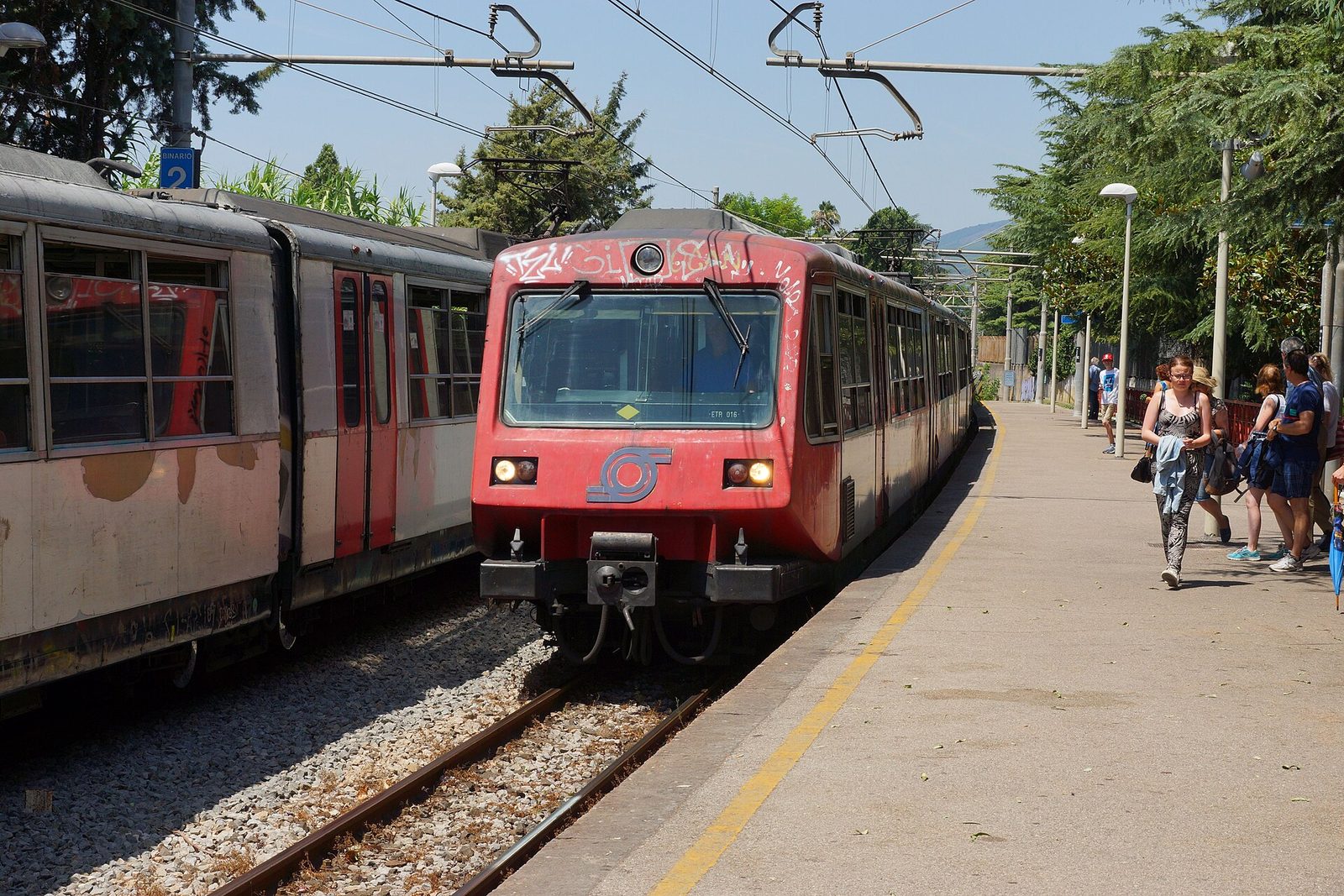
A word on the train itself, because first-timers are sometimes shocked by it. The Circumvesuviana is a working commuter line, not a tourist service. Many of the carriages are old, some are covered in graffiti, air conditioning is unreliable, and in summer the Sorrento trains fill up with suitcases and day-trippers. Pickpockets know this. Keep your bag in front of you and your phone out of your back pocket. None of this is a reason to avoid it. It’s simply what the train is, and it gets you from the center of Naples to the gate of Pompeii for the price of a coffee and a pastry.
Coming back, trains to Naples leave from the opposite platform at Pompei Scavi. Check the time of the last convenient return before you walk into the ruins, especially in the shorter winter season. The station empties out quickly once the park closes.
The Campania Express, until October 1, 2026
EAV also runs the Campania Express, a tourist train on the same line with reserved seating and only a few stops (Pompei Scavi among them). It costs €15 one way or €25 return, runs only a handful of times a day, and its selling point is simple: you’re guaranteed a seat and a calmer ride. EAV has announced that the service is suspended from October 1, 2026 “until further notice.” If you’re traveling before then and the idea of standing on a hot, packed commuter train with luggage fills you with dread, it’s a reasonable splurge. Otherwise the regular train does the same job at a fraction of the cost.
Trenitalia to the other Pompei station
Pompeii has a second railway station, simply called Pompei, on Trenitalia’s regional line from Naples toward Salerno. It’s in the modern town near the big Sanctuary of the Madonna of Pompei (the Santuario, a major pilgrimage church), and it’s a 10–15 minute walk to the Piazza Anfiteatro entrance at the eastern end of the ruins. Regional trains leave from the main upper level of Napoli Centrale, not the Circumvesuviana level below, and run less often than the Circumvesuviana. Fares and times are on trenitalia.com.
When is this better? If you’re coming from Salerno or the Amalfi Coast side, if the Circumvesuviana is on strike (it happens), or if you specifically want to start at the quiet eastern gate and walk the city in reverse. For a first visit from central Naples, I’d still take the Circumvesuviana.
Pompei, Pompeii, Pompei Scavi: the name trap
Here’s the confusion in one paragraph. In Italian, both the ancient city and the modern town are spelled Pompei, with one “i.” English uses Pompeii for the ruins. Scavi means “excavations.” So “Pompei Scavi–Villa dei Misteri” is the Circumvesuviana station for the excavations, beside the western gates, and “Pompei” is the Trenitalia station in the modern town, nearer the eastern gate. Both get you to the ruins. They’re on different railways, sold on different tickets, and they leave from different levels of the Naples station. If a train ticket just says “Pompei,” check which company issued it.
The three gates, and which one to use
The ancient city has three public entrances, and choosing the right one does more for your day than almost any other decision.
Porta Marina is the main entrance at the western end, a few minutes from the Circumvesuviana station. It’s named after the ancient sea gate: the coastline was much closer in AD 79. You walk up a steep, polished stone ramp through the original gateway and emerge moments later near the Forum, which is why almost every tour group uses it. It’s the most dramatic way in and, from mid-morning, the most crowded.
Piazza Esedra is close to Porta Marina and also near the station, and often has shorter lines for ticket checks. It feeds into the same western part of the city, so if Porta Marina is jammed, walk the extra few minutes.
Piazza Anfiteatro is at the far eastern end, beside the amphitheater, and closer to the modern town and the Trenitalia station. It’s usually the quietest gate. The trade-off is that you start at the “back” of the city and walk toward the Forum, against the flow of most visitors.
My advice: on a morning visit arriving by Circumvesuviana, use Porta Marina if you’re there at 9:00, and Piazza Esedra if you’re later. If crowds are what you dread most, take the Trenitalia train or walk 20 minutes along the outside of the walls and enter at Piazza Anfiteatro, then walk the route below in reverse. And whichever gate you enter by, you don’t need to leave by the same one. Plenty of people end at the amphitheater and walk out through Piazza Anfiteatro into the modern town for lunch.
How to see Pompeii properly: a route that works
The walled city covers roughly 66 hectares, and about two-thirds of it has been excavated. That is far more than anyone sees in a day, and far more than most people realize before they arrive. The biggest mistake visitors make isn’t the train or the ticket. It’s walking in without a plan and spending half their energy on streets of anonymous, roofless shops while the extraordinary houses stay on the map.
Individual houses open and close on rotation for restoration and staffing, so check the park’s list of currently open buildings on pompeiisites.org the night before, and pick up the site plan at the gate. With that caveat, this is the route I’d follow.
The essential loop: three to four hours (Express or Pompeii+)
- Porta Marina and the Antiquarium. Enter through the ancient gate. The Antiquarium near the entrance gives you useful context before you’re out in the sun.
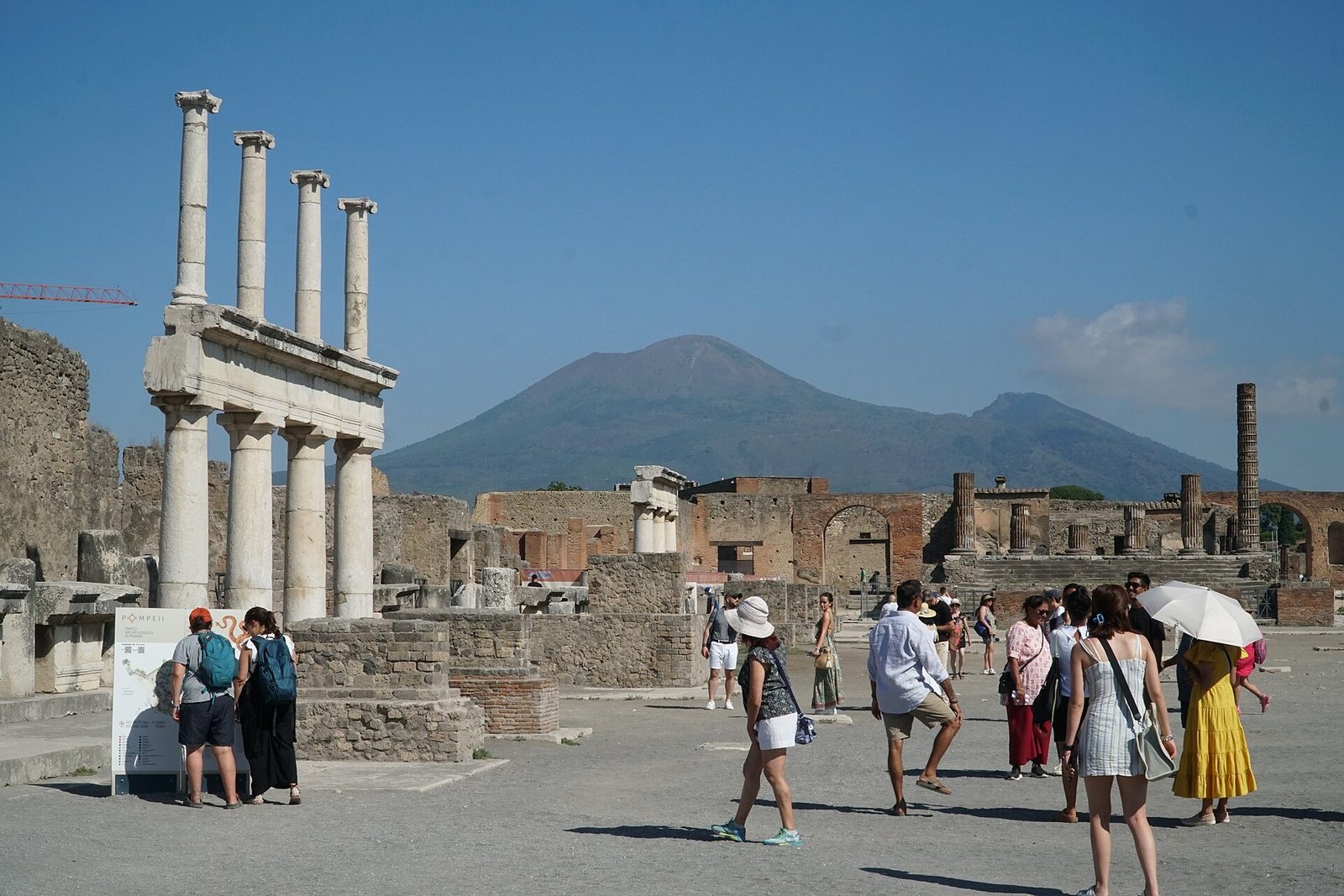
- The Forum. The civic heart of the city, with Vesuvius framed at its northern end. Stand at the southern end for the view everyone photographs, then walk its length.
- The Basilica and the Temple of Apollo. Right off the Forum. The Basilica was the law court and business hall, and the Temple of Apollo has copies of its bronze statues in place.
- The Forum Granary. Iron-barred storerooms along the Forum’s western side, stacked with amphorae and several of the plaster casts of victims. Most people walk past it. Don’t.
- The Forum Baths. A compact bathhouse with its original stucco ceilings and the telamon figures (male statues used as supports) holding up the cornice.
- The House of the Tragic Poet. Famous for the “Cave Canem” (beware of the dog) floor mosaic at its entrance.
- The House of the Faun. One of the largest private houses in the city, named after its bronze dancing faun. The Alexander Mosaic found here is now in the National Archaeological Museum in Naples, and a copy is in place. See the original in the city if you can, because it makes the house make sense.
- The House of the Vettii. Reopened in 2023 after some two decades of restoration, and for me the finest-decorated house in the city proper. It was owned by two freedmen made good, and the painted rooms show off.
- The Lupanar. The purpose-built brothel, with its small stone beds and faded erotic frescoes. It’s tiny and draws a queue. If the line snakes down the street, come back later rather than wait.
- The Stabian Baths. The oldest bath complex in the city, with changing rooms, plunge pools and a big exercise yard.
- The Great Theater and the Odeon. The large open-air theater and the small roofed one beside it, both remarkably intact. Sit for ten minutes in the shade.
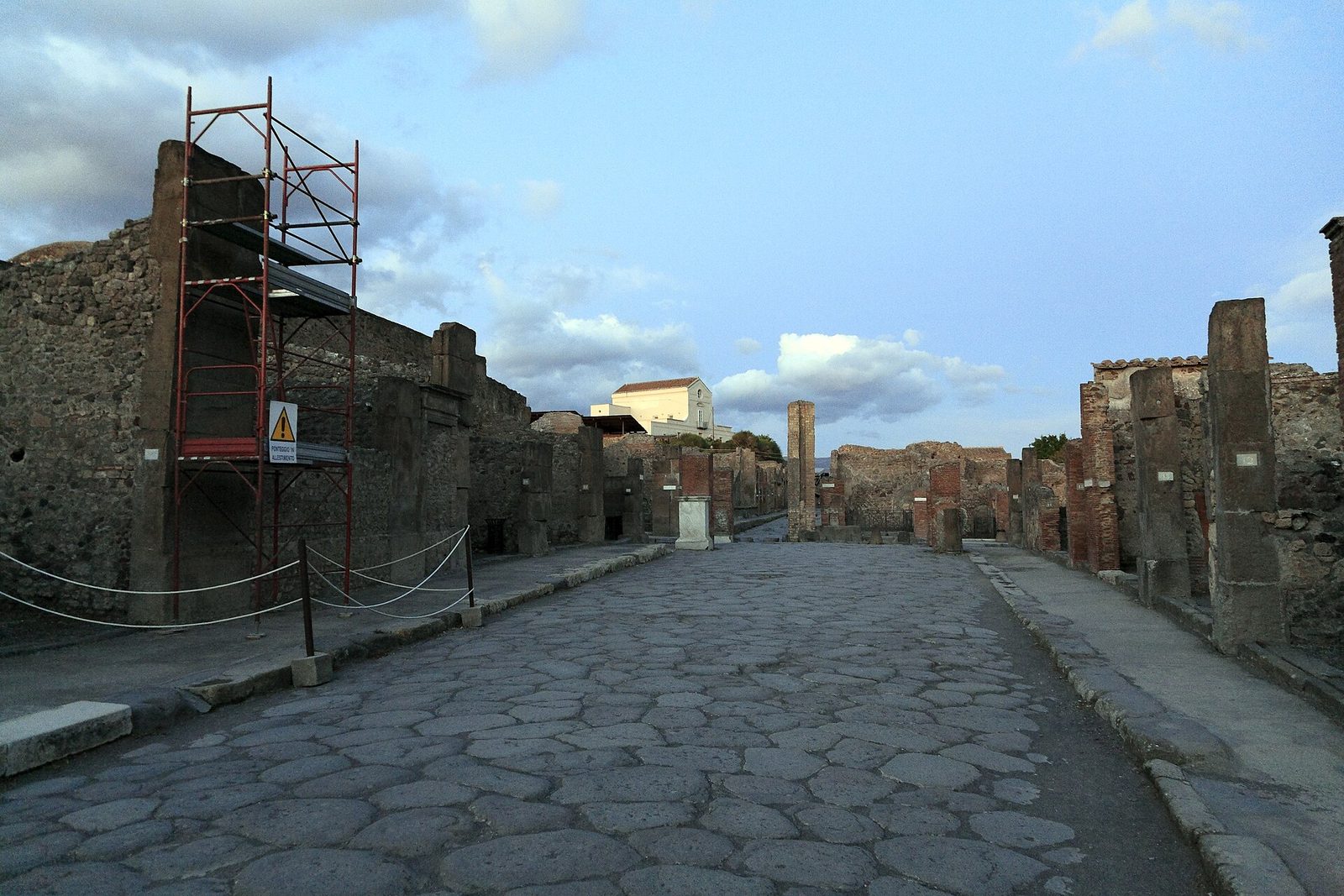
- Via dell’Abbondanza. The main east–west street. Walk it east past shopfronts, painted electoral slogans, stepping stones, cart ruts and the Thermopolium of Vetutius Placidus, a street-food counter with its terracotta jars still set into the bar.
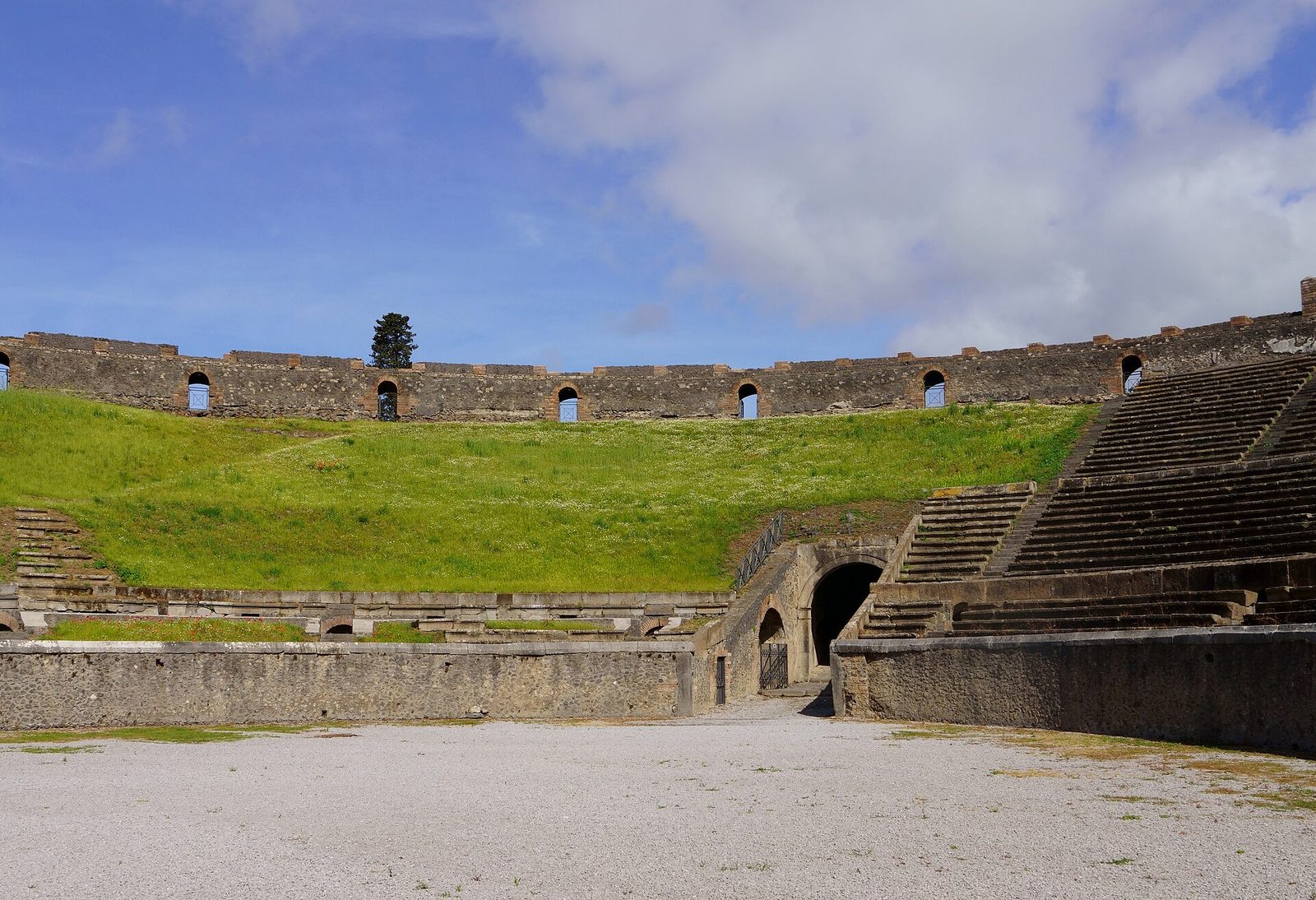
- The Amphitheater and the Great Palaestra. At the far eastern end. Built around 70 BC, it’s the oldest surviving stone amphitheater in the Roman world, and the huge palaestra (exercise ground) beside it is shaded by plane trees.
- The Garden of the Fugitives. A short detour south of the amphitheater: a former vineyard where the casts of a group of people who died trying to flee are displayed in the place they fell. It’s the most affecting stop in Pompeii, and far quieter than the Forum Granary.
Walked at a steady pace with short stops, that loop takes three to four hours. From the Garden of the Fugitives, leave through Piazza Anfiteatro into the modern town, or walk back west along the city walls if you’re heading for the Circumvesuviana.
Adding the Villa of the Mysteries (Pompeii+)
If you’ve bought Pompeii+, and I hope you have, fit the Villa of the Mysteries in either at the very start or at the very end. It lies beyond the northwestern gate, the Porta Ercolano, at the far end of the Via dei Sepolcri, a road lined with Roman tombs that’s worth the walk in itself. Allow 15 minutes to walk there from the Forum area and 30–45 minutes at the villa.
The reason to go is one room: a continuous frieze of life-size figures on a deep red ground, thought to show initiation into the cult of Dionysus. Scholars still argue about exactly what it depicts, which is part of its pull. The rest of the villa, a big working country house with a wine press, is interesting. That room is the one you’ll still be describing to people years later. Doing it first thing, while everyone else surges toward the Forum, is my preferred order. Start at Porta Marina, cut north to Porta Ercolano, see the villa, then walk back in and pick up the loop at the House of the Faun.
The Villa of Diomedes, near the Villa of the Mysteries on the same road, is included on the same ticket and takes 15 minutes. Villa Regina at Boscoreale, also on Pompeii+, is a separate small site a few kilometers north with a replanted Roman vineyard. It’s pleasant, but I wouldn’t make a special trip unless you have a car or the shuttle pass.
If you have a full day
With six hours or more, add the House of Menander, one of the grandest houses on Via dell’Abbondanza, with its own bath suite and fine frescoes. Add the Fullery of Stephanus, a working Roman laundry and cloth-finishing shop that’s one of the best windows on everyday work in the city. And add whichever of the recently excavated houses in Regio V (the northern sector where much of the newest digging has happened) the park has open that season. The finds there, including vividly painted rooms and another thermopolium, have been some of the most exciting archaeology in Italy in the last decade, and the park opens and rotates them as conservation allows.
Guided tour or on your own?
Pompeii is one of the few sites where I think a good guide genuinely changes the visit. It isn’t that you’ll get lost, although you might. It’s that a roofless house is mostly walls and floors until someone shows you where the dining couches stood, what the fresco style tells you about the owner’s ambitions, and where the graffiti on the plaster is a campaign slogan or a rude joke.
There are three ways to get that context:
- A guide hired at the site. Licensed guides work at the entrances. Agree the length, the route and the price before you start, and ask to see their license. A two-hour walk with a good one covers the loop above and leaves you free to explore after.
- A pre-booked small-group or private tour. The best option if you want certainty. Choose one that meets you at the site, not one that includes a coach from Naples, and check that the official entry ticket is either included at its real price or bought separately in your name, as the rules now require.
- Going independently with preparation. Perfectly satisfying if you’ve read up the night before and follow a route like the one above. The signage on site has improved, but it won’t explain much on its own.
What I wouldn’t do is book a full-day coach tour from Naples that promises Pompeii, a “lunch with a view” and Positano or Sorrento all in one day. You’ll spend more time on the bus than in the ruins, you’ll arrive at Porta Marina with every other coach, and you’ll get about 90 minutes inside a site that deserves at least three hours. If you want the Amalfi Coast too, give it its own day.
Practical survival: heat, water, shoes, bags and food
Pompeii is an outdoor site with very little shade, long distances and uneven ground. Most bad visits come down to bad preparation for those basics rather than anything to do with the ruins.
- Heat. The streets are stone, the walls reflect the sun, and trees are scarce outside a few gardens and the palaestra. In the hotter part of the year, a hat, sunscreen and a planned rest in the shade of the theaters make a huge difference. On the hottest days, the afternoon window is only a good idea if you can handle heat.
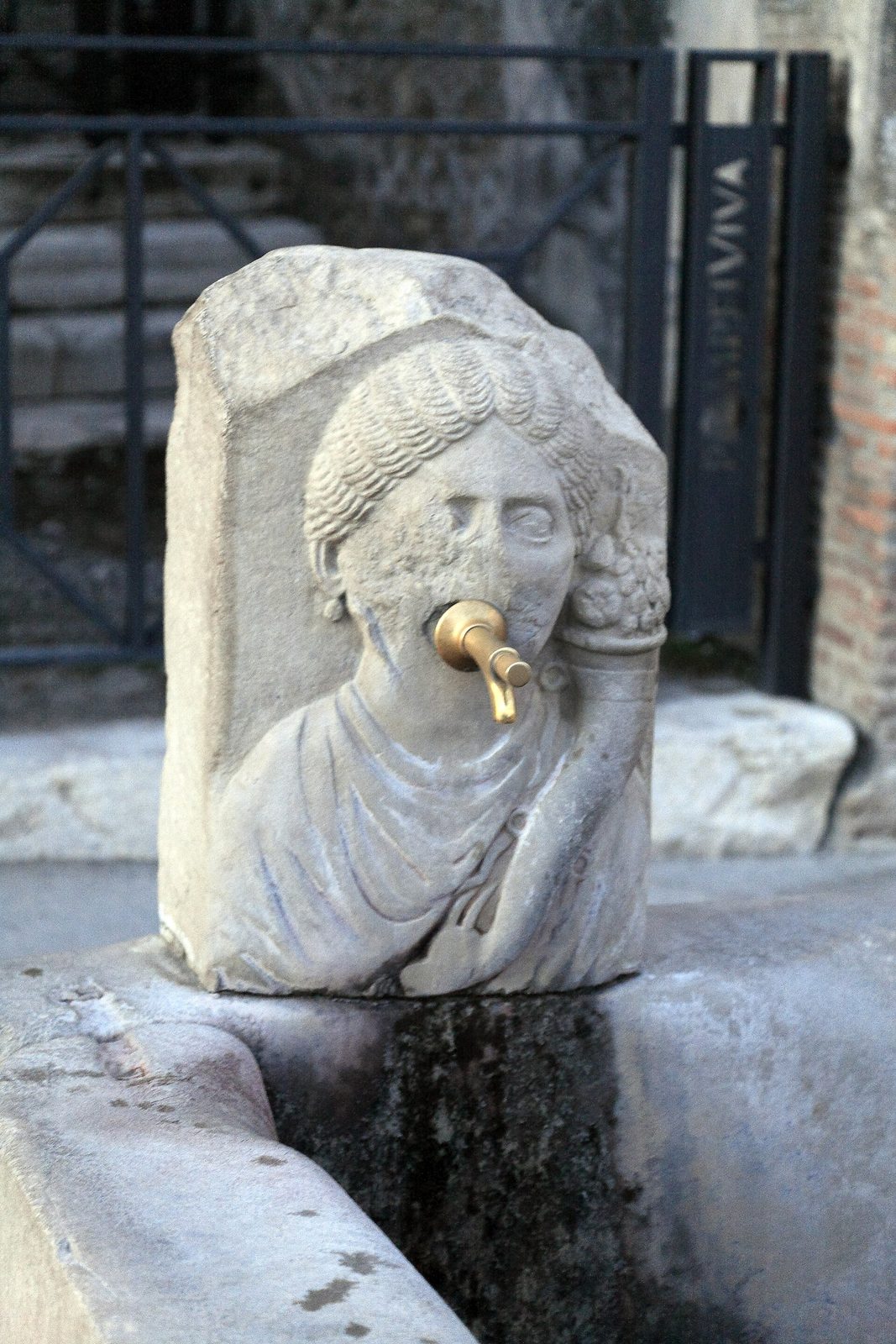
- Water. There are drinking fountains in the ruins, but don’t count on finding one when you need it. Carry at least a liter per person and refill whenever you pass a fountain.
- Shoes. Roman streets are paved with big polished basalt blocks, worn into ruts by carts, and crossed by high stepping stones. Wear shoes with real grip. Sandals with thin soles will ruin your feet by midday.
- Bags. The park admits only small bags, up to 30 × 30 × 15 centimeters. That rules out suitcases and big backpacks. If you’re traveling between Naples and Sorrento with luggage and stopping at Pompeii on the way, sort out luggage storage before you arrive at the gate rather than hoping for space on site.
- Food. There’s a cafeteria inside near the Forum, which is convenient and exactly as good as a monopoly cafeteria at a major site tends to be. Bring snacks, or plan to eat properly in the modern town after you exit, especially if you leave by Piazza Anfiteatro.
- Toilets. They’re at the entrances and near the cafeteria. Use them before you set off on the long walk east.
- Accessibility. The ancient streets are genuinely difficult for wheelchairs and strollers, with high curbs, stepping stones and ruts. The park has created a signposted step-free route through the city, called “Pompei per tutti” (Pompeii for everyone), with ramps and smoother surfaces that reach many of the main sights. Ask at the gate for the current map.
- Weather closures. Occasionally the park closes sectors after heavy storms or during regional weather alerts, and individual houses close for conservation. It’s rare for the whole site to shut, but check the news page before a long trip out.
Pairing Pompeii with Herculaneum, Vesuvius, Oplontis or Sorrento
Pompeii sits on the same railway line as a string of other big sights, which makes combining them tempting. Some combinations work well. Others turn a great day into an exhausting one.
Herculaneum. Ercolano Scavi, the station for Herculaneum, is on the same Circumvesuviana line, much closer to Naples. Herculaneum is smaller, more compact and far better preserved: two-story houses, carbonized wooden furniture, intact upper floors. It needs a separate ticket and about two to three hours. You can physically do both in a day, and plenty of people do. My advice is don’t, unless it’s your only chance. By the second site you’re tired, and one of them gets short-changed. If you must, do Herculaneum first in the morning, then Pompeii in the afternoon window.
Mount Vesuvius. The crater walk needs a timed ticket bought in advance (roughly €10–15 at the time of writing, checked September 2026). Slots are limited and sell out, and the path closes at short notice in high wind. Shuttle buses run up the volcano from the Pompeii and Herculaneum areas. Pompeii in the morning plus Vesuvius in the afternoon is a classic combination that works, provided your Vesuvius slot is booked and you have a plan B if the wind closes the summit.
Oplontis. Two stops back toward Naples at Torre Annunziata, the Villa of Poppaea at Oplontis is an enormous, lavishly frescoed seaside villa thought to have belonged to Nero’s wife. It’s covered by the 3-day pass and is usually very quiet, making it a lovely add-on for anyone who’s already been to Pompeii or who wants a less crowded experience of Roman painting.
Sorrento. If you’re heading on to Sorrento, Pompeii is a natural stop: stay on the same Circumvesuviana line for roughly another half hour. The only problem is luggage, given the small-bags rule. For many travelers based in Sorrento, Pompeii is actually an easier day trip than it is from Naples.
What to skip
Honesty is more useful here than enthusiasm, so this is what I’d leave out.
- Reseller “skip-the-line” entry tickets. Pompeii tickets are timed and in your name. There’s no line to skip beyond the security check everyone goes through. Buy on Vivaticket or at the gate.
- Station touts. Anyone approaching you at Pompei Scavi station with tickets, maps or tours is not the park. Walk on to the gate.
- Coach tours that cram Pompeii and the Amalfi Coast into one day. Too long on the road, too little time in the ruins.
- Arriving between 10:30 and noon via Porta Marina. It’s the peak of the tour-group wave. Arrive at 9:00, or come in the afternoon window.
- The free first Sunday, unless the saving really matters to you. It’s the busiest day of the month.
- Trying to see everything. You can’t, and trying makes the day worse. A focused route plus one or two personal choices beats a forced march.
- The Express ticket, for most people. Unless you’re certain you won’t walk out to the Villa of the Mysteries, the €5 difference is the best value in the park.
- Waiting in the Lupanar queue at its peak. Come back to it later. It’s a tiny building and the line moves slowly.
- The Sarno train. It doesn’t go to Pompeii. Read the front of the train.
Frequently asked questions about Pompeii from Naples
How long does it take to get to Pompeii from Naples?
About 35–40 minutes on the Circumvesuviana from Napoli Garibaldi to Pompei Scavi–Villa dei Misteri, plus a few minutes’ walk to the Porta Marina gate. Allow an hour door to door from a central Naples hotel, including getting to the station and buying a ticket. Driving takes 30–60 minutes depending on traffic.
How much does it cost to visit Pompeii?
As of September 2026, Pompeii Express costs €20 (ancient city only) and Pompeii+ costs €25 (city plus the Villa of the Mysteries and other suburban villas). A 3-day pass covering the wider park is €30. Under-18s enter free, EU citizens aged 18–24 pay €2, and entry is free on the first Sunday of the month. Add around €3.30 each way for the train.
Do I need to book Pompeii tickets in advance?
You can still buy at the gate, but I’d book ahead on Vivaticket. Pompeii now caps entries at 20,000 a day, split between a morning window (up to 15,000) and an afternoon window (up to 5,000) during the long-hours season. On busy days the morning can sell out. Tickets are personal, so bring the ID matching the name on yours.
Which station do I get off at for Pompeii?
Get off at Pompei Scavi–Villa dei Misteri on the Circumvesuviana’s Naples–Sorrento line, a few minutes’ walk from the Porta Marina and Piazza Esedra gates. The Trenitalia station called simply “Pompei” is in the modern town, 10–15 minutes’ walk from the Piazza Anfiteatro gate. Both work, but they’re on different railways with different tickets.
Is Pompeii worth a day trip from Naples?
Yes, without hesitation. It’s the most complete picture of an ordinary Roman town anywhere, and it’s easy to reach by train in well under an hour. The key is doing it properly: a Pompeii+ ticket, an early or afternoon entry, a planned route that includes the House of the Vettii, the Villa of the Mysteries and the Garden of the Fugitives, and enough water.
How many hours do you need at Pompeii?
Plan on three to four hours for the essential loop of the city, and five to six if you add the Villa of the Mysteries and a few extra houses. Serious enthusiasts can fill a whole day and still not see everything. Less than two and a half hours means rushing past the best houses.
Can you visit Pompeii and Vesuvius in one day?
Yes, and it’s a popular combination: Pompeii in the morning, then a shuttle bus up Vesuvius for an afternoon crater slot. Book the Vesuvius ticket in advance, because slots are limited and sell out, and keep a backup plan, since the summit path closes at short notice in high wind.
Is the Circumvesuviana safe?
Yes. It’s a busy commuter railway used by thousands of locals every day. It can be crowded, hot and scruffy, and pickpocketing on packed trains is the real risk, so keep your bag in front and your phone out of your back pocket. Travel in daylight and check the last return train before you enter the ruins.
Is Pompeii free on the first Sunday of the month?
Yes, general admission is free on the first Sunday of every month. It’s also the busiest day of the month, and the daily cap still applies. The arrangements for free-Sunday entry have changed more than once, so check the official Pompeii Archaeological Park site the week before you go.
If you’re pairing the ruins with the volcano that buried them, book the crater first. Vesuvius sells timed tickets online only, in small slots released 30 days ahead, and the summit path shuts at short notice in high wind. My Mount Vesuvius guide covers the tickets, the shuttle up from Ercolano and what happens if the wind closes the mountain.
One ticket warning before you head for the station: the integrated city ticket stops at the Naples city limits, so it won’t get you to Pompeii. You need a separate EAV fare for the Circumvesuviana. My guide to getting around Naples, Italy explains which ticket covers what, including the contactless gates at Garibaldi and Pompei Scavi.
One piece of sequencing advice: visit the National Archaeological Museum in Naples before you come here, not after. Almost everything portable, from the frescoes to the bronzes and the carbonized bread, was carried out of these houses to the museum, and seeing it first fills the empty rooms in your head. My guide to the museums of Naples explains what’s on view there right now.
If Pompeii’s size and crowds sound daunting, or you’re visiting in high summer, consider Herculaneum instead, or as well. It was buried by the same eruption but preserved better, with upper floors, wooden furniture and a beach full of skeletons, and you can see it in two or three hours. My Herculaneum guide compares the two and covers the quiet villas at Oplontis and Stabiae.
If you’re weighing a guided tour against doing Pompeii alone, the cheapest good option is usually to take the train and join a small-group tour that meets at the site. The Naples tours guide explains how to spot a licensed guide, what to check about the ticket a tour includes, and when a full-day coach tour makes sense.
Photo credits
- The Forum at Pompeii with Vesuvius: photo by Adam Harangozó, Wikimedia Commons, CC BY-SA 4.0.
- Circumvesuviana train at Pompei Scavi: photo by Chris Sampson, Wikimedia Commons, CC BY 2.0.
- Via dell’Abbondanza, Pompeii: photo by Falk2, Wikimedia Commons, CC BY-SA 4.0.
- The amphitheater at Pompeii: photo by Commonists, Wikimedia Commons, CC BY-SA 4.0.
- Street fountain on Via dell’Abbondanza: photo by Falk2, Wikimedia Commons, CC BY-SA 4.0.
Sources: Pompeii Archaeological Park, pompeiisites.org (timetables, tickets, entry caps, gates and visitor rules, checked September 10, 2026); Vivaticket official Pompeii sales; EAV (Circumvesuviana and Campania Express; the fare is cross-checked against EAV app listings because EAV’s tariff page was unavailable on September 10, 2026); Trenitalia; Campania Artecard. Prices change: confirm on the official sites before you travel.