On this page
Last updated September 16, 2026. Port and ferry status checked against 2026 reporting on the Campi Flegrei earthquakes; thermal park seasons and castle details against 2026 visitor listings, flagged where I couldn’t confirm them with the operator. Ferry timetables change by season, so I describe the options rather than print a schedule.
Ischia, Italy is the largest island in the Bay of Naples, about an hour from Naples, Italy by hydrofoil. It’s famous for thermal spa parks, the Aragonese Castle, beaches like Maronti and the car-free village of Sant’Angelo. It’s six times the size of Capri, so it deserves a stay of at least two nights rather than a rushed day trip.
Ischia gets far less attention in English than Capri, and I think that’s a gift to anyone who goes. It’s a green, volcanic island of vineyards, pine woods, hot springs and fishing villages, with a mountain in the middle, a medieval castle on a rock, and more thermal spa parks than anywhere else in Italy. Italians and Germans have been coming here for the waters for generations. Most American visitors either skip it or try to squeeze it into a day from Naples, and then wonder what the fuss was about.
This guide makes the honest case for Ischia: what it’s like, how it compares with Capri and Procida, why it rewards a stay rather than a day, how to get there and around, which towns to base yourself in, how to choose a thermal park, where the best beaches and free hot springs are, and what I’d skip.
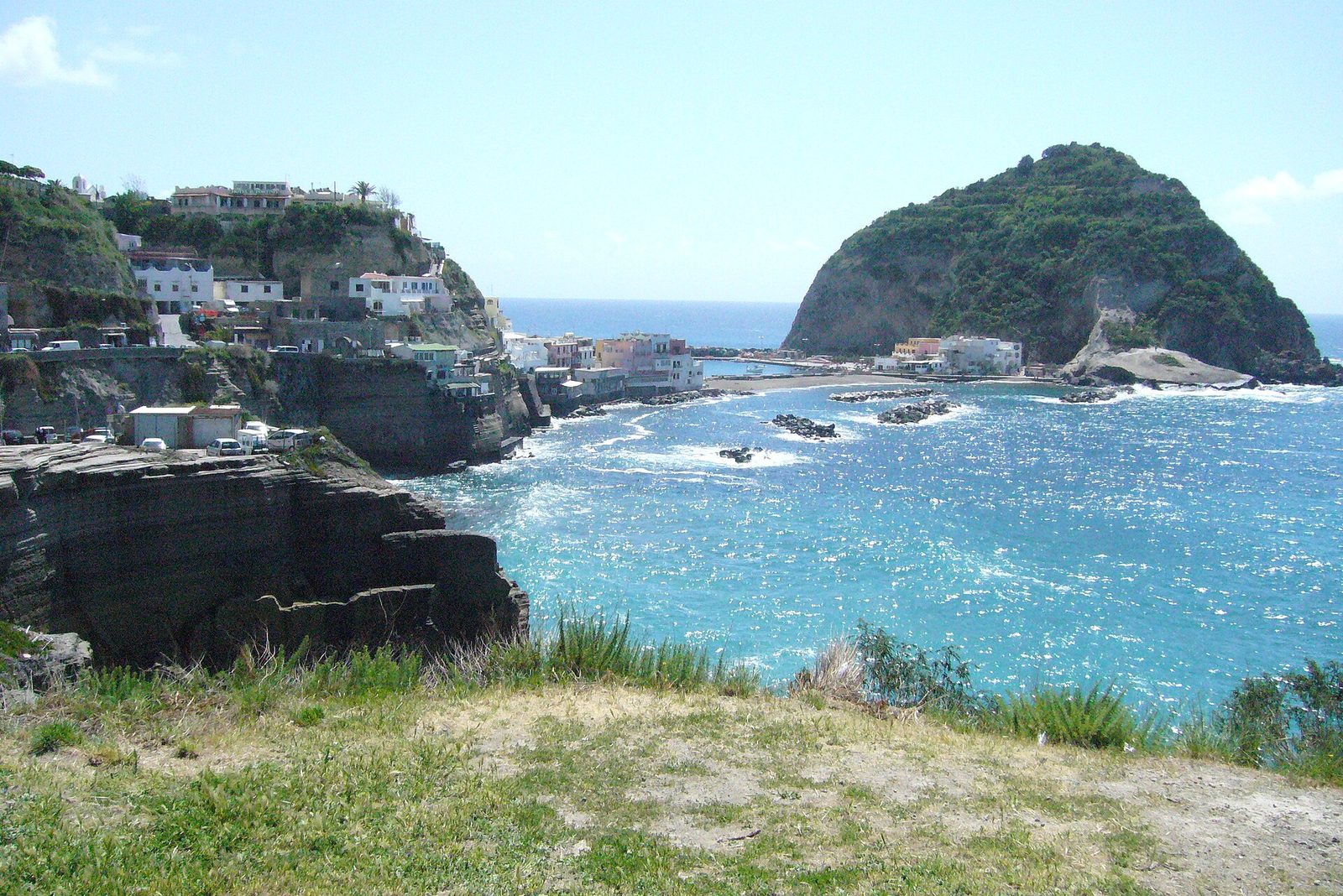
Ischia at a glance
| Question | Short answer (checked September 2026) | What catches people out |
|---|---|---|
| Where is it? | At the northwestern edge of the Bay of Naples, about 30 km from the city | Confusing it with smaller, closer Procida |
| How big? | About 46 square kilometers, with six towns and a mountain in the middle | Assuming you can see it all in a day |
| How do I get there? | Hydrofoil or ferry from Naples; ferries also from Pozzuoli | Going to the wrong Naples pier |
| How do I get around? | Island buses, taxis, scooters, boats | Buses crowded in summer; distances longer than they look |
| Why go? | Thermal spas, beaches, walking, food, a slower pace than Capri | Expecting Capri’s glamour |
| Best-known sights | Castello Aragonese, Sant’Angelo, Maronti beach, Mount Epomeo, La Mortella gardens | Some sights and spa parks are seasonal |
| How long? | At least two nights to enjoy it | A day trip mostly on boats and buses |
Why Ischia needs more than a day
I’m usually happy to recommend day trips from Naples. Ischia is the exception, and here’s the arithmetic. Getting from central Naples to Ischia takes around an hour on a fast boat, longer on a ferry, plus the time to reach the port and wait for departure. Once you land, the most interesting places, Sant’Angelo, Maronti, Sorgeto and the big thermal parks, are on the far side of the island, often another 30 to 45 minutes by bus in summer traffic. Then you have to leave time to get back for the last convenient boat.
On a day trip, you might get three or four hours actually doing anything, and you’ll spend much of the rest on buses. What makes Ischia special is precisely what a day trip can’t give you: a slow morning in a thermal park, an afternoon on the beach, a sunset aperitivo in Forio, dinner in Sant’Angelo after the day visitors have gone, and a warm evening soak in natural hot springs.
If you only have a single spare day in Naples and want an island, Capri is smaller, more concentrated and better suited to a day trip, and Procida, the closest island to Naples, is small enough to enjoy in a day too. Save Ischia for when you can stay.
Ischia, Capri or Procida?
| Ischia | Capri | Procida | |
|---|---|---|---|
| Character | Green, volcanic, spa island; relaxed and family-friendly | Glamorous, dramatic cliffs, designer shops | Tiny, colorful fishing island, very local |
| Size | The biggest by far | About a sixth of Ischia | The smallest |
| Best for | Stays of several days, spas, beaches, walking, families | A spectacular day trip or a luxury stay | A quiet, photogenic day or a peaceful stay |
| Beaches | The best of the three, including long sandy ones | Mostly rocks and bathing clubs | A few small beaches |
| Crowds | Busy in August, but spread out | Very crowded in summer | Busy on summer weekends, calm otherwise |
| Price level | Moderate, with a wide range | Expensive | Moderate |
| Works as a day trip? | Not really | Yes | Yes |
Getting to Ischia
Ischia is served by fast hydrofoils and slower car ferries. The detailed timetables, operators and fares belong in my ferry guide, so here’s what you need to plan.
From Naples
Naples has two departure points about a kilometer apart, and it matters which one you want. Molo Beverello, by Piazza Municipio, is where the hydrofoils and fast jets leave; the crossing takes roughly an hour. Calata Porta di Massa, further east along the port, is where the slower car ferries leave, taking longer but usually costing less, with more room for luggage and the option of sitting outside on deck. Check the pier on your ticket. From the airport, the Alibus stops at both.
From Pozzuoli
Pozzuoli, west of Naples, offers a shorter crossing to Ischia and Procida, and it’s popular with locals. Its port was affected by the strong Campi Flegrei earthquake on July 31, 2026. According to local reporting, passenger ferry connections resumed in early August, but restrictions on heavy vehicles using the port road were still being worked out in September, with a target date in October. If you’re planning to sail from Pozzuoli, confirm the current situation with the ferry company close to your travel date.
Which Ischia port?
Boats arrive at three harbors on the island: Ischia Porto, the main port, on the northeast coast; Casamicciola Terme, a little to the west; and Forio, on the west coast, served by fewer, mostly seasonal, services. Choose the one closest to your accommodation. Ferries also connect Ischia with Procida, and in the warmer months with Capri, Sorrento and the Amalfi Coast.
Bringing a car
Don’t, unless you’re staying for a long time in a remote villa. The island’s roads are narrow and congested in summer, parking is difficult, and restrictions on bringing vehicles to the island during the busy season have applied in recent years. Buses, taxis and scooters cover everything most visitors need.
Getting around Ischia
Ischia’s roads form a ring around the island, with a few branches climbing to the hill villages and down to the coast. The main options are:
- Buses. Run by EAV, with two circular lines, the CD clockwise and the CS counterclockwise, looping around the whole island, plus lines connecting the port with the main towns. They’re cheap and frequent but can be very crowded in July and August, and journeys take longer than the map suggests. Buy tickets before boarding at tabacchi and bars, and validate them.
- Taxis. Ischia’s taxis include regular cars and the island’s famous microtaxi, small three-wheeled vehicles that squeeze through narrow streets. Agree the price before you set off.
- Scooters. The most flexible way to explore if you’re confident on two wheels. Rentals are available in all the main towns. Traffic is busy in summer, and helmets are compulsory.
- Boats and water taxis. Water taxis link Sant’Angelo with Maronti beach and other coves, and boat trips around the island leave from the main harbors.
- Walking. Ischia has a network of footpaths through the hills and around Mount Epomeo, a lovely way to see the island’s interior.
A short history of Ischia
Ischia has been a destination for almost three thousand years. In the 8th century BC, Greek settlers from Euboea founded Pithecusae at what is now Lacco Ameno, the earliest Greek settlement in the western Mediterranean and a trading post between the Greek world and the peoples of Italy. The Romans knew the island as Aenaria and prized its springs.
The island’s volcanic history has shaped it throughout. Its last eruption, in 1302, sent a lava flow, the Arso, down toward the east coast and drove many inhabitants to the mainland for years. In the centuries that followed, pirate raids forced islanders to take refuge behind the walls of the castle and in the hill villages, and watchtowers still stand along the coast.
Ischia’s reputation as a spa island grew from the 18th and 19th centuries, when doctors began prescribing its waters and the Bourbon kings opened the crater lake at Ischia Porto to the sea to create a harbor. Visitors came for their health, including Giuseppe Garibaldi, who recovered from a war wound at Casamicciola, and the playwright Henrik Ibsen, who worked on Peer Gynt during a stay on the island. The 1883 earthquake that destroyed Casamicciola was a terrible blow to that first spa age.
The island’s modern revival came after the Second World War. The poet W. H. Auden spent summers in Forio for about a decade, drawing writers and artists after him, and in the 1950s Angelo Rizzoli turned Lacco Ameno into a luxury resort that attracted film stars. Ischia has been one of Italy’s favorite holiday islands ever since, with a loyal following among Italian and German visitors in particular.
The six towns of Ischia
The island is divided into six municipalities, each with its own feel. Where you stay shapes your whole trip, so it’s worth understanding them.
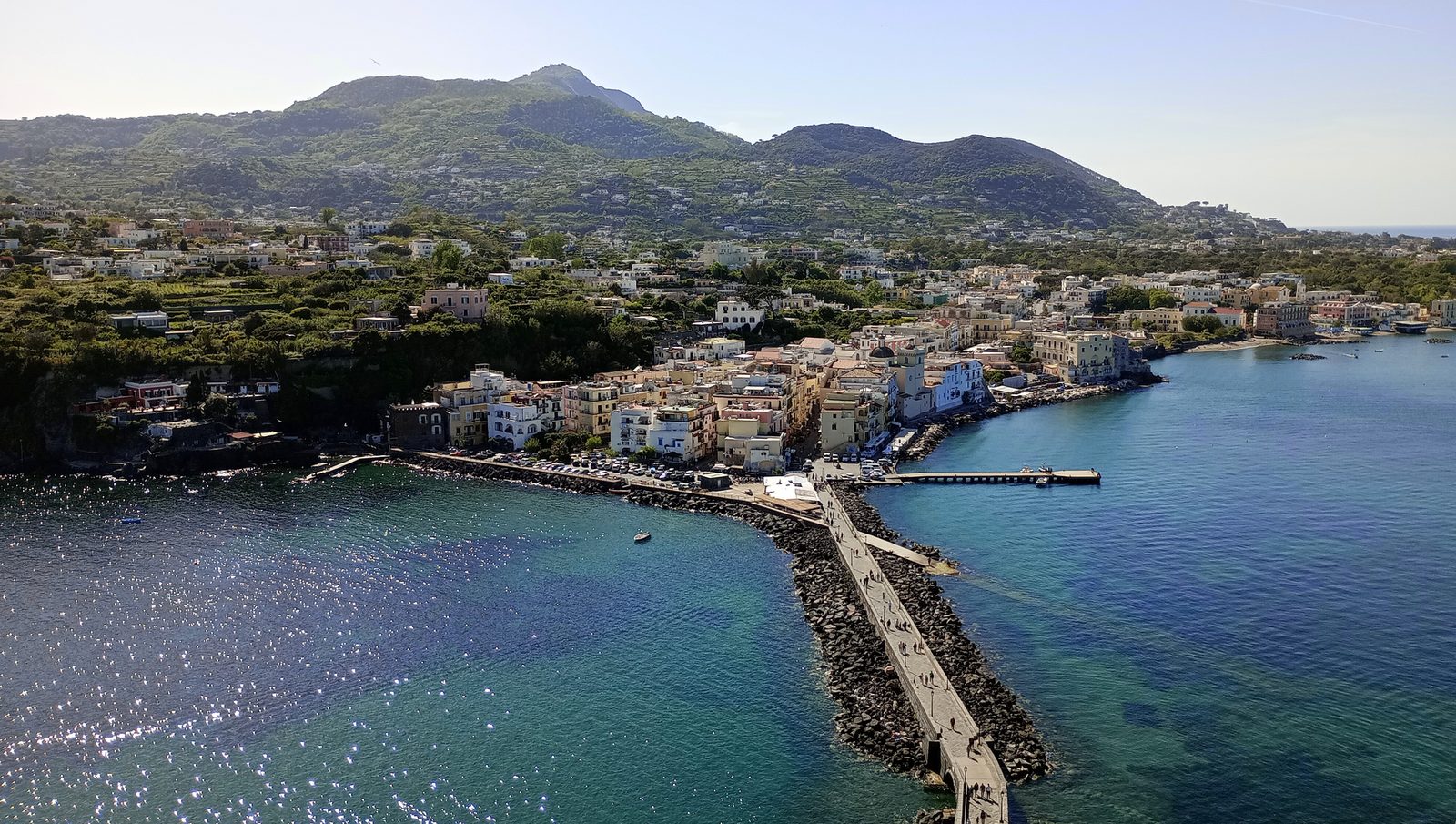
Ischia (Ischia Porto and Ischia Ponte)
The island’s largest town has two halves. Ischia Porto grew up around the main harbor, a round basin created in the 19th century when the Bourbon kings opened a volcanic crater lake to the sea. It’s the busiest part of the island, with hotels, restaurants, shops, spa hotels and a long pedestrian shopping street. Ischia Ponte, a pleasant walk away along the seafront, is the older fishing quarter, with narrow lanes, a small beach and the causeway to the Aragonese Castle. For first-time visitors without a car, this area is the most convenient base.
Casamicciola Terme
Just west of Ischia Porto, Casamicciola has been a spa town for centuries, and its thermal hotels made it one of the first resorts on the island. It’s also a town that has suffered: it was devastated by an earthquake in 1883, hit by another in 2017, and struck by a deadly landslide in November 2022. It remains a working town with a ferry port and spa establishments, and recovery continues. I’d choose somewhere else as a holiday base, but it’s worth understanding its story.
Lacco Ameno
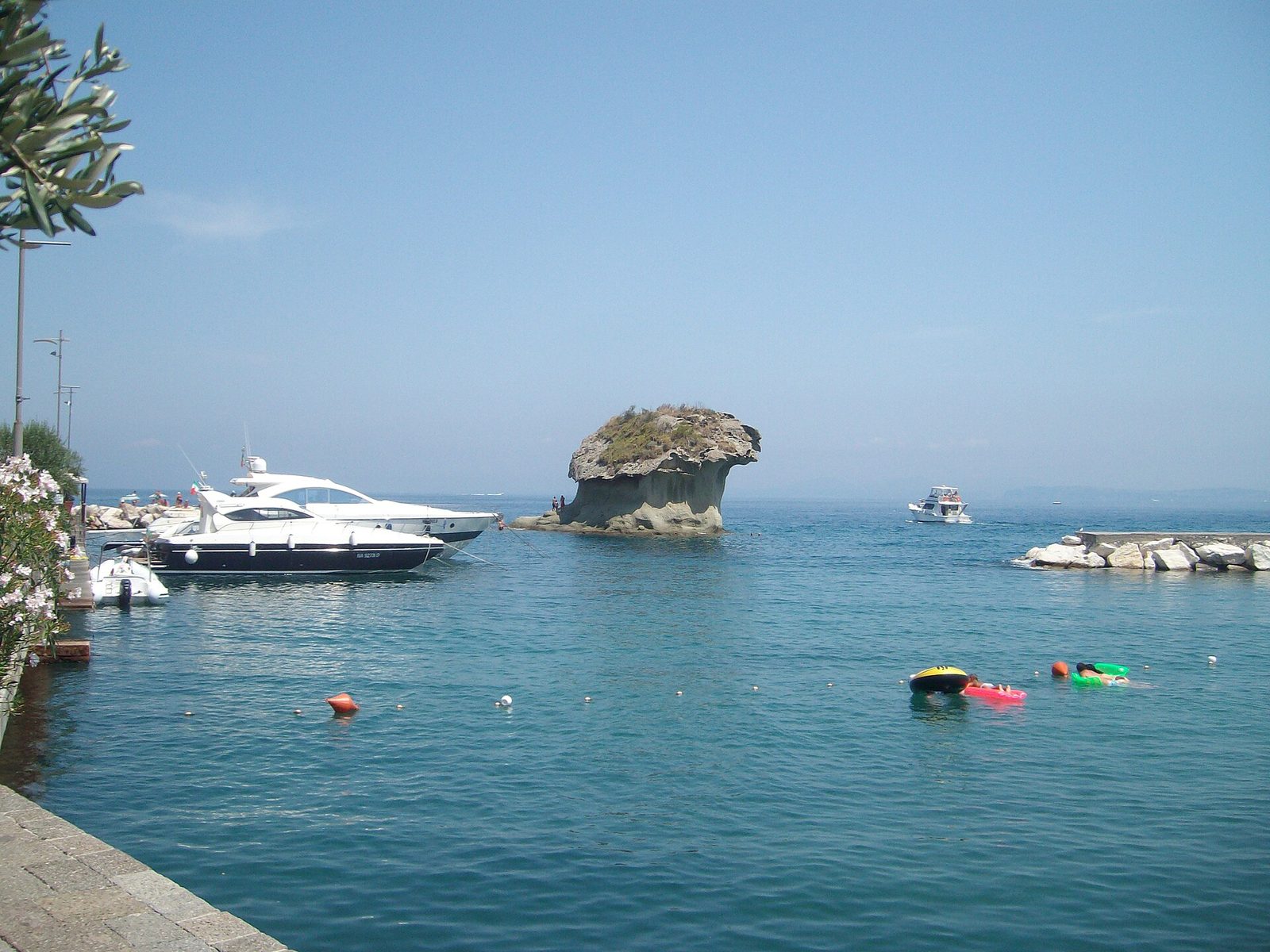
The smallest of the island’s towns is also one of its most elegant. Lacco Ameno was transformed into an upmarket resort in the 1950s by the publisher and film producer Angelo Rizzoli, who built luxury spa hotels that drew film stars. Its symbol is Il Fungo, a mushroom-shaped rock in the harbor. The town is home to the Negombo thermal park on the bay of San Montano and to the archaeological museum at Villa Arbusto, which displays finds from Pithecusae, the earliest Greek settlement in the western Mediterranean, including the famous Cup of Nestor, which carries one of the oldest known Greek inscriptions.
Forio
Ischia’s largest municipality by area covers the west coast, and it’s my favorite base. Forio town has a lively seafront, good restaurants and some of the best sunsets in the Bay of Naples, watched from beside the white church of Santa Maria del Soccorso on its promontory. The municipality also includes the beach of Citara with the Poseidon thermal gardens, the La Mortella gardens, the Ravino cactus gardens, and the village of Panza, near the free hot springs of Sorgeto.
Serrara Fontana and Sant’Angelo
The hill villages of Serrara and Fontana sit high on the slopes of Mount Epomeo, and Fontana is the usual starting point for the walk to the summit. Down on the south coast, the same municipality includes Sant’Angelo, a car-free former fishing village of pastel houses clustered around a small harbor, connected by a narrow sandy isthmus to a rocky islet with a tower. It’s the island’s prettiest village, full of restaurants and boutiques, and in the evening, when the day visitors leave, it’s magical. Access is on foot from the bus stop at the top of the village, so it’s a base for travelers with light luggage.
Barano d’Ischia
The southeastern municipality is rural and green, with vineyards and small villages. It includes the long beach of Maronti, the ancient Cavascura hot springs in a gorge above it, and the Nitrodi spring, whose waters have been celebrated since Roman times. It’s quieter than the north coast, and a good choice for beach-focused stays.
Ischia’s thermal spas
This is what Ischia is famous for, and the reason many people come back year after year. The island sits on a volcanic system that heats groundwater and mineral springs, and it has the largest concentration of thermal parks and spa hotels in Italy. You don’t need to be interested in “treatments” to enjoy them: a day moving between warm and hot outdoor pools, with the sea a few steps away, is simply one of the most pleasant things to do in southern Italy.
The big thermal parks
The thermal parks are outdoor complexes with a series of pools at different temperatures, often in gardens by the sea, with sunbeds, restaurants, saunas and access to a beach or the water. They’re usually open from spring to autumn, and prices vary by season, with half-day afternoon tickets cheaper than a full day. The best known are:
- Giardini Poseidon, above Citara beach near Forio, the largest thermal park on the island, with more than twenty pools of different temperatures on terraces running down toward the sea, and access to the beach. It’s the classic first choice.
- Negombo, on the bay of San Montano at Lacco Ameno, a thermal park laid out in beautiful botanical gardens around a sandy beach, with contemporary art and a quieter, more stylish atmosphere. Listings for 2026 gave a season from late April to mid-October, with prices rising in high summer.
- Castiglione, between Ischia Porto and Casamicciola, a smaller park on the rocks with pools stepping down to the sea.
- Aphrodite Apollon, in Sant’Angelo, a thermal park reached on foot from the village, with pools in a garden above the bay.
How to choose a thermal park
| If you want… | Choose | Why |
|---|---|---|
| The most pools and a classic experience | Giardini Poseidon | The largest park, with a beach below |
| Gardens, a sandy beach and a calmer feel | Negombo | Botanical setting and design-minded atmosphere |
| Something close to Ischia Porto | Castiglione | Easy to reach from the main town |
| To combine spa time with Sant’Angelo | Aphrodite Apollon | Walking distance from the village |
| A free, natural experience | Sorgeto or Cavascura | Hot springs in the sea or a gorge |
Tips for a thermal park day
- Buy a half-day ticket if you’re arriving after lunch; the afternoon rates are noticeably cheaper.
- Bring flip-flops, a swim cap if required, a towel or plan to rent one, and water; some parks also rent robes.
- Don’t stay long in the hottest pools. Move between temperatures, drink water, and follow the posted times. People with heart conditions, high blood pressure or pregnancy should check with a doctor before using very hot thermal water.
- Remove silver jewelry. Some mineral waters can tarnish it.
- Check the season. Most parks close for the winter, but many spa hotels keep indoor thermal pools open for guests year-round.
Spa hotels
Many Ischia hotels have their own thermal pools, fed by natural springs, along with spa treatments. They’re one of the island’s distinctive pleasures, especially outside the warm months, when an evening in a hot outdoor pool under the stars is a wonderful thing. If spas are the point of your trip, compare hotels by the size, temperature and setting of their thermal pools, not just the room.
The free hot springs
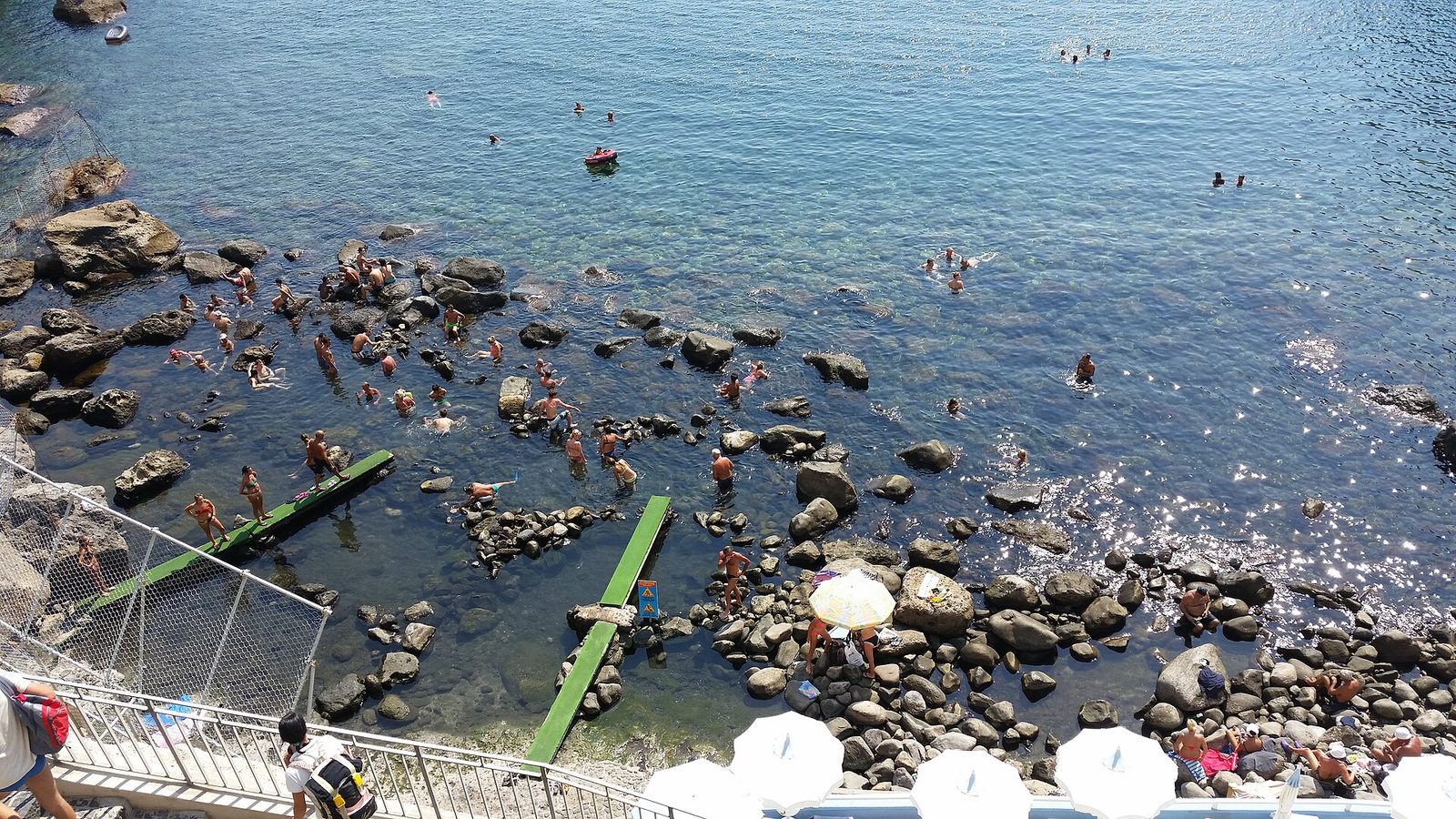
Sorgeto
Near the village of Panza, at the bottom of a long flight of steps, the little bay of Sorgeto is one of the most extraordinary places on the island. Hot springs bubble up directly into rock pools at the water’s edge, so you can sit in naturally hot water while the sea washes in. It’s free, it’s open year-round, and on a cool evening or in the off-season it’s pure magic. The steps down are steep and there are a lot of them, and in summer the pools get crowded. Boats and water taxis also reach the bay from Sant’Angelo in season. Wear water shoes, since the rocks are slippery and the water near some springs is very hot.
Cavascura
In a narrow gorge above Maronti beach, the Cavascura springs have been used since Roman times, with small pools carved into the rock and steaming water flowing through them. It’s rustic and atmospheric; there’s usually a small charge for the facilities, so check locally. Combine it with a day at Maronti.
The Nitrodi spring
In the hills of Barano, the Nitrodi spring was dedicated in antiquity to Apollo and the nymphs, and ancient votive reliefs were found here. Today it’s a garden with showers of spring water, known for its mild rather than hot water, and a peaceful escape from the beach crowds.
Ischia beaches
Ischia has the best beaches of the three islands in the Bay of Naples, including some genuinely sandy ones. Expect a mix of free public stretches and paid bathing clubs with sunbeds and umbrellas, and expect them to fill up in August.
- Maronti. The longest beach on the island, a sweep of sand of about three kilometers on the south coast below Barano. It has free sections, bathing clubs and restaurants, and in places the sand is hot from the volcanic activity underneath. Reach it by bus to the top of the hill, or by water taxi from Sant’Angelo, which is much more fun.
- Citara. A sandy beach south of Forio, below the Poseidon thermal gardens, with gorgeous sunsets.
- San Montano. A sheltered, sandy bay at Lacco Ameno, much of it occupied by the Negombo park, with calm, clear water.
- Chiaia and San Francesco. Sandy beaches near Forio town, easy to reach and popular with families.
- Cartaromana. A small, rocky bay beside the Aragonese Castle, with views of the castle and warm springs in the water.
- Spiaggia dei Pescatori. The beach at Ischia Ponte, with fishing boats and a view of the castle. Convenient if you’re staying nearby.
- Sant’Angelo and the Fumarole. Beaches on either side of the isthmus at Sant’Angelo, with the Fumarole beach known for steam rising from the hot sand.
For the best water, rent a small boat or take a boat trip around the island, which reaches coves impossible to get to from land.
The Aragonese Castle
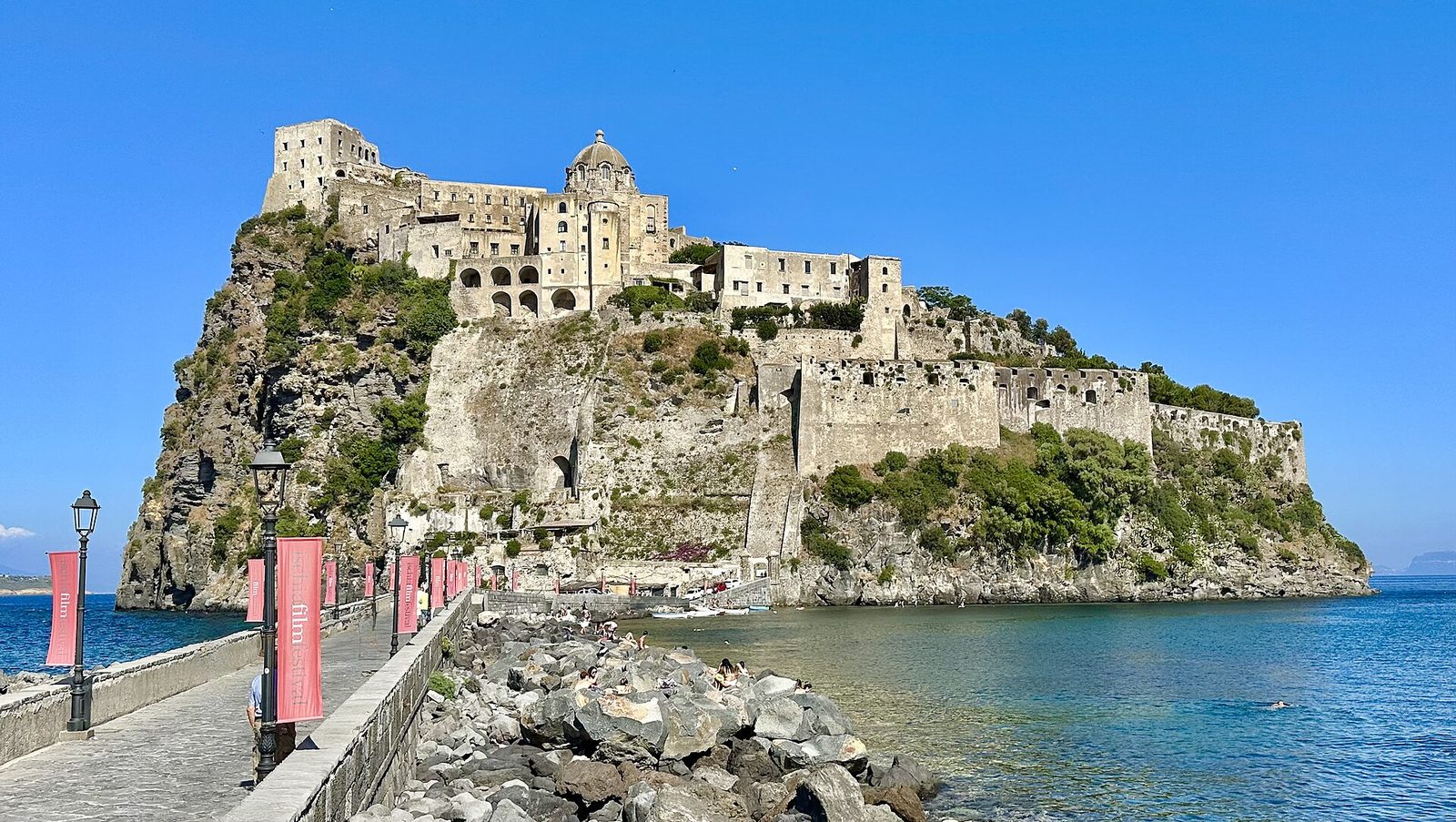
Ischia’s most famous landmark rises on a rocky islet off Ischia Ponte, connected to the shore by a long stone causeway first built in the 15th century by Alfonso V of Aragon. The rock has been fortified since ancient times, and for centuries the islanders retreated to the citadel to escape pirate raids. At its height, it held a cathedral, convents, churches and a small town of its own.
A visit today means climbing (or taking the lift partway) through the ruins and restored buildings: the remains of the cathedral, the Church of the Immacolata, gardens, terraces with sweeping views of the island and the bay, and the grim, fascinating cemetery of the Poor Clare nuns, where the bodies of dead sisters were placed on stone seats to decompose. The poet Vittoria Colonna, one of the most celebrated women of the Italian Renaissance and a friend of Michelangelo, lived at the castle.
The castle is privately owned and open year-round, with shorter hours in winter. Visitor listings in 2026 gave an adult ticket of around €10 (reduced around €6), which I couldn’t confirm directly with the castle, so check its official site. Allow around two hours, and wear comfortable shoes.
Mount Epomeo
The island’s highest point, at 788 meters, is a volcanic block pushed up from below rather than a classic cone, and its summit, carved with rock-cut hermitages and a small chapel, has views over the whole Bay of Naples to Capri, Vesuvius and the mainland. The most popular route starts in Fontana and takes around an hour on foot up a mix of road and path; the final section is rocky and steep. There’s a simple restaurant near the top, which is a fine reward for the climb, but carry your own water anyway, as its hours depend on the season. Go early or late in summer, bring water and wear proper shoes. On a clear day, it’s one of the finest viewpoints in southern Italy.
Gardens and museums
La Mortella
Near Forio, La Mortella is a spectacular garden created from a rocky quarry by Susana Walton, the Argentine wife of the English composer William Walton, who lived and worked here. It’s a green, terraced world of tropical and Mediterranean plants, water features, a Thai pavilion and a Greek-style theater, with concerts in season. The garden has seasonal opening days and hours, so check before visiting. It’s one of the most beautiful gardens in Italy, and even visitors who don’t think of themselves as garden people tend to leave it talking about the upper terraces, where the view opens out over the sea toward Forio. Allow a couple of hours and bring water.
The Ravino gardens
Also in Forio, the Giardini Ravino is a large botanical garden of cacti and succulents, surprisingly lush and a favorite with plant lovers and families.
Villa Arbusto and Pithecusae
In Lacco Ameno, the archaeological museum in Villa Arbusto tells the story of Pithecusae, founded by Greek settlers in the 8th century BC, the first Greek colony in the western Mediterranean. The star exhibit is the Cup of Nestor, a small clay drinking cup with a playful verse inscription referring to Homer, among the oldest examples of Greek writing anywhere. The villa’s gardens also have a small museum about Angelo Rizzoli.
A boat trip around the island
If I had to choose one excursion on Ischia, it would be a boat trip around the coast. From the water you see the island’s shape and variety in a few hours: the castle on its rock, the cliffs and coves of the south coast that no road reaches, the fishing village of Sant’Angelo, steam rising at the Fumarole, and the western headland at Punta Imperatore with its lighthouse.
Round-the-island trips leave from Ischia Porto, Forio, Lacco Ameno and Sant’Angelo in the warmer months. Group boats stop for swimming in clear coves, sometimes at Sorgeto or near the castle at Cartaromana. Private charters, including traditional wooden gozzi, let you choose the stops, the pace and where to have lunch, and they make sense for families or small groups splitting the cost. You can also rent a small motorboat that doesn’t require a license and explore on your own, as long as the sea is calm and you stay close to shore.
Before booking, check how long the trip lasts, how many swimming stops are included, and what happens if the sea is too rough to sail. Boat days are the first plans to be canceled when the wind gets up, so don’t leave yours for the last day of your stay.
Walking on Ischia
Ischia’s interior is a surprise for visitors who only know its beaches. Away from the coast, footpaths climb through chestnut woods, vineyards and terraces to the slopes of Mount Epomeo, with views over the sea on every side.
- Mount Epomeo. The classic walk, starting in Fontana, with the whole Bay of Naples spread out below the summit.
- The Falanga woods. A chestnut forest on Epomeo’s western flank, dotted with extraordinary houses and shelters carved out of huge boulders of green tuff, once used by farmers and shepherds.
- Punta Imperatore. A walk out to the lighthouse on the island’s western tip, with sunset views toward the open sea.
- Coastal paths. Short paths link beaches and viewpoints on the south coast, including routes around Sant’Angelo and down to Sorgeto.
Paths aren’t always well signposted, so use a good trail map or app, ask locally about conditions, and avoid walking in the heat of the day in summer. Some trails were affected by the landslides of recent years, so respect any closures.
Ischia with children
Ischia is one of the best places in southern Italy for a family holiday. The sandy beaches at Maronti, Citara, San Montano and around Forio are easier for small children than the rocky coves of Capri or the Amalfi Coast, and the shallow water on some of them is ideal for paddling. Thermal parks are fun for children too, although the hottest pools aren’t suitable for young children, and most parks have rules on minimum ages or heights for some areas. The Ravino cactus gardens, boat trips and the castle’s ramparts tend to go down well.
For a family base, choose somewhere with a beach or pool within walking distance, since crowded summer buses with small children are hard work. Forio, Lacco Ameno and Ischia Porto all work well, while Sant’Angelo’s car-free steps can be tricky with a stroller.
Ischia out of season
Ischia is a seasonal island. In the cooler part of the year many hotels, restaurants and the big thermal parks close, boat services to other islands and the coast stop, and ferries from Naples run less often. But the island doesn’t shut entirely, and there’s a lot to be said for visiting when it’s quiet.
Many spa hotels stay open for thermal holidays, and soaking in a hot outdoor pool on a cool evening is one of the great pleasures of the island. Sorgeto’s natural hot springs are arguably at their best when the air is cool. Walking is more comfortable, prices are lower, and you’ll share the island with locals rather than crowds. Check which hotels and restaurants are open before you go, and keep flexibility in case rough seas cancel a crossing. For how the seasons compare across the region, see my guide to the best time to visit Naples, Italy.
Ischia on screen and in books
Ischia has a long history with film. Scenes of the 1963 epic Cleopatra were shot on the island, bringing Elizabeth Taylor and Richard Burton to Ischia, and The Talented Mr. Ripley used both Ischia and Procida as locations for its fictional Italian seaside town. Elena Ferrante’s Neapolitan novels also send their characters to Ischia for a formative summer. The island hosts a film festival and awards, and its links to cinema are part of its old-fashioned glamour.
What to eat and drink on Ischia
- Coniglio all’ischitana. The island’s signature dish: rabbit, traditionally raised in pits, slow-cooked in a terracotta pot with tomatoes, garlic, white wine and herbs. The sauce often dresses spaghetti as a first course, with the rabbit as the main.
- Seafood. Fish of the day, spaghetti with clams, and fish cooked in acqua pazza, a light broth of tomatoes and herbs, especially in Sant’Angelo, Forio and Ischia Ponte.
- Island wines. Ischia has made wine since the Greeks arrived. Look for whites made from the native Biancolella and Forastera grapes, and reds from Per’e Palummo, the local name for the Piedirosso grape.
- Rucolino. A dark, herbal digestive liqueur made with arugula, the island’s after-dinner drink.
- Sweets. Pastry shops in Ischia Porto and Forio sell the Neapolitan classics, plus local cakes and biscuits.
For the city’s food before or after your island days, see my guide to Naples food.
Where to stay on Ischia
| Base | Best for | Trade-offs |
|---|---|---|
| Ischia Porto and Ischia Ponte | First visits, no car, restaurants, the castle, ferry connections | Busier and less scenic |
| Forio | Sunsets, restaurants, Poseidon, beaches, a lively town | Further from the main ferry port |
| Lacco Ameno | Elegant spa hotels, Negombo, a quieter stay | Smaller and more upmarket |
| Sant’Angelo | Romance, car-free charm, evenings, Maronti by water taxi | Walk in with luggage; buses at the top |
| Barano and the Maronti area | Beach stays, nature | Hills, fewer services |
| Hill villages of Serrara Fontana | Walking, views, quiet, lower prices | Need transport for beaches |
Spa hotels with thermal pools are available in all price ranges, and many offer half board. If you’re splitting your trip between the islands and the city, see my guide to where to stay in Naples, Italy for the mainland side.
Island hopping from Ischia
Ischia makes a good base for seeing the other islands. Procida, the smallest island in the bay, is a short ferry ride away, close enough for a relaxed half day among its pastel houses, the fishing harbor of Marina Corricella and the views from the old citadel of Terra Murata. In the warmer months, boats also link Ischia with Capri, which makes a long but memorable day out, and with Sorrento and the Amalfi Coast towns.
If you’re planning a longer trip around the bay, a sensible order is Naples, then Procida or Ischia, then Capri or Sorrento, then the Amalfi Coast, so you’re always moving forward rather than doubling back through Naples. Direct routes between the islands are more limited than routes to and from Naples, and some run only in summer, so check which connections exist on your dates before building a plan around them.
Ischia on a budget
Ischia can be expensive in August and in its luxury spa hotels, but it’s generally much better value than Capri, and with a little planning it can be surprisingly affordable.
- Travel outside the peak weeks. Prices for rooms and ferries drop sharply outside the height of summer.
- Take the car ferry rather than the hydrofoil if you’re not in a hurry; it usually costs less, and sitting on deck is part of the fun.
- Use the island buses. A day ticket covers as many rides as you like.
- Use the free hot springs. Sorgeto costs nothing, and the free sections of Maronti and other beaches are fine if you bring your own umbrella.
- Buy afternoon tickets at thermal parks, which are cheaper than a full day.
- Stay in the hill villages or in Forio rather than in Lacco Ameno’s upmarket hotels, and look for half-board deals at spa hotels.
- Eat where islanders eat. Pizzerias, rosticcerie and trattorias away from the harbor fronts are much cheaper than waterfront restaurants.
Earthquakes, landslides and staying informed
Ischia is a volcanic island, and like the nearby Campi Flegrei, it has a history of earthquakes. The 1883 earthquake destroyed Casamicciola, a 2017 earthquake caused damage and deaths in the same area, and in November 2022 a landslide after torrential rain devastated parts of Casamicciola, killing twelve people. Recovery and safety work continue.
For visitors, the practical advice is the same as anywhere with natural hazards: follow local instructions, respect closed paths and areas, and check weather warnings in periods of heavy rain. The vast majority of visits are completely untroubled. Because the Campi Flegrei unrest has affected ferry operations from Pozzuoli in 2026, check the status of your crossing before you travel, and keep some flexibility in your plans.
What to skip
- A rushed day trip. You’ll spend most of it on boats and buses. Give the island at least two nights.
- Bringing a car. Buses, taxis and scooters are enough, and summer traffic is heavy.
- The peak summer weeks, if you can avoid them. Beaches, buses and prices all peak.
- Staying in the hottest thermal pools too long. Move between temperatures and drink water.
- Arriving at Sorgeto with heavy bags. The steps are long; come with a towel, water shoes and little else.
- Expecting Capri. Ischia’s charm is relaxed and green, not glamorous.
- Leaving Sant’Angelo before dinner. It’s at its best after the day crowds leave.
Ischia, Italy: frequently asked questions
Is Ischia worth visiting?
Yes, especially if you have at least two nights. It has the best beaches in the Bay of Naples, Italy’s largest cluster of thermal spa parks, the Aragonese Castle, the village of Sant’Angelo and fine walking, with a more relaxed feel than Capri.
Can you do Ischia as a day trip from Naples?
You can, but I wouldn’t. The crossing takes about an hour, and many highlights are on the far side of the island, so you’ll spend much of the day traveling. A stay of two nights or more is far more rewarding.
How do I get from Naples to Ischia?
Take a hydrofoil from Molo Beverello, around an hour, or a slower car ferry from Calata Porta di Massa. Ferries also run from Pozzuoli, but check their status in 2026 after the Campi Flegrei earthquakes.
Which is better, Ischia or Capri?
Capri is smaller, more dramatic and glamorous, and better for a day trip. Ischia is bigger, greener and more relaxed, with better beaches and thermal spas, and it’s better for a longer stay.
What are the best thermal parks on Ischia?
Giardini Poseidon near Forio is the largest, with more than twenty pools. Negombo in Lacco Ameno combines thermal pools with gardens and a sandy beach. Castiglione and Aphrodite Apollon are smaller alternatives, and Sorgeto offers free natural hot springs.
What is the best beach on Ischia?
Maronti, a three-kilometer sandy beach on the south coast, is the longest and best known. Citara near Forio, San Montano at Lacco Ameno and the beaches around Sant’Angelo are also excellent.
Are Sorgeto’s hot springs free?
Yes. The natural hot springs at the bay of Sorgeto near Panza are free and open year-round. Reaching them involves a long flight of steps, and water shoes are a good idea.
How do you get around Ischia?
By island bus, including the CD and CS lines that circle the island, by taxi or microtaxi, by rented scooter, or by boat and water taxi along the coast. A car isn’t necessary.
Is Ischia safe after the earthquakes?
Ischia is visited safely by large numbers of people every year. Casamicciola was hit by an earthquake in 2017 and a landslide in 2022, and recovery continues. Follow local guidance and weather warnings, and check ferry status from Pozzuoli in 2026.
How big is Ischia?
About 46 square kilometers, roughly six times the size of Capri, with six towns and Mount Epomeo, 788 meters high, at its center.
For the crossing itself, from terminals and timetables to Pozzuoli’s 2026 disruption and what happens when the hydrofoils are cancelled, see my Naples ferries guide. It covers every route across the bay, including the short hop from Ischia to Procida.
Procida, Ischia’s small neighbor, is only 20 to 30 minutes away by boat and makes a perfect day out from here. It has the colorful harbor of Marina Corricella, the old citadel of Terra Murata and a slower, more lived-in feel than anywhere else in the bay. See the Procida, Italy guide.
Ischia has the longest beaches in the bay, and the Maronti, Citara and San Montano are all on this page for a reason. If you’re weighing an Ischia beach day against Procida, Capri or the sandy coast west of Naples, my Naples beaches guide compares them all, along with what the lidos cost and how the free beaches work.
Photo credits
- The Aragonese Castle and causeway: photo by Steve Jurvetson, Wikimedia Commons, CC BY 2.0.
- The bay of Sant’Angelo: photo by maury3001, Wikimedia Commons, CC BY 3.0.
- The bay of Sorgeto: photo by Manu’ndroid, Wikimedia Commons, CC BY-SA 4.0.
- Mount Epomeo and Ischia Ponte from the castle: photo by Pampuco, Wikimedia Commons, CC BY-SA 4.0.
- Il Fungo, Lacco Ameno: photo by Maxim Karpinskiy, Wikimedia Commons, CC BY-SA 3.0.
Sources: Pozzuoli port and ferry status from 2026 reporting (ANSA, September 2026; local press, August 2026); thermal park seasons from 2026 visitor listings; Aragonese Castle details from 2026 visitor listings (unconfirmed with the castle); island geography from Britannica. Checked September 2026. Thermal park prices and ferry timetables change by season; confirm with operators before you travel.