On this page
Last updated September 25, 2026. Opening hours, booking rules and ticket prices checked against the Sansevero Chapel’s official site, the Ministry of Culture page for the Girolamini, and 2026 listings for the Duomo, Santa Chiara and San Gregorio Armeno. Church hours change often, so I flag the ones worth double-checking.
The Naples churches to see first are the Sansevero Chapel for the Veiled Christ (book ahead), the Duomo for the Chapel of San Gennaro, Santa Chiara’s majolica cloister, the Gesù Nuovo, and the Pio Monte della Misericordia for Caravaggio. Most churches in Naples, Italy are free to enter; a few charge for cloisters, museums or chapels.
Naples has been called the city of five hundred domes, and after a day on Spaccanapoli you’ll believe it. Churches stand on almost every block of the historic center, many of them extraordinary, some of them closed for decades, a few open only when a volunteer turns up with the key. They hold Caravaggios, Gothic royal tombs, baroque interiors of an intensity you won’t find anywhere north of here, and a marble statue that people cross the world to see. Most of them cost nothing to enter, and they’re blissfully cool on a hot afternoon.
Very little of this is explained in English, and the best-known churches can crowd out the rest. This guide sorts them. It covers the handful you shouldn’t miss, how to fit them into a day, the ones worth a detour, and the practical side: the booking you can’t skip at the Sansevero, the midday closures, what to wear, and the three days a year when the Duomo becomes the most crowded building in the city. Each of the major churches will get its own detailed page; this is where you decide which ones deserve your time.
The best Naples churches at a glance
Here are the churches most visitors should consider, in rough order of priority. Costs are bands, since prices change, and each church’s own page will carry the current figure.
| Church | Why go | Where | Entry | Booking | My verdict |
|---|---|---|---|---|---|
| Sansevero Chapel | The Veiled Christ and the most astonishing marble in Naples | Via Francesco De Sanctis, off Spaccanapoli | €10–15 | Compulsory, released 60 days ahead; closed Tuesdays | Book this before anything else |
| Duomo and the Chapel of San Gennaro | The city’s patron saint, his blood, and a baroque chapel of gold and silver | Via Duomo | Free; Treasury museum €11–15 | Not needed | Essential, and free |
| Santa Chiara | A great Gothic church and a cloister covered in painted majolica tiles | Piazza del Gesù Nuovo | Church free; cloister and museum €5–10 | No; cloister tickets at the office | The cloister is one of the loveliest places in the city |
| Gesù Nuovo | A diamond-studded stone facade and a lavish baroque interior | Piazza del Gesù Nuovo | Free | No | Walk in on your way down Spaccanapoli |
| Pio Monte della Misericordia | Caravaggio’s Seven Works of Mercy, still where he painted it for | Via dei Tribunali | €10–15 | No | The best single painting in Naples, in place |
| San Domenico Maggiore | A Gothic church of kings and philosophers, with Aragonese royal coffins | Piazza San Domenico Maggiore | Church free; guided sacristy and museum €8–11 | For the guided visits | Worth it for the sacristy tour |
| San Lorenzo Maggiore | A Gothic church over a Roman market street | Via dei Tribunali | Church free; excavations under €10 | No | Pair it with the underground |
| San Gregorio Armeno | A nuns’ church and cloister on the nativity-workshop street | Via San Gregorio Armeno | Under €5 for the complex | No | A quiet surprise behind the crowds |
| Girolamini | A reopened baroque church with a famous library alongside | Via Duomo | Church under €10; library visit more | Tickets on the Musei Italiani app or on site | For the church lover’s second day |
If you have one afternoon, do the Sansevero Chapel (booked), the Gesù Nuovo, Santa Chiara and the Duomo, in that order along Spaccanapoli and up Via Duomo. If you have a whole day, add the Pio Monte for Caravaggio, San Lorenzo and San Gregorio Armeno. And if you have more time than that, the churches in the second half of this guide are where Naples really starts to reward you.
How to visit churches in Naples
A few practical things make the difference between walking into a baroque masterpiece and staring at a locked door.
Opening hours
Church hours in Naples are a law unto themselves. The big churches that run as tourist sites, like the Duomo, Santa Chiara and the Sansevero, keep published hours through the day. Many parish churches, though, open in the morning, close for a long break in the early afternoon, and reopen in the late afternoon for evening Mass. The worst time to go church-hunting is from about lunchtime to the middle of the afternoon, when you’ll find door after door closed. Plan the cloisters, museums and ticketed sites for that stretch, and the free churches for the morning and early evening.
Some smaller churches open only on particular days, often through volunteer groups, or only for Mass, and a few are closed for restoration for years at a time. If there’s one you particularly want to see, check its current hours shortly before you go, rather than trusting a guidebook or an old listing.
What to wear
These are working churches, and the usual Italian rule applies: shoulders and knees covered. It’s rarely enforced at the door in the smaller churches, but the bigger ones can turn you away, and it’s simple respect. In summer, carry a light scarf or shirt to throw on, and wear trousers or a skirt below the knee rather than shorts.
During Mass
If a service is happening, either join it or leave. Don’t wander around taking photos while people are praying. Sunday mornings are the busiest time for Mass, so they’re the worst time for sightseeing in parish churches, although they’re a wonderful time to hear the organ and see the churches used as they’re meant to be.
Photos, lights and donations
Most churches let you take photos without flash, but not all, and the Sansevero Chapel bans photography completely. You’ll often find a coin box that switches on the lights in a chapel for a few minutes, and a donation box by the door. Dropping in a euro or two helps keep these buildings open. Many are maintained on almost nothing.
Tickets and passes
You’ll only need tickets for the chapels, cloisters and museums attached to churches, not for the churches themselves. The Sansevero is the one you must book, and the only one that sells out. The regional Artecard covers some church museums and not others, and the list changes, so check it before assuming a site is included. Our guide to Naples museums explains which passes cover what.
Almost all the major churches lie within the Greek grid of the old city, so the centro storico guide is the natural companion to this page. It maps the streets that connect them.
The Sansevero Chapel and the Veiled Christ
If you see one thing in a Naples church, make it this. The Cappella Sansevero is a small family chapel just off Spaccanapoli, and at its center lies the Veiled Christ, the dead Christ carved in marble under a veil so thin you’d swear it was cloth. Giuseppe Sanmartino finished it in 1753. The commission had first gone to the Venetian sculptor Antonio Corradini, who died in 1752 having made only a terracotta model, and Sanmartino, then in his early thirties, produced the work that made his name. You can see the veil settle over the eyelids, the wound in the side, the swollen vein at the forehead. People stand in front of it in total silence, which in Naples is saying something.
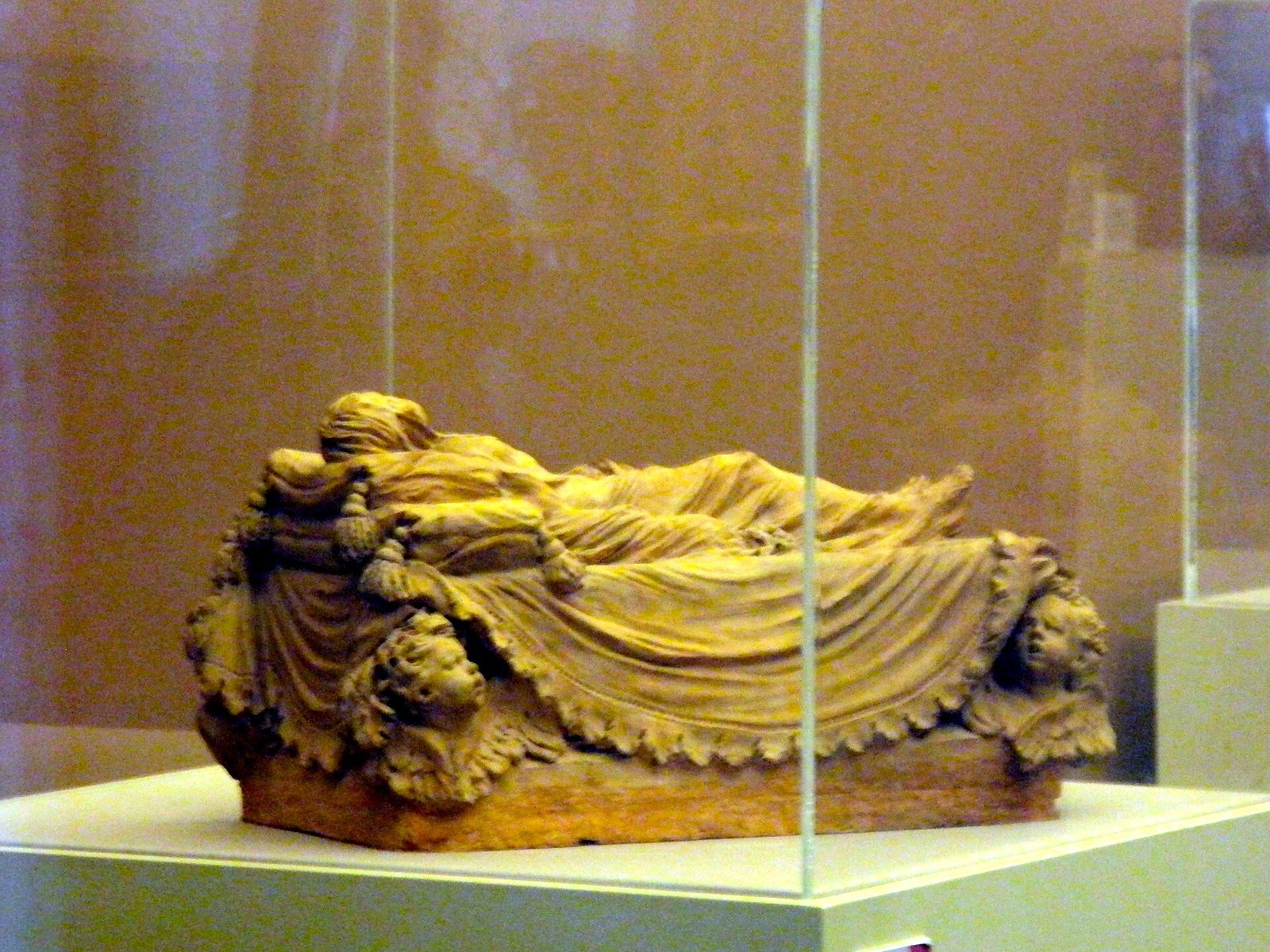
The chapel around it is just as strange. It was remodeled in the 18th century by Raimondo di Sangro, Prince of Sansevero, a soldier, inventor, freemason, alchemist and general object of suspicion. Look for Corradini’s Modesty, a veiled woman, and Francesco Queirolo’s Disillusion, a man struggling out of a marble net carved in open mesh, which seems impossible. Down in the crypt are the “anatomical machines,” two real human skeletons with their veins and arteries reconstructed around them. For two centuries Neapolitans said the prince had turned people to stone and petrified their blood vessels by alchemy. The truth is less gothic but still remarkable, and the legends are part of the fun.
Booking is compulsory
This is the one church in Naples you must book in advance. Visits are timed and must be reserved. Tickets are released 60 days ahead, with a second release two days before each date, according to the chapel’s own site in September 2026. In busy periods the online slots can sell out weeks in advance, so if the Sansevero matters to you, book it the moment your dates are fixed and plan the rest of your day around it. Some older guides still suggest you can simply buy a ticket at the door. Don’t count on it, and don’t let a missed booking be the reason you don’t see it.
The chapel is open daily from 9:00 to 19:00 except Tuesdays, when it’s closed. Since February 2026 the ticket office has been temporarily at Via Raimondo di Sangro 12, around the corner from the chapel entrance. Tickets are in the €10–15 band for adults, with reductions for young people. Photography isn’t allowed inside, and the rule is enforced.
Verdict
Book it first. It’s small and usually busy, but the Veiled Christ is the one work of art in Naples that almost nobody finds overrated. Go as early in the day as you can get a slot, before the room fills up.
The Duomo and the Chapel of San Gennaro
The Cathedral of Naples is the center of the city’s religious life and the home of its patron saint, San Gennaro. From the street it looks like a 19th-century building, since the neo-Gothic facade on Via Duomo is a late addition, designed by Errico Alvino, the same architect who dug the Bourbon tunnel under the Royal Palace. Behind it is a Gothic cathedral begun under the Angevin kings in the late 13th century, remodeled over the centuries into a layered, crowded, magnificent interior.
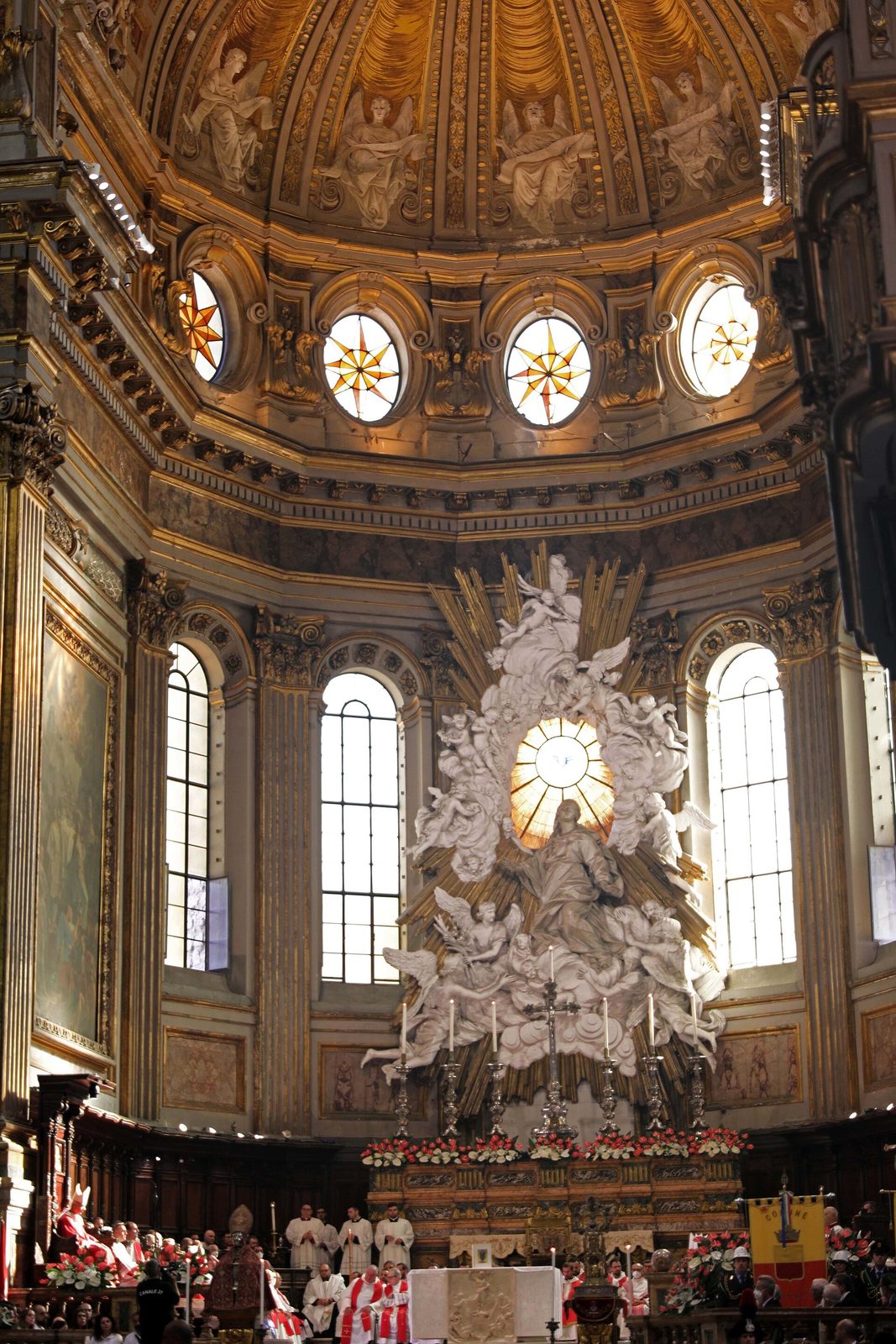
The Royal Chapel of the Treasure of San Gennaro
Halfway down the right aisle, behind a great bronze gate, is the chapel the city built for its saint. During a plague in the 16th century, Naples made a vow to San Gennaro, and the chapel it raised in the first half of the 17th century is one of the richest baroque interiors in Italy. It has frescoes and altarpieces by Domenichino and Lanfranco, a painting by Ribera of the saint emerging unharmed from a furnace, and silver busts of the city’s patron saints. Behind the altar are kept the relics: the saint’s skull, and two glass ampoules holding what the faithful believe is his dried blood.
Three times a year, the blood is expected to liquefy: on the Saturday before the first Sunday in May, on September 19, the saint’s feast day, and on December 16. The Archbishop holds up the reliquary, and if the blood turns liquid, the news spreads across the city. When it doesn’t, people take it as a bad omen. Whatever you believe, being in the cathedral on one of those days is an extraordinary experience of Neapolitan faith. It’s also packed from early morning, with limited access for sightseers. The next dates are December 16, 2026, and May 1, 2027.
Santa Restituta and the oldest baptistery in the West
Off the left aisle, a doorway leads to Santa Restituta, the oldest church in Naples, built in the 4th century and later absorbed into the cathedral. At its end is the Baptistery of San Giovanni in Fonte, whose surviving mosaics make it the oldest baptistery in the Western world. Beneath the complex are Greek and Roman remains, the layers of the ancient city on which the cathedral stands.
Visiting
Entry to the cathedral, the Royal Chapel, Santa Restituta and the baptistery is free, according to 2026 listings, with visits running daily from 9:30 to 17:00. Services and ceremonies can restrict access at any time, so check before you go if you’re traveling on a religious holiday. Next door, the Museo del Tesoro di San Gennaro displays the treasure given to the saint over the centuries, including a jewel-encrusted mitre and a famous necklace. Tickets are in the €11–15 band, with an audio guide included. It’s superb if you love goldsmiths’ work, and a skippable extra if you don’t. The Royal Chapel itself costs nothing.
Verdict
Essential, and free. Allow at least an hour for the cathedral, the Royal Chapel and Santa Restituta. Add the treasury museum only if jewelry and silverwork are your thing.
Santa Chiara and the majolica cloister
Santa Chiara is the great Franciscan church of the Angevin kings, built in the early 14th century by Robert of Anjou and his queen, Sancha of Majorca. Robert’s tomb stands behind the high altar. For centuries its interior was a dazzling baroque confection, until an Allied bombing raid in August 1943 set it on fire and destroyed almost everything. It was rebuilt after the war in its original, austere Gothic form, and the vast, pale nave you see today is closer to what the 14th century saw than to what stood there in 1942. It’s a moving place, all the more so if you know the story. The church is free to enter.
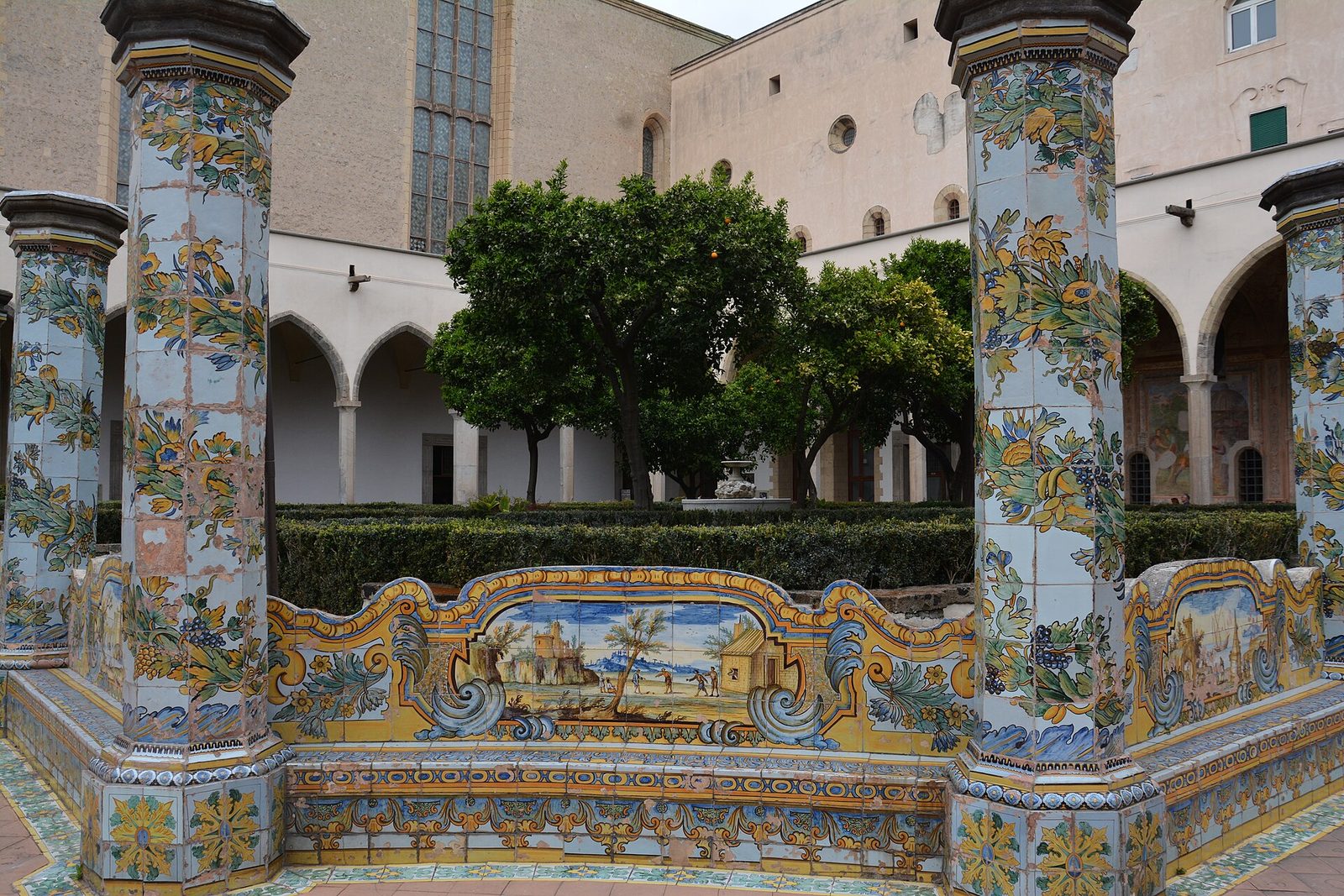
The reason to buy a ticket is the cloister. In the 1740s the architect Domenico Antonio Vaccaro redesigned the nuns’ cloister, and the tile makers Donato and Giuseppe Massa covered its octagonal pillars and long benches in painted majolica: vines, lemons, and scenes of country life, hunting and the sea. It’s one of the most charming places in Italy. There’s also a small museum and the excavated remains of a Roman bath complex. The complex is open from Monday to Saturday 9:30–17:30 and on Sunday mornings, 10:00–14:30, with tickets in the €5–10 band sold at the office only, not online.
Verdict: the church takes ten minutes and the cloister half an hour. Both are worth it. If you’re short of time, prioritize the cloister, which you won’t find anywhere else.
Gesù Nuovo
Across the square from Santa Chiara, the Gesù Nuovo looks more like a fortress than a church. Its facade is covered in pointed, diamond-shaped blocks of gray volcanic stone, because it was once a palace: the Palazzo Sanseverino, built in the 1470s and converted by the Jesuits into a church at the end of the 16th century. They kept the facade and built one of the most sumptuous baroque interiors in Naples behind it, all colored marble, frescoes and gilding, with Francesco Solimena’s huge fresco of Heliodorus driven from the Temple over the entrance.
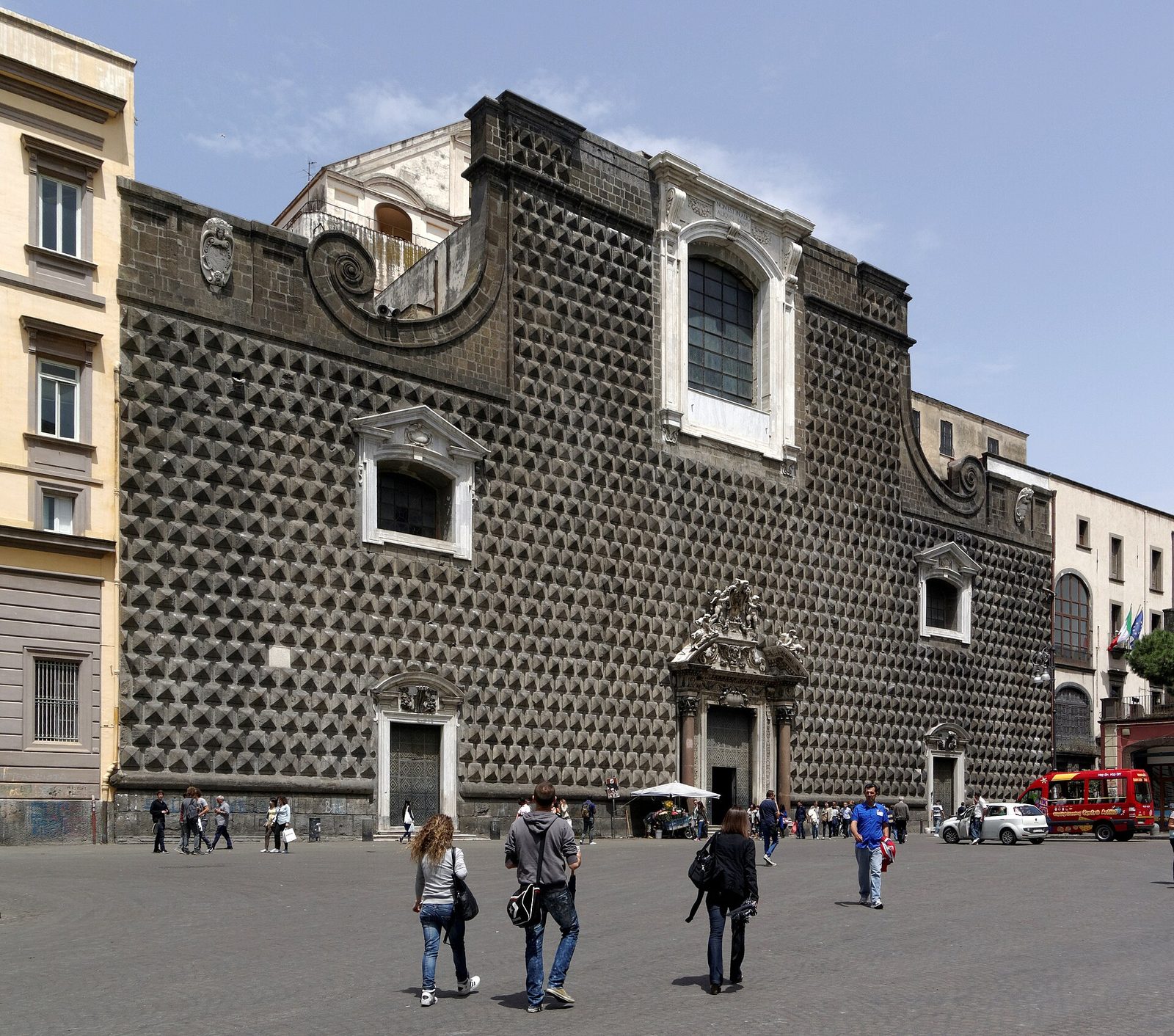
The strange marks carved into some of the stones have inspired theories that they’re a code, or even a musical score. The church is also the shrine of Saint Giuseppe Moscati, a Neapolitan doctor who treated the poor for free and was canonized in 1987. His rooms are preserved inside, and the walls around them are covered in silver ex-votos, small offerings in the shape of the body parts people prayed to have healed. It’s free, and it’s right on the route down Spaccanapoli. Walk in.
Caravaggio in Naples: the churches and the trail
Caravaggio fled to Naples in 1606 after killing a man in Rome, and the city changed his art and was changed by it. Three of his paintings survive in Naples today, and seeing them together is one of the great art experiences in Italy.
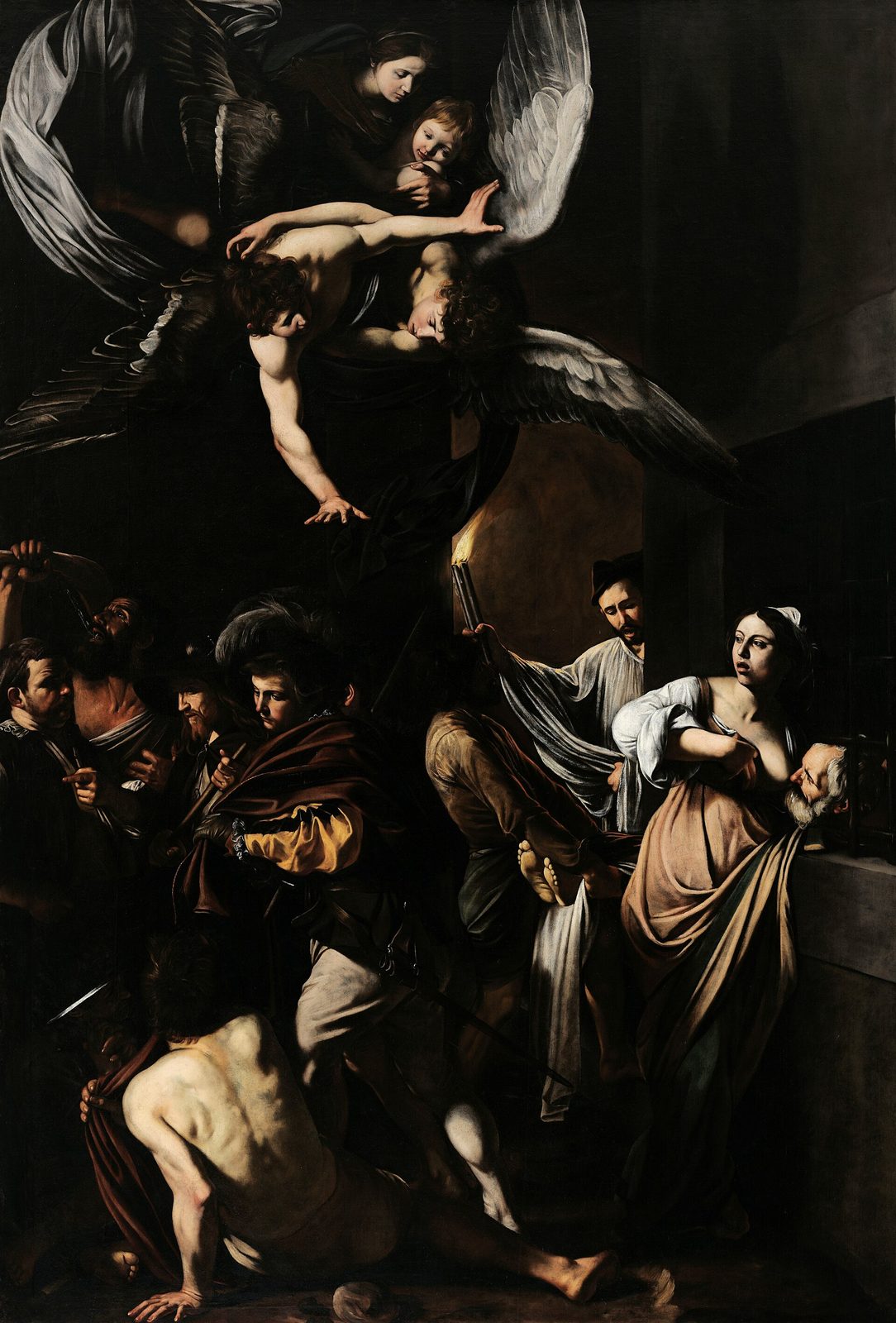
- The Seven Works of Mercy, at the Pio Monte della Misericordia on Via dei Tribunali. Caravaggio painted it in 1607 for the charitable brotherhood’s church, where it still hangs over the high altar. He packed all seven acts of mercy into a single dark Neapolitan street corner: a woman breastfeeding an old man in prison, a corpse carried out feet first, a saint cutting his cloak for a beggar. It is the finest painting in Naples, and seeing it in the place it was made for is part of the power. Entry is in the €10–15 band and includes the charity’s small picture gallery upstairs.
- The Flagellation of Christ, painted for a chapel in San Domenico Maggiore and now in the Capodimonte museum, with a copy in the church.
- The Martyrdom of Saint Ursula, probably the last painting Caravaggio made, in 1610, now at the Gallerie d’Italia on Via Toledo.
A fourth, a Resurrection painted for Sant’Anna dei Lombardi, was lost when the church was damaged in the early 19th century. Across the city’s churches you’ll also find the Neapolitan painters who followed him, above all Battistello Caracciolo and the Spanish-born Jusepe de Ribera, whose dramatic light and ordinary faces owe everything to Caravaggio’s two short stays here.
For the paintings in museums, including Capodimonte and the Gallerie d’Italia, see the Naples museums guide. For the church, go to the Pio Monte first. It’s a five-minute walk from the Duomo and ten from the Sansevero, so it fits easily into the same day.
More churches worth your time
Once you’ve seen the big names, this is where Naples becomes addictive. These are the churches I’d add on a second or third day, roughly grouped by area so you can string them together.
Along Spaccanapoli and Via dei Tribunali
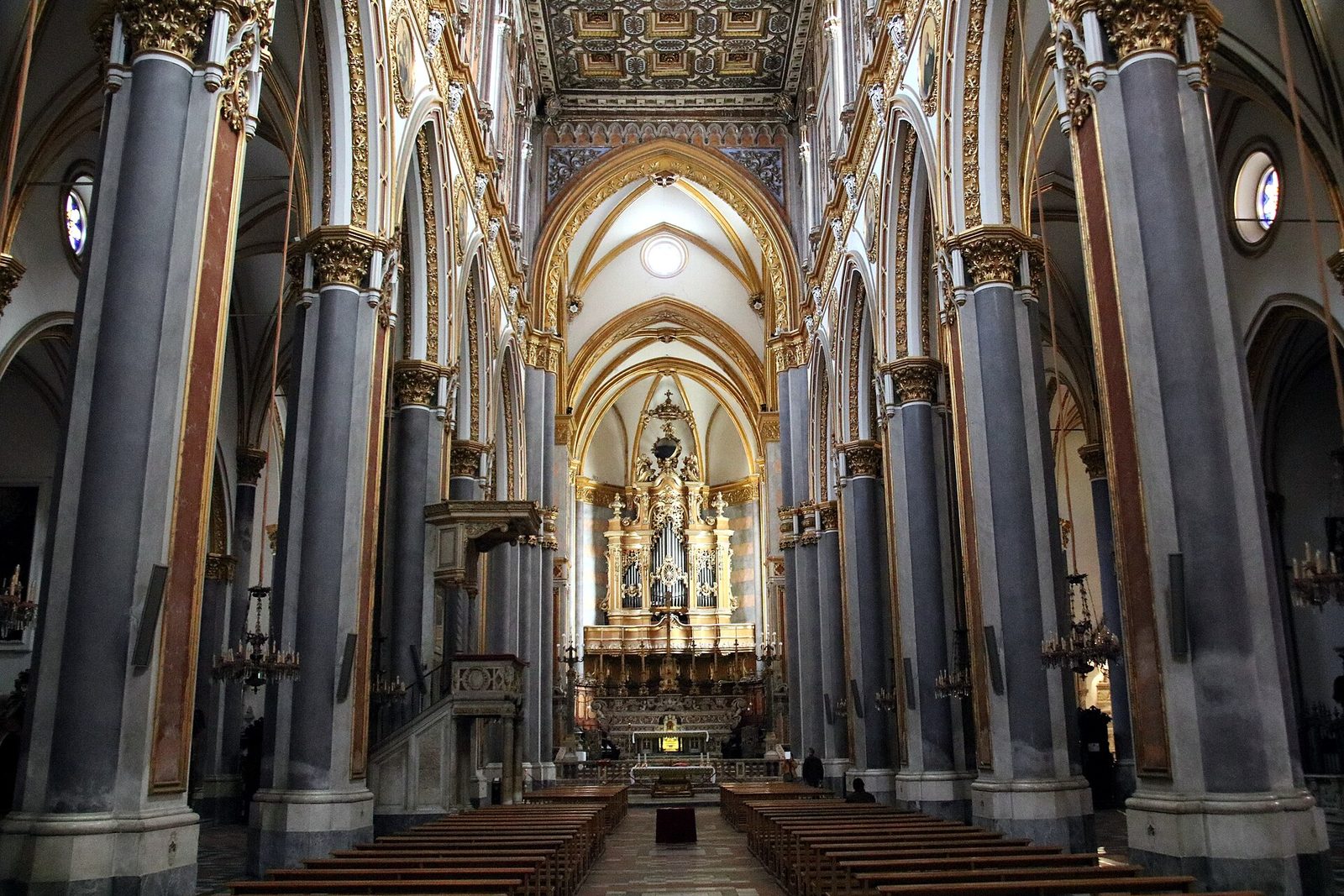
San Domenico Maggiore is the Gothic church of the Dominicans, on the piazza of the same name. Thomas Aquinas taught in its convent, and the young Giordano Bruno was a friar here. The church is free, but the real treasure is the sacristy. Its upper gallery holds the coffins of the Aragonese kings and nobles of Naples, lined up above the paneled cupboards like props in an opera. The guided visits to the sacristy and the convent museum, sold as DOMA, cost €8–11 and are well worth it. Caravaggio’s Flagellation hung in a chapel here, and a copy has taken its place.
San Lorenzo Maggiore, on Via dei Tribunali, has the finest French Gothic apse in Naples, with a ring of chapels around the high altar. Boccaccio said he first saw his beloved Fiammetta here. Beneath the cloister, the excavations of the Roman market are among the best underground sites in the city, and they’re covered in our guide to underground Naples. The church itself is free.
San Paolo Maggiore, on the same square, stands on the site of the Roman temple of Castor and Pollux. Two of its Corinthian columns still frame the church’s entrance, and the sacristy has fine frescoes by Solimena. The steep double staircase up from Piazza San Gaetano is a favorite perch for pizza eaters at lunchtime.
San Gregorio Armeno stands halfway down the street of the nativity workshops, and most people shopping for figurines walk straight past it. Behind the door is a gilded baroque church and one of the most peaceful cloisters in Naples, where Benedictine nuns lived for centuries. The complex ticket, under €5, also covers the nuns’ choir, the old refectory, the bread oven and the abbess’s parlor. It’s open daily in the morning and again in the afternoon. The church keeps a relic of Saint Patricia whose blood is also said to liquefy, and devotees come to see it every week.
The Girolamini is the great baroque church of the Oratorians, facing the Duomo across Via Duomo, and one of the city’s most spectacular interiors. After years of restoration it’s open again. In 2026 it welcomes visitors Tuesday to Friday from 10:00 to 18:30 and on weekend and holiday mornings, and it’s closed on Mondays. The church ticket is in the under-€10 band. The adjoining library, where the philosopher Giambattista Vico studied, was looted in 2012 by its own director, in a scandal that shocked Italy. It can be visited separately on a limited number of timed tickets, and parts of the complex are still being restored.
Santa Maria delle Anime del Purgatorio ad Arco, with the bronze skulls on its railings, belongs to the underground story of Naples as much as to its churches. Its lower church is where the cult of the souls in purgatory was practiced, and it’s covered in the underground guide.
North along Via Duomo
Santa Maria Donnaregina Vecchia, behind the Duomo, is a Gothic nuns’ church with one of the finest cycles of 14th-century frescoes in southern Italy in its raised choir. It’s now part of the diocesan museum complex, together with the baroque Donnaregina Nuova next door.
San Giovanni a Carbonara, reached by a theatrical baroque double staircase, is the church I’d most like more visitors to find. Inside are the colossal tomb of King Ladislaus of Naples, towering over the high altar, and behind it the round Caracciolo del Sole chapel. Its walls are covered in 15th-century frescoes of the life of the Virgin, over a floor of old majolica tiles. It keeps short hours, so check before you walk up.
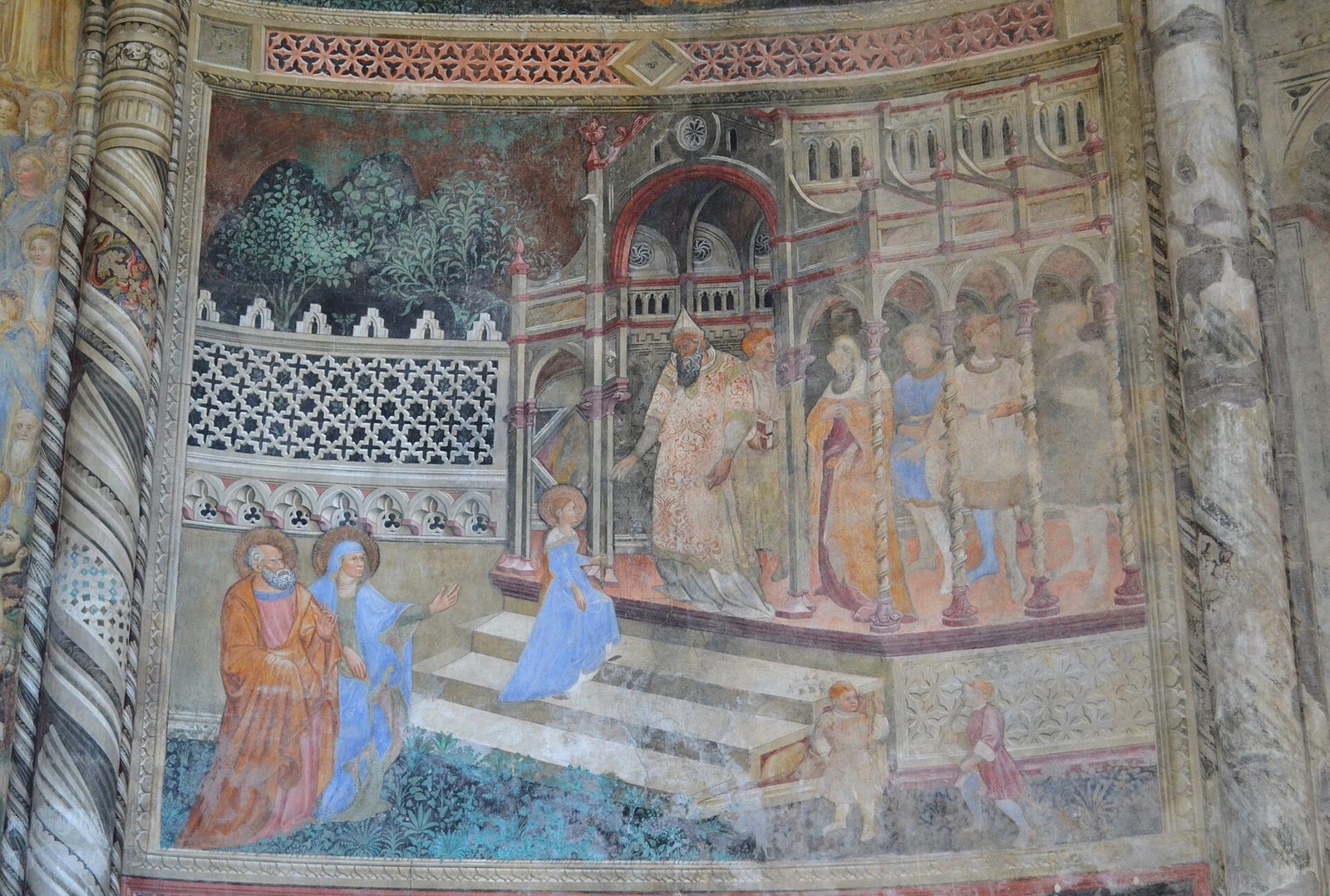
Santa Caterina a Formiello, near Porta Capuana, is a fine Renaissance church with a big dome and a painted interior, and it keeps the relics of the Martyrs of Otranto, killed in 1480. It’s a good last stop before the station.
Toward Toledo and the Royal Palace
Sant’Anna dei Lombardi, also called Monteoliveto, is a treasure-house of Renaissance Naples. There are Tuscan marble chapels, a sacristy with inlaid wooden panels and frescoes by Giorgio Vasari, and a life-size group of terracotta mourners around the dead Christ by Guido Mazzoni, whose faces are so real that they’re thought to be portraits of the court.
San Francesco di Paola closes one side of Piazza del Plebiscito with its colonnade and dome, a neoclassical copy of Rome’s Pantheon. It was built by the Bourbon King Ferdinand I to fulfill a vow on regaining his throne after the Napoleonic years. The interior is cool and rather bare, but the view of the piazza from its steps is one of the grand sights of the city.
The Sanità and Capodimonte
Santa Maria della Sanità, in the valley of the same name, is a domed church with an unusual raised altar above the entrance to the Catacombs of San Gaudioso. It’s the parish at the heart of the neighborhood’s revival. Up the hill, the Madre del Buon Consiglio is a 20th-century copy of St. Peter’s in Rome, interesting mainly as a curiosity next to the entrance to the Catacombs of San Gennaro.
Up on the hill: the Certosa di San Martino
The church of the Carthusian monastery on the Vomero hill, now part of the Certosa museum, is perhaps the most complete baroque church interior in Naples. It’s a riot of colored marble inlay by Cosimo Fanzago, with paintings by Ribera, Guido Reni and Luca Giordano, and choir stalls and sacristy cupboards of astonishing workmanship. It’s visited on the museum ticket, in the under-€10 band, and the museum also holds the finest collection of Neapolitan nativity scenes in the city. The easiest way up is one of the funiculars to the Vomero, covered in the getting around Naples guide.
Great churches beyond the city
The churches don’t stop at the city limits. If you’re taking day trips around the bay, several of the region’s finest religious buildings sit right on your route, and they’re worth building a few minutes into the day.
Amalfi Cathedral. The Duomo of Sant’Andrea rises at the top of a great flight of steps above Amalfi’s main square, its striped facade and bronze doors a reminder that this little town was once a maritime republic trading with Constantinople. Behind it is the Cloister of Paradise, with its interlaced Arab-Norman arches, and in the crypt lie the relics of Saint Andrew the Apostle. Up the hill, Ravello’s cathedral has a marble pulpit covered in mosaics. The Amalfi Coast from Naples guide covers how to get there.
San Michele in Anacapri. On Capri, the small baroque church of San Michele hides one of the most delightful floors in Italy: an 18th-century majolica pavement showing Adam and Eve’s expulsion from the Garden of Eden, surrounded by a menagerie of animals. You look down on it from a raised walkway. It’s a short walk from the main square of Anacapri, and it’s covered in the Capri from Naples guide.
Sorrento’s San Francesco. The cloister of San Francesco in the middle of Sorrento mixes medieval arches of different periods around a garden, and it’s a lovely quiet corner in a busy town. See the Sorrento guide.
The Sanctuary of Pompeii. In the modern town of Pompei, a short walk from the entrance to the ancient city, the Pontifical Shrine of the Blessed Virgin of the Rosary is one of Italy’s great pilgrimage churches, visited by huge crowds on its feast days. Most visitors to the ruins never go in, but it’s worth ten minutes if you’re passing on your way back to the station. The Pompeii from Naples guide covers the trains.
The cathedral of Pozzuoli. On the Rione Terra, Pozzuoli’s cathedral was built inside a Roman temple, and after a fire in the 1960s the ancient columns were exposed and left visible inside the church. The Rione Terra has been affected by the bradyseism, so check the current access arrangements before you plan a visit.
For which of these trips suits your time, the day trips from Naples guide weighs them against each other.
Church walks: how to see the most in a day
Naples’s churches cluster tightly, so the smart way to see them is on foot, grouped by area. Here are three routes that work.
The Spaccanapoli and Tribunali loop (a full day): start at the Gesù Nuovo, cross to Santa Chiara and its cloister, continue down Spaccanapoli to San Domenico Maggiore and the Sansevero Chapel (booked), walk up San Gregorio Armeno to San Lorenzo and San Paolo on Via dei Tribunali, then turn right to the Purgatorio ad Arco, the Pio Monte for Caravaggio and the Girolamini, finishing at the Duomo. Lunch in the middle is a pizza on Via dei Tribunali, and our best pizza in Naples guide shows where.
Via Duomo and the north (a morning): the Duomo, then Donnaregina, San Giovanni a Carbonara and Santa Caterina a Formiello, with Porta Capuana at the end.
The Sanità (a morning, combined with the catacombs): the Catacombs of San Gennaro and the Madre del Buon Consiglio, then down to Santa Maria della Sanità and the Catacombs of San Gaudioso.
Plebiscito to Toledo (an afternoon): start under the colonnade of San Francesco di Paola on Piazza del Plebiscito, walk up Via Toledo to Sant’Anna dei Lombardi for Mazzoni’s terracotta mourners and Vasari’s sacristy, then drop down to the Gesù Nuovo and Santa Chiara. It’s the best route for a day when the Sansevero slots have gone, and it passes the Gallerie d’Italia, where Caravaggio’s last painting hangs, if you want to add a museum stop.
For how these fit into a whole trip, the Naples itinerary page sets out the options, and the full list of things to do in Naples weighs the churches against everything else in the city.
What to skip
- Reseller tickets for the Sansevero Chapel at a markup. Book on the chapel’s official website, and only buy a third-party ticket if it comes with a genuine guided tour you want.
- Trying to see fifteen churches in a day. After the fifth baroque interior, they blur. Choose five or six and give them time.
- Church-hunting in the early afternoon. Many doors are shut from lunchtime until late afternoon. Use that stretch for cloisters, museums and pizza.
- The treasury museum at the Duomo, if you’re short of time. The Royal Chapel is free and more moving. The museum is for lovers of jewelry and silverwork.
- The Madre del Buon Consiglio as a destination. It’s worth a glance if you’re at the San Gennaro catacombs anyway, not a trip on its own.
- Wandering during Mass, especially on Sunday mornings.
Naples churches frequently asked questions
Do you have to book the Sansevero Chapel in advance?
Yes. Visits to the Sansevero Chapel are timed and must be booked. Tickets go on sale 60 days ahead on the official website, with a second release two days before each date, and busy days sell out weeks in advance. The chapel is closed on Tuesdays. Book as soon as your dates are fixed, and don’t rely on buying a ticket at the door.
Can you take photos of the Veiled Christ?
No. Photography is banned throughout the Sansevero Chapel, including the Veiled Christ and the anatomical machines in the crypt, and staff enforce the rule. Part of the experience is simply standing and looking, which the no-photo rule makes easier.
Are churches in Naples free to visit?
Most are. The Duomo, including the Royal Chapel of San Gennaro, Santa Chiara’s church, the Gesù Nuovo, San Domenico Maggiore and hundreds of others cost nothing to enter. You pay for the Sansevero Chapel, the Pio Monte della Misericordia, cloisters such as Santa Chiara’s and San Gregorio Armeno’s, church museums and some guided visits.
What is the most beautiful church in Naples?
For a single work of art, the Sansevero Chapel. For baroque splendor, the Gesù Nuovo, the Girolamini and the church of the Certosa di San Martino. For Gothic grandeur, Santa Chiara and San Lorenzo Maggiore. For sheer charm, the majolica cloister of Santa Chiara. My personal answer is San Giovanni a Carbonara, which almost nobody visits.
When does the blood of San Gennaro liquefy?
Three times a year: on the Saturday before the first Sunday in May, on September 19 (the saint’s feast day), and on December 16. The ceremony takes place in the Duomo, which fills with worshippers from early morning. The next dates are December 16, 2026, and May 1, 2027. Access for sightseers is limited on those days.
What should I wear to visit churches in Naples?
Cover your shoulders and knees. The bigger churches can refuse entry to visitors in shorts or sleeveless tops, and it’s expected everywhere as a matter of respect. In summer, carry a light scarf or overshirt to put on at the door. Hats should come off inside.
Where can I see Caravaggio in Naples?
The Seven Works of Mercy hangs in the church of the Pio Monte della Misericordia on Via dei Tribunali, where Caravaggio painted it to be seen. The Flagellation of Christ is at the Capodimonte museum, and the Martyrdom of Saint Ursula, probably his last painting, is at the Gallerie d’Italia on Via Toledo. All three can be seen in a day.
What time do churches open in Naples?
It varies. The main tourist churches keep daytime hours; the Duomo’s visits run from 9:30 to 17:00, and the Sansevero Chapel opens from 9:00 to 19:00 except Tuesdays. Many parish churches open in the morning, close for a long break from around lunchtime, and reopen in the late afternoon for evening Mass. Check individual churches before a special trip.
Many of these churches come into their own on feast days. The Duomo fills for the three San Gennaro rites, Santa Chiara receives the May procession of the saints’ busts, and the Carmine’s bell tower “burns” with fireworks every July. For the dates and how to see them, see my guide to festivals and events in Naples.
Photo credits
- San Domenico Maggiore interior: photo by Mongolo1984, Wikimedia Commons, CC BY-SA 4.0.
- Terracotta model of the Veiled Christ, Certosa di San Martino: photo by E. della Morte, Wikimedia Commons, CC BY-SA 3.0.
- The Duomo during the feast of San Gennaro: US Navy photo by Petty Officer 1st Class Indra Beaufort, Wikimedia Commons, public domain.
- Santa Chiara majolica cloister: photo by MentNFG, Wikimedia Commons, CC BY-SA 4.0.
- The Gesù Nuovo facade: photo by Berthold Werner, Wikimedia Commons, CC BY-SA 3.0.
- Caravaggio, The Seven Works of Mercy: Wikimedia Commons, public domain.
- San Giovanni a Carbonara, Caracciolo del Sole chapel: photo by Giuseppe Guida, Wikimedia Commons, CC BY-SA 2.0.
Sources: Sansevero booking rules, hours and ticket office from the Museo Cappella Sansevero; Girolamini hours and tickets from the Ministry of Culture’s Girolamini page; Duomo, Treasury museum, Santa Chiara and San Gregorio Armeno details from 2026 visitor listings; San Gennaro dates from the Archdiocese’s fixed calendar. All checked September 2026.