On this page
Last updated September 10, 2026. Street layout and history checked against UNESCO and standard historical sources; opening days and booking rules for the sights mentioned checked against their official sites and current listings. Ticket prices for individual sights live on their own guides, so here I give only rough bands.
In the centro storico, Naples still runs on a Greek grid: three parallel streets, the decumani, crossed by narrow lanes. In this UNESCO-listed old city of Naples, Italy, Spaccanapoli is the lower street, Via dei Tribunali the middle and Via Anticaglia the upper. Walk them in that order and you’ll pass most of the great sights.
The historic center is where you’ll spend most of your time in Naples, and where the concentration of things to see is simply staggering: dozens of major churches, a buried Greek and Roman city under your feet, the Sansevero Chapel, the Duomo, and more pizzerias per square meter than anywhere on earth. It’s also where first-time visitors most often feel lost. Not physically, since the streets are straight, but conceptually. Everyone tells you to “walk Spaccanapoli,” and nobody explains how the old city actually fits together.
That’s what this guide is for. It’s the map, not the list. It explains the Greek street plan that still shapes every walk you’ll take, then goes street by street along each of the three ancient main roads, the decumani, and the lanes that cross them, the cardini, telling you what sits where and what’s worth stopping for. It finishes with walking routes, practical advice and an honest word on what to skip. The individual churches, the underground sites and the castles have their own guides. This page shows you how they connect.
If you’re still choosing what to see in the city as a whole, start with my guide to things to do in Naples, Italy. If you’re thinking of staying in the old city, read where to stay in Naples, Italy first, because the historic center is wonderful and very loud at night.
The Centro Storico, Naples: the old city at a glance
| Street | Ancient name | Modern names | Character | Don’t miss |
|---|---|---|---|---|
| Spaccanapoli | Decumano Inferiore (lower) | Via Benedetto Croce, Via San Biagio dei Librai, continuing east as Via Vicaria Vecchia | The busiest, most famous street: shops, churches, street life | Gesù Nuovo, Santa Chiara, San Domenico Maggiore, the Sansevero Chapel, the Nile statue |
| Via dei Tribunali | Decumano Maggiore (main) | Via dei Tribunali | The ancient main street: pizzerias, churches, the underground | San Lorenzo Maggiore and its excavations, San Paolo Maggiore, Napoli Sotterranea, Pio Monte della Misericordia |
| Via Anticaglia | Decumano Superiore (upper) | Via della Sapienza, Via Pisanelli, Via Anticaglia | Quieter and more residential, with the Roman theater hidden in its buildings | The arches of the Roman theater, the Farmacia degli Incurabili |
| Via San Gregorio Armeno | A cardo (cross-street) | Via San Gregorio Armeno | The street of nativity-scene workshops, linking Spaccanapoli and Tribunali | The workshops, the church and cloister of San Gregorio Armeno |
| Via Duomo | A widened cardo | Via Duomo | A broad 19th-century street cutting north–south through the old grid | The Duomo and the Treasury of San Gennaro, the Girolamini, the Filangieri museum |
How the old city works: the Greek grid
The single most useful thing to understand about the centro storico is that it’s still, essentially, a Greek town plan.
Greek settlers from nearby Cumae founded Neapolis, the “new city,” in the 5th century BC, on the flat ground behind the older settlement of Parthenope on the Pizzofalcone hill. They laid it out on a regular grid. Three long parallel streets ran east–west, the plateiai, which the Romans later called decumani. They were crossed at right angles by some twenty narrow north–south lanes, the stenopoi, later cardini. The blocks between them were long and narrow, and they’re still there. The Romans built on the same plan, the medieval and Baroque city built on top of the Roman one, and the grid survived the lot.
That’s why the historic center feels the way it does. The main streets are dead straight, and the cross-streets are narrow, steep in places, and so regular that you can navigate by counting them. The tall buildings lean in over the lanes, laundry strung between them, because they’re packed into blocks designed for single-story Greek houses. And almost everywhere you walk, there’s another city underneath. The ground level of ancient Neapolis lies several meters below today’s streets, which is why the excavations under San Lorenzo Maggiore and the tunnels of Napoli Sotterranea exist at all.
UNESCO inscribed the historic center of Naples as a World Heritage Site in 1995, recognizing the survival of this ancient plan and the extraordinary layering of monuments on top of it. The protected area covers around 1,021 hectares, well beyond the Greek grid itself. But when people say “centro storico,” they usually mean the ancient core between Via Toledo and Via Duomo, and that’s what this guide concentrates on.
How to use the grid. Think of the three decumani as three rungs of a ladder, running roughly east–west, with Spaccanapoli at the bottom (south), Via dei Tribunali in the middle and Via Anticaglia at the top (north). The narrow cardini are the sides and steps between them. If you get turned around, walk downhill to find Spaccanapoli, or uphill to find Tribunali. The western edge of the old city is Piazza Dante and Via Toledo, and the eastern edge is Via Duomo, beyond which the decumani run on toward Forcella and Castel Capuano.
Spaccanapoli: the lower decumanus
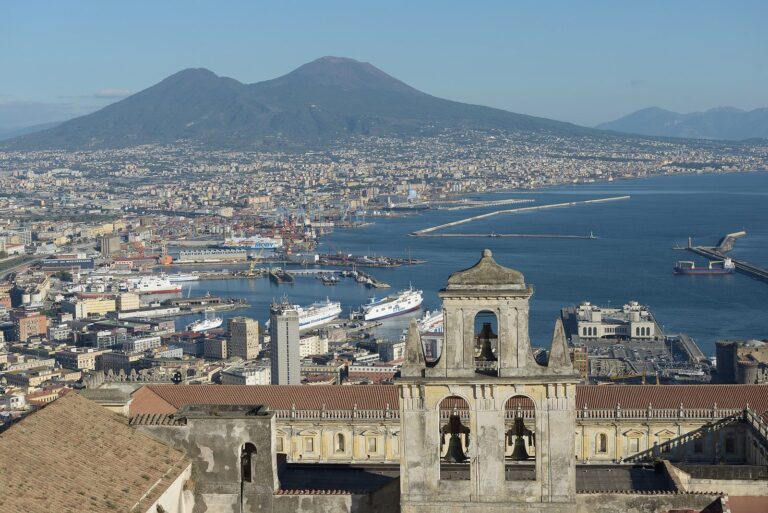
Spaccanapoli, literally “Naples-splitter,” is the name everyone knows. From the hill of San Martino above the city, you can see it as a single straight line slicing the old town in two. Officially it’s a chain of streets: Via Benedetto Croce from Piazza del Gesù Nuovo, then Via San Biagio dei Librai as far as Via Duomo, then Via Vicaria Vecchia beyond. It’s the busiest and most famous street in the historic center, crowded with shops, cafés, churches, street vendors and scooters from morning to late evening. Here’s what you’ll pass, walking east from its western end.
Piazza del Gesù Nuovo
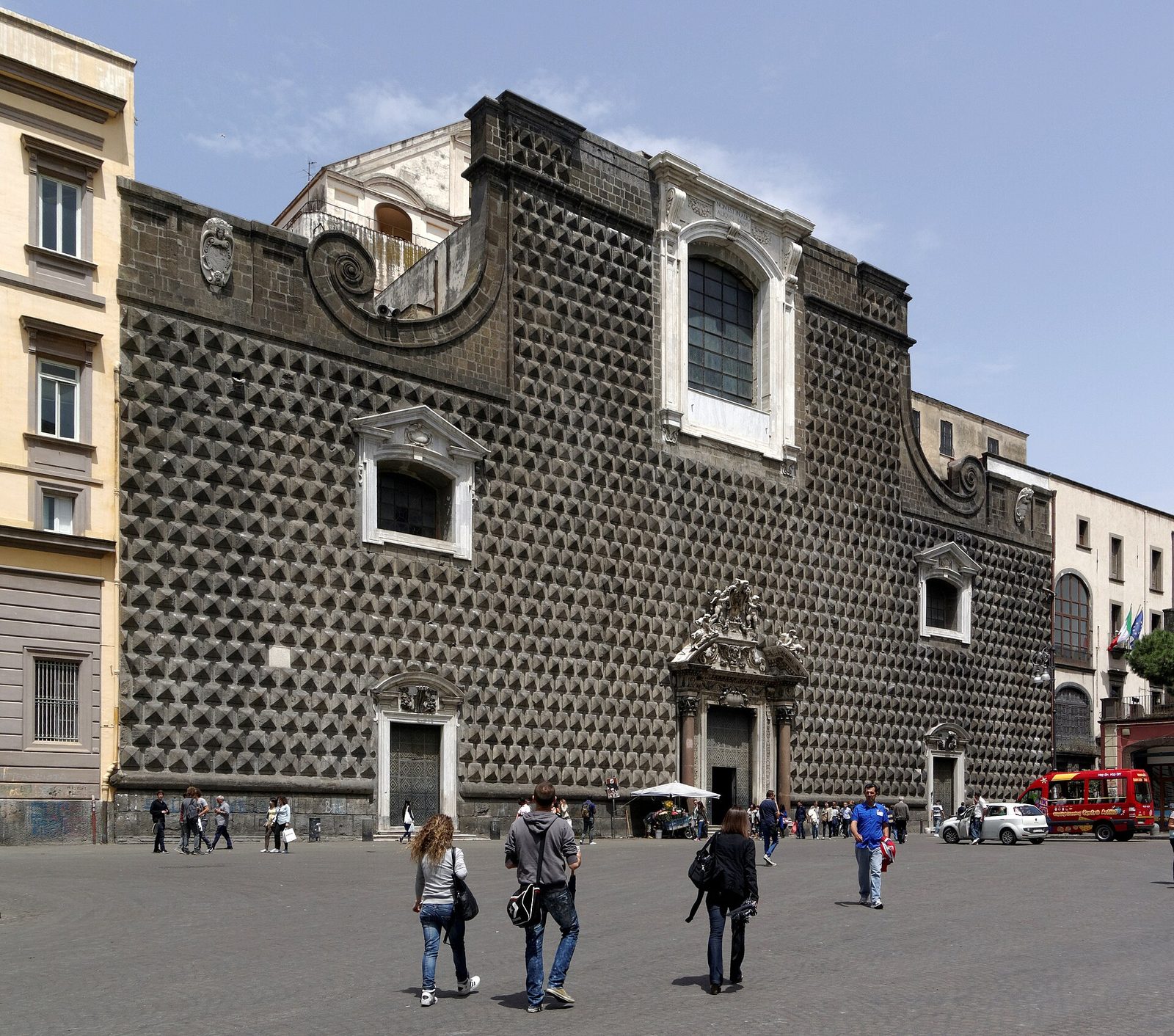
Spaccanapoli begins in Piazza del Gesù Nuovo, a square framed by two remarkable churches and centered on the Guglia dell’Immacolata, a towering Baroque spire of carved marble. On the north side is the church of the Gesù Nuovo, whose extraordinary facade of diamond-pointed gray stone is the facade of a 15th-century palace. The Jesuits converted it into a church and kept the front, and behind it the interior is a riot of Baroque marble and fresco. It’s free to enter, and one of the most striking churches in the city.
Santa Chiara
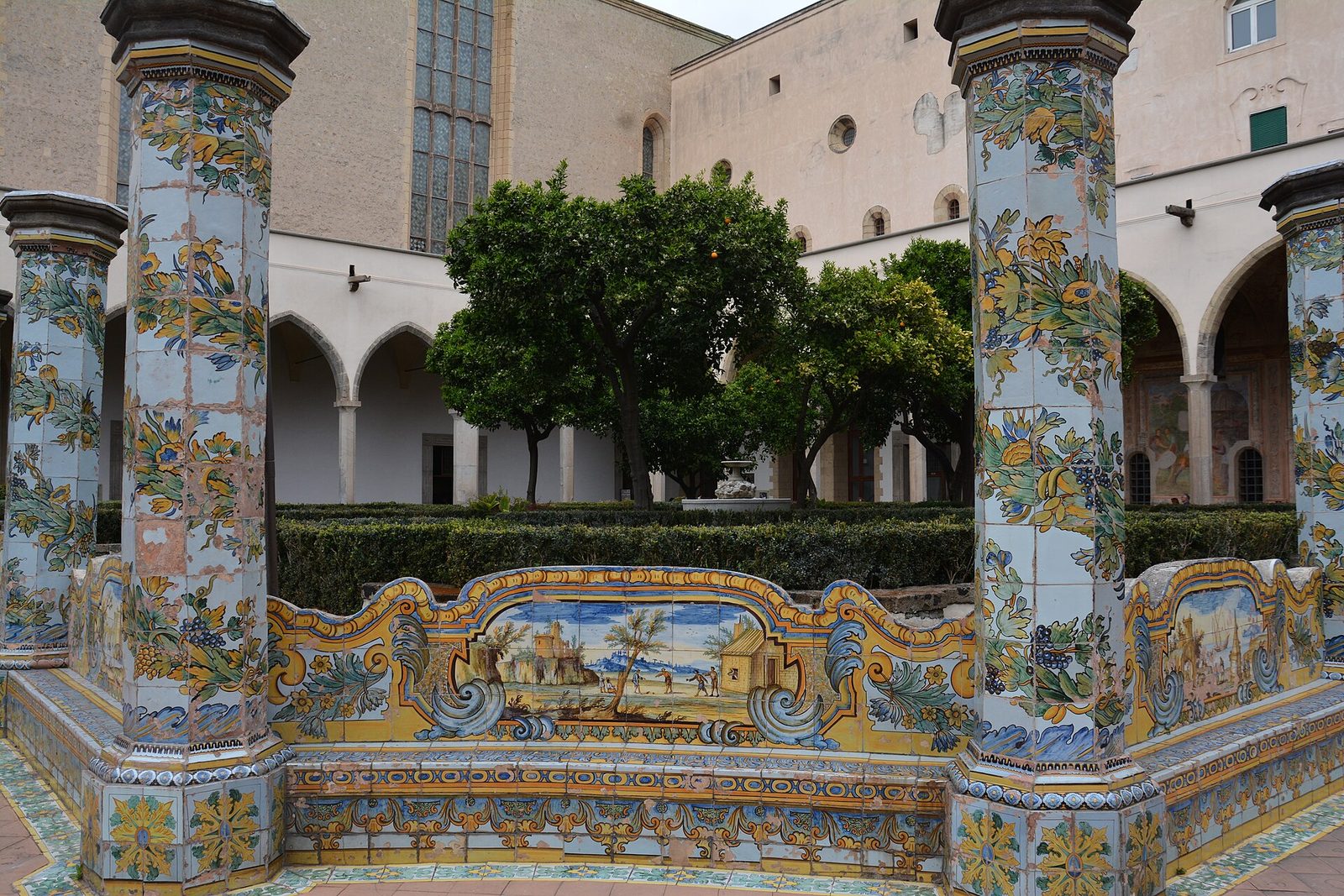
Across the street stands the complex of Santa Chiara: a huge, austere Gothic basilica, rebuilt after wartime bombing, and behind it the cloister of the Poor Clares. The cloister is one of the loveliest spaces in Naples. Its garden paths are lined with 18th-century columns and benches covered in hand-painted majolica tiles showing country scenes, vines and lemon trees. The basilica is free. The cloister, museum and archaeological area are paid and ticketed at the office on site. The complex has no weekly closing day, but it closes early on Sunday afternoons.
Piazza San Domenico Maggiore and the Sansevero Chapel
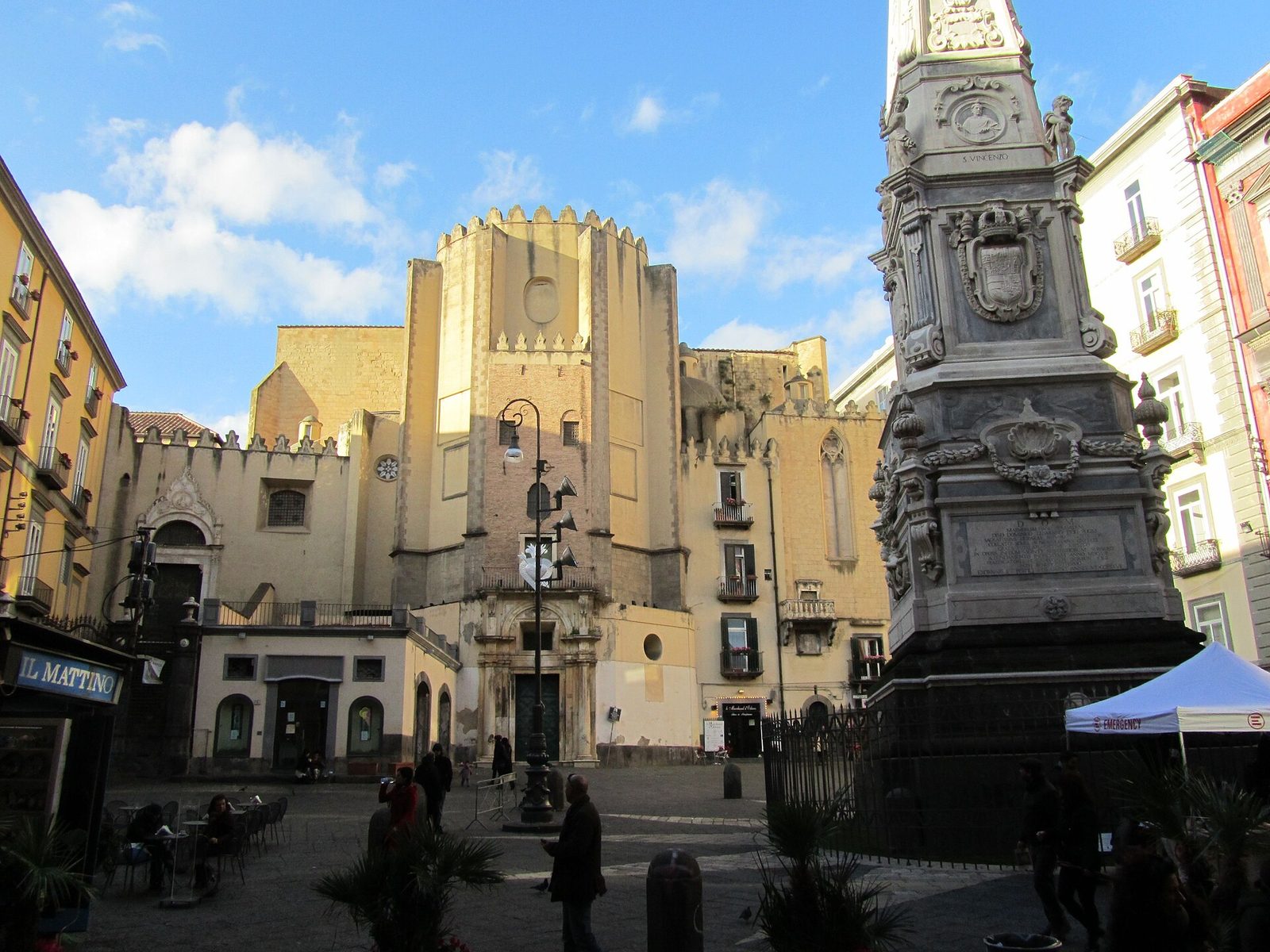
A few minutes east, Spaccanapoli opens into Piazza San Domenico Maggiore, with its own Baroque spire and the back of the great Gothic church of San Domenico Maggiore rising above the square. The church, reached by a staircase from the piazza, is one of the most important in Naples, and the sacristy is lined with the coffins of Aragonese royalty. The square is a good place for a coffee, and the historic Scaturchio pastry shop is here.
Just off the square, in Via Francesco de Sanctis, is the Sansevero Chapel, home of the Veiled Christ, Giuseppe Sanmartino’s marble figure of the dead Christ under a shroud so fine it seems transparent, and the most extraordinary single work of art in the historic center. Visits require a timed booking, released 60 days ahead, with a small second release two days before. The ticket office is temporarily around the corner on Via Raimondo di Sangro. The chapel is closed on Tuesdays, and photography is not allowed inside. Book it before you do anything else in this guide.
The Nile statue and Via San Biagio dei Librai
Continuing east, Spaccanapoli becomes Via San Biagio dei Librai, the street of the booksellers. At the small Largo Corpo di Napoli stands the Roman statue of the Nile, a reclining river god from the days when Alexandrian merchants lived in this quarter. Neapolitans have long called it the “body of Naples.” Next to it is the church of Sant’Angelo a Nilo, and along the street you’ll pass jewelers, gold workshops, bookshops and the famous Ospedale delle Bambole, the century-old “doll hospital.” Where Via San Gregorio Armeno crosses Spaccanapoli, turn north for the nativity workshops, described below.
To Via Duomo and beyond
Spaccanapoli meets Via Duomo at a busy crossroads. Beyond it, as Via Vicaria Vecchia, it runs on into Forcella, one of the most traditional working-class quarters of the city, lively, crowded and much less touristy. Most visitors turn back at Via Duomo. If you’re curious, walk on for a block or two to see a very local Naples.
Via dei Tribunali: the main decumanus
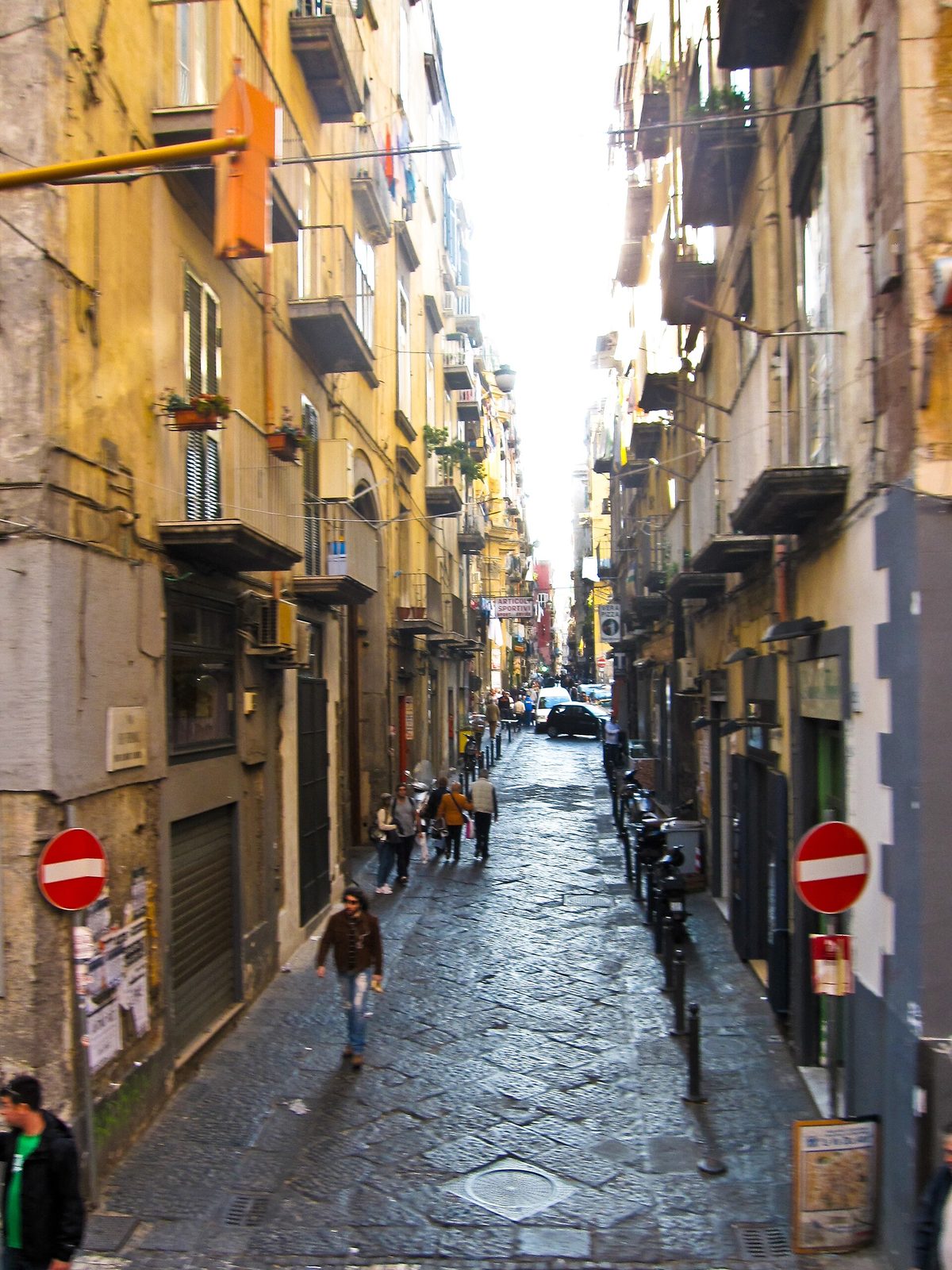
Via dei Tribunali, the decumanus maximus or Decumano Maggiore, was the main street of ancient Neapolis. It runs parallel to Spaccanapoli, one block uphill, from the area of Piazza Bellini in the west to Castel Capuano in the east, whose law courts gave the street its name. It’s narrower and darker than Spaccanapoli, arcaded in places, and it’s the historic pizza street, lined with some of the most famous pizzerias in the world, as well as a remarkable number of churches. Walking east:
Piazza Bellini and the Greek walls
At the western end, Piazza Bellini is a leafy square of cafés and bars, the social heart of the university quarter, busy late into the night. In a sunken area in the middle of the square, you can see a stretch of Neapolis’ original Greek city walls, excavated below street level. It’s a vivid reminder that the ancient city lies a story or two beneath your feet. Nearby, the church of Santa Maria Maggiore della Pietrasanta, with its medieval bell tower, marks the start of Via dei Tribunali.
Purgatorio ad Arco and the pizzerias
Heading east, look out for the church of Santa Maria delle Anime del Purgatorio ad Arco, with its bronze skulls on the posts outside. Beneath it is a hypogeum where, until the practice was banned in the 20th century, Neapolitans adopted and cared for anonymous skulls, the capuzzelle, in return for favors from the souls of purgatory. It’s one of the strangest and most fascinating places in the city. Along this stretch are some of the best-known pizzerias in Naples, with queues outside at lunchtime and in the evening. Come a little early or late, or be prepared to wait.
Piazza San Gaetano: the ancient agora
Halfway along, Via dei Tribunali opens into Piazza San Gaetano, which stands on the site of the ancient city’s agora and later its Roman forum, the heart of Neapolis. On its north side, the church of San Paolo Maggiore stands on the site of the Roman temple of the Dioscuri, and two ancient Corinthian columns still frame its facade. On the south side is the Gothic church of San Lorenzo Maggiore. And at number 69, the entrance to Napoli Sotterranea leads down into the network of Greek and Roman cisterns and tunnels under the old city.
San Lorenzo Maggiore and the buried city
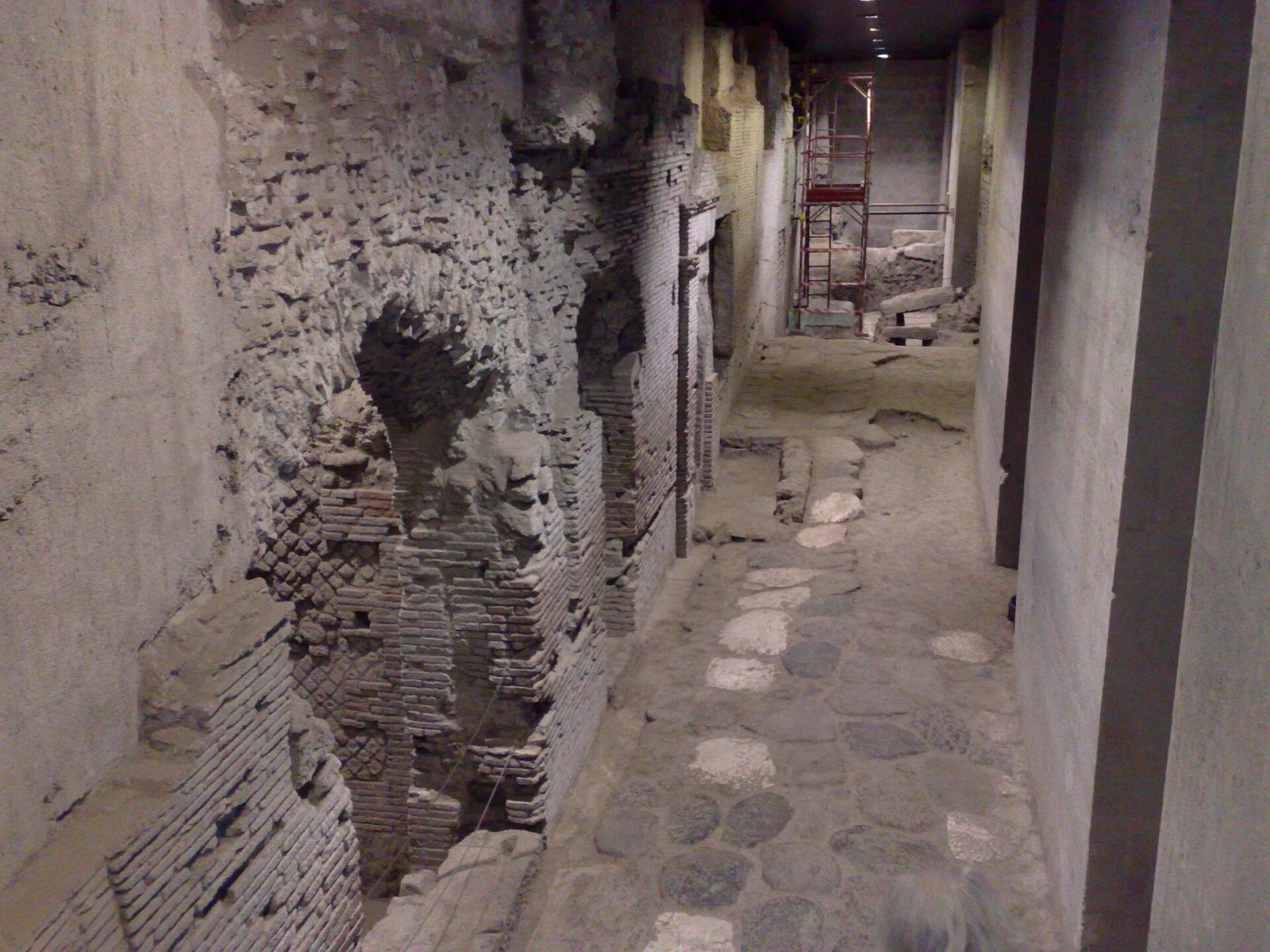
San Lorenzo Maggiore is one of the finest Gothic churches in Naples, but the real reason to visit is underneath it. Excavations below the cloister have uncovered a section of the Roman city: a paved street, shops, workshops and a market hall, the Roman macellum, several meters below the modern ground level. Walking along a Roman street beneath a medieval church, in the middle of a living city, is one of the most remarkable experiences in Naples, and it makes the idea of the “layered city” completely concrete.
Napoli Sotterranea
The Napoli Sotterranea (Underground Naples) tour starts on Piazza San Gaetano and takes you some 40 meters below the street into the tuff quarries and cisterns that supplied the city’s water from Greek times until the late 19th century, and that sheltered Neapolitans during the Second World War air raids. The tour also visits a section of the Roman theater, reached through an ordinary ground-floor home. Visits are guided only and last around 90 minutes, with tours in English at set times. The site is open every day, and booking ahead is wise at weekends and in high season. It isn’t suitable for children under 10, and some passages are very narrow.
Pio Monte della Misericordia and the eastern end
Toward Via Duomo, the small church of Pio Monte della Misericordia holds one of the greatest paintings in Naples: Caravaggio’s Seven Works of Mercy, painted for this church in 1607 and still hanging above the altar where it was always meant to be seen. Beyond Via Duomo, Via dei Tribunali continues east to Castel Capuano, a Norman castle that served for centuries as the city’s law courts.
How the old city was built: five layers in one walk
What makes the historic center so absorbing is that every period of Naples’ history is visible at once, often in the same building. Once you know the layers, you start reading them everywhere.
Greek and Roman Neapolis. The grid itself is the oldest layer: the three decumani and their cross-streets, laid out by Greek settlers in the 5th century BC and kept by the Romans. Neapolis stayed Greek in language and culture long into Roman times, and wealthy Romans prized it as a place of leisure and learning. Today the ancient city survives mostly below ground: in the Roman street under San Lorenzo Maggiore, the cisterns of Napoli Sotterranea, the Greek walls in Piazza Bellini and the theater hidden in the blocks of Via Anticaglia. Above ground, you see it in the temple columns on the facade of San Paolo Maggiore.
Medieval and Angevin Naples. From the 13th century, the French Angevin kings made Naples a royal capital and filled the old city with great Gothic churches: Santa Chiara, San Lorenzo Maggiore and San Domenico Maggiore were all built or rebuilt in this period. Their tall, austere naves are the second layer, and Castel Capuano, a Norman castle at the eastern end of Via dei Tribunali, is older still.
Spanish and Baroque Naples. Under the Spanish viceroys of the 16th and 17th centuries, Naples became one of the largest cities in Europe. The viceroy Pedro de Toledo laid out Via Toledo in 1536 on the western edge of the old city, and as the population exploded, buildings inside the ancient grid rose ever higher, turning its lanes into the canyons you walk today. Then came the Baroque, which dressed the old city in marble and gold: the Gesù Nuovo, created from a Renaissance palace, the soaring spires in the squares, and in the 18th century the Sansevero Chapel and its Veiled Christ. The nativity-making craft of San Gregorio Armeno flourished in the same century.
The 19th-century rebuilding. After a devastating cholera epidemic in 1884, the city launched the Risanamento, a “making healthy” program that cut broad new streets through the crowded lower city. Corso Umberto I, known locally as the Rettifilo (“the straight line”), and the widening of Via Duomo date from this era. They opened up the old center to light and traffic, and destroyed a great deal of it in the process.
War and recovery. Allied bombing in the Second World War badly damaged the old city. In August 1943, Santa Chiara was hit and gutted by fire, and its Baroque interior was lost. It was rebuilt in its original Gothic form, which is why it looks so bare today. UNESCO’s recognition in 1995 marked the start of a long, slow effort to protect and restore the historic center, which is still very much a place where people live and work.
Via Anticaglia: the upper decumanus
The third and northernmost of the ancient main streets is the least known and, for many people, the most atmospheric. The Decumano Superiore runs as Via della Sapienza and Via Pisanelli from the Piazza Bellini end, then as Via Anticaglia toward Via Duomo. It’s quieter and more residential than the two streets below it, with fewer shops and far fewer tourists, and it gives you a sense of the old city as a place where people simply live.
The name Anticaglia comes from the “antiquities” that line it. The street runs past the site of the ancient Roman theater of Neapolis, where the emperor Nero once performed, and two great brick arches that supported the theater still span the street above your head. The rest of the theater survives hidden inside the surrounding buildings, its curve preserved in the shape of the blocks. Part of it is visited on the Napoli Sotterranea tour, reached through what looks from outside like an ordinary ground-floor home.
Near the western end of the upper decumanus, the old Ospedale degli Incurabili, the “hospital of the incurables,” founded in the 16th century, houses the Farmacia degli Incurabili. It’s an 18th-century pharmacy with carved walnut shelves lined with majolica apothecary jars, one of the most beautiful interiors in Naples. It’s part of a small museum of the history of medicine, and opening arrangements have varied over the years, so check before you go. Along the street, look out for the Baroque church of San Giuseppe dei Ruffi, and for the glimpses into cloisters and courtyards through half-open doors.
Walk Via Anticaglia when the lower streets feel too crowded. It’s the best place in the historic center to slow down.
The cross-streets: San Gregorio Armeno, Via Duomo and the cardini
Between the three decumani run the narrow north–south lanes of the ancient grid. Most are simply beautiful to wander, but a few are destinations in their own right.
Via San Gregorio Armeno: the nativity street
The most famous cross-street in Naples links Spaccanapoli and Via dei Tribunali, and it’s lined from end to end with the workshops of the presepe makers, the craftsmen who produce Naples’ famous nativity scenes. Their stalls overflow with hand-made figures of shepherds, bakers, fishmongers and angels, miniature market stalls and taverns, running water features, and satirical figures of footballers, politicians and celebrities, updated every year. It’s busy all year and astonishingly crowded in the weeks before Christmas. Go early on a weekday morning if you want to see the workshops rather than the backs of other visitors’ heads.
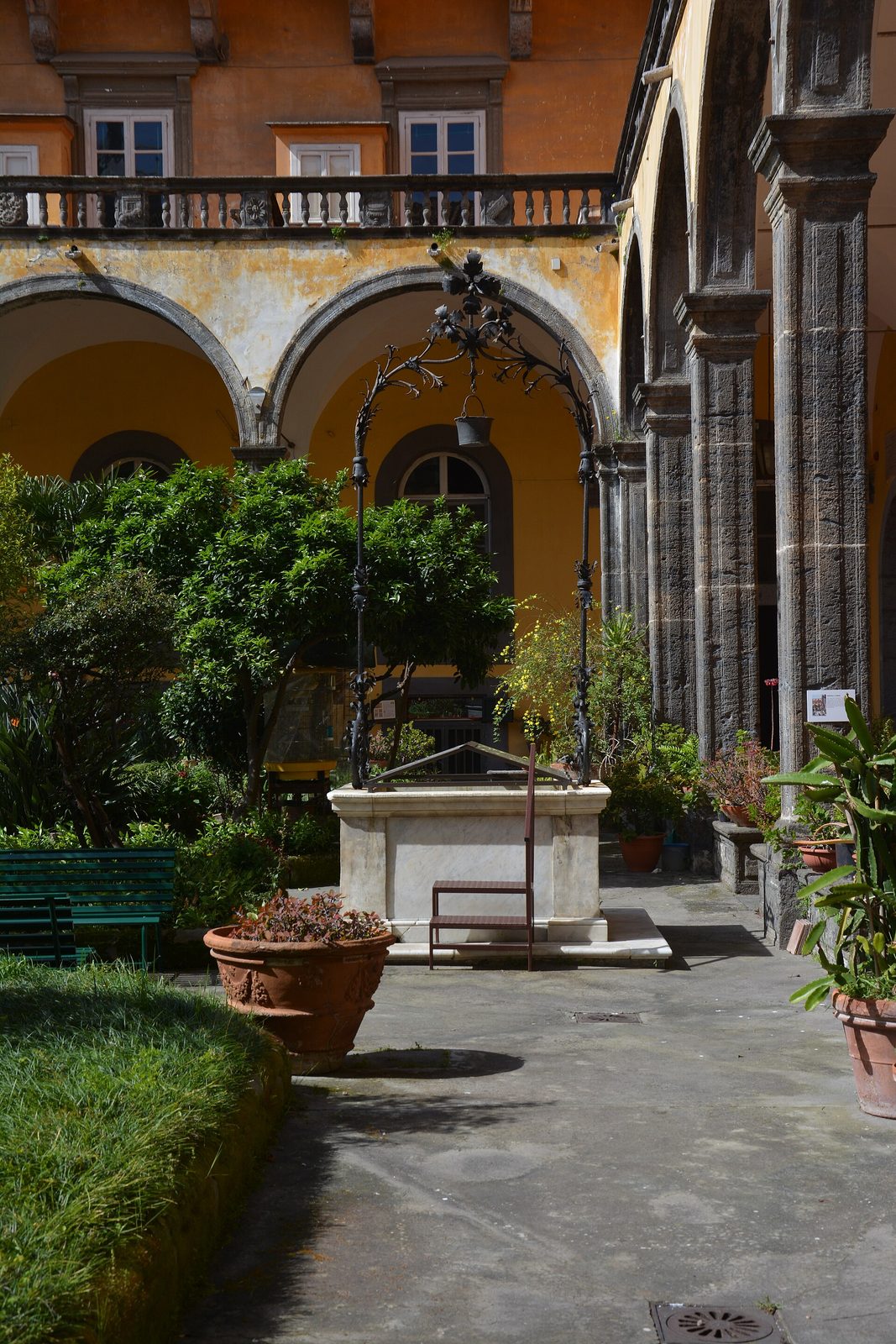
Halfway up the street, the church of San Gregorio Armeno is one of the most lavish Baroque interiors in the city, all gold and fresco. Behind it is the peaceful cloister of the nuns’ convent, with a fountain, citrus trees and views of the bell tower, entered from the lane at the side.
Via Duomo: the cathedral and its neighbors
Via Duomo is the broad street that forms the eastern edge of the ancient core. It was widened in the 19th century, cutting through the old grid, but it’s lined with some of the most important buildings in the city.
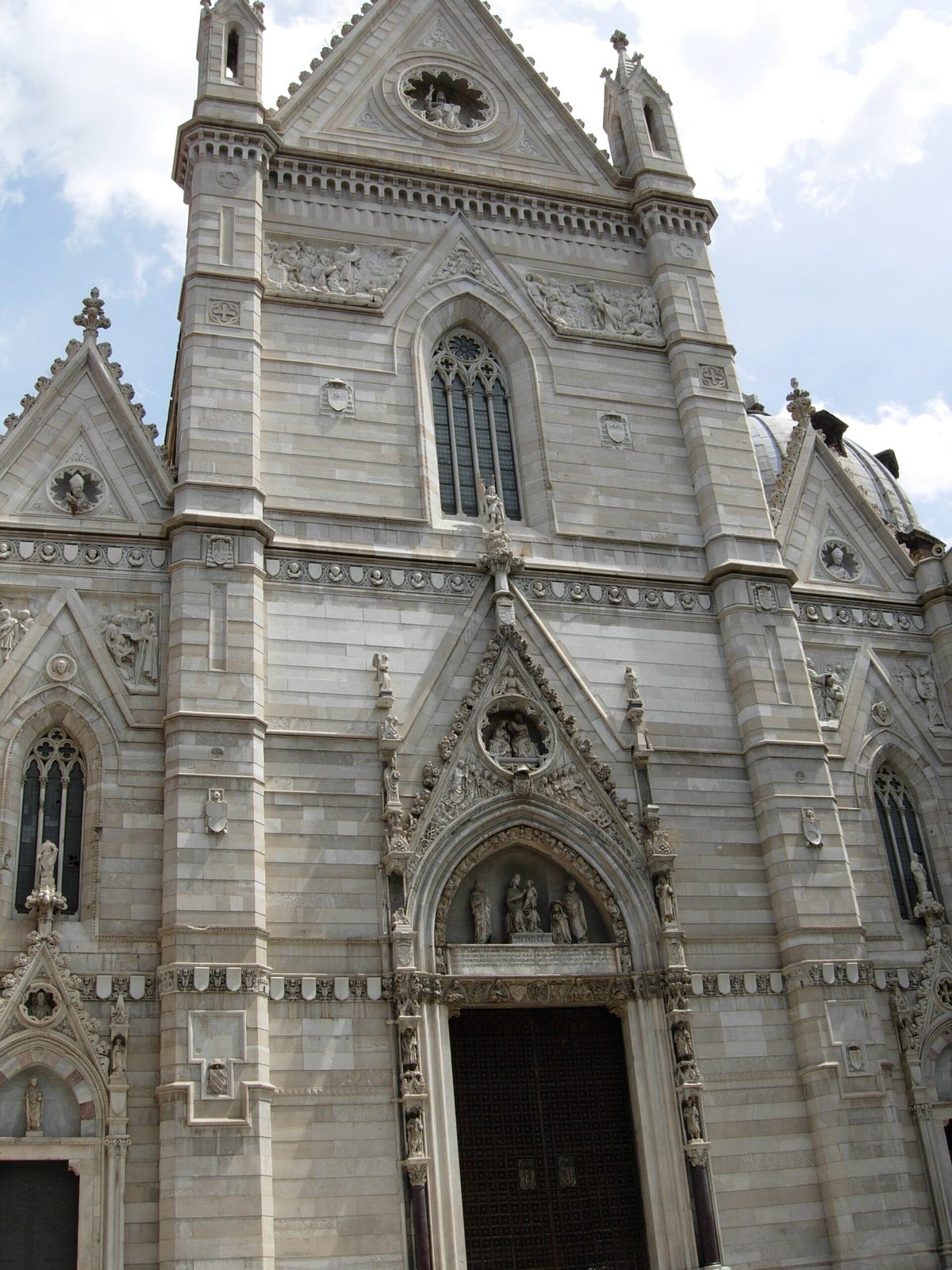
The Duomo, the cathedral of Naples, dedicated to the Assumption but known to everyone as the cathedral of San Gennaro, stands behind a 19th-century Gothic Revival facade. Inside, it’s a history of the city in stone. The Royal Chapel of the Treasury of San Gennaro, a Baroque chapel dripping with silver and fresco, keeps the relic of the saint’s blood, whose liquefaction three times a year is the city’s most important religious event. Off the left aisle, the basilica of Santa Restituta is the oldest church in Naples, built on the site of a temple of Apollo, and its baptistery of San Giovanni in Fonte, with its 4th- and 5th-century mosaics, is one of the oldest baptisteries in the Western world. The cathedral itself is free. The Treasury of San Gennaro museum next door is a separate paid visit and well worth it.
Across and along the street are the Girolamini, a vast church and convent complex with an important picture gallery and a historic library, and the Museo Filangieri, a prince’s eclectic collection of art and armor in a Renaissance palace.
The other cardini
Via Mezzocannone runs downhill from Spaccanapoli to the university and Corso Umberto, lined with student bars and copy shops. Via Nilo, beside the Nile statue, links Spaccanapoli to Via dei Tribunali. The dozens of smaller lanes between them, the vicoli, are where the old city is at its most intimate: shrines built into walls, washing lines overhead, doorways into centuries-old courtyards. You don’t need a plan for them. Turn off the main streets and wander.
The squares of the old city
- Piazza del Gesù Nuovo: the western gateway to Spaccanapoli, with the Gesù Nuovo, Santa Chiara and the Guglia dell’Immacolata. A lively meeting point, busy with students in the evening.
- Piazza San Domenico Maggiore: the heart of Spaccanapoli, with the apse of San Domenico above the square, a Baroque spire, cafés and the famous Scaturchio pastry shop. The Sansevero Chapel is around the corner.
- Largo Corpo di Napoli: the tiny square with the Roman statue of the Nile.
- Piazza San Gaetano: the ancient agora on Via dei Tribunali, with San Paolo Maggiore, San Lorenzo Maggiore and the entrance to Napoli Sotterranea.
- Piazza Bellini: leafy, bohemian and busy late, with the Greek walls visible in its sunken center and bars all around.
- Piazza Dante and Port’Alba: the western edge of the old city. Port’Alba, a 17th-century gateway lined with secondhand bookstalls, leads from Piazza Dante into the historic center.
Markets, shops and street food
The historic center isn’t just monuments. It’s a working neighborhood, and some of its best experiences are about eating, shopping and simply watching the city go by.
- Street food. Look for pizza fritta (deep-fried pizza), the cuoppo (a paper cone of fried seafood or vegetables), frittatine (fried pasta balls) and arancini, sold from hole-in-the-wall counters along Spaccanapoli and Via dei Tribunali. Pizza a portafoglio, a small pizza folded in four and eaten on the go, is the classic cheap lunch.
- Pastries. The historic center is full of pastry shops selling sfogliatelle, the shell-shaped ricotta pastries (crisp riccia or soft frolla), babà soaked in rum, and at Easter the pastiera.
- Coffee. Take it standing at the bar, the Neapolitan way. It’s quick, strong and cheap.
- Nativity figures on Via San Gregorio Armeno, from mass-produced souvenirs to museum-quality hand-made pieces.
- Books and old prints at the stalls of Port’Alba and the shops of Via San Biagio dei Librai.
- Markets on the edge of the old city: the Porta Nolana market, near the Circumvesuviana terminus east of the center, is a noisy, glorious fish and produce market, liveliest in the morning. Forcella, beyond Via Duomo, is full of market stalls and street life.
Three walking routes through the centro storico
Route 1: the classic loop (2–3 hours plus stops)
Start in Piazza del Gesù Nuovo and visit the Gesù Nuovo and Santa Chiara. Walk east along Spaccanapoli to Piazza San Domenico Maggiore and the Sansevero Chapel (booked in advance). Continue past the Nile statue, then turn north up Via San Gregorio Armeno through the nativity workshops. At the top, turn west along Via dei Tribunali, past San Lorenzo Maggiore and San Paolo Maggiore on Piazza San Gaetano, the Purgatorio ad Arco and the pizzerias, and finish in Piazza Bellini for a drink. Add the Duomo at the eastern end if you have time. It’s the best introduction to the old city.
Route 2: the underground and the Roman city (half a day)
Start at San Lorenzo Maggiore and walk the Roman street and market under the church. Cross Piazza San Gaetano for a booked Napoli Sotterranea tour, including the cisterns and the Roman theater. Then visit the skull cult under the Purgatorio ad Arco, and finish in Piazza Bellini at the Greek walls. It’s a morning that makes the layered city real, and a good choice on a rainy or very hot day, because much of it is underground.
Route 3: the quieter upper city (2 hours)
Start at the Piazza Bellini end of the upper decumanus and walk Via della Sapienza, Via Pisanelli and Via Anticaglia, passing the Incurabili and the arches of the Roman theater. At Via Duomo, visit the cathedral and the Treasury of San Gennaro, then walk down to Pio Monte della Misericordia on Via dei Tribunali for Caravaggio’s Seven Works of Mercy. If you’re curious, continue east toward Castel Capuano and the market streets of Forcella for a very local view of Naples.
Practical tips for the historic center
- Book the Sansevero Chapel first. It’s the one sight in the historic center that you can’t count on walking into, with timed booking released 60 days ahead. It’s closed on Tuesdays.
- Mind the closing days. The Sansevero Chapel and the nearby National Archaeological Museum both close on Tuesdays. Santa Chiara and Napoli Sotterranea have no weekly closing day.
- Churches in the morning. Many of the smaller churches close for a few hours in the early afternoon, while the larger complexes and museums stay open. Plan churches for the morning.
- Dress for churches. Covered shoulders and no very short shorts, especially in summer.
- Be respectful during Mass. These are working churches, so visit quietly and keep away from services.
- Watch for scooters. They ride through even the narrowest lanes. Keep to the side and look both ways.
- Keep valuables close. Pickpockets work the crowds, especially on Via San Gregorio Armeno in the Christmas season and in the pizzeria queues.
- Getting there. Metro Line 1 stations at Dante, Università and Duomo are all on the edge of the old city, and the historic center is a short walk from Via Toledo.
- Accessibility. The streets are paved with uneven volcanic stone, and many churches have steps. The underground sites involve stairs and narrow passages.
Beyond the old city: where to go next
The historic center sits at the heart of everything else in Naples, and it’s easy to head out from here.
- The National Archaeological Museum is a short walk north from Piazza Dante, and it holds the mosaics and frescoes from Pompeii and Herculaneum. See it before your trip to the ruins, which is covered in my guide to Pompeii from Naples.
- The Circumvesuviana to Herculaneum, Pompeii and Sorrento leaves from Porta Nolana and Garibaldi, a short walk east of Via Duomo, and the shuttle up the volcano starts at Ercolano. My Mount Vesuvius guide explains how it works.
- Molo Beverello, where the hydrofoils to Capri leave, is about a 20-minute walk downhill from Spaccanapoli. For the island itself, see my guide to Capri from Naples.
- The Amalfi Coast is a longer day out by ferry, or by train and bus. I compare every route in the Amalfi Coast from Naples.
- Via Toledo and the Quartieri Spagnoli are just west of Piazza del Gesù Nuovo, and Piazza del Plebiscito and the seafront are a 15-minute walk beyond.
What to skip
- Turning up at the Sansevero Chapel without a booking. Timed slots sell out.
- Via San Gregorio Armeno at midday in December. It’s shoulder to shoulder. Go first thing on a weekday.
- Queuing an hour for one famous pizzeria. The standard on Via dei Tribunali is so high that the place next door is almost always excellent.
- Trying to see every church. There are dozens. Choose a handful and leave time to wander.
- Staying only on Spaccanapoli. The upper decumanus and the side lanes are where the old city feels most like itself.
- Cheap souvenir stalls on the main drag. If you want a nativity figure, buy one hand-made piece from a real workshop rather than a bag of mass-produced trinkets.
Frequently asked questions about the centro storico of Naples
What is the centro storico of Naples?
It’s the historic center of Naples, Italy, the old city built on the grid of the Greek colony of Neapolis, founded in the 5th century BC. It’s a UNESCO World Heritage Site, inscribed in 1995, and it contains most of the city’s great churches, the Sansevero Chapel, the Duomo and the underground Greek and Roman city.
What is Spaccanapoli?
Spaccanapoli, “Naples-splitter,” is the popular name for the lower of the three ancient main streets of the historic center, made up of Via Benedetto Croce and Via San Biagio dei Librai. It runs dead straight from Piazza del Gesù Nuovo to Via Duomo, past Santa Chiara, San Domenico Maggiore and the Sansevero Chapel.
What are the decumani of Naples?
The decumani are the three parallel east–west main streets of the ancient Greek and Roman city: the Decumano Inferiore (Spaccanapoli), the Decumano Maggiore (Via dei Tribunali) and the Decumano Superiore (Via Anticaglia and its continuations). They’re crossed by narrow north–south lanes called cardini.
Is the historic center of Naples safe?
Yes, for visitors using ordinary big-city sense. It’s busy from morning until late at night, which helps. The main risks are pickpockets in crowds and scooters in the narrow lanes. Keep valuables out of sight and walk on the main streets late at night.
How long do you need in the centro storico?
You can walk the classic loop in two to three hours, but to see the Sansevero Chapel, the Duomo, San Lorenzo’s excavations and an underground tour properly, give it a full day, ideally spread over two. Many visitors return to the historic center every day of their stay.
When is the best time of day to walk Spaccanapoli?
Early morning, before about 10:00, when the shops are opening, the churches are open and the crowds haven’t built up. The early evening is lovely too, when the street fills with locals. Avoid midday in high summer, when the narrow streets trap the heat.
Can you visit the Sansevero Chapel without booking?
Don’t count on it. Visits require a timed booking, released 60 days ahead, with a small second release two days before. In busy periods, slots sell out well in advance. Book as soon as your dates are fixed, and remember the chapel is closed on Tuesdays.
Is it worth staying in the centro storico?
For atmosphere, yes. You’ll step out of your door into the heart of the old city. But it’s very noisy at night, many buildings have no lift, and ground-floor rooms can be dark. If you’re a light sleeper, stay on the Toledo side and walk in. It’s five minutes away.
Where does Spaccanapoli start and end?
It starts at Piazza del Gesù Nuovo in the west and runs east, as Via Benedetto Croce and then Via San Biagio dei Librai, to Via Duomo, roughly a kilometer. Beyond Via Duomo it continues as Via Vicaria Vecchia into Forcella. Walked without stopping, the main stretch takes about 15 minutes. With stops, it takes most of a morning.
Is the centro storico the same as the old town?
Yes. Centro storico is Italian for “historic center,” and in Naples it means the old town: the ancient grid of Spaccanapoli, Via dei Tribunali and Via Anticaglia and the lanes around them, between Via Toledo and Via Duomo. The UNESCO-protected area is larger and takes in other historic districts too.
Via dei Tribunali is the historic pizza street, and the queues outside its best-known doors are part of the scenery. Before you join one, read my guide to where to eat pizza in Naples, which covers the name-at-the-door systems, the classics and the pizzerias locals rank highest.
The old town is also where most of the city’s traditional trattorias cluster, alongside a few places that exist mainly to catch visitors. I explain how to tell them apart, and which long-established names have earned their reputations, in my Naples restaurant guide.
The Greek street grid you’re walking has a second level. From Piazza San Gaetano on Via dei Tribunali, the Napoli Sotterranea tour takes you down into the old cisterns and then through a private home into the buried Roman theater. Across the square, the excavations under San Lorenzo Maggiore expose a Roman market street you can explore without a guide. My underground Naples guide compares those two with the other sites in the city, including the catacombs and the Galleria Borbonica.
Almost every great church in Naples stands inside this grid: the Gesù Nuovo and Santa Chiara at the top of Spaccanapoli, the Sansevero Chapel and San Domenico Maggiore halfway along, and San Lorenzo, the Pio Monte and the Duomo up on Via dei Tribunali and Via Duomo. The Naples churches guide covers which to prioritize, when they’re open and what to wear.
Photo credits
- Piazza San Domenico Maggiore (featured image): photo by IlSistemone, Wikimedia Commons, CC BY-SA 3.0.
- Santa Chiara majolica cloister: photo by MentNFG, Wikimedia Commons, CC BY-SA 4.0.
- The cloister of San Gregorio Armeno: photo by MentNFG, Wikimedia Commons, CC BY-SA 4.0.
- The Duomo facade: photographer unknown, Wikimedia Commons, public domain.
- The Gesù Nuovo facade: photo by Berthold Werner, Wikimedia Commons, CC BY-SA 3.0.
- The Roman street under San Lorenzo Maggiore: photo by IlSistemone, Wikimedia Commons, CC BY-SA 3.0.
- Via dei Tribunali: photo by Armando Mancini, Wikimedia Commons, CC BY-SA 2.0.
Sources: UNESCO World Heritage listing for the historic center of Naples; opening days and booking rules from the Sansevero Chapel, the Santa Chiara complex and Napoli Sotterranea (checked September 10, 2026, some via current visitor listings). Individual ticket prices are covered on each sight’s own guide. Opening arrangements change: confirm before you go.