On this page
Last updated September 25, 2026. Opening days, booking rules and meeting points checked against each operator’s own site and the City of Naples page for the Fontanelle cemetery. Where operators and guidebooks disagree, I say so.
The Naples underground is not one attraction but half a dozen, run by rival operators. For a first visit to Naples, Italy, take the Napoli Sotterranea tour on Via dei Tribunali for Greek cisterns and wartime shelters, add the Catacombs of San Gennaro for early Christian art, and save the Galleria Borbonica for a weekend.
Beneath the old city there is a second one. It is made of the quarries the Greeks cut for building stone, the cisterns the Romans turned them into, a 17th-century aqueduct, the air-raid shelters where much of the city waited out the bombing of 1943, and burial galleries older than most of the churches standing above them. Somewhere between twenty and forty meters down, depending on where you enter, the temperature stops caring what month it is and the noise of the Vespas disappears completely.
The trouble is the way it’s sold. Every operator markets its own slice as “Naples Underground.” Two of them use almost the same name. The ticket sellers working the corner of Via dei Tribunali are happy to let you believe there is only one door, and it happens to be the one they get commission on. Search results are no help either: each page is written by, or for, one operator, and none of them mentions the others except in passing.
So this is the map I wish someone handed out at the station. It covers what each underground site actually is, how they differ, which to pick if you only have an afternoon, and the warnings about narrow passages, stairs and small children that sit in the small print or aren’t printed at all. The underground sits under the same streets as the rest of the centro storico of Naples, so most of it slots into a day you were going to spend there anyway.
Naples underground sites compared: which door leads where
Here is the whole system on one screen. Cost bands rather than exact prices, because prices change and each site will get its own page with the current figure. Every one of these is a real site with real history. None is a tourist trap, though some suit certain travelers far better than others.
| Site | What you actually see | Where | How you visit | Cost band | Booking | My verdict |
|---|---|---|---|---|---|---|
| Napoli Sotterranea | Greek quarries turned Roman cisterns, WWII shelters, a candlelit squeeze, and the buried Roman theater reached through a private home | Piazza San Gaetano 69, Via dei Tribunali | Guided only | €10–15 | Small groups can usually walk up; book for weekends and April–October | The best single tour for a first visit |
| La Napoli Sotterranea (LAES) | Aqueduct cisterns and wartime shelters under the streets behind Via Toledo | Vico Sant’Anna di Palazzo 52, near Piazza Trieste e Trento | Guided only, about an hour | Confirm when booking | Advised; English at 10:00, 12:00, 14:00 and 16:30 | A real alternative, not a copy, and handy if you’re staying near Toledo |
| Galleria Borbonica | A Bourbon king’s unfinished escape tunnel, wartime shelters, and the cars and scooters of a postwar impound lot | Vico del Grottone 4, behind Piazza del Plebiscito | Guided only | €10–15 standard; adventure routes cost more | Compulsory; runs Friday to Sunday and on public holidays | The most memorable, if your dates include a weekend |
| Neapolis Sotterrata (San Lorenzo Maggiore) | A paved Roman street with its shop units still in a row, under a Gothic church | Piazza San Gaetano, Via dei Tribunali | At your own pace | Under €10 | Not needed | The best value underground in the city |
| Catacombs of San Gennaro | Two levels of early Christian galleries with frescoes and mosaics from the 2nd to the 5th century | Via Capodimonte 13, Rione Sanità | Guided only | €10–15 | Compulsory; closed Wednesdays | Essential if you care about art |
| Catacombs of San Gaudioso | A smaller catacomb with 17th-century “draining” niches and real skulls set into painted walls | Under Santa Maria della Sanità, Piazza Sanità | Guided only | Same operator as San Gennaro | Compulsory; closed Wednesdays | The eerie one; pair it with San Gennaro |
| Cimitero delle Fontanelle | A cathedral-sized old quarry stacked with the bones of plague and cholera victims | Via Fontanelle, Materdei | By reservation | Under €10 | Compulsory since the April 2026 reopening | Haunting, and a place to behave yourself |
The one thing the table can’t show is how differently they feel. Napoli Sotterranea and LAES are about water and war: cisterns, aqueduct channels, the traces of people sheltering from bombs. The Galleria Borbonica adds royal paranoia and a very strange car park. San Lorenzo is pure archaeology, the Roman city left exactly where it stood. The two catacombs and the Fontanelle are about the dead, and about how Neapolitans have kept talking to them for two thousand years. If you choose by theme rather than by whichever tout reached you first, you’ll pick well.
The name trap: Napoli Sotterranea versus La Napoli Sotterranea
This catches a lot of people. Napoli Sotterranea is the association that runs the tour from Piazza San Gaetano on Via dei Tribunali, in the Greek grid of the historic center. La Napoli Sotterranea, with the article, is the LAES tour, which starts across town on Vico Sant’Anna di Palazzo, a lane just up from Piazza Trieste e Trento and the Gambrinus café. They are separate organizations, with separate routes, separate booking systems and separate meeting points about twenty minutes’ walk apart.
Both are genuine. The mistake is booking one and walking to the other, or booking through a reseller whose listing just says “Naples Underground Tour” and finding out which one you bought at the last minute. Before you pay, check the meeting address. If it says Piazza San Gaetano or Via dei Tribunali, it’s Napoli Sotterranea. If it says Vico Sant’Anna di Palazzo, Piazza Trieste e Trento or “near Gambrinus,” it’s LAES.
How Naples ended up with a city underneath it
The underground makes much more sense once you know what the city is built from. Almost all of old Naples stands on, and is built out of, yellow tuff: compacted volcanic ash left by a huge eruption in the Campi Flegrei, the volcanic field just west of the city, around fifteen thousand years ago. Tuff is soft enough to cut with hand tools when it’s fresh and hardens as it dries in the air. That combination shaped everything that followed. The cheapest way to get building stone in Naples has always been to dig it out from under the spot where you want to build.
The Greeks who founded Neapolis in the 5th century BC did exactly that, quarrying blocks for their walls and temples and leaving hollow chambers below. The Romans turned many of those chambers into cisterns and fed them with the Aqua Augusta, the great aqueduct that brought spring water from Serino in the hills inland. Narrow channels ran from cistern to cistern, and every house of any size had a well shaft dropping straight down to the water. Walk down Via dei Tribunali today and you are walking over the street plan of that Greek city, and over the water system that kept it alive.
The pozzari and the munaciello
For centuries the cisterns were maintained by the pozzari, the well-men, who climbed down the shafts and moved through the channels to clean and repair them. They knew the underground better than anyone, and since the channels ran under private homes, they could come up almost anywhere. Neapolitan folklore has an explanation for household mysteries that grew out of exactly that: the munaciello, a small hooded “little monk” spirit who appears in homes, hides things, sometimes leaves coins and sometimes takes them. Plenty of Neapolitans will tell you, only half joking, that the munaciello was a pozzaro who had worked out that the well shaft came up in a kitchen. You will hear the story on almost every tour, and it tells you something true about how porous this city has always been.
The system kept growing. In the early 17th century the Carmignano aqueduct added a new supply from the hills to the northeast and fed it into the old network of cisterns. Then came the break. The cholera epidemic of 1884 killed thousands in the crowded lower city and was blamed, correctly, on contaminated water. A modern aqueduct from Serino followed, the old wells were sealed, and the cisterns were abandoned. For half a century they became the city’s dumping ground.
The war years and the rubble
World War II brought them back into use. Naples was, by most accounts, the most heavily bombed city in Italy, and the old cisterns and quarries were cleared, lit, fitted with latrines and turned into public shelters. Families spent nights, and eventually whole days, down there. The graffiti they left is still on the walls in several of the sites below: names, dates, drawings of planes, the odd prayer. After the war, the rubble of bombed buildings was tipped back down the shafts, and the underground was forgotten again.
The rediscovery was slow work by speleologists and volunteers who spent decades digging out debris and mapping what was there. The associations that run today’s tours grew out of that effort; LAES, for example, was founded in 1988. The Galleria Borbonica only opened to visitors in 2010. The routes you can visit now are a small fraction of the total. Napoli Sotterranea puts the whole cavity system at around two million square meters, and much of it will never be open to the public.
If you’re heading to Pompeii or Herculaneum on the same trip, the underground fills a gap they leave. Those sites show you how Romans lived above ground; the cisterns show you the engineering that let a crowded Roman city function at all.
Napoli Sotterranea (Piazza San Gaetano): the classic tour
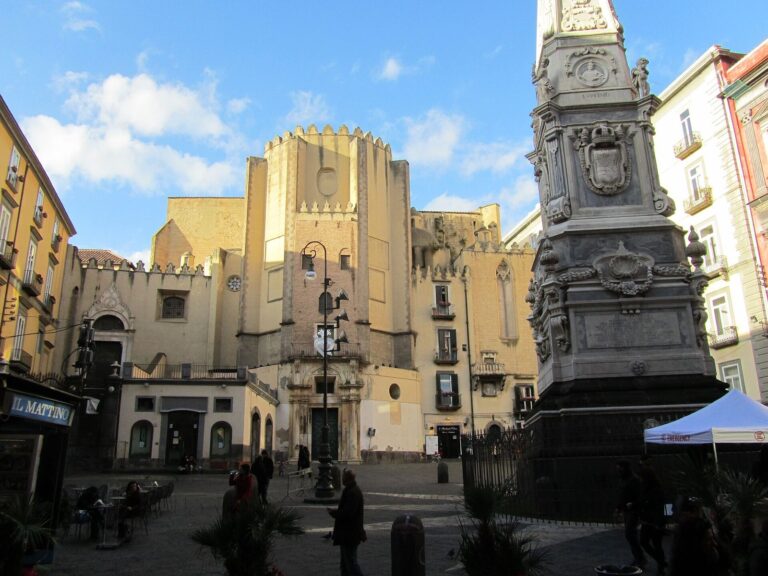
This is the one most people mean when they say “the Naples underground tour,” and for a first-timer it’s the one I’d book. It starts at Piazza San Gaetano 69 on Via dei Tribunali, right beside the steps of San Paolo Maggiore, in the square that sat on top of the Greek agora and the Roman forum. It’s a guided visit only. Tours run roughly every hour from 10:00 to 18:00 and last about ninety minutes.
What you see
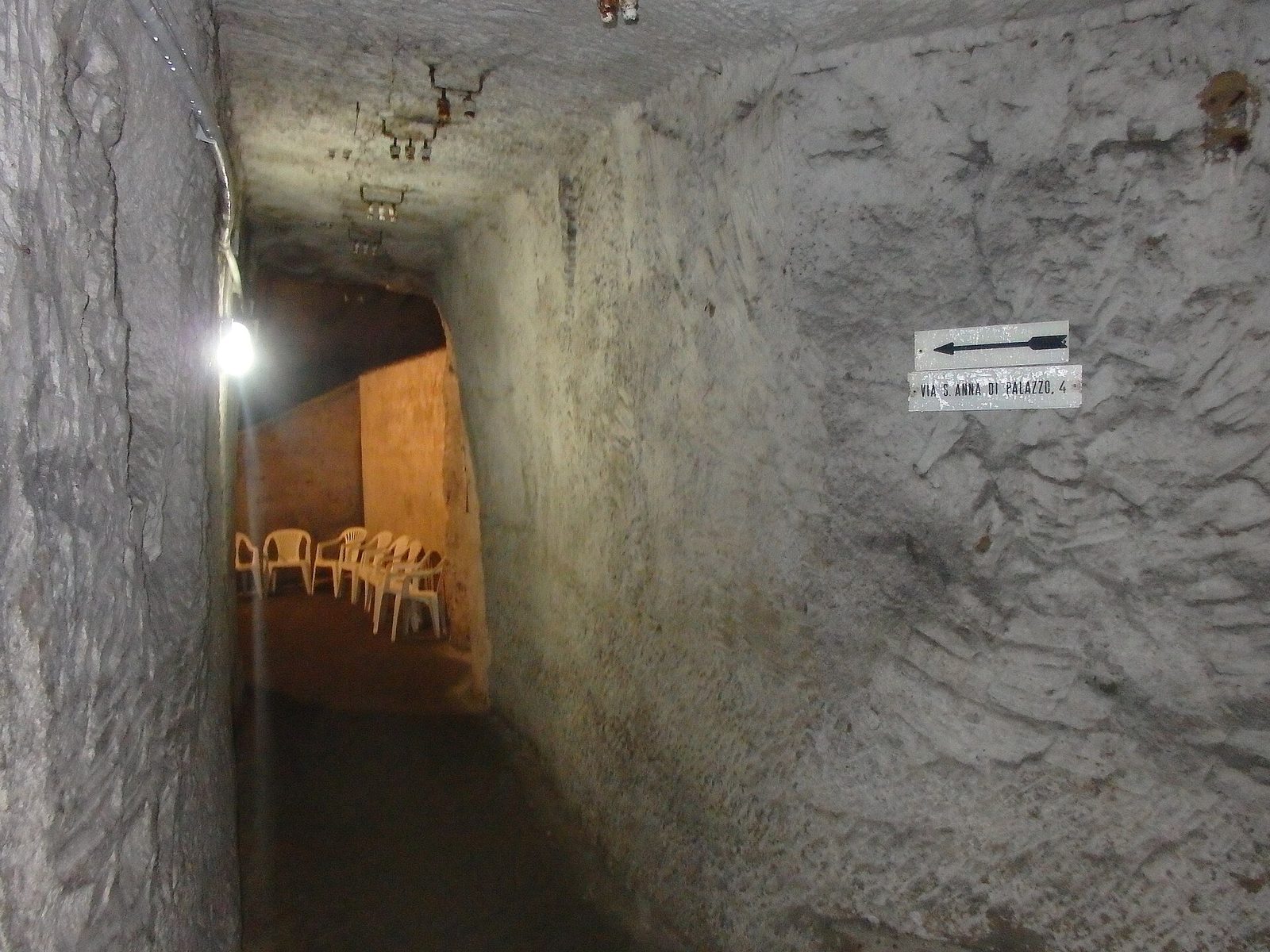
The first half is below ground. You go down a long staircase into the tuff, and the guide walks you through the quarries and cisterns, explaining how the water system worked and how the chambers were dug. There are wartime shelter sections with graffiti, and a small war museum of objects recovered from the spaces. The operator also runs underground garden plots, plants grown in the constant cool and damp as an experiment, which are more interesting than they sound. The set piece is a narrow passage along an old aqueduct channel, walked sideways in places by candlelight, that opens into a cistern still holding clear water. It’s the part people talk about afterwards, and the part to think about if you dislike tight spaces.
The second half surprises people. Back at street level, the guide takes you a few steps along the lane into a basso, one of the one-room ground-floor homes Naples is famous for. A section of floor lifts up (in the version most visitors describe, it’s under the bed), and steps lead down into the substructure of the Roman theater of Neapolis. This is the theater where Nero chose to make his stage debut, and the Roman historian Tacitus records that an earthquake shook the building during the performance. The curve of the auditorium is built into the houses around you. You can see its line from the street if you know where to look, but you’d never find the way in on your own.
Timing, languages and booking
On languages there’s a conflict worth knowing about. The operator describes Italian and English tours running through the day. Several independent guides list only a couple of English departures, around midday and early afternoon. Before you plan a day around an English tour, check the English slot on the booking page or send a message. For a small group you can usually just turn up, though booking is sensible at weekends and between April and October. There is also an evening tour on Thursdays, by reservation. Wear shoes with some grip, since the steps and floors can be damp.
Verdict
If you only do one underground tour in Naples, make it this one. It covers the most of the story, from Greek quarry to Roman theater to air-raid shelter, and it sits at the heart of the historic center, so you walk out onto Via dei Tribunali at lunchtime with the best pizza in Naples a few doors away. My one hesitation is the narrow passage. If you’re claustrophobic, read the warnings section further down before booking. The tour is still worth doing, and you’ll want a plan for that stretch.
LAES “La Napoli Sotterranea” near Piazza Trieste e Trento
The other big cistern tour is run by LAES, an association of cavers and underground enthusiasts founded in 1988. Its tour starts at Vico Sant’Anna di Palazzo 52, a lane climbing from Piazza Trieste e Trento into the Quartieri Spagnoli, with the Gambrinus café on the square as the easy landmark. Tours are guided, last about an hour, and run in English at 10:00, 12:00, 14:00 and 16:30, according to the association’s own site. Groups can book any day of the week, and individuals are advised to book by phone, by email or at the entrance.
What you see
The route covers the same kinds of spaces as the Tribunali tour, because the same city made them: Greek and Roman quarries, cisterns fed by the old aqueducts, and shelters from the Second World War with their graffiti and domestic leftovers. The cavities under this part of town tend to be big, open chambers rather than tight channels, and there’s plenty of walking and plenty of stairs. What it doesn’t have is the Roman theater, which only exists under the old Greek grid across town.
Price and verdict
LAES didn’t publish a price on its English page when I checked in September 2026, so confirm it when you book rather than trusting a reseller’s figure. My view: LAES is a proper alternative, not a knockoff. If you’re staying around Via Toledo, Chiaia or the seafront, or you want a shorter tour and an English slot you can count on, it’s the easier choice. What I wouldn’t do is book both it and Napoli Sotterranea on the same trip. The two overlap heavily, and your second underground hour is far better spent in the Galleria Borbonica or the catacombs, which show you something completely different.
If you’re still choosing where to base yourself, the Naples neighborhood guide for where to stay covers both ends of town, the Tribunali side and the Toledo–Plebiscito side, and the underground is a small but real point in favor of each.
Galleria Borbonica: the king’s escape tunnel and the forgotten cars
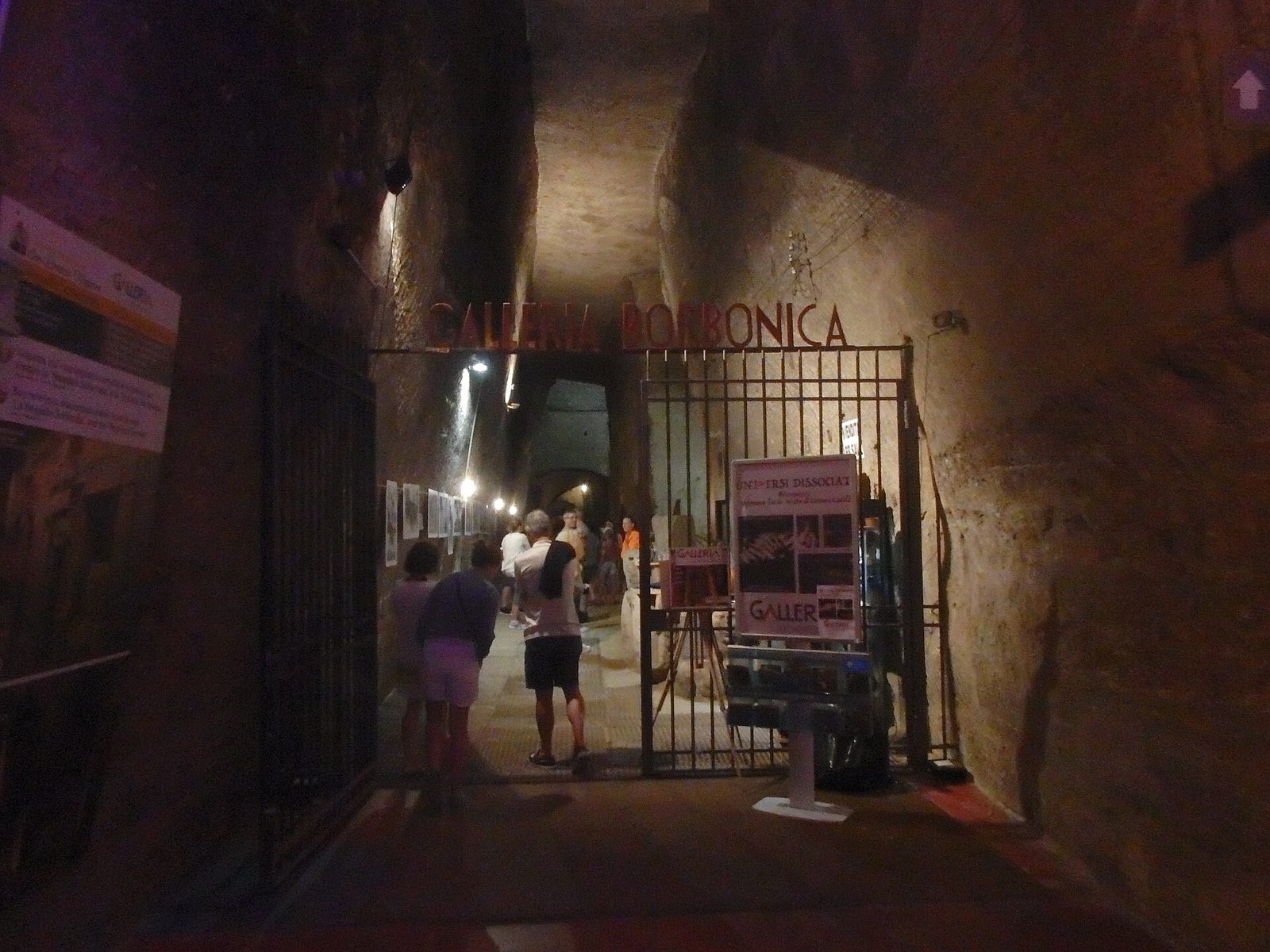
If Napoli Sotterranea is the classic, the Galleria Borbonica is the one people describe to their friends. It’s a tunnel dug on the orders of a nervous king, used as an air-raid shelter, then turned into a municipal impound lot and sealed with everything still in it. It was reopened to visitors in 2010 after years of volunteer clearance, and it’s the site I’d most like more travelers to know about. The catch is the calendar.
The story
In 1853, a few years after the revolts of 1848 had shaken every throne in Europe, Ferdinand II of Bourbon commissioned the architect Errico Alvino to dig a tunnel from the Royal Palace toward the sea and the barracks near what is now Via Morelli. On paper it was a road for moving troops. In practice everyone understood it as an escape route if the city rose against him again. The diggers cut straight through the tuff and through the old cisterns of the Carmignano aqueduct, which is why the tunnel changes character as you walk it. Bourbon masonry gives way to 17th-century water chambers, and those open onto shafts that disappear upward toward the palazzi of Monte di Dio. The work was never finished. The kingdom itself only had a few years left.
During the Second World War the tunnel and its cisterns became a shelter, and you’ll see the same kinds of traces as elsewhere: beds, lamps, graffiti, and small household objects people carried down with them. After the war, the city used the space as a judicial vehicle depot, where impounded cars and motorbikes were stored. When the depot closed, a lot of them simply stayed. That’s why an underground Bourbon tunnel in Naples contains vintage Fiats, motorbikes and scooters coated in decades of dust. It is one of the oddest sights in Italy, and the photos never quite convey the scale of it.
The routes
The standard route is the one most visitors take and the one I’d recommend. It covers the tunnel, the cisterns and the wartime and impound-lot sections at an easy pace, with a lot of stairs but nothing technical. On top of that, the operator runs adventure-style routes. One includes a stretch on a raft along a flooded section of old aqueduct, and a caving variant has you in a helmet and harness in tighter spaces. These cost more than the standard visit and have their own age and fitness conditions. They’re a fine idea if you already know you enjoy that kind of thing, and a bad way to find out that you don’t.
Days, times and booking
Here’s the catch I mentioned. The Galleria Borbonica runs on Fridays, Saturdays, Sundays and public holidays, not every day. Standard-route departures are at 10:00, 12:00, 15:00 and 17:00 on those days, and booking is compulsory, according to the operator’s own schedule when I checked in September 2026. The meeting point is Vico del Grottone 4, a lane just behind Piazza del Plebiscito, easy to combine with the Royal Palace or a coffee on Piazza Trieste e Trento. If your trip is Monday to Thursday, it simply isn’t an option, and no reseller can change that.
Verdict
If your dates include a weekend, this is my pick for a second underground site after Napoli Sotterranea. If you’re choosing only one and you’re in town on a Saturday, it’s a genuinely close call. Napoli Sotterranea tells the fuller story; the Borbonica leaves the stronger memory. Families with children who are bored by ruins tend to be won over by the cars.
Neapolis Sotterrata: the Roman street under San Lorenzo Maggiore
Across Piazza San Gaetano from the Napoli Sotterranea entrance is the great Gothic church of San Lorenzo Maggiore. It’s the church where, by his own account, Boccaccio first saw the woman he called Fiammetta, and whose convent put up Petrarch during his stay in Naples. Under its cloister is the most straightforward piece of archaeology in the city. Excavations have exposed the Roman market district that stood on top of the Greek agora. There’s a paved street running downhill between rows of vaulted shop units, the foundations of the market hall, and a vaulted room identified as the city treasury. You are walking on a Roman street at the level the Romans walked it, with a medieval church standing on top.
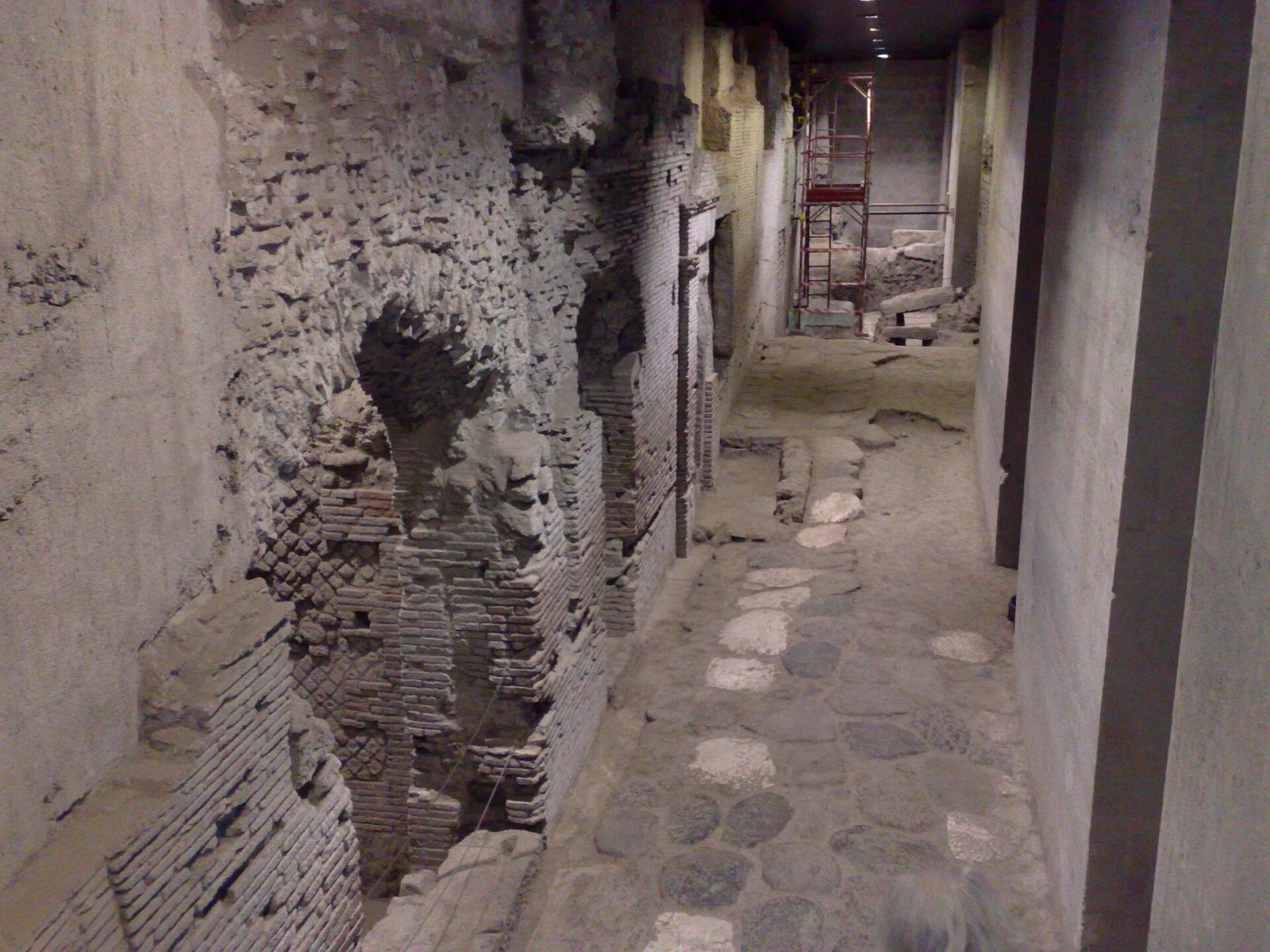
The site is branded Neapolis Sotterrata (“buried Neapolis”) and sold together with the church complex’s museum. It’s the best-value ticket in the underground, in the under-€10 band, and it doesn’t need booking. Unlike every other site on this page, you can go round at your own pace. It’s also the least claustrophobic. The spaces are wide and lit, and you never feel the weight of the city above you the way you do in the cisterns.
My verdict: do it. It takes about as long as you give it; most people are happy with the better part of an hour including the museum. It fits neatly before or after Napoli Sotterranea, since the two entrances face each other across the square. If you’ve already seen Pompeii, you’ll recognize the shop fronts; if you haven’t, this is a good preview. It also gives you the context the cistern tours can’t. The cisterns were the city’s plumbing; this was its high street.
The Catacombs of San Gennaro and San Gaudioso
North of the old walls, in the valley that became the Rione Sanità, the Greeks and then the Romans buried their dead, and the early Christians dug their catacombs into the same hillside. Two of those catacombs are open today, and they’re the most important underground sites in Naples for art and history. They are run by the same cooperative, La Paranza, which was set up by young people from the Sanità with the support of their parish priest. It reopened the catacombs and uses the ticket money to create jobs in a neighborhood that has long been short of them. The Sanità has changed a great deal since then, and this is one of the reasons.
San Gennaro: two levels of early Christian Naples
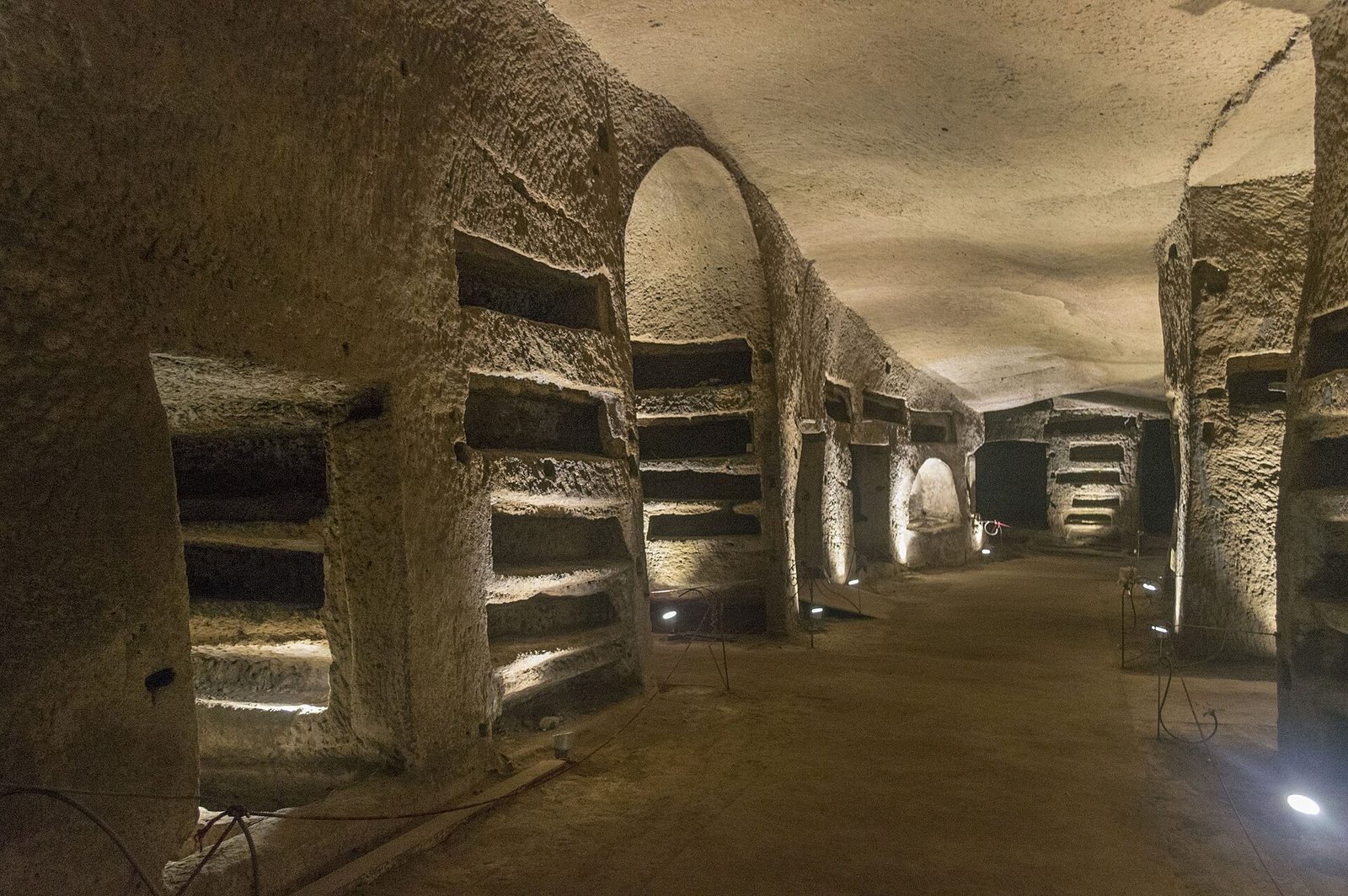
The Catacombs of San Gennaro began in the 2nd century as a family tomb and grew into two levels of galleries. Growth quickened after the remains of San Gennaro, the city’s patron saint, were brought here in the 5th century. This is not what most people picture when they hear “catacombs.” The galleries are broad and high, cut generously into the tuff, with wall tombs, family chambers and small basilica spaces for worship. The frescoes are the draw. They include the oldest known image of San Gennaro. In the crypt of the bishops, mosaic portraits of the early bishops of Naples include Quodvultdeus, the bishop of Carthage who fled the Vandal invasion of North Africa and died in exile here. For a sense of how old Christian Naples really is, nothing else in the city comes close.
Visits are guided, and the entrance is at Via Capodimonte 13, beside the big domed church of the Madre del Buon Consiglio on the road up to Capodimonte. The tour also takes in the Basilica of San Gennaro extra moenia (“outside the walls”), the early church over the catacombs. It’s an easy pairing with the Capodimonte museum up the hill; our guide to Naples museums has the details of that one.
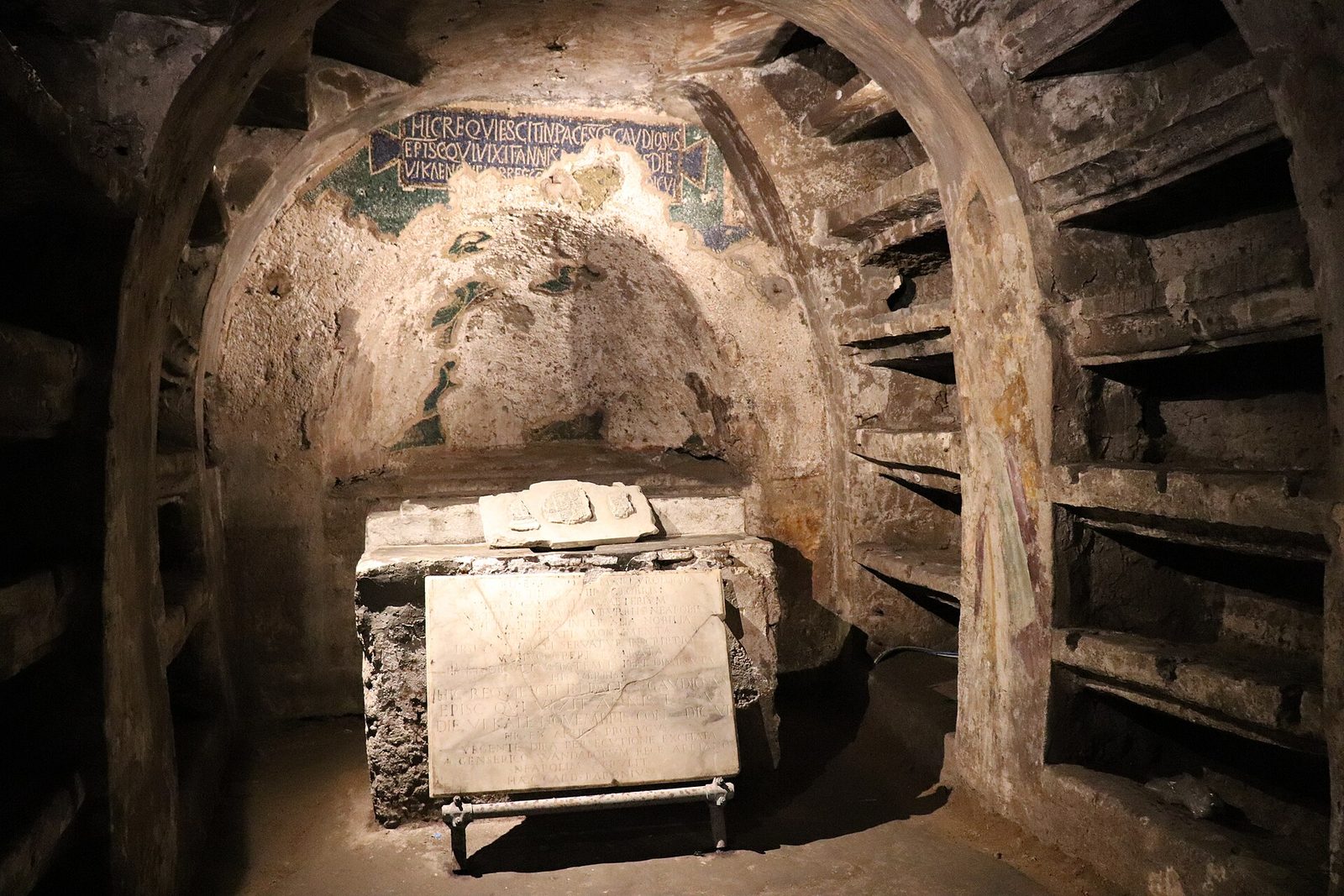
San Gaudioso: skulls in the walls
The Catacombs of San Gaudioso lie under the church of Santa Maria della Sanità, down in the valley. Gaudiosus was another North African bishop who fled the Vandals and died in Naples in the 5th century. The catacomb is smaller than San Gennaro and some of its early decoration survives, but what visitors remember is what the Dominican friars did here in the 17th century. Bodies of the well-to-do were placed in seated niches to drain and dry out. Once only bone remained, the skull was set into the wall and a body was painted beneath it in fresco, dressed to show the person’s rank or trade. The practice left a curse in Neapolitan dialect, puozze sculà, “may you drain,” which tells you how everyone felt about the process.
Practical details
Both catacombs open from 10:00 with last admissions at 17:00, both are closed on Wednesdays, and reservation is mandatory, according to the Catacombe di Napoli site in September 2026. The ticket sits in the €10–15 band. The cooperative has long sold one ticket covering both sites, but confirm that when you book rather than assuming it. The walk between them is a short downhill stroll through the Sanità, and the guides will point you the right way at the end of the first visit.
For getting up there, you can walk from the Museo metro stop through the Sanità, or take a bus up toward Capodimonte and walk down. The Naples transport guide has the lines and current fares. The Sanità is a real working neighborhood, not a museum district. In daylight, with the ordinary care you’d take anywhere in a big city, it’s fine and far more welcoming than its old reputation suggests.
Verdict
If you care about art or early Christianity, San Gennaro is the underground site to book above all others, and it’s worth the trip out of the historic center. San Gaudioso is the one to add if you want the macabre. For most people who are doing both, the order I’d suggest is San Gennaro first, then the walk down, then San Gaudioso, and lunch in the Sanità afterwards.
Cimitero delle Fontanelle: the ossuary in a quarry
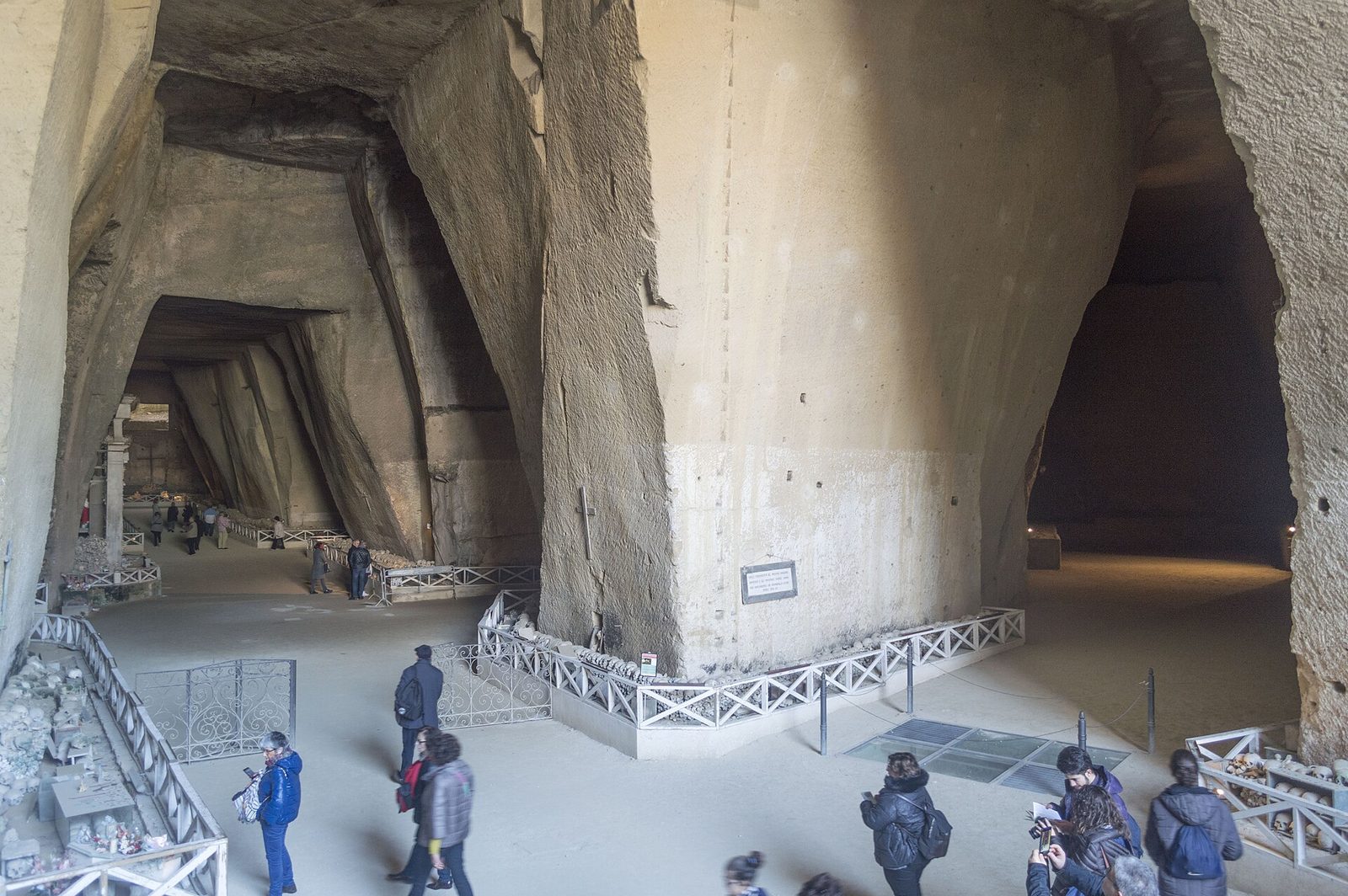
Nothing else on this page prepares you for the Fontanelle. On the edge of the Sanità, where Materdei meets the hillside, a vast old tuff quarry opens into the rock. It’s big enough that you’re standing in something closer to a cathedral nave than a tunnel. Along its walls and across its floor lie human bones, stacked and arranged: skulls in rows, long bones in piles, crosses and little shrines tucked in among them. The number of remains is commonly put at around 40,000.
The quarry became an ossuary in stages. Remains were moved here from overcrowded church burial grounds, then came the dead of the great plague of 1656 and the cholera of 1836. In 1872 a priest, Father Gaetano Barbati, organized local women to sort and arrange the bones. That’s when the cult of the anime pezzentelle took hold, the “poor souls” of the anonymous dead stuck in purgatory. Neapolitans would adopt a skull, a capuzzella, clean it, give it a name, sometimes build it a small house of wood or marble, and pray for its soul. In return they hoped for favors: a husband, a recovery, a good lottery number. Particular skulls acquired reputations and stories. One, known as the Captain, is the subject of several. The Church grew uneasy with the whole thing, and in 1969 the Archbishop of Naples, Cardinal Ursi, banned the cult. Many of the little shrines are still there, and so, in quieter ways, is the devotion.
Visiting now
The Fontanelle has had a stop-start history as a visitor site. It reopened on April 18, 2026, after its latest closure, and visits are now by compulsory reservation through the City of Naples. When I checked the city’s information, it listed Wednesday as the closing day, and admission sits in the under-€10 band, with a guided option costing slightly more. Check the booking page before you go, because this is exactly the sort of site where arrangements change.
Two things matter more than the practicalities. First, this is a burial place, and a lot of local people still treat it as one. Keep your voice down, don’t touch anything, and please don’t pose for a grinning selfie with a skull. Second, it’s physically the easiest site on this page. The entrance is at street level and the quarry floor is broadly flat, so it’s the one I’d suggest for anyone who can’t manage stairs but still wants to see this side of Naples.
Verdict: if you can handle it emotionally, go. It’s the single most Neapolitan place in the underground, the one that explains the city’s relationship with death, luck and its own poor better than any museum. If you’re the sort of traveler who finds that kind of thing distressing rather than moving, skip it without guilt. The catacombs give you the history without the piles of bones.
Smaller underground stops worth a detour
The big sites above get the queues, but Naples has more below ground than the major tours cover. None of these needs half a day, and a couple are free or close to it. They’re the ones I’d add once the main booking is sorted.
Santa Maria delle Anime del Purgatorio ad Arco
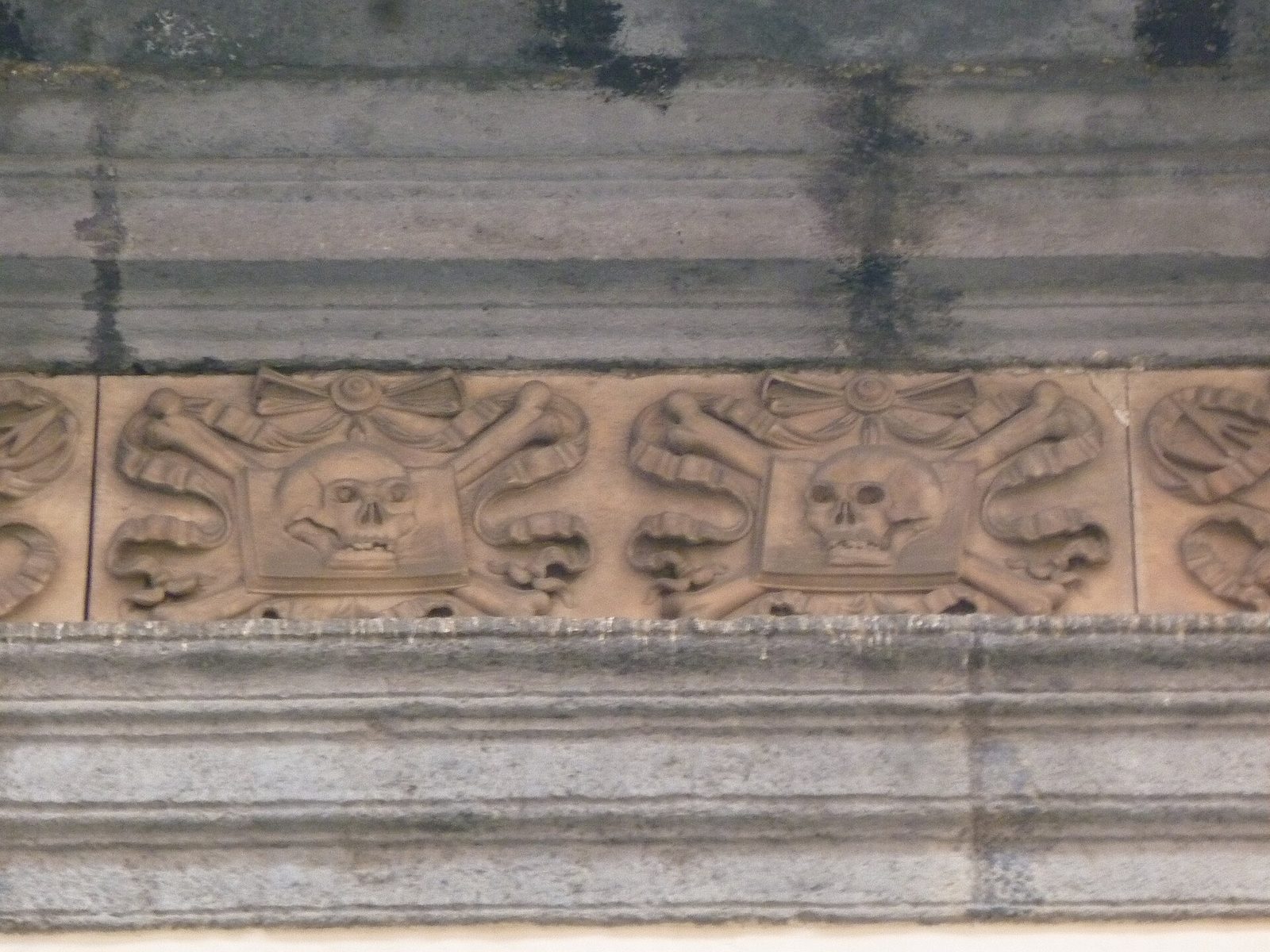
Halfway along Via dei Tribunali, a few minutes’ walk from the Napoli Sotterranea entrance, is a 17th-century church whose street railings are topped with bronze skulls. Its upper church is a fine baroque interior, but the reason to come is the lower church, a bare underground space where the same devotion to the souls in purgatory that filled the Fontanelle was practiced for centuries. The best-known skull here is called Lucia and wears a bridal veil. Local legend makes her a young bride who died before her time, and people still leave notes, flowers and rosaries for her. There’s a small admission fee for the museum and the lower church. It takes twenty minutes, and it’s the perfect bridge between the cistern tour and an afternoon at the Fontanelle.
The Duomo’s buried layers
The cathedral on Via Duomo has two underground stories to tell. Off its left aisle, the basilica of Santa Restituta, the oldest church in the city, leads to the Baptistery of San Giovanni in Fonte. Its late Roman mosaics make it the oldest baptistery in the Western world. Beneath the complex, excavations have exposed Greek and Roman walls and a stretch of ancient street. Entry to the cathedral, Santa Restituta and the baptistery was free in 2026 listings, with visits running through the day, though services can restrict access. It’s one of the most overlooked visits in the historic center.
Ipogeo dei Cristallini
Under a private palazzo in the Sanità lie Greek chamber tombs from the 4th and 3rd centuries BC, cut into the tuff and decorated with carved funeral beds, painted details and a sculpted head of the Gorgon. They were opened to small guided groups by reservation in recent years, after a long restoration. They’re older than anything else you can visit underground in the city and far less visited. If you’re already doing the catacombs, check whether a slot fits the same morning.
Pausilypon and the Grotta di Seiano
Out on the Posillipo headland, a Roman tunnel the best part of a kilometer long cuts straight through the hill to the ruins of a seaside villa and its little theater above the Gaiola bay. Visits run by booking. It’s a different kind of underground: engineering rather than burial or shelter. If you’re spending a morning around Gaiola and Marechiaro anyway, it’s a wonderful add-on.
The metro’s art stations
The cheapest underground visit in Naples costs one metro ticket. Toledo station on Line 1 is regularly named among the most beautiful stations in Europe. It has a deep-blue lower level designed to feel like being underwater and a light shaft rising toward the street. Municipio station, down by the port, displays the remains of the ancient harbor that were found while it was being dug. The getting-around guide covers tickets.
Further out: the Campi Flegrei
West of the city, the volcanic Campi Flegrei hold two more spectacular underground spaces: the Piscina Mirabilis in Bacoli, a colossal Roman cistern that supplied the imperial fleet, and the Rione Terra under Pozzuoli, where the streets of the Roman town survive beneath the later one. Both belong to a different day trip, and the ongoing bradyseism (ground uplift and earthquakes) in the Pozzuoli area means closures can happen at short notice. Check the current status of anything in the Campi Flegrei before you set out.
Which Naples underground tour should you choose?
Most people have room for one or two of these, not six. Here’s how I’d choose, depending on who you are and when you’re in town.
- One slot and a first visit: Napoli Sotterranea. It tells the whole story, from Greek quarry to Roman theater to air-raid shelter, and sits in the historic center you’re visiting anyway.
- In town on a Friday, Saturday or Sunday: add the Galleria Borbonica, or make it your only tour if you’d rather have the stronger memory than the fuller story.
- Art and history lovers: the Catacombs of San Gennaro, ahead of any tunnel. The frescoes and mosaics are the real treasure of underground Naples.
- Drawn to the macabre: Fontanelle, San Gaudioso and the Purgatorio ad Arco, ideally in that order over one day.
- On a tight budget: Neapolis Sotterrata under San Lorenzo, plus the Toledo metro station. Both are cheap and neither needs a booking.
- Staying near Toledo, Chiaia or the seafront: LAES instead of Napoli Sotterranea, not as well as it.
- Claustrophobic: San Lorenzo, the Catacombs of San Gennaro and the Fontanelle are all roomy. Leave Napoli Sotterranea’s candle passage and the Borbonica’s caving route for someone else.
- With young children: the Borbonica’s standard route (the cars do the work) and San Lorenzo. More on that below.
If you’re still sketching the trip, the Naples itinerary planner shows where an underground slot fits in a short stay, and the full list of things to do in Naples puts it against everything else competing for the same afternoon.
Claustrophobia, stairs, children and wheelchairs
This is the section the ticket sellers leave out. None of it should put you off going underground, but some of it should change which site you choose.
Tight spaces
The only genuinely narrow stretch on the mainstream routes is Napoli Sotterranea’s candlelit passage along the old aqueduct channel, where you turn sideways to fit in places. If that worries you, tell the guide before the group goes in; people who don’t fancy it can usually wait it out. The Borbonica’s caving route is tight by design. Everything else on this page, from the Borbonica’s standard route to both catacombs, San Lorenzo and the Fontanelle, is made of big chambers or broad galleries. If you’re claustrophobic in the ordinary sense rather than severely, you’ll be fine in those.
Stairs and mobility
Almost every underground site in Naples starts with a long staircase down and ends with one up. That includes Napoli Sotterranea, the Borbonica, the catacombs and the Roman street at San Lorenzo. The exception is the Fontanelle, which you enter at street level onto a broadly flat floor. If you use a wheelchair or can’t manage stairs, the Fontanelle is the site to try, and it’s worth asking each of the others directly about any alternative access before you give up on them. Floors in the cisterns can be damp and uneven, so wear shoes with some grip, not sandals.
Children
Children who find churches boring often love the underground. The Borbonica, with its abandoned cars, is the easiest win. Napoli Sotterranea works well for most school-age kids, and the narrow passage is physically fine for small bodies. The problem is a panicking child in a single-file line with a group behind, so think about your own child’s temperament honestly. The Fontanelle is a judgment call that only a parent can make. Some children find the skulls fascinating, others have nightmares.
Temperature and what to bring
The underground stays cool and damp all year. In high summer that’s a joy, and many visitors book a cistern tour precisely to escape the midday heat in the streets above. It also means a light layer is worth carrying, even in August. Big backpacks are a nuisance in narrow spaces, so leave them at the hotel if you can. Photography rules vary by site, so follow what the guide says, especially around frescoes.
How to fit the underground into a day in Naples
The sites fall into three clusters, and planning around them saves a lot of criss-crossing.
The Tribunali cluster. Napoli Sotterranea, Neapolis Sotterrata under San Lorenzo and the Purgatorio ad Arco are all within a few minutes of each other on Via dei Tribunali. Do the cistern tour mid-morning, San Lorenzo straight after, then eat on Tribunali; the Naples food guide covers the street food you’ll pass. That’s a complete morning without a single bus.
The Sanità cluster. The Catacombs of San Gennaro, the Catacombs of San Gaudioso and the Fontanelle are all in or beside the Rione Sanità, and the Capodimonte museum is just up the hill. A good day starts at Capodimonte when it opens, drops down to San Gennaro, walks through the Sanità to San Gaudioso and finishes at the Fontanelle. That’s a lot of death in one day, but it’s also the best day in Naples that most visitors never have.
The Plebiscito cluster. The Galleria Borbonica and the LAES tour both start around Piazza del Plebiscito and Piazza Trieste e Trento, next to the Royal Palace and the Galleria Umberto I. Pair either one with the palace or a walk along the seafront.
Book in the right order
Book the sites with compulsory reservations first: the Galleria Borbonica, the catacombs and the Fontanelle. Then fit the walk-up sites around them. And keep Wednesday away from the Sanità: that’s the catacombs’ closing day and, according to the city’s listing, the Fontanelle’s too.
Rainy days
If you’re keeping a wet-weather plan in reserve, the underground is the obvious one, along with the museums. Book one of the walk-up tours for the afternoon a rainy forecast arrives, and keep the compulsory-booking sites for fixed days. The Naples travel tips page has more on building slack into a trip.
What to skip
- Street sellers pushing “underground tickets.” On and around Via dei Tribunali you’ll be offered underground tours, sometimes bundled with other things. Buy from the operator directly. You’ll know which site you’re getting and where it starts, and you won’t pay someone else’s markup.
- Reseller listings that don’t name the operator. If a listing says “Naples Underground Tour” and hides the meeting point until after you’ve paid, look elsewhere. You need to know whether it’s Napoli Sotterranea, LAES or something else.
- Doing Napoli Sotterranea and LAES on the same trip. The overlap is heavy. Spend the second slot on the Borbonica or the catacombs instead.
- The adventure routes as a first underground experience. The rafting and caving routes at the Borbonica are fun if you already know you like tight, wet spaces, and a bad way to find out that you don’t.
- The Sanità on a Wednesday. Both catacombs are closed, and the Fontanelle is listed as closed too.
- Treating the Fontanelle as a photo op. Go, by all means. Just leave the skull selfies to other people.
Naples underground frequently asked questions
What is the best underground tour in Naples?
For a first visit, Napoli Sotterranea at Piazza San Gaetano on Via dei Tribunali. It covers Greek quarries, Roman cisterns, wartime shelters and the buried Roman theater of Neapolis in one guided tour of about ninety minutes. If you’re in town at a weekend, the Galleria Borbonica is the most memorable alternative, and art lovers should put the Catacombs of San Gennaro first.
What is the difference between Napoli Sotterranea and the Galleria Borbonica?
Napoli Sotterranea is a network of Greek and Roman cisterns and WWII shelters under the historic center, plus the Roman theater, and it runs daily. The Galleria Borbonica is a 19th-century tunnel dug for King Ferdinand II, later a shelter and then a vehicle impound lot full of old cars. It starts near Piazza del Plebiscito and runs only from Friday to Sunday and on public holidays.
Do I need to book Naples underground tours in advance?
It depends on the site. The Galleria Borbonica, the Catacombs of San Gennaro and San Gaudioso, and the Fontanelle cemetery all require reservations. Napoli Sotterranea usually takes small walk-up groups, but booking is sensible at weekends and from April to October. The Roman excavations under San Lorenzo Maggiore don’t need booking at all.
Is the Naples underground OK for claustrophobic people?
Mostly, yes. The one tight stretch on a mainstream route is Napoli Sotterranea’s candlelit passage, which you can usually skip by telling the guide beforehand. The Borbonica’s standard route, both catacombs, San Lorenzo and the Fontanelle are all roomy chambers or broad galleries. Avoid the Borbonica’s caving route if confined spaces bother you.
Can children go on the Naples underground tours?
Yes, and many love them. The Galleria Borbonica’s standard route, with its abandoned cars, is the easiest choice for younger children. Napoli Sotterranea suits most school-age kids, though a nervous child may struggle in the narrow passage. The adventure and caving routes have their own age limits, and the Fontanelle’s piles of bones are a call only parents can make.
How long does the Napoli Sotterranea tour take?
About ninety minutes, including the underground section and the short walk to the Roman theater beneath a neighboring house. The LAES tour near Piazza Trieste e Trento takes about an hour. Leave time either side for the queue and for San Lorenzo Maggiore across the square, which most people see in under an hour.
Are the Catacombs of San Gennaro worth visiting?
Yes, especially if you care about art or history. The galleries are broad and high, not cramped, and the frescoes and mosaics include the oldest known image of San Gennaro and portraits of the early bishops of Naples. The catacombs are closed on Wednesdays and visits must be booked. The same cooperative runs the nearby Catacombs of San Gaudioso.
Is the Fontanelle Cemetery open to visitors?
Yes. The Cimitero delle Fontanelle reopened on April 18, 2026, and visits are now by compulsory reservation through the City of Naples. The city’s listing gives Wednesday as the closing day. Because arrangements at the Fontanelle have changed several times over the years, check the booking page shortly before you go.
How deep is the Naples underground?
The Napoli Sotterranea operators put the cavity system at between twenty and forty meters below street level, spread over around two million square meters under the city. Only a small fraction is open to visitors. Most tours start with a long staircase, and the deepest sections stay cool and damp all year, whatever the weather above.
The churches above ground are the other half of this story. The Purgatorio ad Arco, San Lorenzo Maggiore and Santa Maria della Sanità all sit on top of the sites on this page. For the Duomo, the Sansevero Chapel and the rest, see the guide to Naples churches.
Photo credits
- Cimitero delle Fontanelle ossuary: photo by Dominik Matus, Wikimedia Commons, CC BY-SA 4.0.
- Napoli Sotterranea corridor: photo by Nemo bis, Wikimedia Commons, CC BY-SA 3.0.
- Galleria Borbonica entrance: photo by Nemo bis, Wikimedia Commons, CC BY-SA 3.0.
- San Lorenzo Maggiore excavations: photo by IlSistemone, Wikimedia Commons, CC BY-SA 3.0.
- Catacombs of San Gennaro: photo by Dominik Matus, Wikimedia Commons, CC BY-SA 4.0.
- Catacombs of San Gaudioso: photo by Fabien Bièvre-Perrin, Wikimedia Commons, CC BY-SA 4.0.
- Purgatorio ad Arco facade: photo by Antoine Pitrou, Wikimedia Commons, FAL.
Sources: tour times, meeting points and booking rules from Napoli Sotterranea, LAES La Napoli Sotterranea, the Galleria Borbonica’s official schedule, the Catacombe di Napoli and the City of Naples for the Fontanelle. All checked September 2026; cost bands are indicative and each site’s own page carries the current price.