On this page
Last updated October 16, 2026. Dates, opening days and site status checked against official sources (UNESCO, the Comune di Napoli, the museums and SSC Napoli) in October 2026.
Naples, Italy history runs for more than 2,500 years: a Greek colony called Parthenope, then Neapolis, a Roman resort town, an independent duchy, the capital of the Kingdom of Naples under Angevins, Aragonese and Spanish viceroys, the Bourbon capital of the Two Sicilies, and from 1861 a city of united Italy. Most of it is still standing in the street plan you walk today.
That last point is why this page exists. Naples does not keep its past behind glass. The three long streets of the old center follow the lines the Greeks drew, the Spanish barracks quarter is still a neighborhood with laundry across the alleys, and the royal palace faces a square named after the vote that ended the kingdom. If you know roughly who built what, and why, a day in the city stops being a blur of churches and becomes a story you can read off the walls.
I’ve organized it the way it is useful to a traveler: a one-table timeline first, then each era with the places where you can still see it, then the three cultural questions almost every visitor asks sooner or later. What is the Camorra, and does it affect me? Why is Diego Maradona painted on walls like a saint? And why does a modern European city still carry red horns against the evil eye? I’ll be straight about each, including where the popular version is more legend than record.
Naples, Italy history at a glance
Here is the whole sweep in one table. The dates are the ones historians agree on; where the record is fuzzy, the table says “c.” or gives a century rather than inventing a year. The last column is the practical one: where to stand to see that era with your own eyes.
| Era | Dates | What happened | Where to see it today |
|---|---|---|---|
| Greek Parthenope | Late 8th century BC | Settlers from Cumae found a town on the Pizzofalcone hill | Very little survives; the hill above Santa Lucia |
| Greek Neapolis | Late 6th to 5th century BC | The “new city” laid out on a grid in today’s centro storico | The decumani street plan; Greek walls in Piazza Bellini |
| Roman Naples | 4th century BC to AD 476 | A Greek-speaking ally, then a Roman town and a resort coast; Vesuvius buries Pompeii and Herculaneum in AD 79 | Theatre remains under Piazza San Gaetano; Pompeii, Herculaneum; MANN |
| Duchy of Naples | 661 to 1139 | A self-governing duchy, nominally Byzantine | Early medieval fabric inside the old-center churches |
| Normans and Swabians | 1139 to 1266 | Roger II takes the city; Frederick II founds the university (1224) | The university still bears Frederick’s name |
| Angevin Naples | 1266 to 1442 | Charles of Anjou makes Naples a royal capital | Castel Nuovo; Gothic Santa Chiara and San Lorenzo Maggiore |
| Aragonese Naples | 1442 to 1501 | Alfonso V of Aragon conquers the city | The triumphal arch of Castel Nuovo |
| Spanish viceroyalty | 1503 to 1707 | Naples ruled from Madrid by viceroys; Via Toledo, the Quartieri Spagnoli, Masaniello’s revolt (1647), plague (1656) | Via Toledo; Quartieri Spagnoli; Palazzo Reale; Fontanelle cemetery |
| Austrian interlude | 1707 to 1734 | The Habsburgs take over during the War of the Spanish Succession | Little that is specific to it |
| Bourbon Naples | 1734 to 1860 (with breaks) | Charles of Bourbon’s capital; Teatro di San Carlo (1737); excavations at Herculaneum and Pompeii begin | Teatro di San Carlo; Palazzo Reale; Capodimonte; Reggia di Caserta |
| Revolution and Napoleon | 1799; 1806 to 1815 | The Parthenopean Republic; Joseph Bonaparte and then Joachim Murat as kings | Piazza del Plebiscito, laid out in this period |
| Kingdom of the Two Sicilies | 1816 to 1861 | Naples as capital of the largest state in Italy; the first railway on the Italian peninsula (1839) | Palazzo Reale; Via Toledo’s palazzi |
| United Italy | 1860 onward | Garibaldi enters Naples; plebiscite; cholera (1884) and the Risanamento rebuild | Galleria Umberto I; Corso Umberto I |
| War and aftermath | 1943 to 1980 | The Four Days of Naples; Vesuvius erupts (1944); the Irpinia earthquake (1980) | Bomb shelters in the Galleria Borbonica and Napoli Sotterranea |
| Recent | 1995 onward | UNESCO lists the historic center; Napoli win the league in 2023 and 2025 | The whole centro storico; Maradona murals everywhere |
If you only take one thing from the table, take this: the centro storico is not a “medieval quarter” with Greek leftovers. It is a Greek city that never stopped being lived in. UNESCO’s listing of the Historic Centre of Naples (inscribed in 1995) covers 1,021 hectares, and the street plan is a large part of the reason it is there.
Greek Parthenope and Neapolis: the city under the city
The Greeks got here first, and they came from next door. Cumae, on the coast west of today’s city, was one of the oldest Greek colonies in mainland Italy, and in the late eighth century BC its settlers put a small town on the Pizzofalcone hill above the sea, the rise behind today’s Santa Lucia seafront. They called it Parthenope, after the siren of Greek myth who, so the story goes, drowned herself when Odysseus sailed past and washed up on this shore. Neapolitans still call themselves partenopei, and the football club’s nickname comes from the same place.
The second foundation is the one that matters for a visitor. Sometime between the late sixth and the fifth century BC (sources disagree on the date) a new town was laid out on the flatter ground to the east. The Greeks called it Neapolis, “new city,” and that is where the word Naples comes from. They built it on a grid: three long east-west streets, the plateiai, crossed at right angles by narrow north-south lanes, the stenopoi.
Those three streets are still the spine of the centro storico. The Romans called them decumani and the name stuck. The lower one is the street everyone knows as Spaccanapoli (officially a chain of names, Via Benedetto Croce and Via San Biagio dei Librai among them). The middle one is Via dei Tribunali, the pizza street. The upper one runs along Via della Sapienza and Via dell’Anticaglia. When you turn off Tribunali into a lane so narrow you can touch both walls, you are walking a Greek stenopos. That is not a figure of speech; it is the same line on the map.
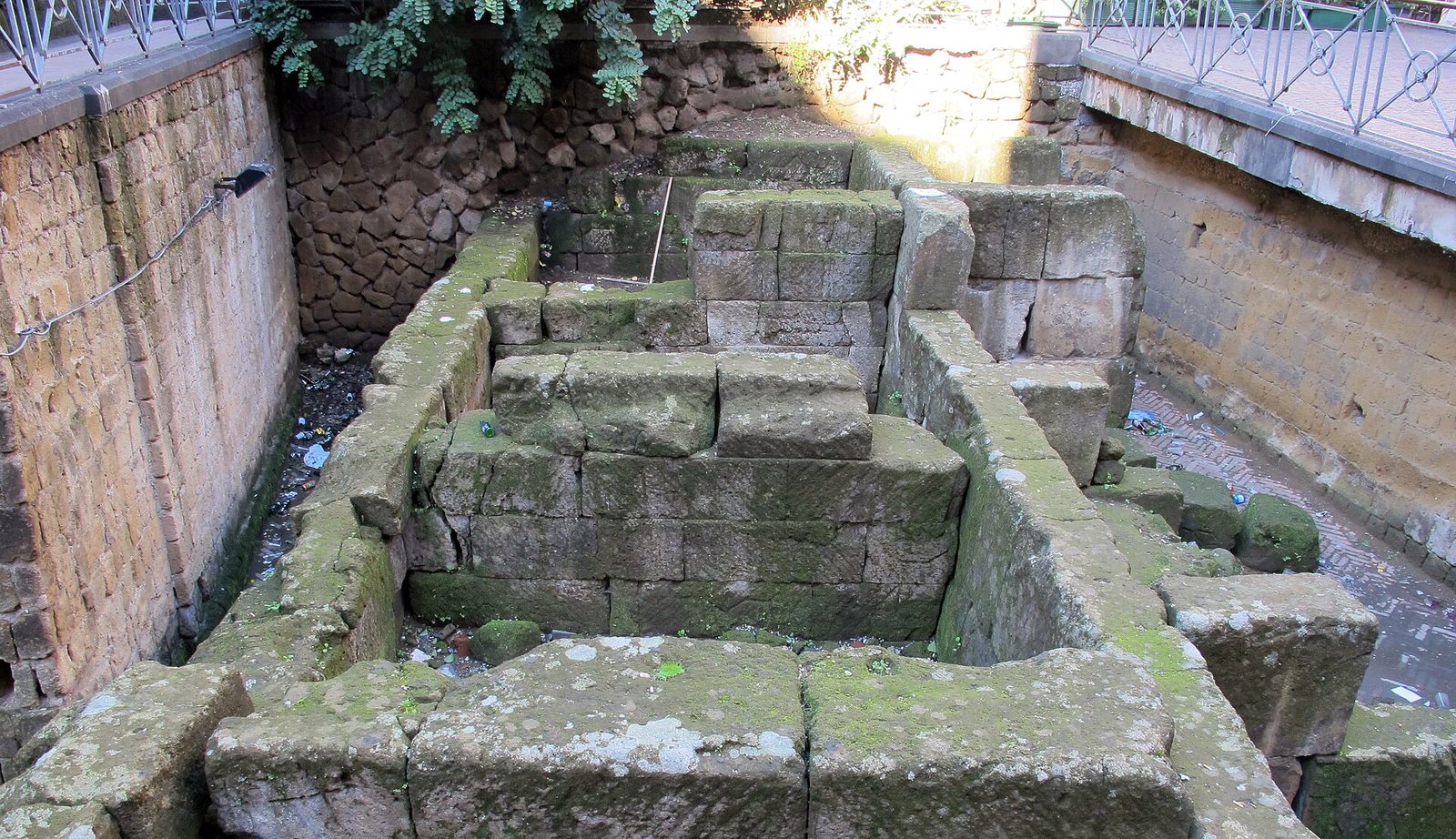
Above ground, the Greek city is mostly felt rather than seen. The best single thing to look at is the stretch of Greek wall in Piazza Bellini, a few big tufa blocks in an open pit in the middle of a square full of café tables. Most people walk past it with a spritz in hand. Stop and look: those blocks are older than almost anything you will see in Rome.
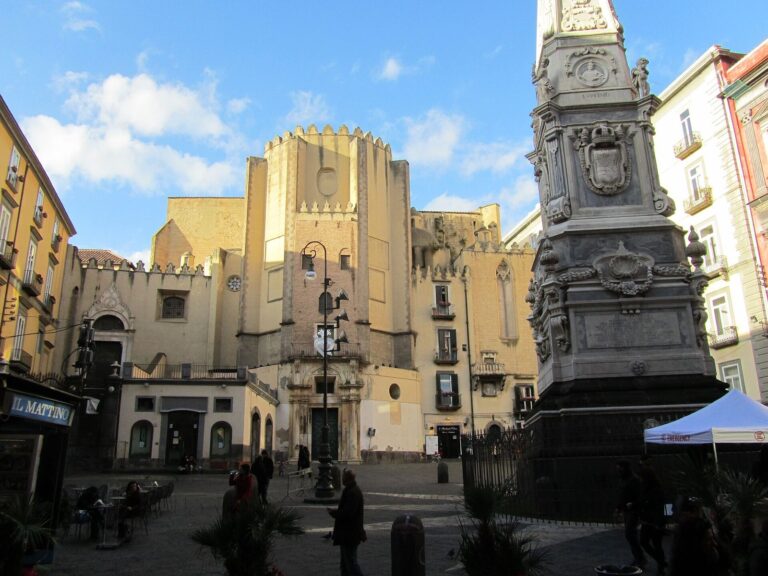
Below ground is where the Greek and Roman city really shows. Under Piazza San Gaetano, on Via dei Tribunali, the tours of Napoli Sotterranea take you down into the cisterns and passages carved out of the soft yellow tufa, and part of the route passes through the remains of the Greco-Roman theatre, built into the houses above it. The Greeks quarried that tufa to build the city, and the holes they left became cisterns, then aqueduct channels, then, in 1943, air-raid shelters. Our guide to underground Naples compares the different routes and which one is worth your time.
Roman Naples and the Bay: a Greek town Rome went on holiday to
Rome absorbed Naples gradually and, unusually, let it stay Greek. The city became an ally of Rome in the fourth century BC and stayed loyal through the wars with Carthage. Long after it was a Roman town in law, Neapolis kept the Greek language, Greek games and a Greek reputation as a place of learning and leisure. For wealthy Romans, the Bay of Naples was where you went to be cultured and comfortable at the same time. Villas lined the coast from Posillipo to Sorrento, the hot springs of the Campi Flegrei to the west drew bathers, and the naval base at Misenum guarded the whole gulf.
The event that defines Roman Campania for every visitor happened in AD 79. Vesuvius erupted and buried Pompeii, Herculaneum, Oplontis and Stabiae under ash and pyroclastic flows. Naples itself survived, but the disaster preserved a picture of Roman life that exists nowhere else on the same scale. If you are going to see one Roman site, our Pompeii from Naples guide covers the logistics; if you want the better-preserved, less crowded one, read the Herculaneum guide first.
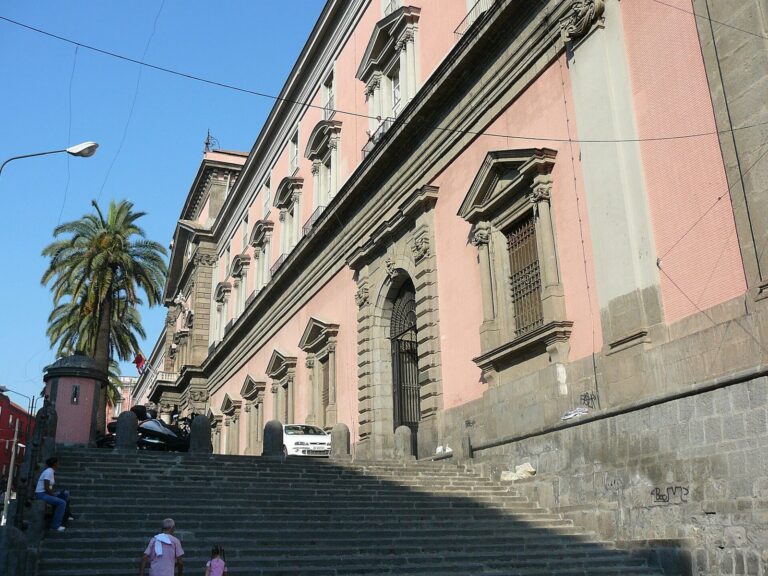
Here is the part many visitors miss: the best objects from both sites are not at the sites. They are in Naples, at the National Archaeological Museum (MANN), along with the Farnese collection of Roman sculpture. The frescoes, the mosaics, the bronzes and the household things that make Pompeii human are on Piazza Museo, though the mosaic collection is closed from 21 September to 30 November 2026, so check MANN’s schedule of open rooms before you go. My advice is blunt: do MANN either before or after Pompeii, never neither. Note that the museum is closed on Tuesdays. Our Naples museums guide has the full rundown and the tickets.
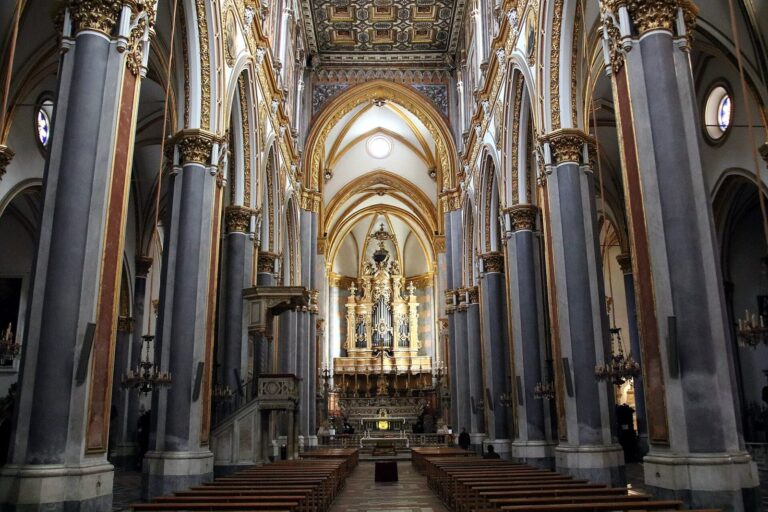
Roman Naples is also under your feet in the old center. Beneath the Gothic church of San Lorenzo Maggiore, excavations have exposed a stretch of the Roman city’s commercial streets, with shop fronts along a paved road. It is one of the few places where you can walk a Roman street in the middle of a living city and then come back up into a Franciscan cloister. The Western Roman Empire’s story even ends here, in a way. In 476 the last emperor in the West, the teenage Romulus Augustulus, was deposed and sent to live out his life in a villa on the Bay of Naples.
The Duchy of Naples, the Normans and Frederick’s university
After Rome fell, Naples did something unusual for a city in its position: it governed itself for about five centuries. The Duchy of Naples, from 661 to 1139, was nominally part of the Byzantine world, ruled from Constantinople on paper and by local dukes in practice. It fought off the Lombards inland and Saracen raiders by sea, played the Pope and the Byzantine emperor against each other, and kept its Greek-flavored identity well into the Middle Ages.
That independence ended in 1139, when Roger II, the Norman king of Sicily, took the city and folded it into his kingdom. The Normans were followed by the German Hohenstaufen (the Swabians, as Italian historians call them), and the most remarkable of them, the emperor Frederick II, left Naples a gift that still runs today: in 1224 he founded a university here, one of the oldest in Europe, to train administrators for his state without sending them to the Pope’s schools in Bologna. It is still called the Università degli Studi di Napoli Federico II, and its students still fill the bars around Piazza Bellini and Via Mezzocannone.
Honestly, there is not much of this period you can point to as a sightseer. Its traces are mostly inside later buildings: early medieval walls and fragments embedded in the old-center churches, and some of the oldest catacomb art in the city at the Catacombs of San Gennaro in the Sanità district. If the duchy era interests you, the catacombs are the place to see it.
Angevin and Aragonese Naples: the city becomes a capital
The big turn came in 1266. Charles of Anjou, brother of the King of France, won the southern kingdom with the Pope’s backing and made Naples its capital. After the uprising of 1282 known as the Sicilian Vespers, Sicily broke away, and what was left, the whole southern mainland, became the Kingdom of Naples. For the next five and a half centuries, Naples was not just a big city. It was a royal capital, and it built like one.
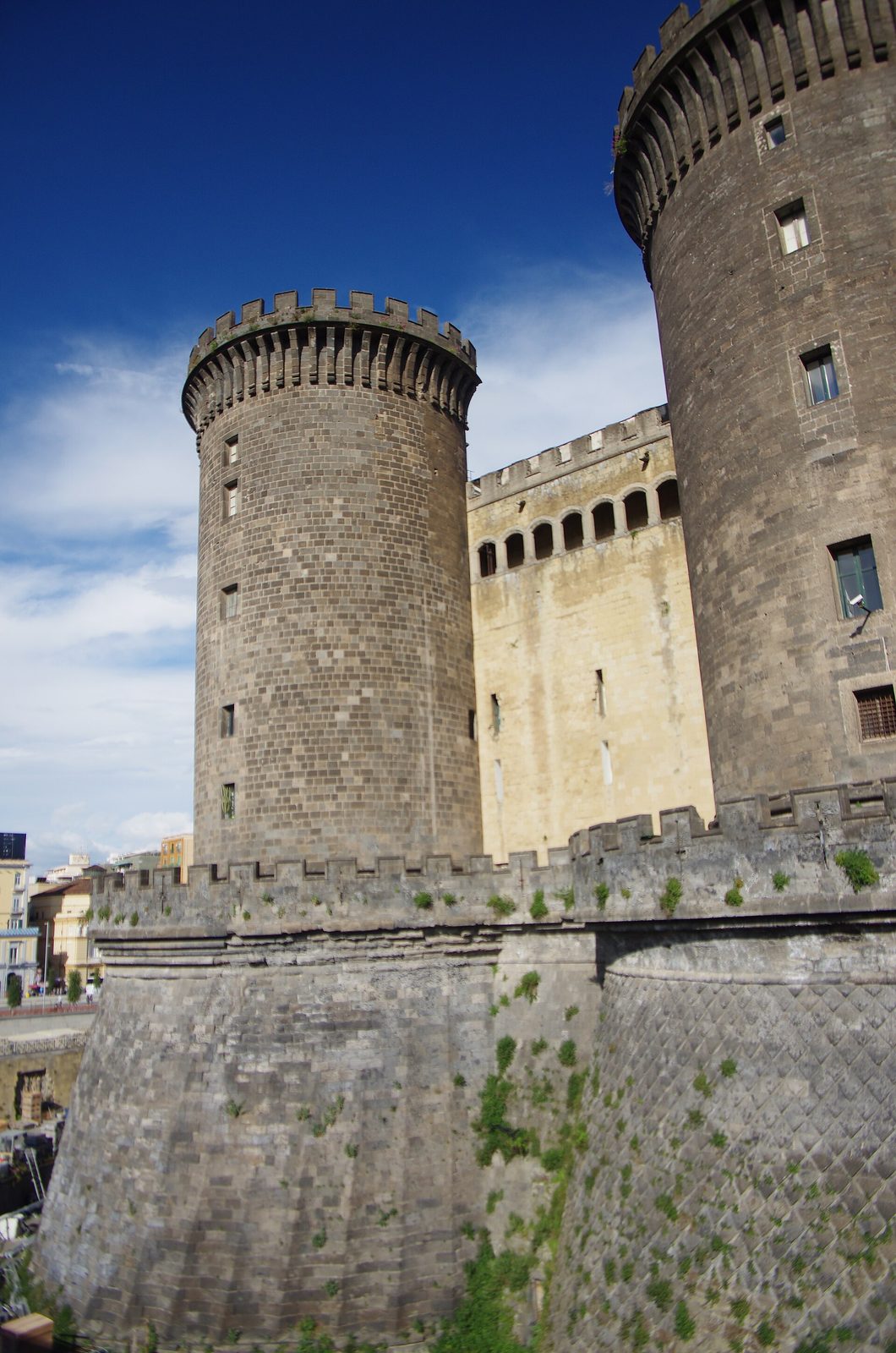
The Angevins built in French Gothic. Santa Chiara, the huge monastery church at the start of Spaccanapoli, was their dynastic church; its majolica-tiled cloister is a later Baroque refit, but the church itself is pure Angevin ambition. San Lorenzo Maggiore and San Domenico Maggiore are from the same period. And on the waterfront they built a new royal fortress, so new that it is still called the Castel Nuovo, even though it dates from the late thirteenth century. Locals call it the Maschio Angioino, the Angevin keep.
The castle you see now, though, is mostly Aragonese. Alfonso V of Aragon conquered Naples in 1442 and rebuilt the fortress with the fat round towers that make it the city’s most recognizable silhouette. Look at the entrance: the white marble triumphal arch squeezed between two of the towers celebrates Alfonso’s entry into the city, and it is one of the key early Renaissance monuments in southern Italy. The juxtaposition, a Roman-style arch jammed between medieval war towers, is the Aragonese era in one image.
Inside, Castel Nuovo houses the city’s civic museum, with painting and sculpture spread through the old halls. The Comune di Napoli lists it as open Monday to Saturday, 9:00 to 18:00, last entry 17:30, and closed on Sundays, which catches out a lot of weekend visitors. Check that page before you go, because closures for weather alerts and events do happen. For how it compares with the city’s other fortresses, including Castel Sant’Elmo on the hill and the Castel dell’Ovo on the sea (closed to the public for restoration, with no reopening date set), see our guide to the castles of Naples.
The Aragonese court also made Naples a center of Renaissance humanism. Scholars, poets and printers gathered around the kings, and the academy that grew out of that circle is often cited as one of the first of its kind in Italy. That intellectual side of Naples tends to get lost behind the pizza and the chaos, and it is worth knowing it was there.
Spanish Naples: viceroys, Via Toledo and the revolt of Masaniello
In 1503 the Kingdom of Naples became part of the Spanish crown, and for two centuries it was ruled not by a resident king but by viceroys sent from Spain. This is the period that shaped the look and feel of the city you walk most: its main shopping street, its densest neighborhood, its Baroque churches and its taste for spectacle.
The defining viceroy was Pedro de Toledo, who governed in the mid-sixteenth century and remade the city. He pushed out the walls, drained and paved, and cut the long straight street that still carries his name, Via Toledo, from the royal palace area north toward the hills. On the slope just west of it he packed in a grid of tight blocks to house Spanish soldiers. Those are the Quartieri Spagnoli, the Spanish Quarters: steep, narrow, full of washing lines, tiny shrines and ground-floor homes called bassi that open straight onto the street. For decades the Quartieri had a rough reputation; today they are a much-visited part of Naples, partly because of the Maradona mural (more on that below). Our Naples neighborhoods guide covers how the area feels now and where its edges are.
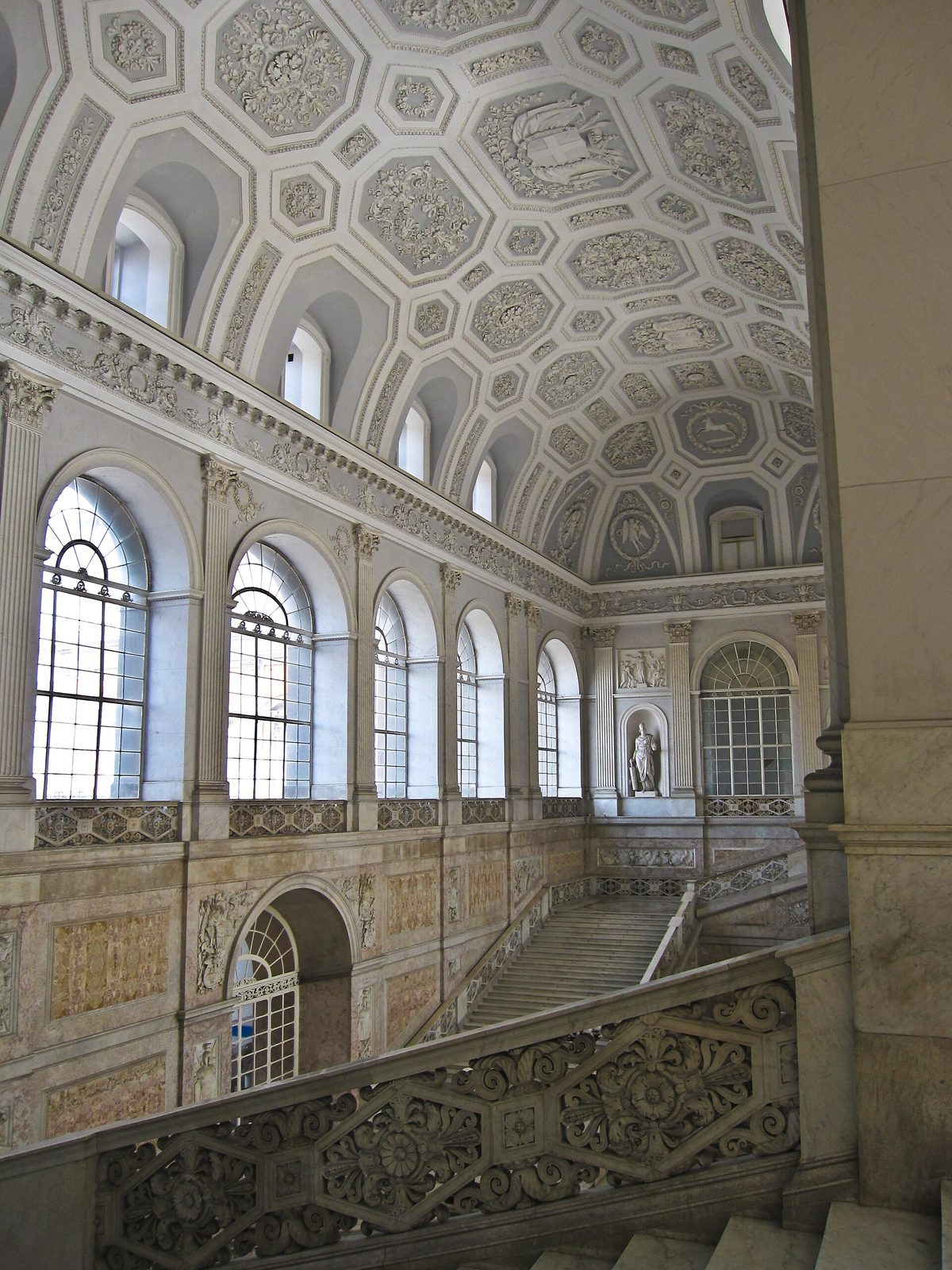
The Spanish also gave Naples its royal palace. The Palazzo Reale on Piazza del Plebiscito was begun in the early seventeenth century to house the viceroys and a hoped-for royal visit, and every later dynasty added to it. Its monumental staircase and royal apartments are a sight I think gets overlooked, which is a mistake: it is an easy place to understand how grand this capital once was.
Spanish rule was also heavily taxed, and Naples was by then one of the largest cities in Europe, crowded and hungry. In July 1647 a new tax on fruit set off a revolt in the market district, and its leader was a young fish seller named Tommaso Aniello, remembered as Masaniello. For a few days he effectively ran the city. Then, in the way of these things, he was murdered, the revolt carried on without him, and a short-lived Neapolitan Republic was declared before Spanish control was restored. Masaniello became a folk hero and an opera subject, and Neapolitans still use his name for a populist firebrand. The square where it started, Piazza del Mercato, is a scruffy, little-visited space east of the center today; worth a look only if the story grabs you.
Two disasters bookend the century. In December 1631 Vesuvius had its most violent eruption since antiquity, devastating the towns at its foot. The city’s devotion to its patron saint, San Gennaro, was credited with stopping the lava, and one of the three yearly liquefaction dates, December 16, still commemorates it. Then in 1656 plague tore through the city and killed a huge share of its people. The dead were too many to bury in churches, and many ended up in the tufa quarries of the Sanità valley, which became the Fontanelle cemetery. Hold that thought for the section on superstition.
Art boomed anyway. Naples became one of the capitals of the Baroque. Caravaggio arrived on the run from a murder charge in Rome in 1606 and painted The Seven Works of Mercy for the Pio Monte della Misericordia, a charitable institution just off Via dei Tribunali, where the painting still hangs above the altar it was made for. His dark, dramatic style ran through a whole school of Neapolitan painters after him. The best place to see that school together is the Museo di Capodimonte; the best place to see Baroque Naples at full volume is any church in the old center, and our guide to Naples churches will tell you which ones are worth the detour.
Bourbon Naples and the Kingdom of the Two Sicilies
The Spanish era ended with the War of the Spanish Succession. Austria held Naples from 1707, and then in 1734 a young Spanish prince, Charles of Bourbon, son of Philip V of Spain and Elisabetta Farnese, took the kingdom and, crucially, came to live in it. For the first time in two centuries Naples had a king of its own in residence, and he set out to give it a capital worthy of the title.
Charles’s building program is still the backbone of a Naples sightseeing list:
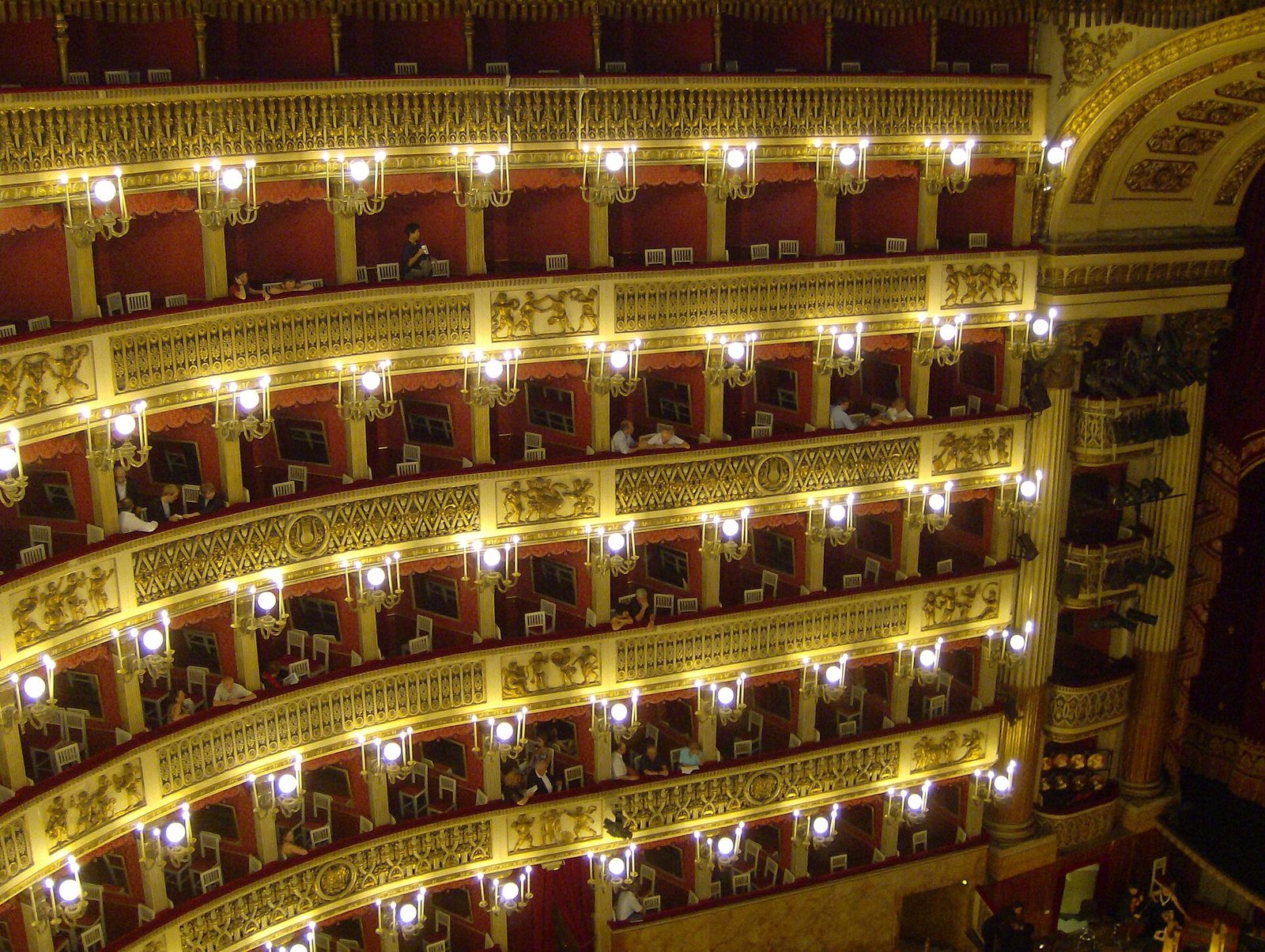
- The Teatro di San Carlo, built next to the royal palace and opened on 4 November 1737. It is commonly described as the oldest continuously active opera house in the world, and its season is still running; the theatre’s own site lists performances and guided tours.
- The palace at Capodimonte, begun as a royal hunting lodge and picture gallery on the hill north of the city, and now one of Italy’s great art museums.
- The Reggia di Caserta, the vast palace and garden north of Naples meant to rival Versailles. Our Reggia di Caserta guide covers the day trip.
- The excavations at Herculaneum (from 1738) and Pompeii (from 1748), begun under royal patronage. The finds went to the king, which is why they are in Naples today.
- The Farnese collections, inherited from Charles’s mother, moved to Naples and now split between MANN and Capodimonte.
When Charles left to become King of Spain in 1759, his son Ferdinand took the throne as a boy, and the long Bourbon reign that followed is the one most people mean by “Bourbon Naples.” It was a court of enormous cultural energy and frequent political repression. The capital was one of the biggest cities in Europe, a stop on the Grand Tour, home to composers, archaeologists and visiting Romantics. It was also a kingdom where much of the rural population lived in deep poverty, and the gap between court and street is a theme you meet again and again.
Revolution reached Naples in 1799. With French armies in Italy and the royal family fled to Sicily, Neapolitan liberals proclaimed the Parthenopean Republic on 24 January 1799. It lasted only months. A peasant army loyal to the Church and the king, the Sanfedisti, marched on the city, the republic collapsed, and the returning Bourbons executed many of its leaders. It is still a sore and much-argued chapter in the city’s memory.
Napoleon came back for Naples. In 1806 he made his brother Joseph king, and in 1808 he gave the throne to his brother-in-law Joachim Murat, a cavalry marshal who turned out to be an energetic reformer: new roads, a modernized administration and the start of the great semicircular square in front of the royal palace. After Napoleon’s fall the Bourbons returned, and in 1816 the mainland and Sicily were formally merged into the Kingdom of the Two Sicilies, with Naples as its capital. That square was finished with the church of San Francesco di Paola as its centerpiece and later renamed Piazza del Plebiscito, after the vote that ended the kingdom.
One more Bourbon first that people like to quote: in 1839 the kingdom opened the first railway on the Italian peninsula, a short line from Naples to Portici along the bay. It was a showpiece more than a network, and by 1860 the south had far less railway than the north. But it is a good corrective to the idea that the south was simply backward and the north simply modern. The real picture, as with most of this history, is messier.
Unification, the “southern question” and the rebuilding of Naples
The end came fast. In 1860 Giuseppe Garibaldi landed in Sicily with his volunteers, the Thousand, swept up through Calabria, and entered Naples on 7 September 1860, welcomed as a liberator, while King Francis II retreated to the fortress of Gaeta. On 21 October 1860 a plebiscite approved joining the new Italian state under the House of Savoy, and the Kingdom of Italy was proclaimed in 1861. Naples went from capital of the largest state on the peninsula to a provincial city of a new country run from Turin, then Florence, then Rome.
What followed is what Italians call the questione meridionale, the southern question: why the south fell behind the north economically after unification, and whose fault that was. Taxes, tariffs and industrial policy that suited the north, a brutal war against rural “brigandage,” and the loss of a court economy all played a part, and the argument is still very much alive. You will meet it in Naples as a kind of wounded civic pride, a sense that the city was once a great capital and was demoted. That pride is part of the Neapolitan character, and it helps explain some of what follows about football.
The decades after unification also brought mass emigration. Millions of southern Italians left for the Americas, and the port of Naples was one of the main departure points. If you have Italian-American roots, there is a fair chance your family’s story passes through these docks.
Then came cholera. In 1884 an epidemic hit the crowded, unsanitary lower city hard, and the shock led to the great urban renewal program known as the Risanamento, literally “the making healthy again.” Whole blocks of old housing near the port were demolished, and a straight boulevard, the Corso Umberto I (still called the Rettifilo, “the straight line”), was driven through them toward the station. The glass-roofed Galleria Umberto I, across from the San Carlo, belongs to the same late-century rebuilding. Walk the Rettifilo and then step one block off it into the old lanes, and you can see exactly what was cut away.
War, eruption and earthquake: Naples from 1943 to 1980
Naples suffered badly in the Second World War. As a major port it was bombed heavily, and the city’s ancient tufa cisterns and quarries were turned into air-raid shelters, which is why bunker graffiti, children’s toys and wartime debris turn up on underground tours today. The Galleria Borbonica, a tunnel dug for the Bourbon king Ferdinand II, was one of them, and its tours show how it was used in the war. Check its own site for current tour times.
After Italy’s armistice in September 1943, German forces occupied the city, began deportations and prepared to wreck the port. In late September the people of Naples rose up in what is remembered as the Four Days of Naples, street fighting led largely by ordinary citizens and teenagers. The Germans withdrew, and Allied troops entered a city that had, in large part, liberated itself. It is one of the proudest episodes in modern Neapolitan memory, and the city holds the Medal of Military Valor for it.
Six months later, in March 1944, Vesuvius erupted, for the last time to date. The eruption ran from 17 to 23 March, destroyed villages on the slopes, and wrecked dozens of Allied aircraft parked at a nearby airfield. Vesuvius has been quiet since, which is not the same thing as harmless; our Mount Vesuvius guide covers the crater hike and how the volcano is monitored.
The postwar decades brought the hard years Neapolitans still talk about: chaotic reconstruction and speculative building on the hills, a cholera scare in 1973, and on 23 November 1980 the Irpinia earthquake, centered inland but felt hard in Naples, which killed at least 2,483 people across the region. In the city, damaged buildings were propped up with timber for years, and the reconstruction money that followed became, notoriously, a feeding ground for organized crime.
The turnaround story starts in the 1990s. The city cleaned up and reopened its historic center, the metro began to extend, and in 1995 UNESCO inscribed the Historic Centre of Naples on the World Heritage List. Since then the city has tilted, slowly and unevenly, toward tourism, and the visitors who come now see a Naples that is a lot more welcoming than the one their parents were warned about.
San Gennaro and the blood: the city’s oldest ritual
You cannot understand Naples without its patron saint. San Gennaro (Saint Januarius) was a bishop martyred in the early fourth century, and the cathedral keeps two glass ampoules said to hold his dried blood. Three times a year the archbishop brings them out, and the faithful wait for the blood to turn liquid. When it does, it is read as a good sign for the city. When it does not, people worry, and Neapolitans will list the disasters that followed failed liquefactions in the past.
The three dates, as the Royal Chapel of the Treasure of San Gennaro sets them out, are:
- The Saturday before the first Sunday in May, marking the transfer of the saint’s relics to Naples, with a procession from the Duomo to Santa Chiara. In 2026 it fell on 2 May, and the blood was reported liquefied that afternoon.
- 19 September, the saint’s feast day and the big one, with crowds packing the Duomo from early morning.
- 16 December, commemorating the saint’s protection during the 1631 eruption of Vesuvius. In 2026 that is a Wednesday.
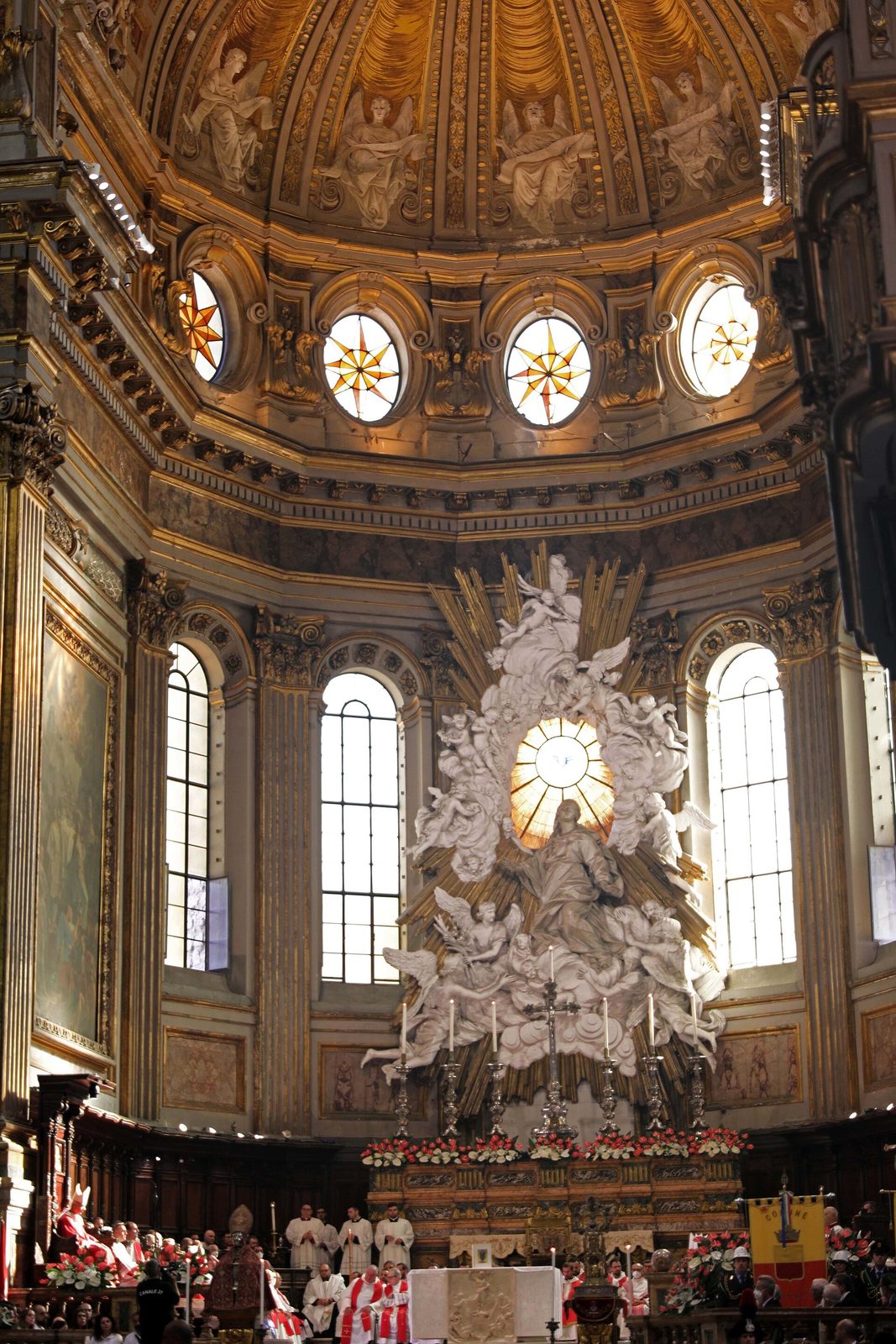
I’ll say what I think: you do not have to believe in the miracle to find the ritual moving. It is a city talking to itself about luck, protection and survival, in a place that lives under a volcano. If you are in town on one of those days, go early and expect a crush. On any other day, the Chapel of the Treasure inside the Duomo and the Museo del Tesoro di San Gennaro next door show the extraordinary jewels and silver given to the saint over the centuries; check the museum’s own site for current hours. Our Naples festivals guide covers the feast days in more practical detail.
Why Naples is so superstitious
Naples has a reputation as the most superstitious city in Italy, and while nobody can measure that, you will see the evidence everywhere. Most of it is affectionate and half-joking; some of it is taken quite seriously. Here is what you will run into and what it means.
The cornicello. The little red horn sold on every souvenir stall is an amulet against the evil eye, malocchio, and against jettatura, the bad luck some people are believed to cast without meaning to. Tradition says it works best as a gift, so buying one for someone else is the proper move. Red for luck, horn-shaped for strength, and ideally handmade; the plastic ones count, the locals will tell you with a grin, but less.
La smorfia. Neapolitans have a traditional “dream book” that turns dreams and everyday events into numbers from 1 to 90, the numbers of the lottery. Dream of a dead relative, of falling, of a cat, and there is a number for it. Number 90 is fear; number 17 is bad luck across Italy, which is why some buildings skip it. The smorfia’s origins are uncertain, but it is very much alive, and you will see it printed on tea towels and posters in the old center.
Pulcinella. The white-suited, black-masked figure you will see on every second shop sign is Pulcinella, the Neapolitan character of the seventeenth-century commedia dell’arte: lazy, hungry, cunning, unlucky and indestructible. He is the city’s self-portrait.
The cult of the anonymous dead. This is the strange one, and it goes back to that 1656 plague. In the Fontanelle cemetery, the vast tufa quarry in the Sanità where victims of plague and later cholera were piled, ordinary Neapolitans for generations “adopted” individual skulls, the capuzzelle. They cleaned them, built them little houses, prayed for the souls in purgatory and asked them for favors in return, including lottery numbers. The Church tried to stamp the cult out in the twentieth century, and the cemetery itself was closed for years. It has reopened to visitors, by booking, so check the current arrangements with the Comune di Napoli before you go. It is one of the most powerful places in Naples, and I would put it ahead of most churches.
Why all this? Partly it is the long Catholic and pre-Christian folk culture of the south. Partly it is a city that has lived with plague, eruption, earthquake and poverty, where luck, protection and the help of the dead felt like practical concerns. And partly, today, it is a joke the city enjoys telling about itself. Treat it with the same mix of respect and humor and you will be fine.
The Camorra: what it is and what it means for you
Every visitor who has watched Gomorrah asks about this, so here is the honest answer. The Camorra is the organized crime system of Naples and Campania, a mafia-type network that emerged in the city in the late eighteenth and early nineteenth centuries. Unlike the Sicilian Mafia, it is not a single pyramid but a shifting set of family clans, each controlling territory, which is why its feuds can be so violent. Its business is the usual: drugs, extortion, counterfeit goods, waste disposal, construction contracts and, historically, the reconstruction money after the 1980 earthquake.
Roberto Saviano’s 2006 book Gomorrah exposed much of that to an international audience, and the TV series based on it ran from 2014 to 2021. Both are worth your time, but they are about specific peripheral districts in the city’s north, not about the historic center where you will spend your days.
What it means for a traveler, in practice:
- Clan violence is directed at rivals, not tourists. Visitors are not targets, and the places you will go (the centro storico, Chiaia, Via Toledo, the seafront, Vomero, the museums) are not where the conflicts play out.
- Your realistic risks are petty crime: pickpockets on crowded buses and the Circumvesuviana, phone and bag snatching from scooters, and the occasional scam near the station. Our Naples travel tips cover the precautions that actually help.
- Do not go “Gomorrah touring” in Scampia or Secondigliano. It is voyeuristic, there is nothing there for you to see, and the residents, most of whom have nothing to do with any clan, have had enough of it.
- Buy from real shops, not the street sellers of fake designer goods. Counterfeiting is one of the trades that funds organized crime.
The Camorra is a real problem for Naples, and it is a real problem mostly for Neapolitans. That is the right frame: neither a reason to stay away nor a piece of local color to romanticize.
Maradona: why a footballer is treated like a saint
Walk through the Quartieri Spagnoli and you will see him everywhere: on walls, on shrines next to the Madonna, on scarves, on espresso cups. Diego Armando Maradona played for SSC Napoli from 1984 to 1991, and to understand why that made him something close to a patron saint, you need the history above.
Naples was the demoted former capital, the southern city northern fans mocked with insulting chants about cholera, dirt and Vesuvius. Its club had never won the Italian league. In the summer of 1984 Napoli signed the best player in the world from Barcelona, and he was presented to the fans on 5 July 1984. What followed was the club’s first league title, the scudetto of 1986-87, and a second in 1989-90, won against the rich clubs of Milan and Turin. For a city that felt looked down on by the north for more than a century, it was not just football. It was revenge, and it was proof.
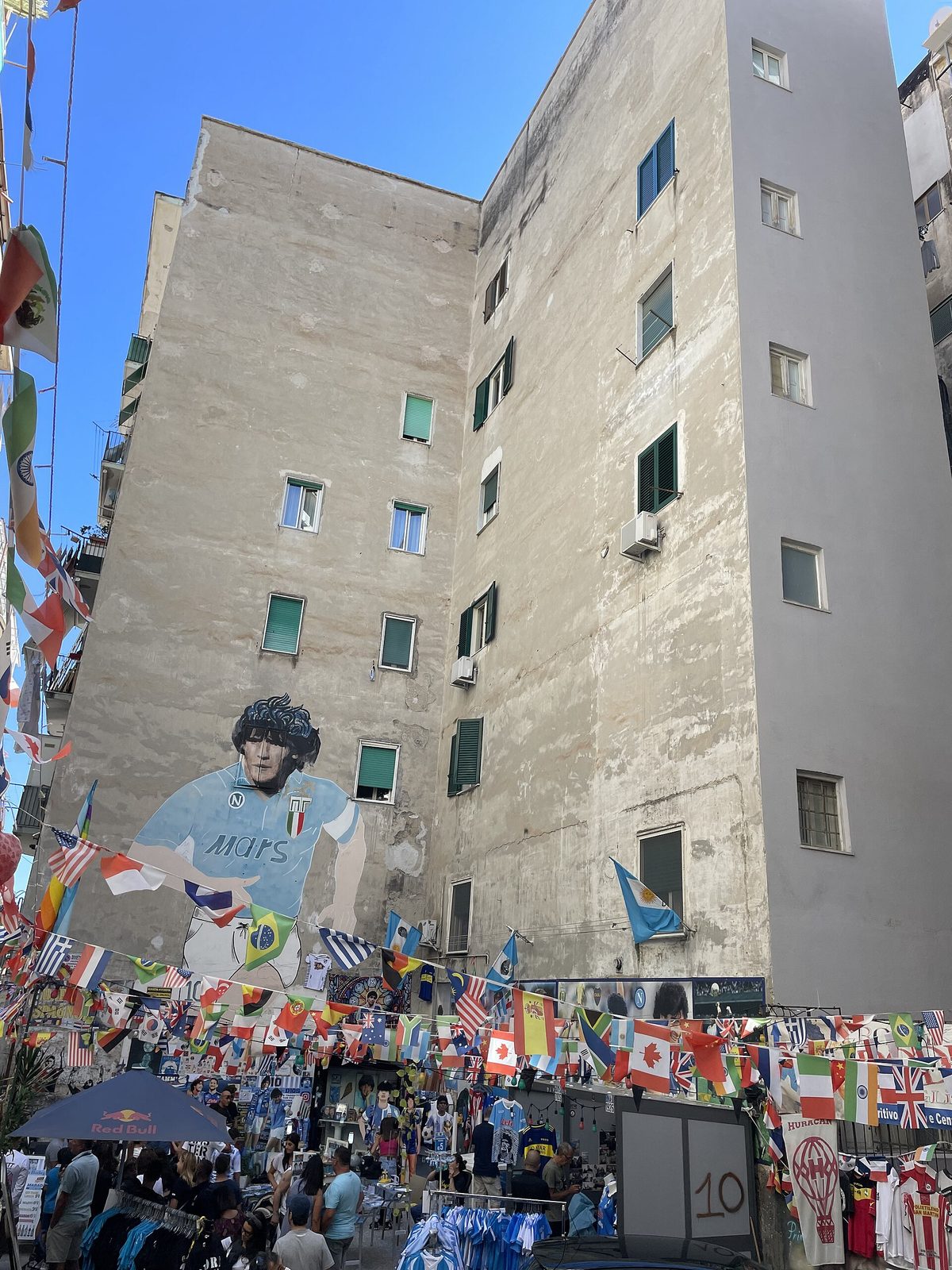
He was also, as everyone in Naples will admit, a flawed hero: his years in the city ended in 1991 with a doping ban amid cocaine scandals and links to Camorra figures. Naples forgave him all of it. When he died in November 2020, the city mourned him like a head of state, and the next month the municipality renamed the club’s stadium, the old San Paolo, the Stadio Diego Armando Maradona.
The famous mural is on a building in the Quartieri Spagnoli, and the small square below it, Largo Maradona, became a shrine and then a full-blown tourist attraction, crammed with stalls, flags and relics. The square was closed for redevelopment works in 2026 and the mural has been restored; check the Comune di Napoli for the current state of the works before you plan around it, and visit early in the day if you want to see the wall rather than the crowd.
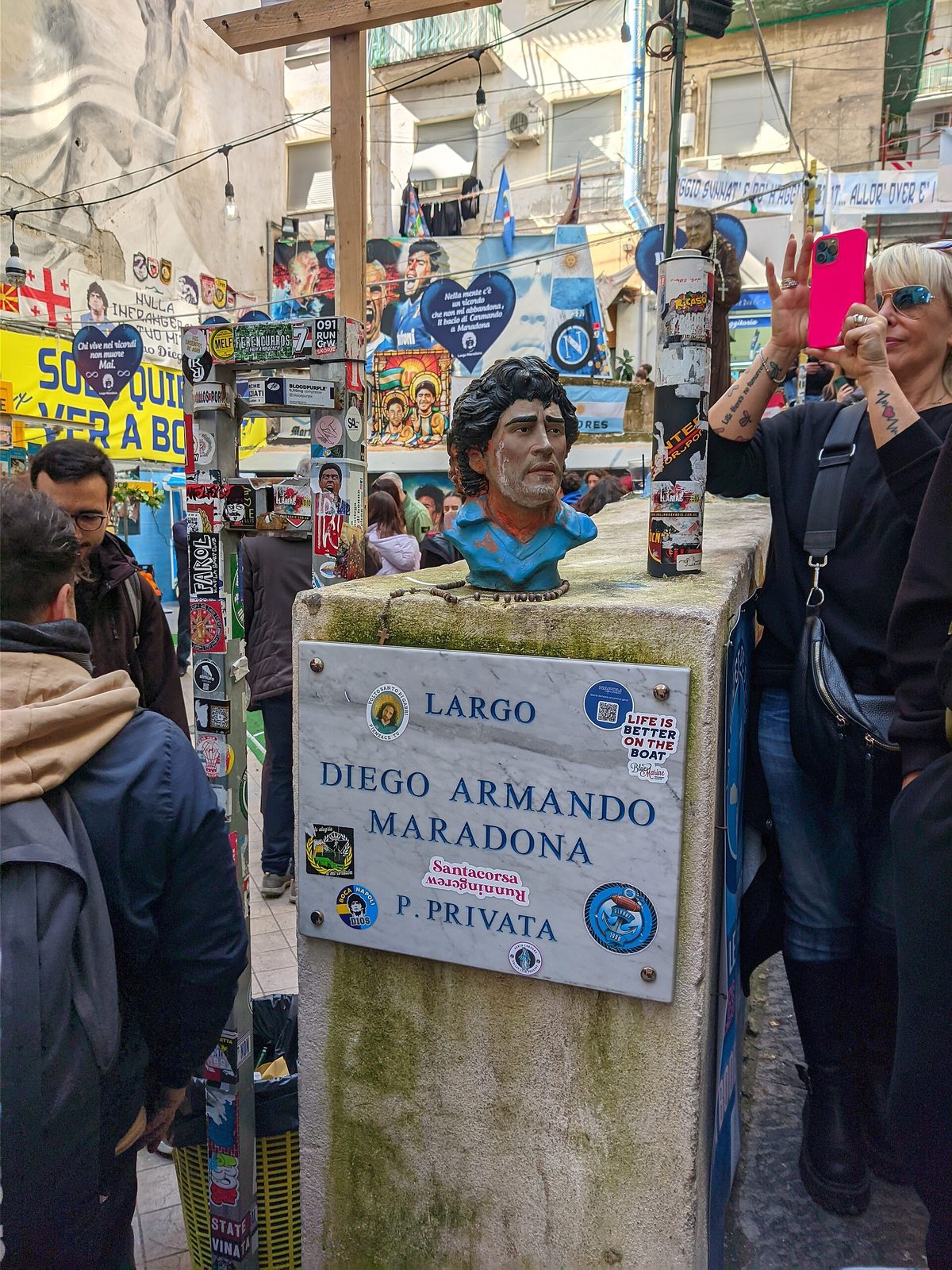
The story has a recent happy ending. Napoli won the league again in 2023, the first title since Maradona, and the city partied for weeks. Then on 23 May 2025, with a 2-0 win over Cagliari, SSC Napoli clinched its fourth scudetto.
Where to see Naples history today: a one-day route
If you want to walk through the eras in order, this route does it in a long day on foot, with a metro hop at the end. It works best on a day when MANN is open (not Tuesday) and Castel Nuovo is open (not Sunday).
- Morning, Greek and Roman: start at MANN on Piazza Museo for the Pompeii and Herculaneum finds and the Farnese sculptures. Then walk down to Piazza Bellini for the Greek walls.
- Late morning, the decumani: walk Via dei Tribunali, go underground at Napoli Sotterranea or San Lorenzo Maggiore, and look into the Pio Monte della Misericordia for Caravaggio. Lunch is a pizza on Tribunali; our best pizza in Naples guide will help you choose.
- Early afternoon, Angevin to Baroque: the Duomo and the Chapel of San Gennaro, then down Spaccanapoli past Santa Chiara and the Gesù Nuovo. Our centro storico guide maps the walk.
- Afternoon, Spanish and Bourbon: down Via Toledo, a detour up into the Quartieri Spagnoli, then Piazza del Plebiscito, the Palazzo Reale, the San Carlo and the Galleria Umberto I, finishing at Castel Nuovo.
Add Capodimonte on another day (check the museum’s own site for its opening days), and the Certosa e Museo di San Martino on the Vomero hill for the city’s own history museum and a sweeping view over the whole thing. For the full list of sights with practical details, start with our things to do in Naples, Italy guide.
What to skip
- “Gomorrah tours” of Scampia. Covered above. Skip them.
- Planning around Castel dell’Ovo. It is closed to the public for restoration with no reopening date set, so admire it from the seafront and spend the time at Castel Nuovo instead.
- Piazza del Mercato as a destination. The history is great, the square today is not; read about Masaniello and save your legs.
- Trying to see everything in one day. The route above is already a lot. If you only have a morning, do MANN and the Greek walls and let the rest wait.
- Treating the Maradona mural as the whole Quartieri Spagnoli. Walk a few blocks beyond it, look up at the shrines and the balconies, and you will see the neighborhood the Spanish built rather than a queue.
Naples history: frequently asked questions
Who founded Naples?
Greek settlers from nearby Cumae founded the first town, Parthenope, on the Pizzofalcone hill in the late eighth century BC. A new town, Neapolis (“new city”), was laid out next to it between the late sixth and fifth centuries BC, and its grid survives as the streets of the centro storico.
What was the Kingdom of the Two Sicilies?
It was the state formed in 1816 when the Bourbon kingdoms of Naples and Sicily were formally merged, with Naples as its capital. It covered all of southern Italy and Sicily and lasted until Garibaldi’s campaign of 1860 and the plebiscite that joined it to the new Kingdom of Italy.
Was Naples ever the capital of Italy?
No. Naples was never the capital of united Italy, but it was the capital of the Kingdom of Naples from the late thirteenth century and of the Kingdom of the Two Sicilies until 1861, which made it for centuries the largest and most important city in the Italian south.
Is the Camorra dangerous for tourists?
Not directly. Camorra violence is between rival clans, mostly in peripheral districts visitors have no reason to go to. The real risks for travelers are pickpocketing and bag snatching, so watch your phone and bag on crowded transport and in busy squares.
Why is Maradona so important in Naples?
He led SSC Napoli to its first two league titles, in 1987 and 1990, beating the powerful northern clubs. For a southern city long mocked by northern fans, that was a matter of pride and identity, which is why his face appears on shrines and murals across the city and the stadium now bears his name.
When does the San Gennaro blood miracle happen?
Three times a year: on the Saturday before the first Sunday in May, on 19 September (the saint’s feast day), and on 16 December, which commemorates the 1631 eruption of Vesuvius. The ceremony takes place in the Duomo, and you should expect a crush.
Why are Neapolitans superstitious?
Centuries of plague, eruption, earthquake and poverty made luck and protection feel practical, and folk traditions like the cornicello amulet, the smorfia dream-number book and the cult of the dead at the Fontanelle cemetery grew out of that. Today it is part faith, part habit and part a joke the city enjoys.
What is the best museum for Naples history?
For the ancient city and Pompeii, the National Archaeological Museum (MANN). For the city’s own story from the Middle Ages to the nineteenth century, the Certosa e Museo di San Martino on the Vomero, which also has a sweeping view over the old center. Do both if you have the time.
Photo credits
- Castel Nuovo (Maschio Angioino): photo by Paolo Villa, Wikimedia Commons, CC BY-SA 4.0.
- Greek walls in Piazza Bellini: photo by Sailko, Wikimedia Commons, CC BY-SA 3.0.
- Palazzo Reale staircase: photo by Armando Mancini, Wikimedia Commons, CC BY-SA 2.0.
- Interior of the Teatro di San Carlo: Wikimedia Commons, public domain.
- The Duomo during the feast of San Gennaro: US Navy photo by Petty Officer 1st Class Indra Beaufort, Wikimedia Commons, public domain.
- Maradona mural, Quartieri Spagnoli: photo by Photo2023, Wikimedia Commons, CC BY 4.0.
- Largo Diego Armando Maradona sign: photo by Evvemoscia, Wikimedia Commons, CC BY-SA 4.0.
Sources: UNESCO World Heritage Centre, Comune di Napoli, Real Cappella del Tesoro di San Gennaro, SSC Napoli, Teatro di San Carlo, Museo Archeologico Nazionale di Napoli and standard historical references; checked October 2026.