On this page
Last updated September 25, 2026. Reggia di Caserta tickets and opening times checked against the palace’s official website (updated September 21, 2026); Paestum and Velia tickets and hours against the archaeological parks’ official information. Prices change, and opening hours shift with the seasons.
The Reggia di Caserta, the vast Bourbon royal palace under an hour from Naples, Italy by train, is the best inland day trip in Campania. Come for its state rooms, a three-kilometer avenue of fountains and the English Garden. South of Naples, Paestum’s Greek temples are the other unmissable trip beyond the bay.
Most visitors to Naples look at the sea: the islands, the Amalfi Coast, Pompeii on the shore of the bay. Behind the coast, though, lies a whole other Campania, and it’s barely touched by international tourism. There’s the largest royal palace ever built, a rival to Versailles set in gardens that run for kilometers. There are three of the best-preserved Greek temples anywhere in the world, standing in a meadow near the sea. There’s a medieval hill town, a utopian silk factory, the amphitheater where Spartacus’s revolt began, the country where buffalo mozzarella is made, and some of the finest wine regions in southern Italy. All of it is reachable by ordinary train or a short drive.
This guide covers it all, starting with the two world-class sites, the Reggia di Caserta and Paestum, and moving on to the places around them and the food and wine country beyond. For how they compare with the trips around the bay, see the day trips from Naples guide.
Inland Campania at a glance
| Destination | Why go | From Naples | Time to give it | My verdict |
|---|---|---|---|---|
| Reggia di Caserta | The Bourbon palace, its park of fountains and the English Garden | Regional train, under an hour; the station faces the palace | Most of a day | Essential; the best inland day trip |
| Casertavecchia and San Leucio | A medieval hill village and a royal silk factory | Short hops from Caserta by taxi or bus | Half a day, added to Caserta | A lovely add-on if you have a car or a spare afternoon |
| Santa Maria Capua Vetere | A giant Roman amphitheater linked to Spartacus | Train or car, north of Naples | Two hours | For Roman history lovers |
| Paestum | Three Greek temples and a superb museum | Regional train south, well over an hour | Most of a day | Essential; the best Greek temples outside Greece and Sicily |
| Velia and the Cilento | A Greek city of philosophers and a wild national park coast | Train or car, far south | A few days | For a longer stay, not a day trip |
| Buffalo mozzarella farms | Tastings where the mozzarella is made | Car or driver, near Caserta or Paestum | A morning | Pair with Paestum |
| Wine country | Taurasi, Fiano, Greco di Tufo and Falanghina | Car or driver | A full day | Worth it with a driver |
| Benevento | Trajan’s arch and a Lombard church | Train or car, inland | A day | Rewarding and almost tourist-free |
The Reggia di Caserta: the palace to outdo Versailles
In 1752, Charles of Bourbon, king of Naples, laid the foundation stone of a new royal palace at Caserta, north of the capital, as the center of a new administrative city. It was built to rival Versailles and to be safer from attack from the sea than the palace in Naples. His architect, Luigi Vanvitelli, designed a colossal rectangular palace around four great courtyards, with some 1,200 rooms on five floors, set at the end of a park stretching for kilometers into the hills. It’s often described as the largest royal palace in the world by volume. The work took decades, and the kings had moved on by the time the last decorations were finished in the 19th century.
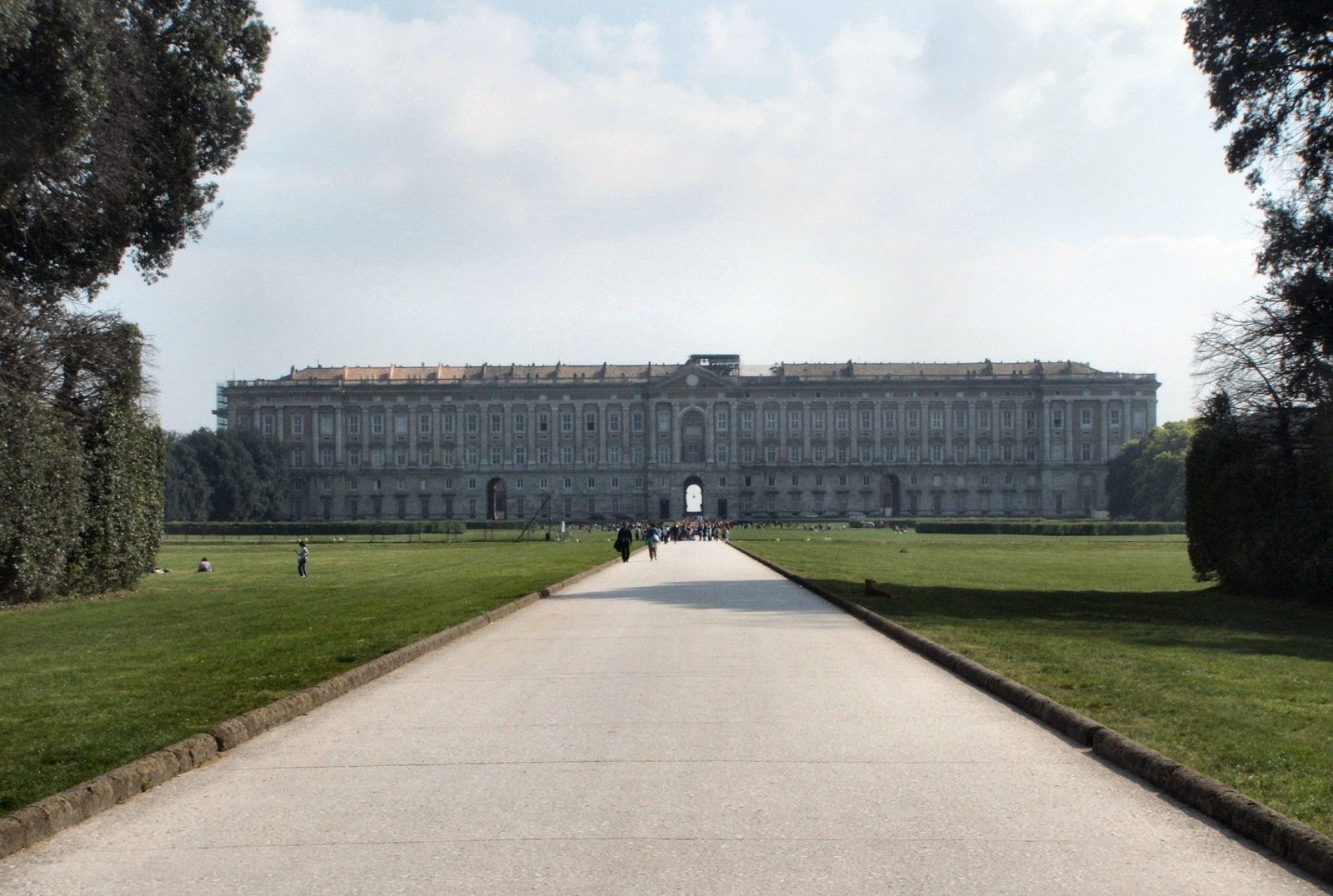
The palace has had a colorful later life. During the Second World War it was the headquarters of the Allied forces in the Mediterranean, and the German forces in Italy signed their surrender here in April 1945. More recently it has starred in films, standing in for the queen’s palace on the planet Naboo in two of the Star Wars prequels. Since 1997 the palace, its park, the aqueduct that feeds the fountains and the silk colony of San Leucio have together formed a UNESCO World Heritage Site.
The palace
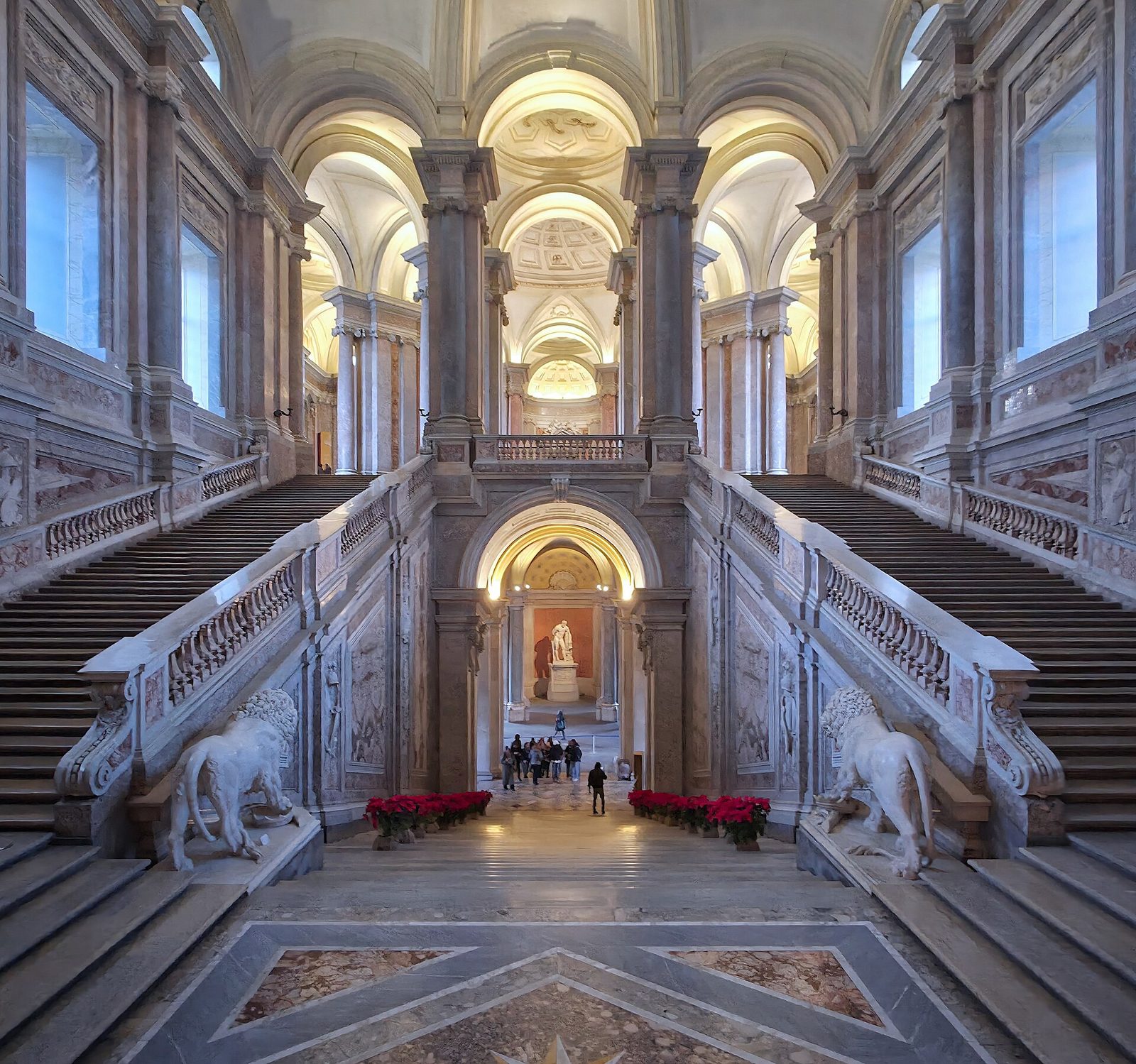
You enter through a vast central vestibule, and then comes the moment that stops everyone: the grand staircase. It’s a broad, marble flight rising between two stone lions to an octagonal upper vestibule under a double vault, designed so that musicians could play in the hidden gallery above while the court arrived. It’s one of the great theatrical spaces in Europe.
Upstairs, the Royal Apartments run through two sets of rooms. The 18th-century apartments are the richer and more rococo, while the rooms finished in the 19th century are in heavier neoclassical style. The long sequence includes the throne room, the halls of the guards, the king’s and queen’s apartments, a library, and a room holding the palace’s great royal nativity scene. Along the way, you’ll also pass the Palatine Chapel and the small court theater, and elsewhere in the palace is the Terrae Motus collection of contemporary art. It’s a lot of gilding, and after two hours most visitors are ready for fresh air.
The park
Behind the palace, the royal park runs straight uphill for about three kilometers, following a single axis of lawns, pools and fountains. Each fountain illustrates a classical myth: Aeolus with his winds, Ceres, Venus and Adonis. At the top, the Fountain of Diana and Actaeon shows the moment the hunter who surprised the goddess bathing is turned into a stag, with the Great Cascade tumbling down the hill behind. The water comes from the Carolino Aqueduct, which Vanvitelli built to carry it across the hills from springs far away. The effect, standing at the top and looking back down the whole avenue to the palace, is one of the great views in Italy.
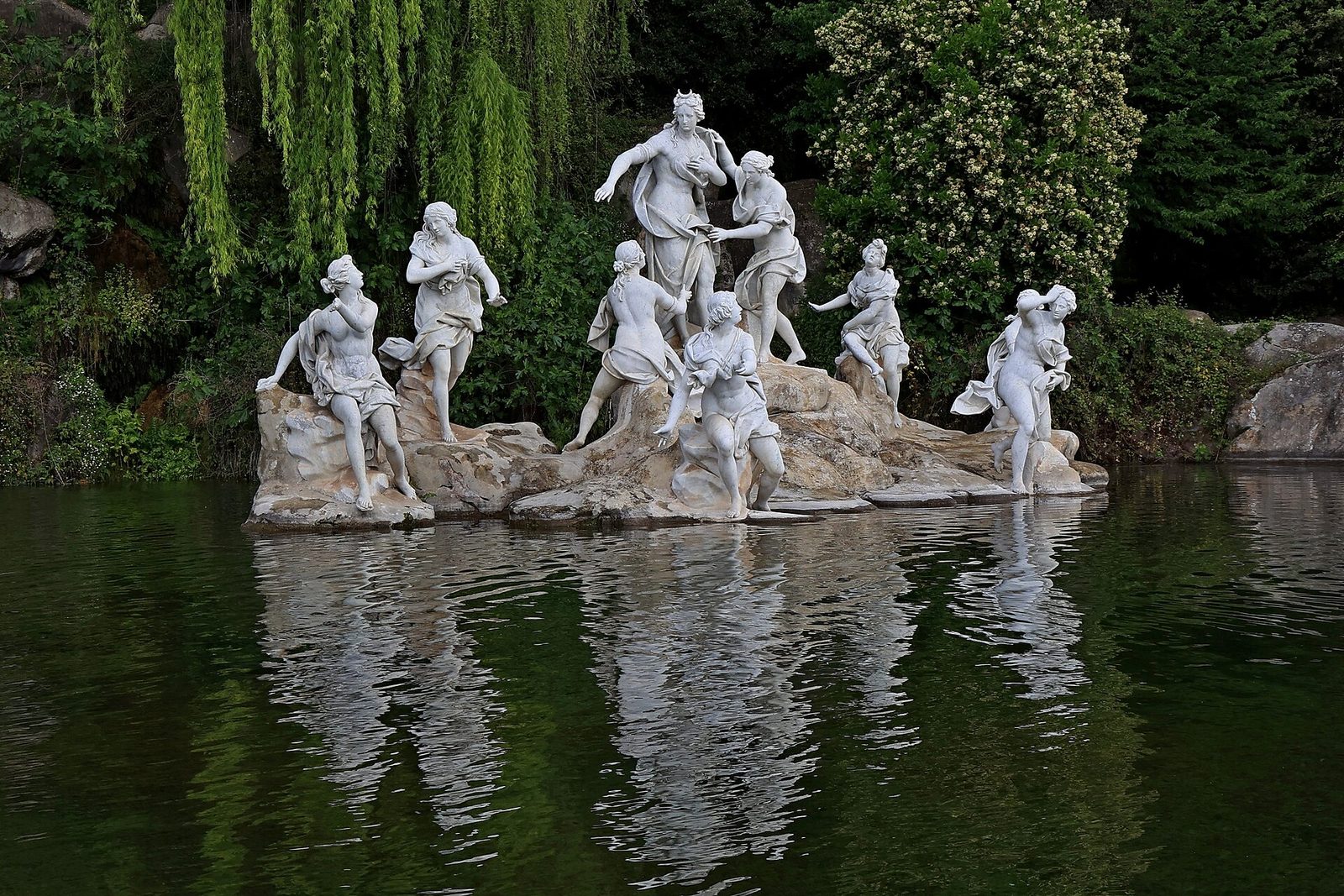
Three kilometers each way is a real walk, especially in summer heat. The palace offers a shuttle service and bicycle rental, each paid separately, and many visitors walk up and ride down, or the reverse. Don’t try to rush it. The park is the best part of the visit for many people.
Corners most visitors miss
The Reggia is so big that most people see the staircase, the apartments and the fountains and head home. A few quieter corners are worth seeking out. The court theater, a jewel box of a horseshoe-shaped auditorium by Vanvitelli, was designed so that the back of the stage could open onto the park, turning the gardens into scenery. The Palatine Chapel, modeled on the chapel at Versailles, still shows the scars of wartime bombing. In the old wood of the park, the Bosco Vecchio, you’ll find the Castelluccia, a miniature fortress where the young king Ferdinand IV staged mock battles, and the Peschiera, a large ornamental fishpond with an island pavilion where the court fished and boated.
The palace is quietest on weekday mornings outside the school holidays. Avoid the free first Sunday of the month, when crowds are heaviest and the English Garden is closed. If you just want the apartments without the crowds, the evening ticket for entry after 17:00 is cheap and often peaceful, though it doesn’t include the park.
The English Garden
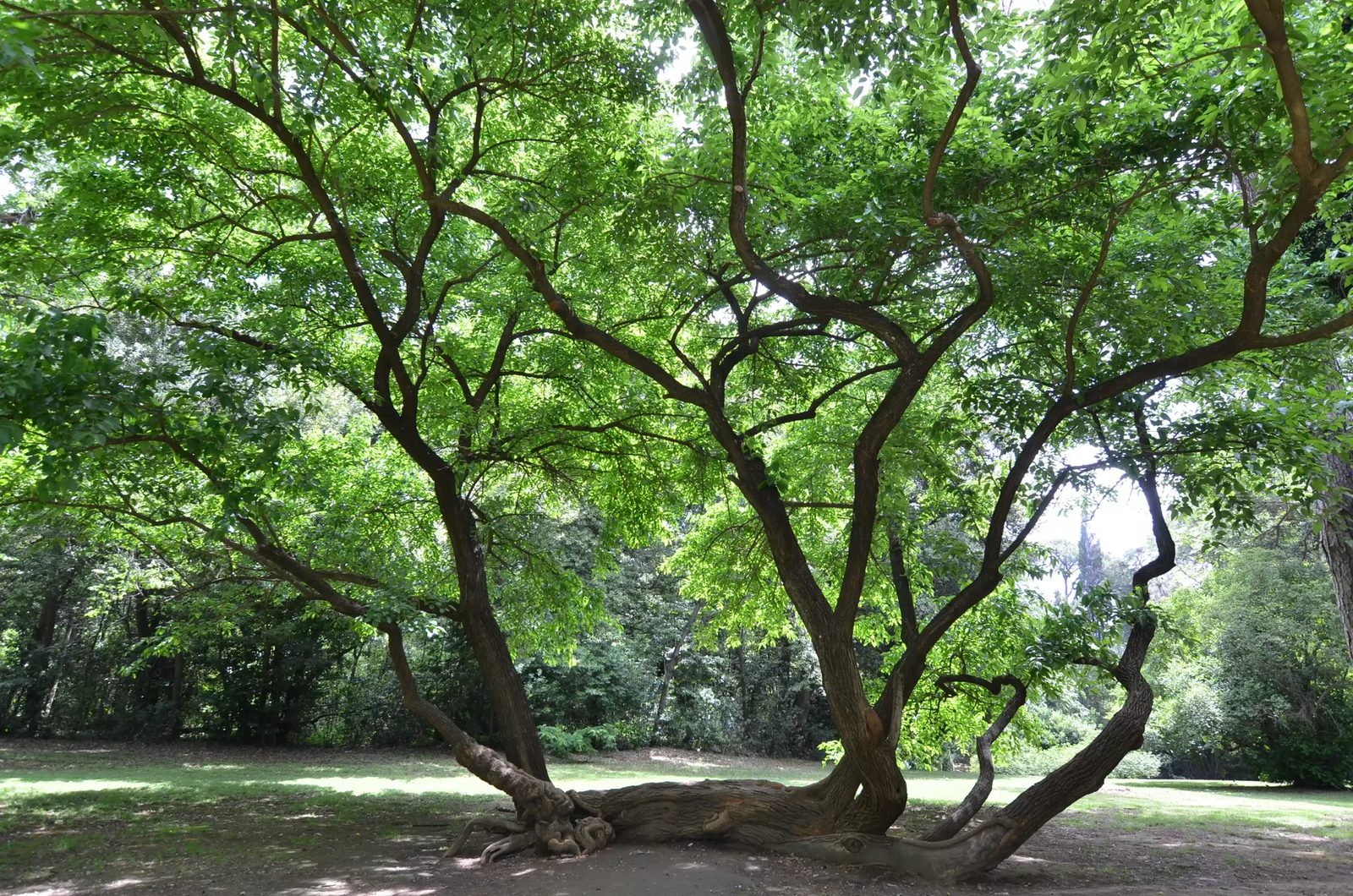
Beside the Great Cascade, Queen Maria Carolina created an English landscape garden in the 1780s, among the first in Italy, with the help of an English gardener. It’s a romantic landscape of winding paths, rare trees from around the world, fake ruins, a lake and hidden statues, including a famous Venus bathing in a grotto. It feels completely different from the formal park, shady and secretive, and it’s easy to lose an hour here. Note that it has shorter opening hours than the rest of the park, and it’s closed on the free first Sunday of the month and other free-entry days.
The Reggia with children
The Reggia is a better family day than it sounds. The apartments are the hard part, so keep that visit brisk and let the children look for the lions on the staircase and the throne room’s gold. Then the park is the reward: huge lawns, fountains full of stone animals and giants, bikes to rent, and the Great Cascade at the top. The English Garden, with its winding paths, hidden statues and fake ruins, feels like an adventure playground for explorers. Bring a picnic blanket, water and snacks, and give the park at least as much time as the palace. Under-18s get in free.
Accessibility
The Reggia’s scale is the main challenge for visitors with limited mobility, since the park avenue alone runs for about three kilometers. The paid shuttle service in the park makes the fountains and the Great Cascade reachable without the long walk. Visitors with disabilities and a companion enter free. For the apartments, contact the palace before your visit to ask about lifts and step-free routes, since the grand staircase is the ceremonial way up. The English Garden’s paths are uneven in places.
Tickets and opening times
As of September 2026, according to the palace’s official website:
- Full entrance ticket, €18 (plus a €1 fee online): the Royal Apartments, the park, the English Garden and the court theater. The ticket allows about two hours in the palace and four in the park and gardens.
- Park and English Garden only, €9 (plus €1 online).
- Royal Apartments only, €12 (plus €1 online), sold when the park is closed.
- Evening apartments, €5 (plus €1 online), for entry after 17:00.
- Park without the English Garden, €3, sold at the ticket office only, when the English Garden is closed.
- Reductions: under-18s go free, EU citizens aged 18 to 24 pay €3 (plus €1 online), and visitors with disabilities and a companion go free.
- Free days: the first Sunday of every month, when the English Garden is closed.
The palace is closed on Tuesdays and on December 25. From April to September, the Royal Apartments open 08:30–19:15 (last entry 18:15), the park 08:30–19:00 (last entry 18:00), and the English Garden 08:30–18:00 (last entry 17:00). The last access through the central gate is at 18:00. The park’s hours change month by month, and are shorter in the colder months, so check the official timetable for your date. You can’t leave and re-enter on the same ticket. The official site names TicketOne as the only authorized online reseller, so be wary of other sites selling “Caserta tickets” at a markup.
Getting there from Naples
Caserta is one of the easiest day trips from Naples. Regional trains run frequently from Napoli Centrale to Caserta, taking under an hour, and Caserta station stands directly across the square from the palace, so you walk out of the train and straight to the entrance. By car, it’s a short motorway drive north, with parking near the palace. The getting around Naples guide covers regional trains and tickets.
How to plan the day
- Arrive when it opens. Take an early train and be at the gates for 08:30, before the tour groups.
- Do the palace first, while you’re fresh. Allow a couple of hours for the staircase and apartments.
- Then the park. Walk, cycle or take the shuttle up the avenue of fountains to the Fountain of Diana and the Great Cascade.
- The English Garden next, which closes earlier than the rest.
- Walk back down the avenue in the afternoon light, with the palace ahead of you.
Bring water, a hat and comfortable shoes. It’s a long day on your feet. For a late lunch, the town around the palace has plenty of restaurants and pizzerias. Caserta has become a serious pizza city in its own right, and one of its pizzerias ranked joint second in Italy in the 50 Top Pizza guide for 2026.
Verdict: essential. Even if palaces aren’t usually your thing, the staircase, the park and the English Garden add up to one of the great days out in Italy, and it’s far quieter than any comparable site. For the royal palace in Naples itself, see the Naples castles and palaces guide.
Around Caserta: Casertavecchia, San Leucio and Capua
Casertavecchia
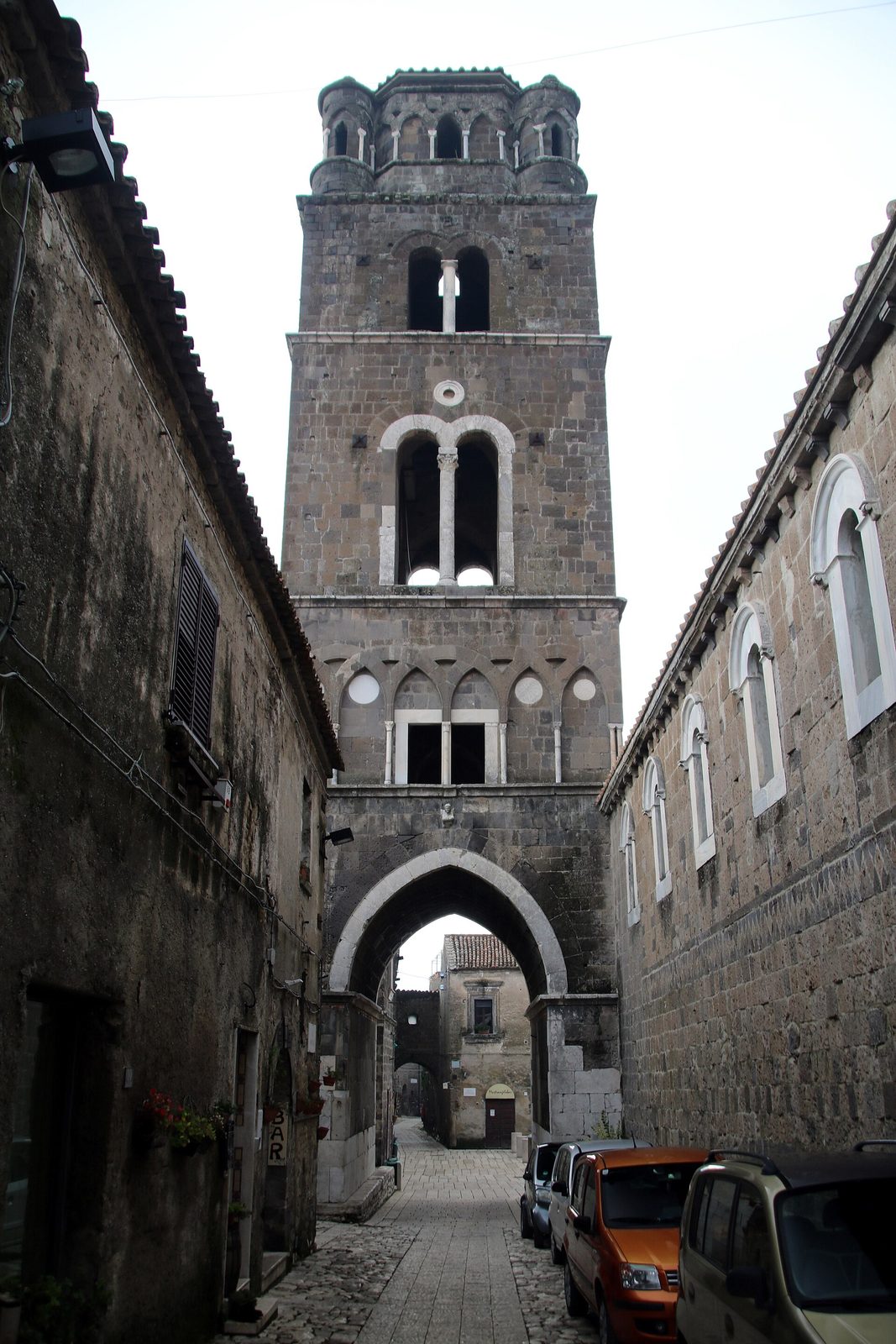
On a hill above modern Caserta, the medieval village of Casertavecchia (“old Caserta”) is a warren of gray stone lanes around a beautiful 12th-century cathedral, which mixes Norman, Arab and Lombard influences, with a tall bell tower and striped arches. The ruins of a castle crown the hill, and the views stretch over the plain to the sea. It’s quiet, atmospheric and full of good restaurants, and the perfect place for dinner after a day at the Reggia. It’s a short taxi ride or a bus from Caserta.
San Leucio
Just north of the Reggia, the Bourbon king Ferdinand IV founded a silk factory at San Leucio in the late 18th century, around a royal hunting lodge, and turned it into an experimental community. Its workers had their own houses, free schooling, equal inheritance for sons and daughters and a code of laws written for them by the king. The silk works still produce luxury fabrics, some of which have furnished palaces around the world, and the Belvedere complex has a museum of the looms and the royal apartments. It’s part of the same UNESCO site as the Reggia.
The Carolino Aqueduct
To feed the fountains of the Reggia, Vanvitelli built an aqueduct that brought water across the hills, crossing the valley near Maddaloni on a spectacular three-tier bridge of arches, the Ponti della Valle. It’s still an impressive sight, and it’s easiest to visit by car.
Capua and Santa Maria Capua Vetere
Ancient Capua was one of the largest cities in Roman Italy, and its amphitheater, the Anfiteatro Campano at Santa Maria Capua Vetere, was second in size only to the Colosseum. The gladiator school where Spartacus began his revolt in 73 BC was here. The amphitheater’s ruins, with a gladiator museum, and the nearby Mithraeum, a painted underground shrine to the god Mithras, make a rewarding stop for anyone interested in Roman history, and they’re far from the crowds. They’re close enough to Caserta to combine with it if you have a car.
Paestum: the Greek temples
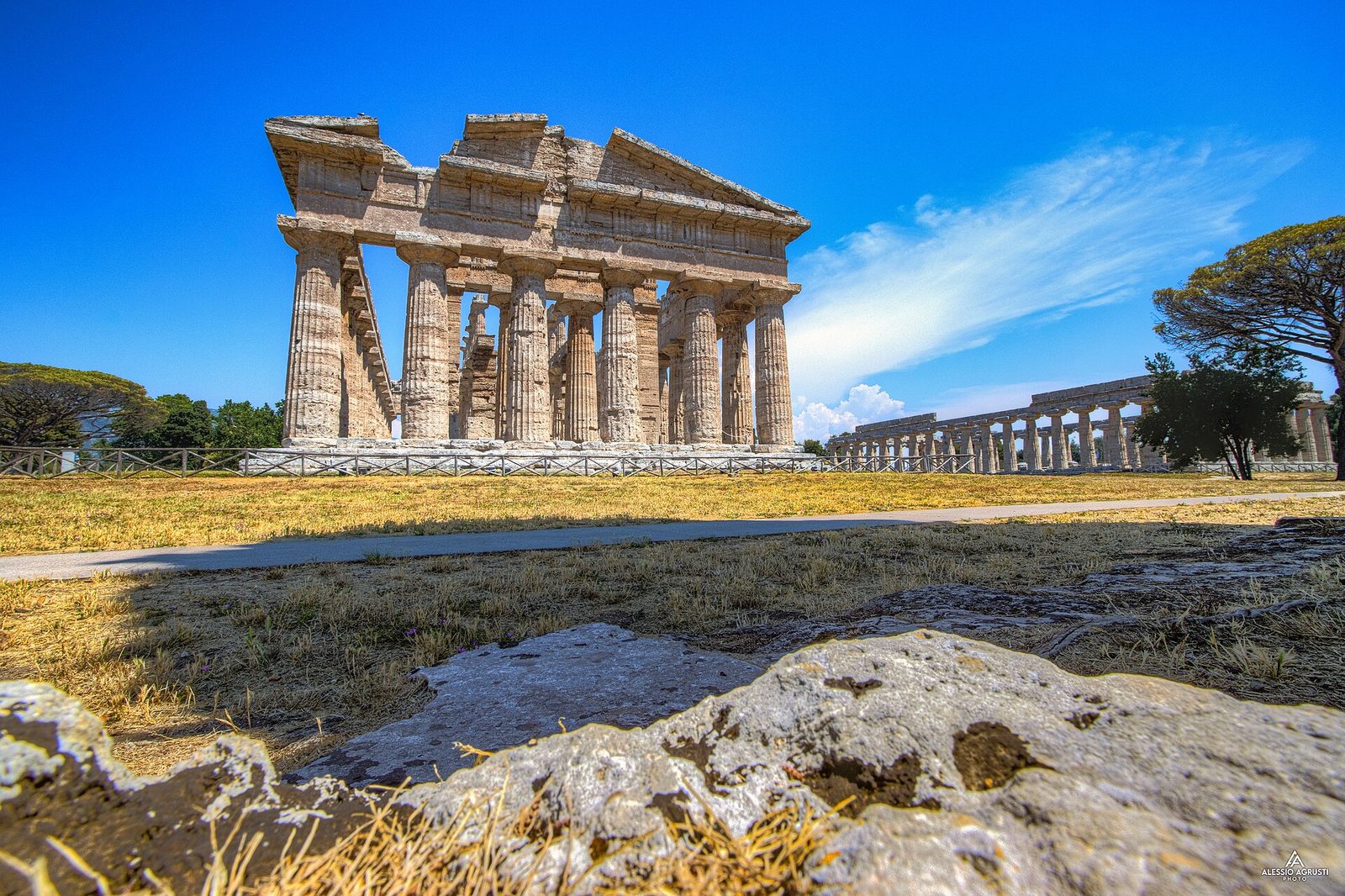
South of Salerno, where the coast flattens into a long plain beside the sea, stand three Doric temples so complete and so beautiful that they stop visitors in their tracks. Paestum was founded around 600 BC by Greek colonists as Poseidonia, the city of Poseidon. Later it was taken by the Italic Lucanians and then by the Romans, who renamed it Paestum. Malaria and marshes emptied it in the early Middle Ages. The temples were so completely forgotten that they were rediscovered only in the 18th century, when the Bourbons built a road straight through the site.
What to see
The three temples stand along the ancient city’s main axis. The oldest, the so-called Basilica, is a 6th-century BC temple of Hera with thick, swelling columns. Beside it, the Temple of Neptune, from the 5th century BC, is the most complete and the most majestic, with its double row of interior columns still standing. At the northern end, the smaller Temple of Athena stands alone among the fields. Between them lie the forum, houses and streets of the Roman town, and around it all run nearly five kilometers of ancient walls, which you can walk along.
Don’t skip the museum. Its star is the Tomb of the Diver, a Greek tomb from around 470 BC whose painted slabs show a young man diving into the sea, one of the very few surviving Greek paintings of its time. There are also dozens of vividly painted Lucanian tombs and sculptures from the sanctuaries.
Look out, too, for the carved metopes from the sanctuary of Hera at the mouth of the Sele river, a few kilometers north of the city. They’re among the oldest Greek architectural sculptures in Italy, telling the stories of Heracles and the Trojan War in crisp, archaic relief. And if you have the energy, walk a stretch of the city walls, with their towers and gates, for a view back over the temples with the mountains behind. Most visitors never leave the central path between the temples, so the walls are often completely empty.
Tickets and practicalities
Paestum’s ticket is in the €10–15 band, depending on the season, and it also covers Velia, further south, and stays valid for three days. Under-18s go free, and 18-to-25-year-olds pay a token amount. In the summer season the site stays open well into the evening. Hours are shorter in autumn and winter, and the museum closes early on some Mondays, so check the official timetable before you travel.
Regional trains from Napoli Centrale toward Salerno and the south stop at Paestum station, a short walk from the site. The journey takes well over an hour, and Trenitalia sells a combined train and entry ticket. By car, it’s about an hour and a half via Salerno. Paestum also has long sandy beaches just west of the temples, and it’s the heart of buffalo mozzarella country, so a farm visit makes an excellent add-on.
Verdict: essential for anyone with an interest in the ancient world. With Agrigento and Segesta in Sicily, Paestum’s are the finest Greek temples outside Greece. Unlike Pompeii, the site is spacious and rarely crowded. It’s a long day from Naples, but you can easily combine it with a night in Salerno or on the Amalfi Coast. The Amalfi Coast from Naples guide covers that side of the gulf.
Salerno: the gateway to Paestum
If you’re heading to Paestum or the Cilento, the city of Salerno, at the eastern end of the Amalfi Coast, is worth a stop in its own right, and it’s the obvious base for a night. It has a long palm-lined seafront promenade, a lively old town full of bars and trattorie, and a magnificent cathedral whose crypt holds the relics of Saint Matthew the Apostle, under a riot of baroque marble. In the Middle Ages, Salerno’s medical school was the most famous in Europe. In winter, its streets fill with the Luci d’Artista, elaborate artists’ light installations that draw visitors from all over Italy.
Salerno is also a transport hub, with fast trains to Naples and Rome, regional trains south to Paestum, and ferries along the Amalfi Coast to Amalfi and Positano in season. The Amalfi Coast guide covers the boats. If you combine Paestum with a night in Salerno and a boat to Amalfi the next morning, you’ve made one of the best short journeys in southern Italy.
Velia and the Cilento
South of Paestum begins the Cilento, a wild, hilly region of olive groves, hill villages and unspoiled coast that forms one of Italy’s largest national parks. Together with Paestum, Velia and the Certosa di Padula, it’s a UNESCO World Heritage Site.
Velia, the Greek city of Elea, was home to the philosophers Parmenides and Zeno, founders of the Eleatic school, whose paradoxes of motion still puzzle students today. Its ruins climb a green hill above the sea, and its highlight is the Porta Rosa, a 4th-century BC gateway that’s one of the earliest surviving arches in Greek architecture. It’s included in the Paestum ticket.
The Cilento coast has some of the cleanest water and least crowded beaches in southern Italy, around towns like Agropoli, Castellabate, Palinuro and Marina di Camerota. Inland, the Certosa di Padula is one of the largest monasteries in Europe, with a vast cloister. The village of Pioppi, where the American scientist Ancel Keys lived and studied the local way of eating, is often called the home of the Mediterranean diet.
Verdict: the Cilento deserves a few days rather than a day trip. It’s best explored by car, and it’s one of the most rewarding corners of southern Italy for anyone who wants to get away from the crowds.
Buffalo mozzarella country
Mozzarella di bufala, the soft, milky cheese made from the milk of water buffalo, is Campania’s great gift to the world, and it comes from two main areas: the plains around Caserta, north of Naples, and the Piana del Sele around Paestum and Battipaglia, to the south. Buffalo have grazed these once-marshy lowlands for centuries. The real thing carries the protected Mozzarella di Bufala Campana DOP label.
The best way to eat it is fresh, on the day it’s made, ideally at the dairy. Many farms around Paestum and in the Caserta plain have shops where you can buy it still warm, and some run tastings and tours of the dairy and the buffalo stables. The difference between mozzarella eaten a few hours after it’s made and the version that reaches supermarkets abroad is enormous. It’s softer, sweeter, and it seeps milk when you cut it. Try the treccia (braid) and the smoked version too, and eat it at room temperature, never straight from the fridge.
Verdict: if you’re going to Paestum, stop at a buffalo farm on the way. It’s the easiest food experience in Campania to love. The Naples food guide covers the rest of the region’s cooking.
The wine country
Campania is one of the oldest wine regions in the world. The Romans prized its Falernian wine above all others, and its volcanic soils and hills still produce some of the best wines in southern Italy. The inland regions are the most rewarding to visit.
- Irpinia, the hilly country around Avellino, is home to three of Campania’s DOCG wines, the highest classification in Italy. Taurasi is a powerful, long-lived red made from the Aglianico grape, sometimes called the Barolo of the south. Fiano di Avellino and Greco di Tufo are two of Italy’s finest white wines.
- The Sannio, around Benevento, is the heartland of the Falanghina white grape and of Aglianico del Taburno.
- Falerno del Massico, in the north of Caserta province, carries the name of the Romans’ favorite wine.
- Vesuvius produces the Lacryma Christi wines on the volcano’s slopes, and the Campi Flegrei makes excellent Falanghina and Piedirosso from vines grown in the craters.
Visiting wineries in Campania needs planning. Most are small, family-run businesses that welcome visitors by appointment, so book ahead. The wine areas are rural and poorly served by public transport, so a car, or better still a driver, is essential if you’re tasting. A day with a local driver-guide in Irpinia is one of the most rewarding food-and-wine days in Italy.
Benevento
Inland, in the Sannio hills, Benevento is one of the most interesting and least visited cities in southern Italy. Its Arch of Trajan, built in the early 2nd century to mark the start of a new road to Brindisi, is one of the best-preserved Roman triumphal arches anywhere, covered in reliefs of the emperor’s achievements. The church of Santa Sofia, built by the Lombard dukes of Benevento in the 8th century, is part of the UNESCO site dedicated to the Lombards in Italy, with a lovely cloister next door. There’s also a Roman theater still used for performances. The compact center is easy to explore on foot, with the arch, Santa Sofia and the theater all within a short stroll of each other, and plenty of cafés for a coffee and a slice of the local torrone in between.
Benevento is famous in Italy for its witches, the legendary janare said to meet under a walnut tree by the river, which gave their name to the Strega liqueur made in the city. It’s reachable by train from Naples and makes a fascinating, almost tourist-free day out, well worth the journey inland.
Eating in inland Campania
Every inland area has its own specialties, and they’re a big reason to make the trip.
- Caserta has become one of Italy’s great pizza cities. Its pizzerias compete with the best in Naples, often with more space and shorter queues. The best pizza in Naples guide explains what makes Neapolitan pizza, and Caserta’s pizzaioli have taken it in their own direction.
- Casertavecchia’s trattorie serve the hearty food of the hills: grilled meats, mushrooms, local cheeses and homemade pasta.
- Paestum and the Piana del Sele mean buffalo mozzarella, of course, but also buffalo ricotta, yogurt and even buffalo meat and gelato, sold at the dairies.
- Irpinia’s cooking is mountain food, with local cheeses like caciocavallo, chestnuts and black truffles, handmade pasta, and the region’s great red and white wines.
- Benevento is famous for its torrone, the nougat made in the surrounding hills, and for the Strega liqueur.
- The Cilento is the land of the Mediterranean diet, with its white figs, olive oil, chickpeas and beans, and the anchovies of Menaica, still caught with traditional nets off the coast.
Where to base yourself
For the Reggia di Caserta, Paestum and Benevento as day trips, Naples is the natural base, since all three are on direct train lines. There’s no need to move hotels. If you want to see Paestum without a long return journey, or to continue into the Cilento, a night or two in Salerno or at one of the agriturismi (farm stays) around Paestum makes the day far more relaxed, and many of those farms make their own mozzarella. For the wine country, a farm stay in Irpinia, with dinner and a tasting on site, is the most enjoyable way to avoid driving after the wine. And if you like the idea of spending a night near the Reggia, Casertavecchia’s small hotels and B&Bs make a peaceful alternative to the city.
Getting around inland Campania
The two big sights are easy by train. Caserta and Paestum both have stations close to the sites, with regular regional trains from Napoli Centrale. Benevento and Salerno are also on the main rail lines. For everything else, including the wine country, the buffalo farms, Casertavecchia, the Carolino Aqueduct, Capua and most of the Cilento, a car or a driver makes life much easier. Rural buses exist, but they’re infrequent and designed for commuters.
If you’re planning to see several sites, the regional Artecard’s Campania cards include the Reggia di Caserta and Paestum among their free entries. The three-day version includes regional public transport. The Naples tours and passes guide works out when the card pays. Remember too that the state sites, including the Reggia and Paestum, are free on the first Sunday of the month, though that’s also when they’re busiest.
Which inland trip should you choose?
- If you love palaces and gardens: the Reggia di Caserta, with Casertavecchia for dinner.
- If you love the ancient world: Paestum first, then Santa Maria Capua Vetere and Benevento if you have more time.
- If you love food: Paestum with a buffalo farm on the way, or a wine day in Irpinia with a driver.
- If you want to get away from it all: a few days in the Cilento.
- If you have one day and no car: the Reggia di Caserta. It’s the easiest to reach and the most spectacular.
Can you do Caserta and Paestum in one day? Technically, by car, but they’re in opposite directions from Naples, and each deserves most of a day. I wouldn’t. For the whole range of excursions, including Pompeii, the islands and the coast, see the day trips from Naples guide, and for how a day trip fits into a short stay, the Naples itinerary.
What to skip
- The Reggia on a Tuesday. It’s closed.
- Arriving at the Reggia after lunch. You’ll run out of time for the park and the English Garden, which close earlier than the palace.
- The first Sunday of the month at the Reggia, if you want the English Garden. It’s closed on free days.
- Reseller tickets for the Reggia. The palace names TicketOne as its only authorized online reseller, and the official prices are the lowest.
- Caserta and Paestum on the same day. They’re in opposite directions.
- Mozzarella from a fridge. Buy it fresh at a dairy and eat it the same day, at room temperature.
- Wine touring without a driver. The roads are winding, the tastings generous and the drink-drive limits strict.
Reggia di Caserta frequently asked questions
How do I get from Naples to the Reggia di Caserta?
Take a regional train from Napoli Centrale to Caserta. The journey takes under an hour and trains run frequently. Caserta station stands directly across the square from the palace, so you walk straight from the train to the entrance. By car, it’s a short motorway drive north of Naples, with parking near the palace.
How much is the ticket for the Reggia di Caserta?
As of September 2026, the full ticket for the Royal Apartments, park, English Garden and court theater costs €18, plus a €1 fee online. The park and English Garden alone cost €9, and the apartments alone €12 when the park is closed. Under-18s go free, and EU citizens aged 18 to 24 pay €3. Entry is free on the first Sunday of the month.
Is the Reggia di Caserta worth visiting?
Yes. It’s one of the most spectacular royal palaces in Europe, with a spectacular grand staircase, lavish royal apartments, a three-kilometer avenue of fountains and a romantic English Garden. It’s also easy to reach from Naples by train and far less crowded than comparable sites. Allow most of a day.
How long do you need at the Reggia di Caserta?
Most of a day. Allow about two hours for the palace and three to four hours for the park, the Great Cascade and the English Garden, including the walk of about three kilometers each way. A shuttle and bike rental can shorten that. Arrive at opening time to fit it all in comfortably.
Is the Reggia di Caserta closed on Tuesdays?
Yes. The Reggia di Caserta is closed every Tuesday and on December 25. On other days, from April to September, the Royal Apartments open 08:30–19:15, the park 08:30–19:00 and the English Garden 08:30–18:00, with shorter park hours in the colder months. The last access through the main gate is at 18:00.
Was Star Wars filmed at the Reggia di Caserta?
Yes. The Reggia’s interiors, including the grand staircase, stood in for the royal palace on the planet Naboo in two of the Star Wars prequels, The Phantom Menace and Attack of the Clones. The palace has appeared in several other international films too.
How do you get to Paestum from Naples?
By regional train from Napoli Centrale toward Salerno and the south, getting off at Paestum station, a short walk from the temples. The journey takes well over an hour, and Trenitalia sells a combined train and entry ticket. By car, it’s about an hour and a half via Salerno. The Paestum ticket also covers Velia and lasts three days.
Can you visit Caserta and Paestum in one day?
Only by car, and I wouldn’t recommend it. Caserta lies north of Naples and Paestum well to the south, so you’d spend much of the day driving, and each site deserves most of a day on its own. Choose one, or split them over two days, perhaps combining Paestum with a night in Salerno.
Photo credits
- The grand staircase of the Reggia di Caserta: photo by NateBergin, Wikimedia Commons, CC BY 4.0.
- The Reggia di Caserta from the park: photo by Twice25 & Rinina25, Wikimedia Commons, CC BY 2.5.
- Fountain of Diana and Actaeon: photo by Monica Rondoni, Wikimedia Commons, CC BY-SA 4.0.
- The English Garden: photo by Carloeusebio, Wikimedia Commons, CC BY-SA 4.0.
- Casertavecchia cathedral bell tower: photo by Mongolo1984, Wikimedia Commons, CC BY-SA 4.0.
- Temple of Neptune, Paestum: photo by AlessioAg89, Wikimedia Commons, CC BY-SA 4.0.
Sources: Reggia di Caserta tickets, reductions, free days and opening times from the Reggia di Caserta official website (updated September 21, 2026); Paestum and Velia tickets and hours from the Paestum and Velia archaeological parks; 50 Top Pizza ranking from the guide’s 2026 Italy list. All checked September 2026.