On this page
Last updated September 10, 2026. Neighborhood advice reflects how each area works for visitors today. Tourist tax rates checked against the City of Naples, and short-let rules against current Italian regulations. There are no hotel prices here: they swing too much by date to be useful, so I compare areas instead.
Where to stay in Naples, Italy: for a first visit, pick the Toledo–Municipio strip or the western edge of the historic center, both walkable to nearly everything. Choose Chiaia or the Santa Lucia seafront for calm and views, and the Vomero for quiet. Book near Piazza Garibaldi only if you have an early train.
That paragraph will serve most people, but the choice matters more in Naples than in almost any other Italian city. The neighborhoods are wildly different from one another. A ten-minute walk can take you from a medieval alley strung with laundry to a seafront promenade lined with grand hotels, or from a hilltop residential district that could be in northern Italy to the busiest, grittiest transport hub in the south. Pick the wrong base and you’ll spend your trip commuting, lying awake at 2 a.m. listening to scooters, or walking back through streets you’d rather not walk at night.
The most common mistake is also the most understandable one: booking a hotel by Napoli Centrale because it’s cheap and it’s where the train arrives. It’s exactly what most people who know Naples tell visitors not to do. I’ll explain why, and when it does make sense. The second most common mistake is booking a charming B&B in the heart of the historic center without being warned how loud it gets. Booking sites will never tell you that. I will.
If you haven’t decided how long you’re staying, my Naples, Italy itinerary guide covers how many days to give the city. Your base should fit that plan, not the other way round.
Where to stay in Naples, Italy: the areas at a glance
Here are the areas worth considering, from the one I’d recommend to most first-timers to the ones that suit specific trips. Walking times are to the heart of the historic center around Piazza del Gesù Nuovo and Spaccanapoli.
| Area | Best for | Watch out for | Walk to the historic center | My verdict |
|---|---|---|---|---|
| Toledo, Municipio and Piazza Dante | First-timers, ferry and cruise travelers, anyone who wants to walk everywhere | Busy streets, traffic noise on the main roads | 5–15 minutes | The best all-round base. My first pick. |
| Historic center (centro storico) | Atmosphere, food, history on the doorstep | Serious night noise, stairs and no lifts in old buildings | You’re in it | Wonderful if you sleep well and choose the room carefully. |
| Quartieri Spagnoli | Character, value, street life | Narrow, noisy lanes, scooters everywhere, variable lodgings | 10–15 minutes | Great for confident travelers who want the real thing. |
| Chiaia | Couples, shopping, restaurants, feeling safe at night | Weekend bar crowds, fewer budget options | 20–30 minutes | The calm, polished choice. Best for a second visit or a longer stay. |
| Santa Lucia and the seafront | Views of Vesuvius, classic grand hotels, evening walks | Pricier, a little removed from the old town’s energy | 20–25 minutes | Worth it for a special trip with a sea-view room. |
| Vomero | Quiet nights, families, longer stays, local life | Hilltop location: every trip down means a funicular or the metro | 15–25 minutes by funicular or metro | The best choice if you hate noise. |
| Posillipo and Mergellina | Views, villas, a slower pace | Far from the sights, you’ll rely on transport | 35–60 minutes on foot, less by transport | Beautiful, but not for a short first visit. |
| Piazza Garibaldi and the main station | An early train or a one-night stopover | Grim after dark, hustle, petty crime | 15–20 minutes | Only for convenience on a single night. |
| Rione Sanità | Repeat visitors, travelers who want off the usual map | Rough edges, uphill walks, fewer lodgings | 10–20 minutes | Fascinating, for travelers who’ve been before. |
My recommendation by type of traveler
If you don’t want to read about every neighborhood, find yourself below.
- First-time visitors on a three- or four-day trip: Toledo, Municipio or Piazza Dante. You’ll walk to the historic center, the Archaeological Museum, Piazza del Plebiscito and the ferries, and have the metro on your doorstep.
- Couples and romantic trips: Chiaia or a sea-view room on the Santa Lucia seafront. Dinner in Chiaia, a walk along Via Caracciolo, and a much quieter night.
- Families with children: Vomero or Chiaia. Both have calmer streets and good parks: the Villa Floridiana in the Vomero and the Villa Comunale on the seafront. Check the lift situation wherever you book, especially with a stroller.
- Food lovers and culture hunters: the historic center, with a room that faces a courtyard rather than the street.
- Budget travelers: the historic center or the Quartieri Spagnoli, where B&Bs and guesthouses are plentiful and prices lower than on the seafront. It’s a better choice than the cheap hotels around the station, even if it costs a little more.
- Catching an early train or the airport bus: Piazza Garibaldi for one night, or Municipio, which is close to the port and one metro ride from the station.
- Taking hydrofoils to Capri, Ischia or Procida: Municipio or Santa Lucia, both a short walk from Molo Beverello.
- Nightlife: the historic center around Piazza Bellini for a student and bohemian scene, or Chiaia for cocktail bars.
- Luxury: the grand hotels on the Santa Lucia seafront, or one of the boutique palazzo hotels in Chiaia and around Toledo.
- Travelers with limited mobility: Chiaia, Santa Lucia or a modern hotel near Municipio. Avoid the steep, stepped streets of the Quartieri Spagnoli and the historic center’s buildings without lifts.
The neighborhoods in detail
Toledo, Municipio and Piazza Dante: the best all-round base
This is the long strip along Via Toledo, the city’s main shopping street, running from Piazza Dante in the north down to Piazza del Plebiscito and the port at Piazza Municipio. It isn’t really one neighborhood, more a spine that joins several. It’s also the most useful place in Naples to have a bed.
From here, the historic center is a few minutes’ walk east, the National Archaeological Museum is up at the top of the strip, the Royal Palace and the Teatro di San Carlo are at the bottom, the seafront is a short walk beyond, and the hydrofoils to the islands leave from Molo Beverello, just across Piazza Municipio. Metro Line 1 runs underneath the whole length of it, with stations at Dante, Toledo and Municipio. Toledo is one of the most striking metro stations in Europe, and the metro takes you directly to the main railway station. The Centrale funicular up to the Vomero starts just off Via Toledo.
The downsides are modest. Via Toledo itself is pedestrianized for long stretches and busy all day, the side streets carry traffic, and rooms facing the main streets can be noisy. But there’s a wide range of hotels and B&Bs, from functional to grand, many of them in old palazzi with the lovely courtyards and grand stairways that are a Naples speciality. For a first visit of three or four days, this is where I’d stay.
Tip
the stretch around Piazza Dante and Via Port’Alba gives you the most historic-center atmosphere with the least noise, while Municipio is best if you’re taking an early ferry or arriving by cruise ship.
The historic center: magical by day, loud by night
The centro storico, the UNESCO-listed historic center, is the reason many people come to Naples: the ancient Greek street grid of Spaccanapoli, Via dei Tribunali and Via Anticaglia, packed with churches, workshops, pizzerias and street shrines. Staying here means stepping out of your door into the city at its most intense. You’ll find the Sansevero Chapel, the Duomo and the best pizza in the world within a few minutes’ walk. Most of the city’s B&Bs are here, often a few rooms on an upper floor of a centuries-old palazzo.
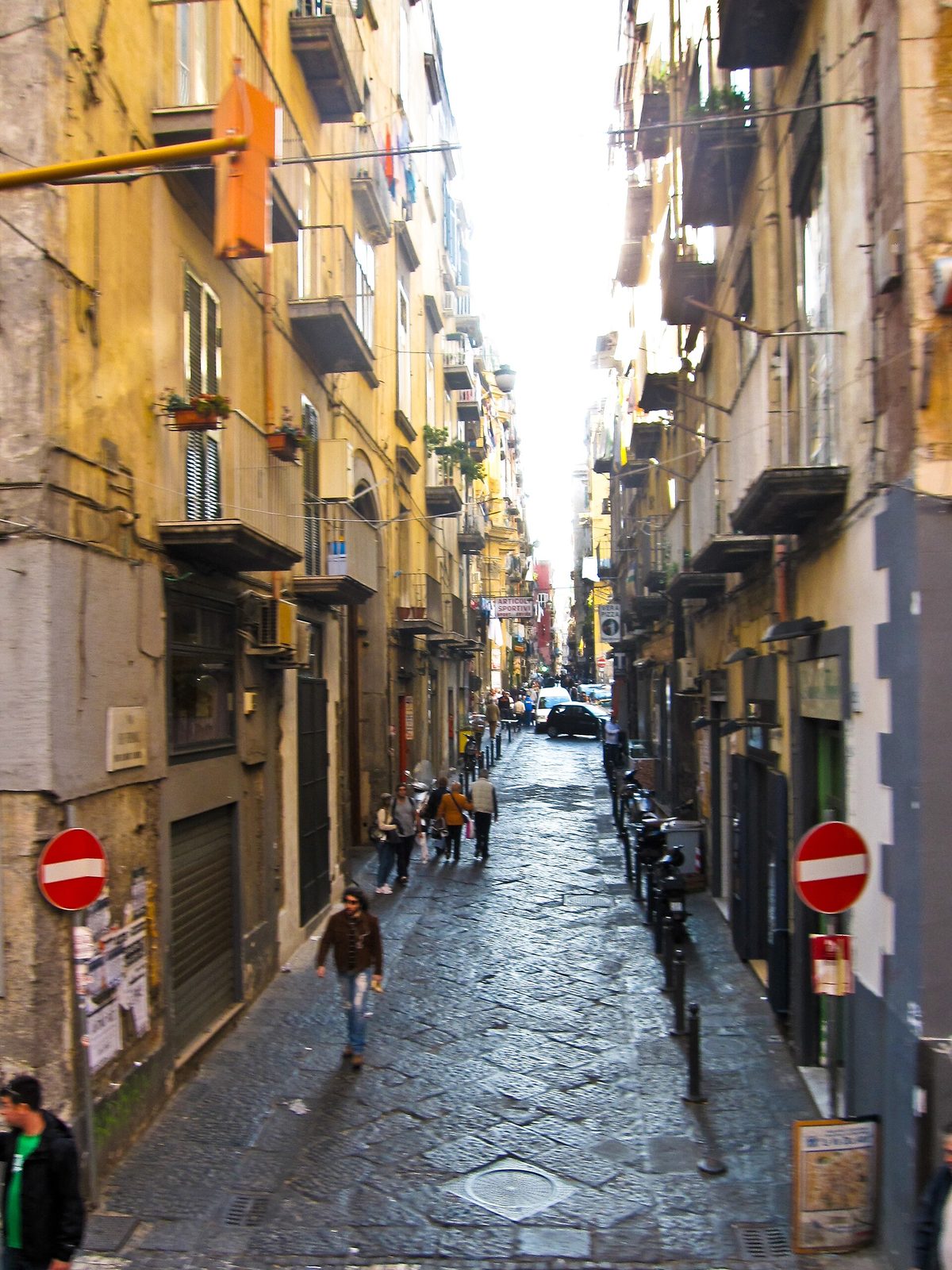
Now the part the booking sites leave out. The historic center is loud, sometimes spectacularly so. The streets are narrow and walled in by tall stone buildings that bounce sound around. Scooters ride through at all hours, the bars around Piazza Bellini and the university streets stay busy late, and on weekends people are still out talking and singing well after midnight. Then comes the early morning: deliveries, shutters going up, church bells. Air conditioning often means keeping the windows shut, which is fine if it works and miserable if it doesn’t.
None of that is a reason not to stay here. It’s a reason to choose carefully:
- Ask for a room facing an internal courtyard (cortile) rather than the street, and a higher floor.
- Read recent reviews for the words “noise,” “noisy” and “rumore,” and look at when the reviewers stayed. Weekends are worse.
- Confirm there’s working air conditioning and check for double glazing.
- Check for a lift. Many old palazzi have none, or one that starts from a mezzanine floor, and five flights with a suitcase is a real test.
- Be wary of ground-floor rooms opening straight onto the street. The traditional basso, a one-room home at street level, is part of Naples life, but it isn’t an ideal hotel room.
If you’re a light sleeper, stay in the Toledo strip and walk into the historic center instead. It’s five minutes away.
The Quartieri Spagnoli: character and value, for confident travelers
The Quartieri Spagnoli (Spanish Quarter) is the dense grid of steep, narrow lanes climbing west of Via Toledo toward the Vomero hill. It was laid out in the 16th century to house Spanish troops, and it has been one of the city’s most crowded, working-class neighborhoods ever since. Laundry hangs across the streets, shrines are tucked into the walls, and families live in the bassi at street level with their doors open. For decades it had a bad reputation. Today it’s also one of the liveliest parts of Naples for visitors, with small restaurants, street food, murals (including the famous Maradona shrine) and a lot of new B&Bs.
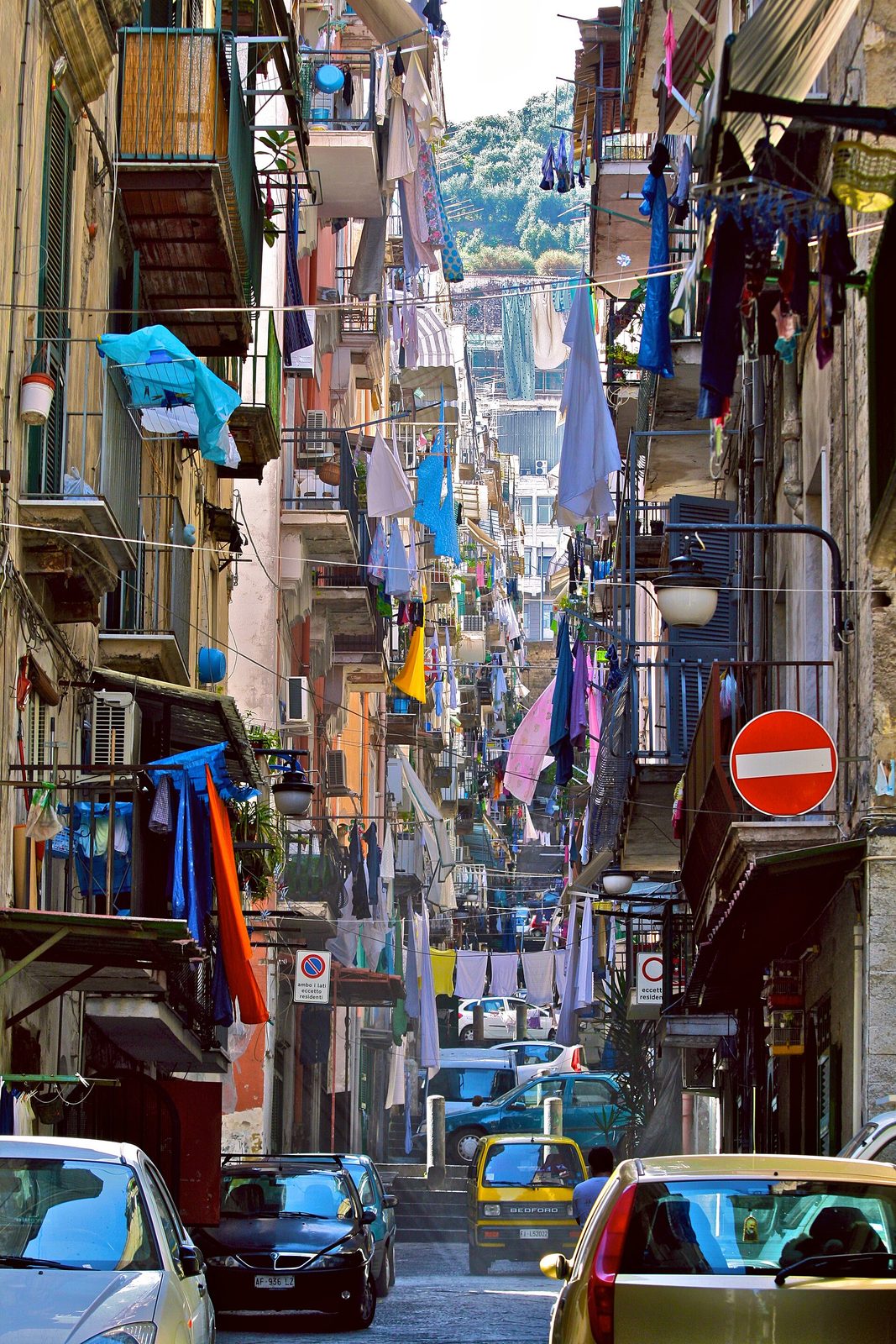
Is it safe? For visitors who use ordinary big-city sense, it’s generally fine, and much safer than its old reputation. The main hazards are the scooters, which fly up and down lanes with no sidewalk, and the noise, which is at least as bad as the historic center’s. Lodgings vary a lot, from lovely renovated rooms to tired ones in buildings with steep stairs, so read the reviews carefully. The lower streets near Via Toledo are the easiest base. The higher you climb, the steeper and quieter it gets.
I’d recommend the Quartieri to travelers who want to feel the city up close, have been to southern Italy before, and don’t mind noise or hills. For a nervous first-timer, the Toledo strip next door gives you most of the convenience with less intensity.
Chiaia: polished, safe-feeling and calm (mostly)
Chiaia is Naples’ elegant quarter, running west from Piazza del Plebiscito between the Vomero hill and the sea. It’s the city of designer shops on Via Filangieri and Via dei Mille, of the Riviera di Chiaia and the long seafront park of the Villa Comunale, of galleries, good restaurants and well-kept 19th-century palazzi. Its heart is Piazza dei Martiri, with its column and marble lions. If the historic center is Naples at full volume, Chiaia is Naples in a good jacket.

It’s the neighborhood I’d suggest for couples, for travelers who want to feel comfortable walking back at night, and for anyone on a second visit who’s already done the historic center and wants a different side of the city. Hotels here tend toward boutique and upmarket, with some good B&Bs in the side streets.
Two things to know. First, Chiaia is further from the historic center than it looks: 20–30 minutes on foot to Spaccanapoli, so on a short first trip you’ll be walking or taking the metro in every morning. Second, the “baretti,” the cluster of small bars in the lanes around Via Bisignano and Vico Belledonne, draw big, loud crowds of young Neapolitans on weekend nights. If your room is in the middle of that, you’ll hear it. Chiaia’s streets closer to the seafront and toward Piazza Amedeo are quieter. The Chiaia funicular links the neighborhood to the Vomero, and Piazza Amedeo has a metro station.
Santa Lucia and the seafront: the classic view
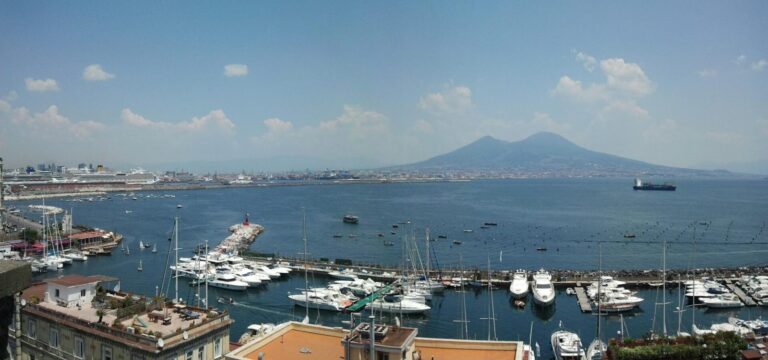
Santa Lucia is the old fishing quarter between Piazza del Plebiscito and the sea. Its seafront, Via Partenope, is lined with Naples’ historic grand hotels, facing Castel dell’Ovo, the little harbor of the Borgo Marinari and, across the whole sweep of the bay, Vesuvius. This is the postcard view of Naples, and waking up to it is one of the great hotel experiences in Italy.
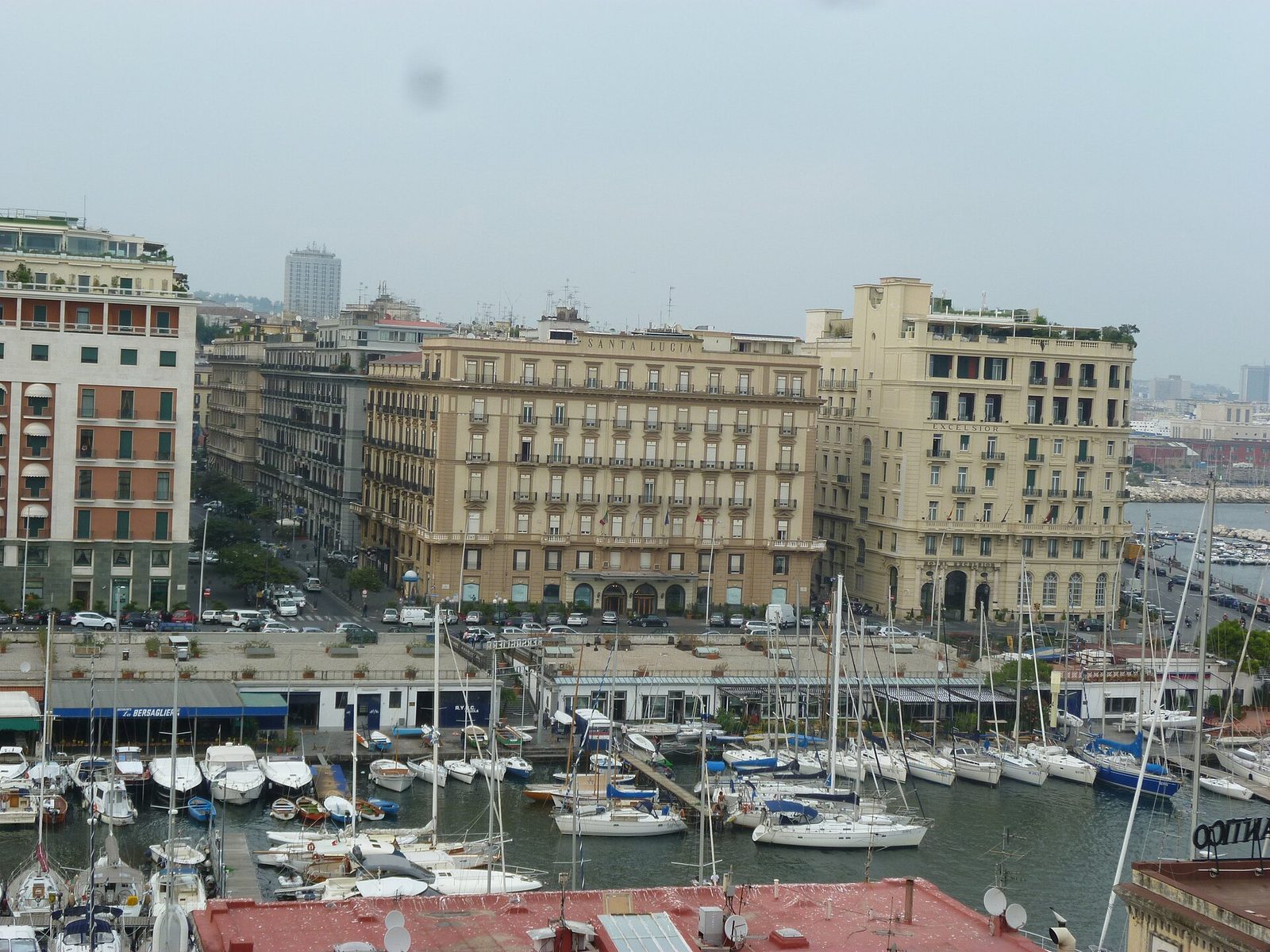
The seafront is also one of the most pleasant places in the city to walk in the evening, when Neapolitans come out for the passeggiata along Via Partenope and Via Caracciolo, and it’s an easy walk to Piazza del Plebiscito, the Royal Palace, the Teatro di San Carlo and the port. The streets behind the seafront, in the old Santa Lucia quarter, have smaller and cheaper hotels and B&Bs.
The trade-off is price and distance. Sea-view rooms on Via Partenope are among the most expensive in Naples, and the historic center is a 20–25 minute walk away. If you’re paying for the view, make sure you’re actually getting it: confirm in writing that your room faces the bay. “Sea view” in a listing can mean anything from a full panorama to a glimpse between two buildings from the corner of a balcony.
Vomero: quiet, residential and up the hill
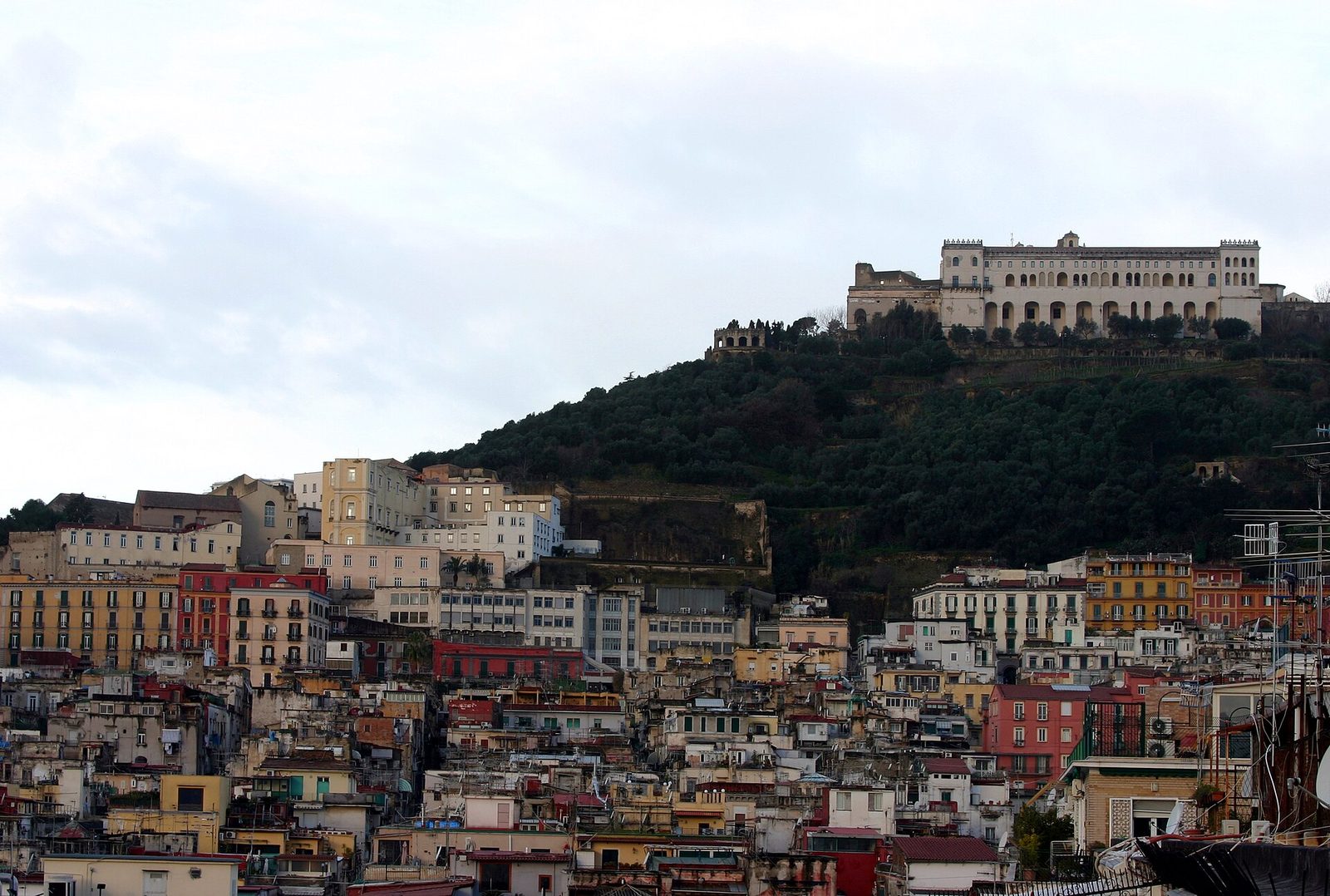
The Vomero is the hilltop district above Chiaia and the Quartieri Spagnoli, built up mostly in the late 19th and 20th centuries. It feels like a different city: wide streets, apartment blocks, department stores, pedestrianized shopping on Via Scarlatti and Via Luca Giordano, and far less chaos. It’s where many middle-class Neapolitans live, and on the summit sit Castel Sant’Elmo and the Certosa di San Martino, with the best views in the city. The Villa Floridiana, a park with a small ceramics museum, is a lovely escape.
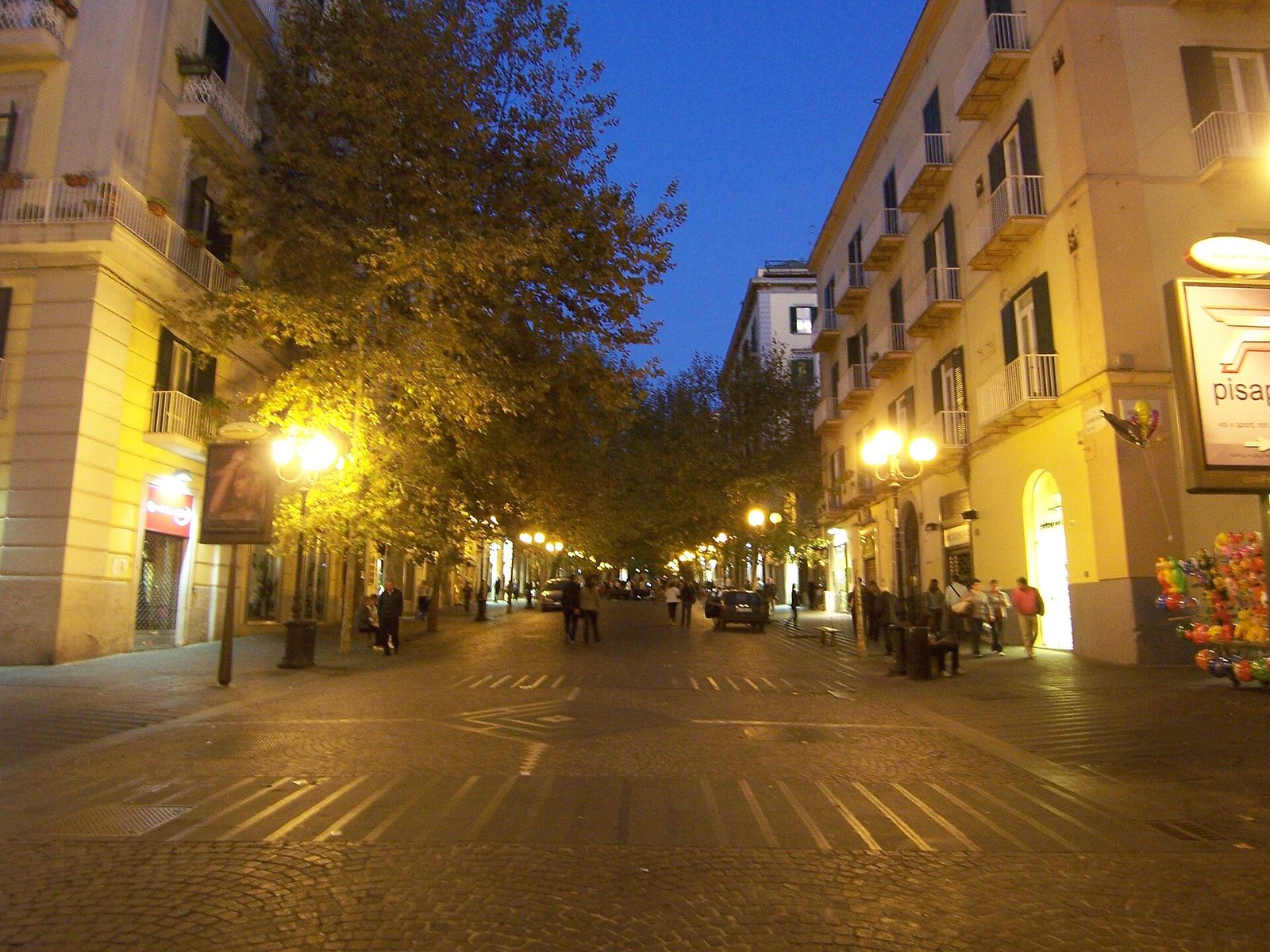
For light sleepers, families and anyone staying a week or more, the Vomero is an excellent base. It’s calmer, feels very safe, and has good local restaurants that cater to residents rather than tourists. It’s well connected too: three funiculars (Centrale, Chiaia and Montesanto) come up from the city below, and Metro Line 1 stops at Vanvitelli and Medaglie d’Oro.
The catch is obvious. Every trip to the historic center, the port or the seafront means going down the hill, and every trip back means coming up. Funiculars stop running in the late evening, so a late dinner downtown means the metro or a taxi home. The Vomero also has fewer hotels than the center, and more of its accommodation is in apartments and B&Bs. On a three-day first visit I’d rather be at the bottom of the hill. For a longer stay, it’s a great choice.
Posillipo and Mergellina: views and villas, a long way from the sights
West of Chiaia, the seafront curves round to Mergellina, a small harbor with a railway station and a row of seafront kiosks famous for evening gelato and snacks. Beyond it, the Posillipo hill rises in a long ridge of villas, gardens and cliff-top roads above small coves, with some of the most beautiful views in Naples: back across the bay to the city, Vesuvius and the Sorrento peninsula.

Staying in Posillipo means villas and B&Bs with terraces and gardens, a slower pace, and evenings spent swimming off the rocks or eating seafood at Marechiaro. It’s lovely. It’s also far from almost everything a first-time visitor wants to see, and you’ll rely on buses and taxis on roads that are often congested. Mergellina is more practical, with a station and a direct walk along the seafront toward Chiaia, but still a 35–45 minute walk from the historic center.
I’d save Posillipo for a second trip, or for a long stay when you want the city as a backdrop rather than the main event.
Piazza Garibaldi and the station: the honest read
Now the question every Naples accommodation guide dances around. Piazza Garibaldi is the vast square in front of Napoli Centrale, the main railway station, and the surrounding blocks are full of cheap hotels, hostels and guesthouses with great prices and “central location” in their descriptions. On paper it’s ideal: high-speed trains to Rome, the Circumvesuviana to Pompeii and Sorrento from the level below, the airport bus from the square, and the metro into town.
In reality, it’s the part of Naples I’d least like to walk back to after dark. Like station districts across Europe, it collects hustle, petty crime, touts, people sleeping rough and people with nowhere else to go. The square itself has been redeveloped and there are respectable hotels on it, but the side streets of the Vasto district, north of the station, and the edge of Forcella can feel grim at night. It’s also noisy, trafficky and has little of the Naples you came for. And the convenience argument is weaker than it looks, because from the Toledo strip you’re a single metro ride from the station anyway.
So when does it make sense? For one night before an early train or an early airport bus, or when you arrive late and leave early. In that case, choose a hotel with good recent reviews directly on the square or on Corso Umberto I, the broad avenue that runs toward the center, rather than one in the side streets, and don’t wander around the back streets late at night. For anything longer than a night, stay somewhere else.
If you’ve already booked there and can’t change it, it’s manageable with a little planning. Use the metro to get back from dinner in the center rather than walking the length of Corso Umberto I late at night. Take taxis only from the official rank in front of the station, and ignore anyone offering a ride inside the concourse. Keep your phone and wallet out of sight in the square, where bag snatching and distraction tricks are most common. By day, the area is simply busy, and plenty of Neapolitans pass through it without a second thought.
The Sanità and other off-the-map choices
The Rione Sanità, the valley just north of the historic center, has a small but growing number of B&Bs in old palazzi, some of them beautifully restored. It’s home to the Catacombs of San Gennaro, the Palazzo dello Spagnolo and a community-led revival that’s one of the most hopeful stories in the city. It’s also gritty, hilly and not where I’d send a nervous first-timer. For a repeat visitor who wants to live among Neapolitans, it’s one of the most rewarding places to stay in the city.
Nearby, Materdei, between the Sanità and Piazza Dante, is a lively residential neighborhood with a famous pizzeria or two and good access to the Archaeological Museum. Around Piazza Bellini and the university streets you’re in the historic center’s student quarter, which is great fun and very noisy at night. And the business hotels of the Centro Direzionale, the modern office district east of the station, are practical for conferences and nothing else.
Hotel, B&B or apartment?
The type of lodging matters almost as much as the neighborhood, and Naples does each of them a little differently.
- Hotels give you a 24-hour reception, usually a lift, luggage storage and someone to call a taxi. They’re the safest choice for a first visit, a late arrival or an early departure.
- B&Bs in Naples are often a handful of rooms in an apartment on an upper floor of an old palazzo. They can be charming and good value, with hosts who give great local advice. But the reception may be staffed only at certain hours, and breakfast sometimes comes as a voucher for a café downstairs. Agree your arrival time in advance.
- Apartments and short-term rentals make sense for families and longer stays. Every legal short-term rental in Italy must have a national registration code, the CIN (codice identificativo nazionale), and show it in its listing. If a listing doesn’t display one, I’d book elsewhere. Italian law also requires hosts to register guests’ identities with the police. After a series of court rulings, fully remote check-in by keybox without any identity check is on uncertain legal ground, so expect your host to meet you in person or check your ID by video before giving you the code.
The Naples tourist tax
Naples charges a tourist tax (imposta di soggiorno) per person per night, on top of the room rate. It’s usually collected by your hotel or host, often in cash. The rates rose from May 1, 2026:
| Type of lodging | Per person, per night (checked September 2026) |
|---|---|
| 4- and 5-star hotels, short-term rentals | €6.00 |
| 3-star hotels, B&Bs | €5.50 |
| 2-star hotels | €4.50 |
| 1-star hotels | €4.00 |
It applies to guests over 14, for a maximum of 14 consecutive nights. For a couple spending four nights in a short-term rental, that’s €48 on top of the booking, so it’s worth budgeting for.
Noise, stairs, cars and the other things booking sites won’t tell you
- “Central” can mean the station. Many listings describe hotels by Piazza Garibaldi as “central” or “near the historic center.” Check the exact address on a map before you book.
- Street noise is the number one complaint. In the historic center, the Quartieri Spagnoli and parts of Chiaia, ask for a courtyard-facing room on a higher floor, and read recent reviews for noise.
- Stairs and lifts. Old palazzi often have no lift, or a tiny one that starts from the first landing and fits one person and one suitcase. If you have mobility problems or heavy bags, ask exactly how many steps there are.
- Air conditioning. In the hotter part of the year it’s essential, not a luxury. Confirm there is some, and that it’s in the bedroom rather than just the living room.
- Getting there with luggage. Many streets in the historic center are pedestrian or restricted to residents’ traffic. A taxi may drop you at the end of the street, and you’ll wheel your suitcase over the uneven lava-stone paving. Ask your host for the nearest drop-off point.
- Cars. Don’t bring one into Naples if you can avoid it. Much of the center is a ZTL (zona a traffico limitato, a restricted traffic zone) monitored by cameras, and fines reach you through the rental company months later. Parking is scarce and expensive. If you do drive, book a hotel with a garage arrangement and leave the car there.
- Safety at night. Chiaia, the Vomero, Santa Lucia and the Toledo strip all feel comfortable after dark. The historic center is busy late, which helps. The station district is the one area where I’d take extra care.
Getting around from each area
How easily you can get out of your neighborhood matters as much as what’s in it, especially if you’re planning day trips. Most visitors make three kinds of journey: into the historic center, to Napoli Centrale for trains to Pompeii, Herculaneum, Sorrento or Rome, and to Molo Beverello for the island hydrofoils. Here’s how each area copes.
| Area | Nearest metro and funicular | To Napoli Centrale (trains, Circumvesuviana) | To Molo Beverello (island hydrofoils) |
|---|---|---|---|
| Toledo, Municipio, Piazza Dante | Line 1 at Dante, Toledo and Municipio; the Centrale funicular off Via Toledo; the Montesanto funicular near Dante | Direct on Line 1 | A short walk from Municipio |
| Historic center | Line 1 at Dante, Università and Duomo | Direct on Line 1, or a walk east along Corso Umberto I | A walk downhill, or Line 1 to Municipio |
| Quartieri Spagnoli | Line 1 at Toledo; the Centrale and Montesanto funiculars | Direct on Line 1 from Toledo | Walk down Via Toledo to Municipio |
| Chiaia | Line 2 at Piazza Amedeo; the Chiaia funicular | Direct on Line 2 to Piazza Garibaldi | A longish walk along the seafront, or a taxi |
| Santa Lucia and the seafront | Line 1 at Municipio, a short walk away | Line 1 from Municipio | An easy walk |
| Vomero | Line 1 at Vanvitelli and Medaglie d’Oro; three funiculars down | Direct on Line 1, a longer ride | Line 1 down to Municipio |
| Posillipo and Mergellina | Line 2 and Trenitalia at Mergellina; buses along the coast road | Line 2 from Mergellina | A bus or taxi into town |
| Piazza Garibaldi | Lines 1 and 2 at Garibaldi | You’re there | Line 1 to Municipio |
Two practical notes. The Circumvesuviana to Pompeii and Sorrento leaves from the level below Napoli Centrale, so from any base served by Line 1 or Line 2 you can reach it without a taxi. And there’s still no rail or metro link to the airport. You’ll use the Alibus shuttle, which stops at Piazza Garibaldi and near the port, or a taxi. That makes the Toledo strip and Municipio every bit as convenient for flights as the station district, without its downsides.
How to choose the actual place once you’ve picked the area
Once you’ve chosen a neighborhood, a few Naples-specific checks separate a great stay from a stressful one.
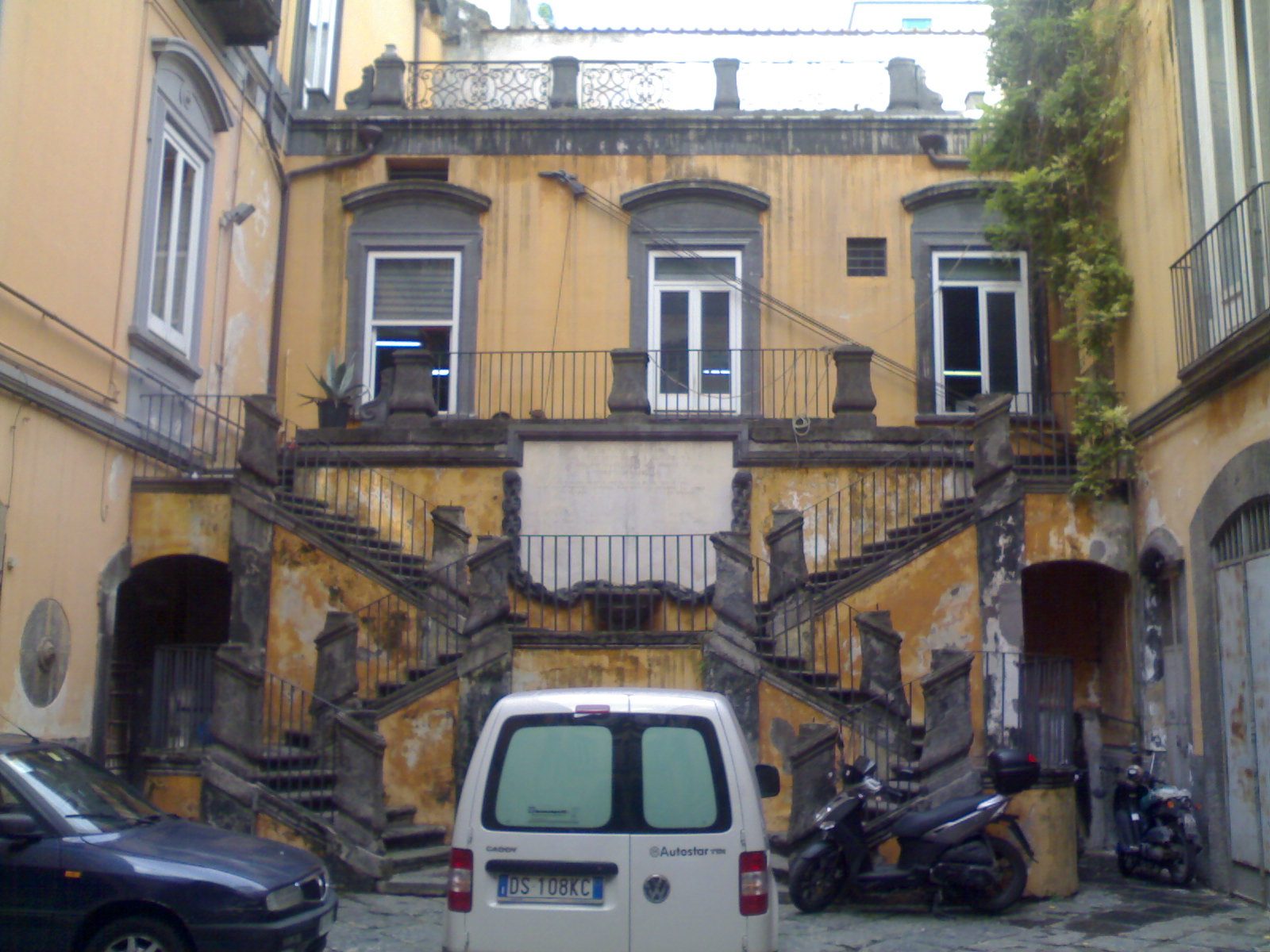
- Don’t judge a building by its front door. Some of the loveliest B&Bs in Naples sit behind a huge, scruffy wooden portone (the carriage door of an old palazzo) that opens onto a grimy entrance hall, then a courtyard, a monumental staircase and finally a beautifully restored apartment. Shabby street frontages are normal here and say nothing about the rooms upstairs.
- Get the arrival instructions in writing. Many B&Bs have no sign on the street and no staffed desk. You’ll need the building number, the floor, the name on the intercom and a phone number that answers. Ask what to do if you arrive late.
- Ask about the lift, and then ask again. “Lift” can mean a modern elevator, or a tiny cabin that starts from the first landing and holds one person plus a suitcase. Some older buildings still have coin-operated lifts, so ask whether you’ll need change.
- Read the most recent reviews, not the average score. Management, renovations and noise from new bars all change quickly. The last few months of reviews tell you far more than a five-year average.
- Check whether the tourist tax is included. Most listings exclude it and collect it on arrival, often in cash. Budget for it either way.
- Look for luggage storage. If your flight or train leaves late in the day, a place that will hold bags after check-out saves you a lot of hassle. Hotels almost always do. B&Bs and apartments often can’t.
- Check the address on a map yourself. Search the street address, not the property name, and see which neighborhood it’s really in. A “historic center” apartment that turns out to be behind the station is a classic Naples booking regret.
- Favor flexible cancellation. Naples is a city where a strike, a cancelled ferry or a change of plan can reshuffle your days. Paying a little more for a refundable rate is often worth it.
Longer stays and special trips
The advice above assumes a typical three- to five-day visit. A few trips work differently.
A week or more in the city. Rent an apartment in the Vomero or Chiaia and live like a resident: local markets, a regular coffee bar, the funicular down in the morning. Longer stays also cap the tourist tax, which applies for a maximum of 14 consecutive nights.
Before or after a cruise. Cruise ships dock at the Stazione Marittima next to Molo Beverello, so Municipio and Santa Lucia are ideal. You can walk to the terminal with your luggage, or take a very short taxi ride.
An opera or concert night at the San Carlo. Stay on the Toledo strip, in Santa Lucia or in Chiaia, all within walking distance of the theater, so you’re not hunting for a taxi at midnight.
An early flight. Stay near an Alibus stop, either Municipio or Piazza Garibaldi, or book a taxi the night before. Traffic to Capodichino is lighter early in the morning, but don’t cut it fine.
A business trip. The Centro Direzionale’s modern hotels are practical for meetings there, but if you have an evening free, a hotel on the Toledo strip puts you ten minutes from dinner in the historic center.
A honeymoon or special occasion. Book a bay-view room on the Santa Lucia seafront, or a villa B&B in Posillipo for a couple of nights at the end of your trip, once you’ve seen the sights and just want the view.
Traveling solo. The Toledo strip is the easiest base: busy until late, well lit, on the metro, and walkable to everything. If you’d like to meet other travelers, the historic center’s hostels and B&Bs around Piazza Bellini are sociable. Just expect noise.
A wider Campania road trip. If you’re driving around the region, don’t keep the car in Naples. Arrive by train, see the city on foot, and pick up a rental on the day you leave for the coast or the countryside. If you must arrive by car, choose a hotel with its own garage or a confirmed arrangement with one nearby, outside the restricted traffic zone, and leave the car there until you go.
Should you stay outside Naples instead?
Sometimes, yes. If your trip is mainly about the Amalfi Coast and Capri, a base in Sorrento or on the coast is more convenient and far calmer, and you can visit Naples and Pompeii as day trips. On a week-long trip, I’d split the nights: three or four in Naples, then three on the coast. The itinerary guide shows how that works day by day.
If you’re focused on the ruins, staying in the modern town of Pompei or in Ercolano puts you next to the sites, but the evenings are quiet and you’ll miss what makes Naples special. For a first trip, I’d stay in Naples and take the train out. The Pompeii from Naples guide covers the journey.
I wouldn’t currently base myself in Pozzuoli or elsewhere in the Campi Flegrei. The area remains on yellow alert for its ongoing bradyseismic activity, and transport links there have been disrupted this year.
What to skip
- A multi-night stay by Piazza Garibaldi to save money. The savings rarely make up for the evenings.
- Ground-floor rooms opening onto the street in the historic center or the Quartieri Spagnoli.
- Any room without air conditioning in the hotter months.
- Booking by “distance from center” on a booking site. Naples’ “center” is ambiguous. Pick the neighborhood first, then the property.
- Short-term rentals with no CIN code in the listing.
- Posillipo on a short first trip. It’s beautiful, but you’ll spend your time in taxis.
- A hotel in the center if you’re arriving by car without a confirmed garage.
- Paying for a “sea view” without confirming which way your room actually faces.
Frequently asked questions about where to stay in Naples
What is the best area to stay in Naples, Italy for first-timers?
The strip along Via Toledo, from Piazza Dante down to Piazza Municipio. It’s a short walk from the historic center, the Archaeological Museum, Piazza del Plebiscito, the seafront and the island ferries, and Metro Line 1 runs underneath it. The western edge of the historic center is a close second if you don’t mind noise.
What is the safest area to stay in Naples?
Chiaia, the Vomero and the Santa Lucia seafront feel the safest and calmest, especially at night. The Toledo strip and the historic center are busy and generally fine with ordinary precautions. The area around Piazza Garibaldi and the main station is the one to avoid for more than a night.
Is it safe to stay near Napoli Centrale and Piazza Garibaldi?
It’s fine for one night before an early train if you choose a well-reviewed hotel on the square or Corso Umberto I, but it’s not a pleasant base for a longer stay. The side streets feel grim after dark, petty crime is more common, and you’re a metro ride from everything you came to see.
Is the historic center of Naples too noisy to stay in?
It can be very noisy, with scooters, late bars, weekend crowds and early deliveries. You can manage it by choosing a courtyard-facing room on a higher floor with air conditioning and double glazing. Light sleepers are better off staying on the Toledo side and walking in.
Is Vomero a good place to stay in Naples?
Yes, especially for families, light sleepers and longer stays. It’s quiet, residential and safe, with good shopping and restaurants and the best views in the city. The downside is the hill: you’ll ride a funicular or the metro down to the sights every day, and the funiculars stop in the late evening.
Should I stay in Naples or Sorrento?
Stay in Naples if the city, the Archaeological Museum, Pompeii and Herculaneum are your priority. Choose Sorrento if your trip centers on Capri and the Amalfi Coast. On a week-long trip, the best answer is both: a few nights in each.
How much is the tourist tax in Naples?
Since May 1, 2026, the Naples tourist tax is €6 per person per night in 4- and 5-star hotels and short-term rentals, €5.50 in 3-star hotels and B&Bs, €4.50 in 2-star hotels and €4 in 1-star hotels. It applies to guests over 14, for up to 14 nights, and is usually paid directly to your hotel or host.
Is the Quartieri Spagnoli safe to stay in?
For visitors using ordinary big-city sense, generally yes. It’s much safer than its old reputation, with busy streets, families and plenty of other travelers. The real hazards are scooters in the narrow lanes and the noise. Stick to the lower streets near Via Toledo if it’s your first visit, and read recent reviews carefully, because lodgings vary a lot.
Is it better to book a hotel or a B&B in Naples?
A hotel is the easier choice for a first visit, a late arrival or heavy luggage: 24-hour reception, a lift and bag storage. A B&B in an old palazzo is often better value and more characterful, with a host who knows the neighborhood, but check reception hours, stairs and arrival instructions before you book.
Where should I stay in Naples to catch the ferry to Capri?
Stay near Piazza Municipio or in Santa Lucia. Both are a short walk from Molo Beverello, where the hydrofoils to Capri, Ischia and Procida leave. The Toledo strip also works, just a few minutes further away.
If you’re leaning toward a room in the old city, it’s worth knowing the streets before you pick one. Spaccanapoli, Via dei Tribunali and the lanes around Piazza Bellini each have a very different feel after dark. My street-by-street guide to the historic center explains the layout.
Whichever neighborhood you pick, check how far you’ll be from a Line 1 station or a funicular. Those two networks do most of the work in this city, and the buses mostly sit in traffic. I break down the metro, funiculars and tickets in my Naples public transport guide.
If safety is part of the decision, the short version is that central Naples is no riskier than Rome or Florence, but some streets feel very different at midnight than at noon. I go through the real pickpocket hotspots, the scams and each neighborhood by day and night in my Naples safety and travel tips guide.
Once you’ve picked a neighborhood, the building matters almost as much. In Naples that means asking about noise, whether the lift reaches your floor, and whether a “sea view” really faces the bay. I go through specific properties, from the Via Partenope grand hotels to palazzo B&Bs in the old town, in my guide to the best hotels in Naples, Italy.
Your arrival route is worth factoring in too: the Alibus stops at the station and the port, while the seafront hotels are best reached by taxi at a fixed fare. My Naples airport transfer guide matches each neighborhood with the easiest way in.
Rooms are where Naples saves you the most money compared with Rome or Florence, and the tourist tax is where it claws a little back. From May 2026 it runs to €6 per person per night at the top end. My Naples budget guide puts accommodation alongside food, transport and day trips, so you can see what a whole day really costs.
This page is about where to sleep. For a fuller picture of what each area is like to spend time in, including how they connect by metro and funicular and an honest read on safety in the Quartieri Spagnoli and the Sanità, see the Naples neighborhoods guide.
Photo credits
- Certosa di San Martino and the Spanish Quarter from the seafront: photo by José Luiz, Wikimedia Commons, CC BY-SA 4.0.
- Laundry day in the Quartieri Spagnoli: photo by Jeroen Bennink from Amsterdam, The Netherlands, Wikimedia Commons, CC BY 2.0.
- Santa Lucia seafront hotels: photo by Antoine Pitrou, Wikimedia Commons, FAL.
- Via dei Tribunali: photo by Armando Mancini, Wikimedia Commons, CC BY-SA 2.0.
- Piazza dei Martiri, Chiaia: photo by Mister No, Wikimedia Commons, CC BY 3.0.
- Via Alessandro Scarlatti, Vomero, by night: photo by Johnnyrotten, Wikimedia Commons, public domain.
- Dawn over the bay from Posillipo: photo by TatsuoTabei, Wikimedia Commons, public domain.
- Palazzo courtyard and staircase: photo by Baku, Wikimedia Commons, CC BY-SA 3.0.
Sources: tourist tax rates from the City of Naples (comune.napoli.it); short-term rental CIN and check-in rules from current Italian regulations and reporting on the 2025–2026 court rulings; Campi Flegrei alert level from Italy’s Civil Protection Department. All checked September 10, 2026. Neighborhood assessments are my own.