On this page
Last updated September 16, 2026. Fares and ticket rules checked against ANM, EAV and regional transport reporting; station openings and suspensions against the operators and local press. Where a price couldn’t be confirmed at the operator’s own site, I say so and name the place to check.
Getting around Naples, Italy is easiest on foot plus Metro Line 1 and the funiculars. A single ANM metro ride costs €1.50, a 90-minute integrated TIC ticket €1.80 (checked September 2026). Use the Circumvesuviana for Herculaneum, Pompeii and Sorrento, skip city buses where you can, and never drive into the historic center.
That’s the short version. The longer version is why this page exists. Naples has five different operators running trains, metros, funiculars, trams and buses. It has at least three overlapping ticket systems, stations that share a name but not an entrance, a “Line 2” that is really a Trenitalia commuter railway, and a suburban train to Pompeii that feels like a different country from the gleaming metro one floor above it. None of that is hard once somebody lays it out. The trouble is that almost nobody does it in one place, in English, with the current prices.
So here it is: what each network is actually for, which ticket to buy for which trip, the mistakes I see visitors make over and over, and the few things I’d simply avoid. Fares for the city live on this page and nowhere else on the site, so if a price changes, this is where you’ll see it first.
The quick answer: how I’d get around Naples
If you’re staying anywhere between Piazza Garibaldi, the centro storico, Via Toledo and the seafront, you’ll walk most of the time. The historic center is compact, much of it is closed to ordinary traffic, and the streets are the point. From the centro storico to Piazza del Plebiscito is a walk of about 20 to 25 minutes down Via Toledo, and you’d take longer waiting for a bus.
For anything longer, reach for Metro Line 1. It links the main train station to the old town, the Archaeological Museum, Via Toledo, the port and the hill neighborhood of Vomero, and it’s clean, fairly frequent and easy to read. The funiculars handle the other direction, lifting you from the flat city up to Vomero and Posillipo in a few minutes. Between them, those two cover almost every sight in town.
Leave the city and the picture changes. The Circumvesuviana is the train for Herculaneum, Pompeii and Sorrento, the Cumana and Circumflegrea go west toward Pozzuoli and the Campi Flegrei, and ferries and hydrofoils take you to the islands. Buses are the last resort in Naples itself, useful for Capodimonte and a few outlying spots and frustrating almost everywhere else.
And the car? Don’t. I’ll explain why further down, but if you’ve rented one for the Amalfi Coast or inland Campania, park it outside the city and forget about it until you leave.
Naples transport at a glance
This is the whole system on one screen. Prices are the single-journey fares for a visitor, checked September 2026; the ticket section below explains what each one covers.
| Network | Who runs it | Best for | Single fare (Sept 2026) | My verdict |
|---|---|---|---|---|
| Metro Line 1 | ANM | Centrale, Duomo, Toledo, Museo, Municipio (port), Vomero | €1.50 | The backbone. Use it constantly. |
| Metro Line 6 | ANM | Mergellina, Chiaia seafront side, Fuorigrotta (Mostra) | €1.50 | Handy for the western seafront; short line. |
| Funiculars (4) | ANM | Vomero, Castel Sant’Elmo, Posillipo | €1.30 | Fast, cheap and fun. Use them. |
| Line 2 | Trenitalia | Crossing the city east to west, Mergellina, Campi Flegrei | Integrated TIC €1.80 | Useful but infrequent. Line 1 usually wins. |
| City buses and trams | ANM | Capodimonte, a few outlying sights | €1.30 | Last resort. Traffic ruins timetables. |
| Circumvesuviana | EAV | Herculaneum, Pompeii, Sorrento | Distance-based; Pompei listed at €3.30 | Essential, crowded, fine if you know the tricks. |
| Cumana and Circumflegrea | EAV | Pozzuoli, Baia, Cuma direction | Integrated TIC inside the city; regional beyond | Check service status before you go. |
| Taxis | Licensed city cooperatives | Luggage, late nights, the airport | Metered or fixed fares | Worth it with bags. Pointless for short hops. |
| Ferries and hydrofoils | Several private lines | Capri, Ischia, Procida, Sorrento by sea | By route | The only sensible way to the islands. |
Who runs what (and why it matters for your ticket)
Naples’ transport confuses people for one reason: it isn’t one system. It’s several companies whose networks overlap, tied together by a shared integrated ticket that works inside the city limits and not beyond them.
ANM (Azienda Napoletana Mobilità) is the city company. It runs Metro Line 1, Line 6, the four funiculars, the city buses and the trams. If a vehicle has an ANM logo and stays inside Naples, one of the ANM tickets below covers it.
Trenitalia, the national railway, runs what the maps call Line 2. It’s a commuter rail line that tunnels under the city between Gianturco and San Giovanni in the east and Pozzuoli in the west. It shares stations and map colors with the metro, but it’s a different company with its own trains and its own gates, and the ANM-only Line 1 ticket won’t open them.
EAV (Ente Autonomo Volturno) is the regional company. It runs the Circumvesuviana around the bay toward Pompeii and Sorrento, the Cumana and Circumflegrea toward Pozzuoli and the Campi Flegrei, and a long list of regional buses. Inside the city boundary its trains accept the integrated ticket; once you’re heading for Herculaneum or Pompeii you need a regional EAV fare.
Then there are the ferry companies, the licensed taxi cooperatives, and the private airport bus. Keep those three layers in your head (city, national rail, region) and every ticket rule that follows makes sense.
Naples metro: Line 1, Line 6 and “Line 2”
Line 1, the one you’ll actually use
Line 1 runs in a long hook from Piscinola in the northern suburbs, down through the hill neighborhoods of Vomero and Arenella, into the historic center, along the port and out to Piazza Garibaldi and Centro Direzionale, the business district east of the station. The Centro Direzionale stop opened in April 2025, and the line is being extended toward Capodichino airport. That extension isn’t open, and I wouldn’t build a trip around a date for it; Naples has been promising it for a long time.
For a visitor, the stretch that matters runs between Vanvitelli in Vomero and Garibaldi at the station. In order, heading downhill:
- Vanvitelli: Vomero’s main square, the shopping streets and a short walk to the funicular stations and Castel Sant’Elmo.
- Quattro Giornate and Salvator Rosa: residential Vomero and the upper Materdei slopes; Salvator Rosa’s station is one of the art stations.
- Materdei: a traditional neighborhood and a back way down toward the Sanità.
- Museo: the National Archaeological Museum, directly above you. Linked underground to Piazza Cavour on Line 2.
- Dante: Piazza Dante, Port’Alba and the western end of the old town.
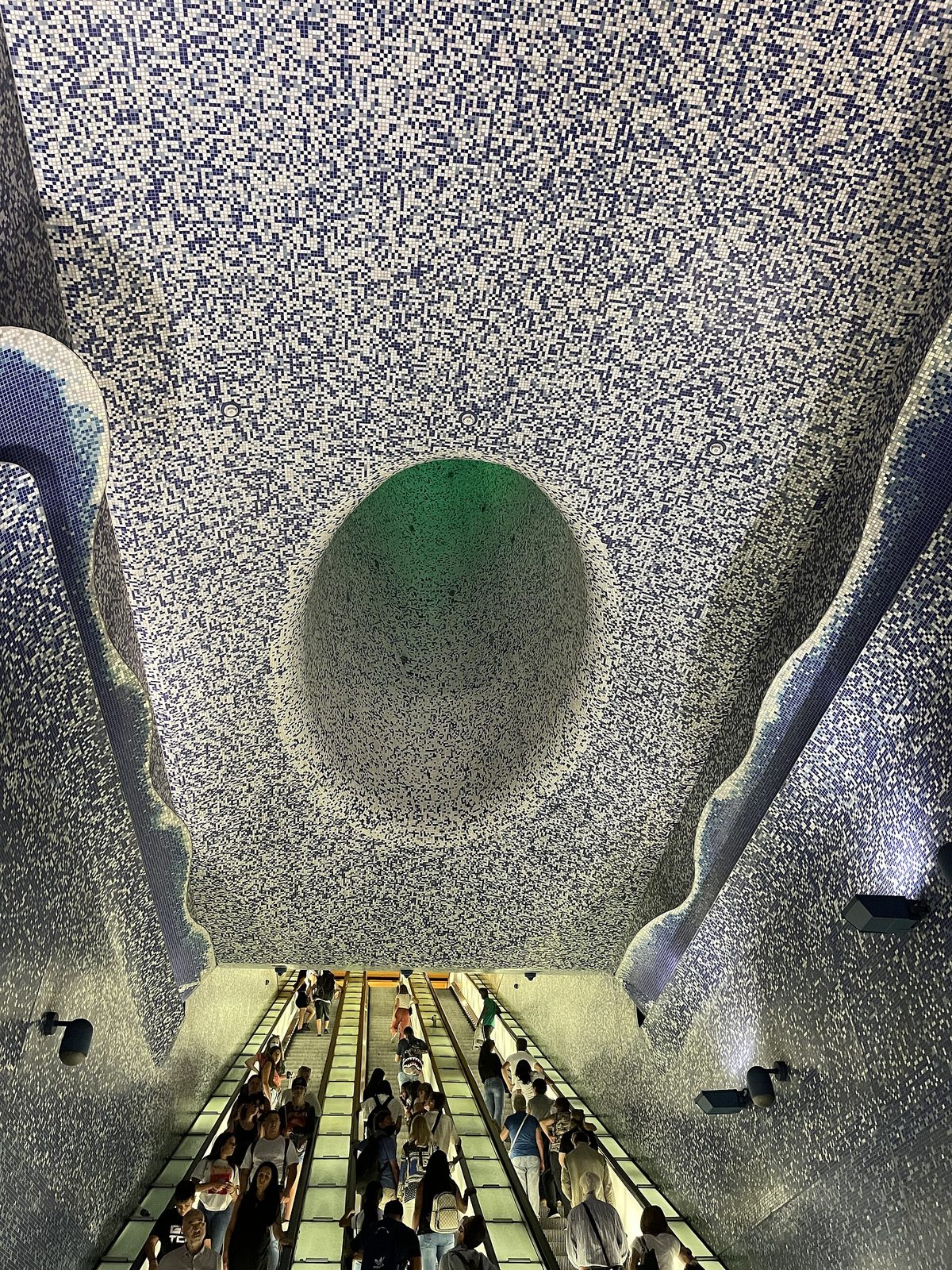
- Toledo: Via Toledo, the edge of the Quartieri Spagnoli and the famous “crater of light” escalator hall.
- Municipio: Piazza Municipio, Castel Nuovo and the ferry port at Molo Beverello. Also a Line 6 interchange.
- Università: Corso Umberto I, the university and the lower old town.
- Duomo: the lower end of Via Duomo, a short walk up to the cathedral and Spaccanapoli.
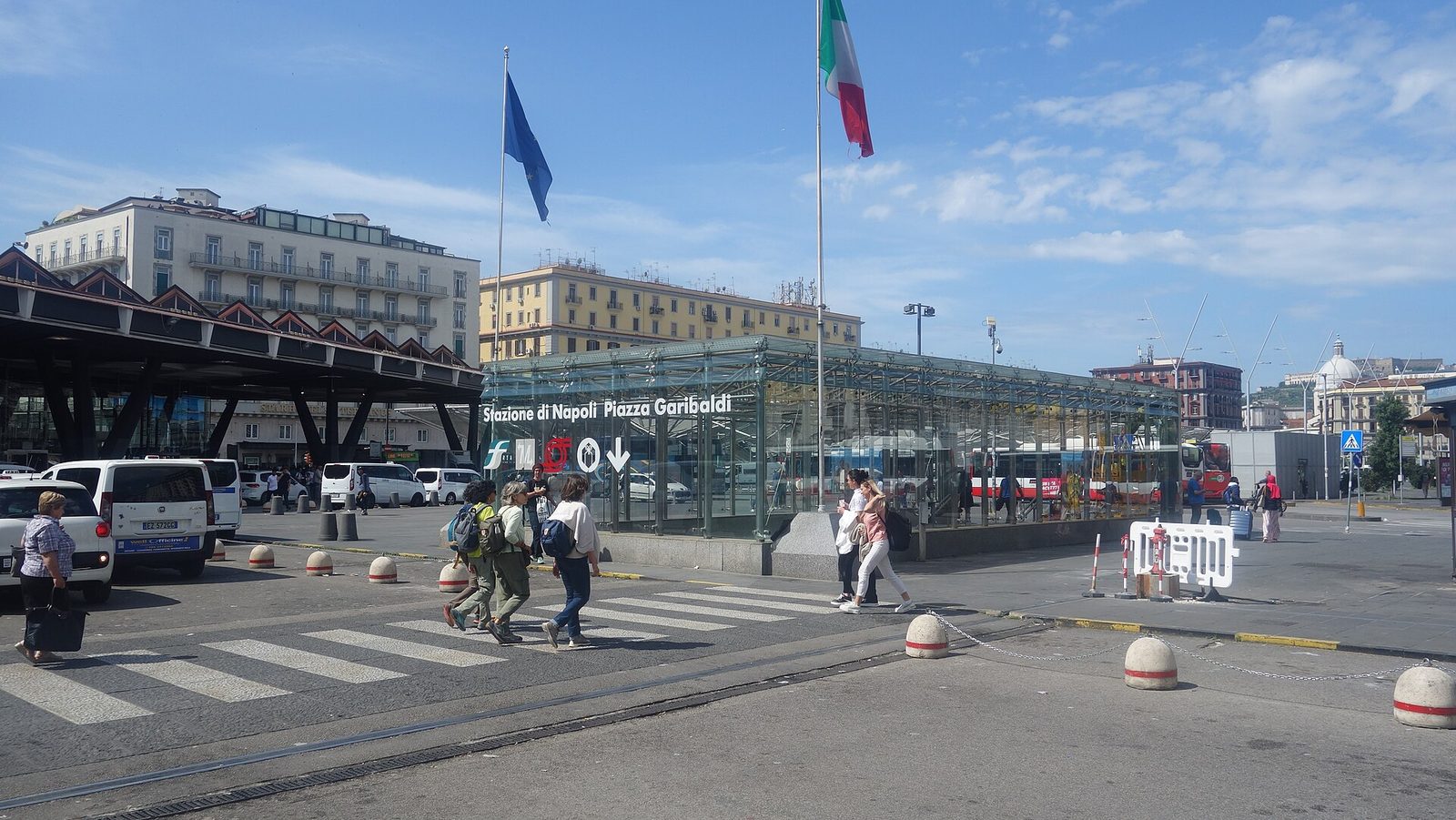
- Garibaldi: Napoli Centrale, Line 2 and the Circumvesuviana.
Trains are modern and air-conditioned. Frequency is the weak point: Line 1 has historically run far less often than a metro in Rome or Milan, with gaps of around ten minutes or more common outside the peaks, and it doesn’t run all night. Check the ANM site or app for the current last train if you’re out late, and have a plan B for the walk back.
The Art Stations
Line 1 is the rare metro people ride for pleasure. Since the early 2000s the city has commissioned architects and artists to design its new stations, and several are genuinely worth a detour. Toledo, by the Spanish architect Óscar Tusquets Blanca, is the celebrated one: a descent through deep-blue mosaic into a cone of light that rises up through the ceiling toward the street. Most travel roundups call it one of the most beautiful metro stations in Europe, and for once the hype is fair.
Università is Karim Rashid’s candy-colored, digital-age hall. Municipio, designed by Álvaro Siza and Eduardo Souto de Moura, was delayed for years because digging kept turning up the ancient harbor, and you’ll see remains of the old city walls at street level. Duomo, by Massimiliano Fuksas, opened in 2021 above excavated remains of a Roman temple. Museo, Dante, Materdei and Salvator Rosa carry contemporary art from the city’s collection.
You need a valid ticket to go past the gates, so the cheapest way to see them is simply to ride: buy one metro ticket, get off at Toledo, look up, and continue on the next train. Toledo is also a perfectly normal stop for Via Toledo, so it rarely costs you anything extra.
Line 6: short, new, occasionally useful
Line 6 runs from Mostra, near the Fuorigrotta exhibition grounds and the stadium district, along the western side of the city through Mergellina to Municipio, where it connects with Line 1. It has eight stations. For most visitors its value is the seafront end: it puts Mergellina, the lower Chiaia area and the start of Posillipo within easy reach of the port and Via Toledo without a bus. If you’re staying at the western end of the Riviera di Chiaia, it’s worth knowing about.
Line 2 is really a train
On the map, Line 2 looks like a second metro. In practice it’s a Trenitalia commuter rail line with longer gaps between trains. It runs from the east of the city through Garibaldi, Piazza Cavour, Montesanto, Piazza Amedeo, Mergellina and Campi Flegrei out toward Bagnoli and Pozzuoli.
It earns its place in two situations. First, it’s the quickest way to cross the city from the station to Mergellina and Chiaia. Second, it’s one way out toward the Campi Flegrei. As of September 2026, though, the section between Campi Flegrei station and Pozzuoli has been suspended following the bradyseism, the slow ground uplift and earthquakes around Pozzuoli. Check the current status before counting on it, and read my notes on the Cumana below.
The ticket rule is the one that catches people: Line 2 takes the integrated TIC ticket or a Trenitalia ticket, not the ANM-only Line 1 ticket. If you plan to mix Line 1 and Line 2 in one day, buy integrated tickets from the start.
Naples funiculars: the best-value rides in town
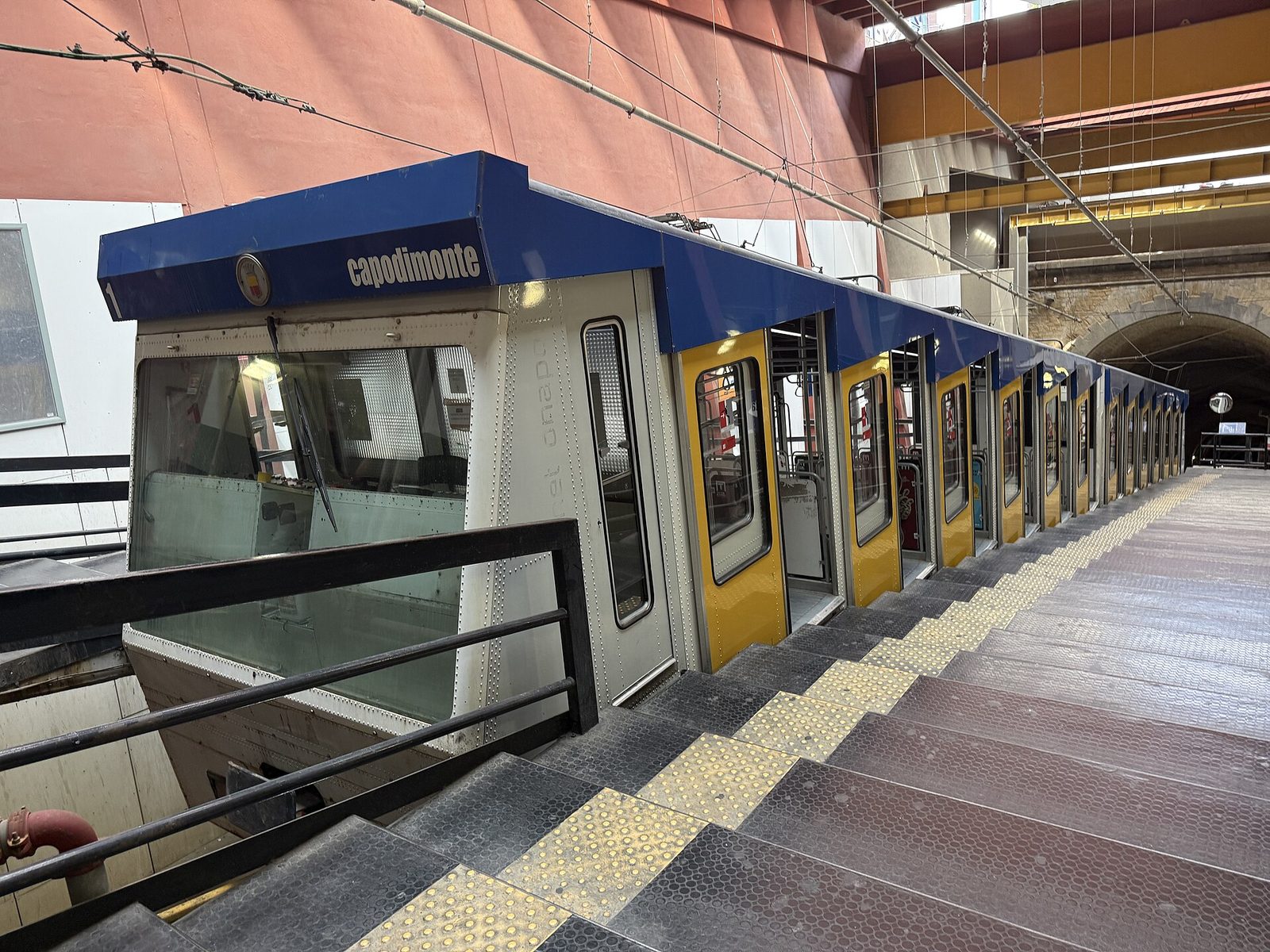
Naples is built on a steep amphitheater of hills, and four funiculars climb it. They are cheap, reliable, quick, and one of the small pleasures of the city. All four are run by ANM and take the same tickets as the buses.
| Funicular | Bottom station | Top station | Use it for |
|---|---|---|---|
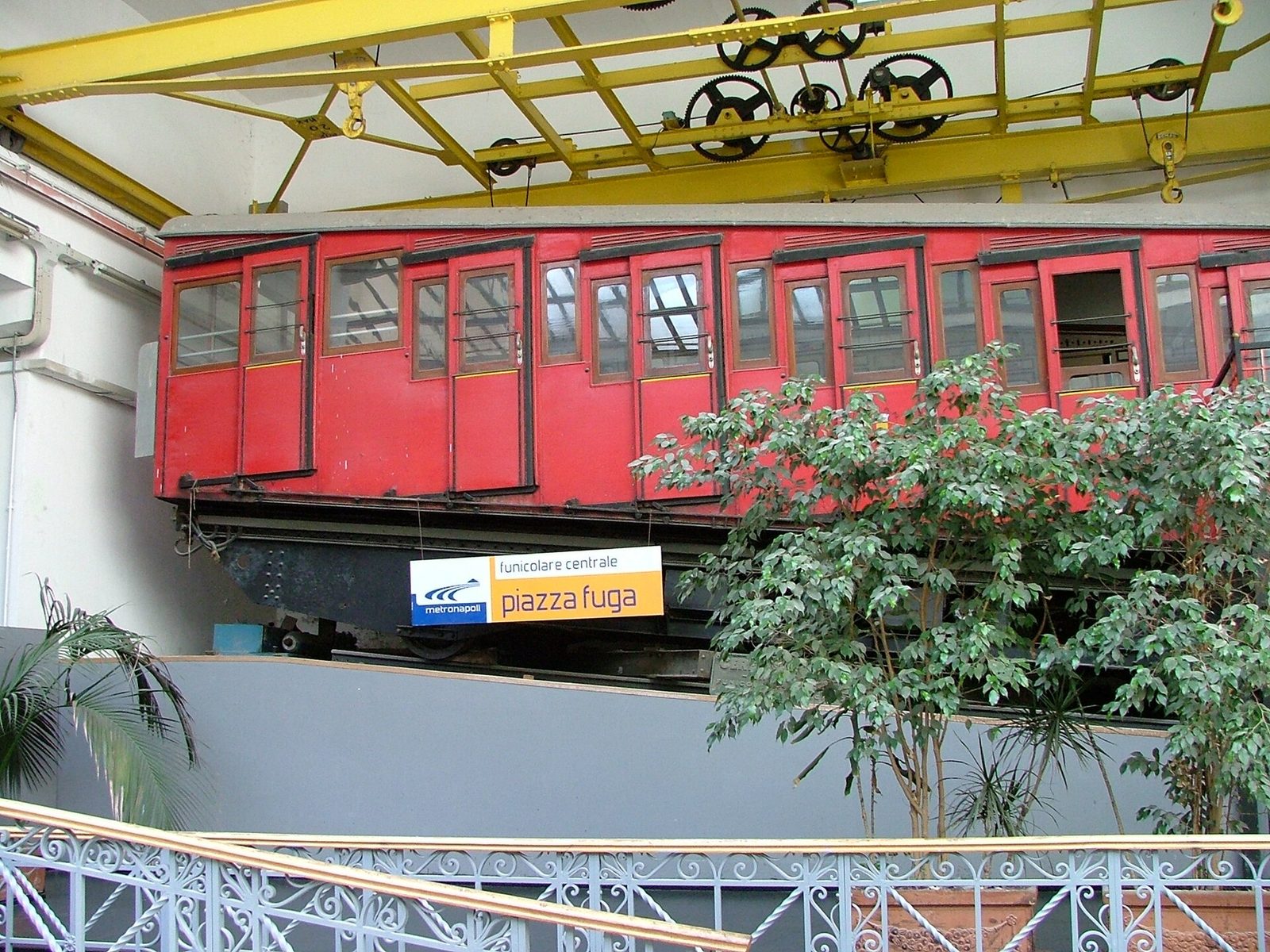
| Centrale | Augusteo (Piazza Duca d’Aosta, off Via Toledo) | Piazza Fuga, Vomero | The busiest; Vomero shopping streets and Villa Floridiana |
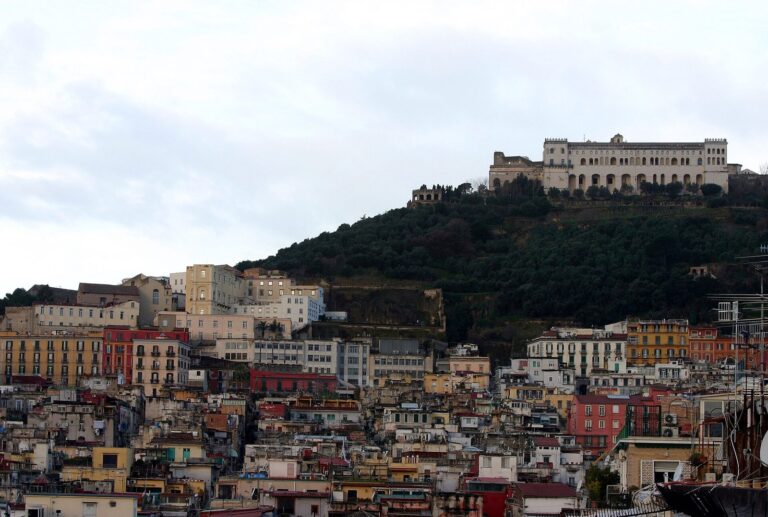
| Montesanto | Montesanto (by the Cumana and Line 2) | Via Morghen, Vomero | Castel Sant’Elmo and the Certosa di San Martino, a short walk from the top |
| Chiaia | Parco Margherita (Chiaia) | Via Cimarosa, Vomero | Linking the elegant Chiaia neighborhood to Vomero |
| Mergellina | Mergellina (Via Mergellina) | Via Manzoni, Posillipo | Posillipo’s hill and viewpoints |
My favorite pairing for a first-time visitor is to walk up through the Quartieri Spagnoli or take the Montesanto funicular to Castel Sant’Elmo and the Certosa di San Martino, admire the view over the whole bay, then take the Centrale back down to Via Toledo. The ride itself is only a few minutes, and it saves a climb that would take you the better part of an hour in the heat.
Funiculars close for maintenance from time to time, sometimes for weeks, and hours are shorter than the metro’s, with the last cars running in the evening rather than late at night. ANM posts closures on its site and at the stations. If one is shut, another usually lands close enough to walk.
Naples public transport tickets and fares
This is the section that matters most, and the one where most online guides are out of date. Prices below were checked in September 2026. Two warnings before the numbers.
First, fares are under review. In July 2026 Campania approved a proposal to raise single tickets by about ten cents (metro €1.50 to €1.60, bus and funicular €1.30 to €1.40), and ANM has pushed for a single flat fare of €1.50 or €1.60 across all modes. As of mid-September 2026 those were still proposals, not prices at the machine, and passes weren’t included. If you arrive to find a slightly higher number, that’s why.
Second, the official ANM ticket page wasn’t loading properly when I checked, so the current prices below come from regional transport reporting and the operators’ 2026 listings. They match each other; the machine is always the final word.
| Ticket | Price (checked Sept 2026) | What it covers | Buy it if… |
|---|---|---|---|
| ANM single, bus / funicular / tram | €1.30 | One ride on an ANM surface vehicle or funicular | You’re taking just one funicular or bus |
| ANM single, Metro Line 1 (and Line 6) | €1.50 | One ride on the ANM metro | You’re making one metro trip and nothing else |
| TIC Napoli integrated, 90 minutes | €1.80 | Unlimited ANM, Line 2 and EAV rail inside the city for 90 minutes | You’ll switch between metro, funicular and Line 2 |
| ANM daily ticket | €4.50 | Unlimited ANM metro, funiculars, buses and trams for the day | You’ll take three or more ANM rides in a day |
| Integrated daily ticket | €5.40 | All operators inside the city for the day, including Line 2 and EAV within Naples | You’ll mix Line 2 or the Cumana with ANM |
| Circumvesuviana to Pompei Scavi | Listed at €3.30 one way | EAV regional fare, Naples to Pompeii | Day trip to Pompeii |
| Circumvesuviana to Sorrento | Listed at €5.00 one way | EAV regional fare, the full line | Heading to Sorrento |
A few details that aren’t obvious from the table.
The integrated ticket stops at the city limits. Herculaneum (Ercolano) and Pompeii are separate towns, so neither the TIC nor the integrated daily ticket gets you there. Buy an EAV ticket for those trips. The Pompeii and Sorrento fares above come from EAV’s own app listings as reported in 2026; EAV’s fare page wasn’t reachable when I checked, and older guides still quote lower prices, so confirm at the machine or in the GoEav app. For Herculaneum, sources quoted different numbers in 2026, so I’m not going to print one.
Daily tickets are calendar-day tickets. They’re valid until the end of the day you first validate them, not for 24 hours. Starting one at 6 p.m. is poor value.
Where to buy. Machines at metro and funicular stations sell ANM tickets and take cards at most major stations. Tabacchi (tobacconists with the blue “T” sign), newsstands and some bars sell paper tickets too, which is handy because you can’t buy a ticket from a bus driver. The regional Unico Campania app sells digital tickets you activate before boarding. For the Circumvesuviana, EAV’s GoEav app sells tickets and, since a 2025 update, no longer asks for an Italian tax code to register.
Contactless. EAV has Tap&Go contactless gates at its busiest stations, including Garibaldi, Porta Nolana, Ercolano Scavi, Pompei Scavi, Castellammare and Sorrento, where you can tap a bank card or phone at the turnstile. Contactless on the ANM metro has been spreading gate by gate; if a gate shows the contactless symbol, it takes your card, and if it doesn’t, buy a ticket.
Validate everything. Paper tickets for buses, trams and some train lines must be stamped in the small validating machine when you board or before you reach the platform. Inspectors do check, particularly on the Circumvesuviana and the buses, and “I’m a tourist” doesn’t cancel the fine.
Does a museum card cover transport?
Sometimes. The Campania Artecard comes in several versions, and only some of them bundle public transport, so read the specific card’s terms before you assume the metro is included. If you’re planning to lean on a card for both museums and trains, check the official Artecard site for which version you’re buying and which operators it covers, then compare it with simply buying daily tickets on the days you need them.
The Circumvesuviana: Herculaneum, Pompeii and Sorrento
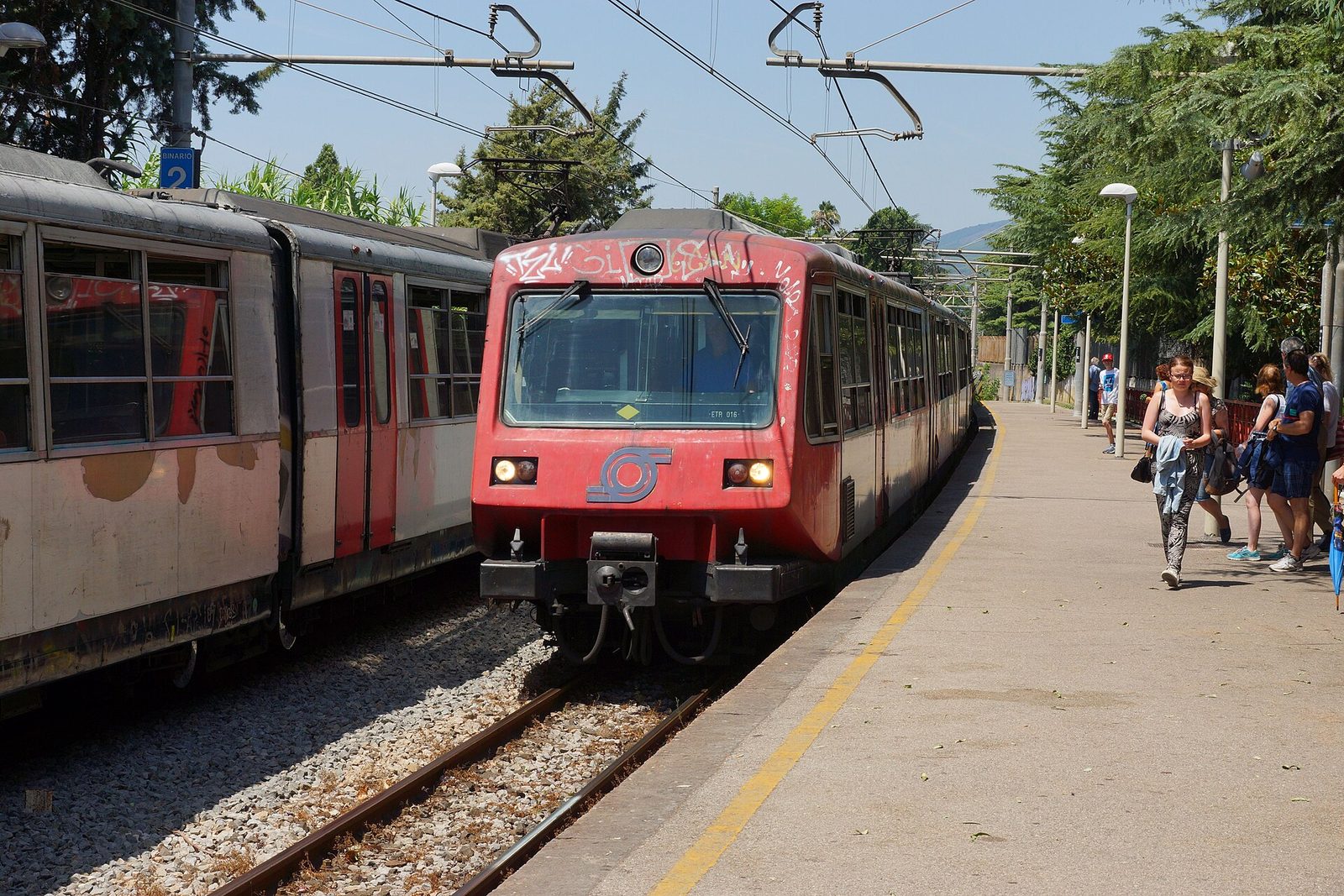
The Circumvesuviana is the train every visitor ends up on, and the one with the worst reputation. Some of that reputation is deserved. The trains on the main lines are often old, can be crowded and hot in summer, have no reserved seats, and run late more often than anyone would like. But it’s also cheap, direct and the most practical way from Naples to Herculaneum, Pompeii and Sorrento. Go in knowing how it works and it’s perfectly manageable.
Finding the platform
In Naples you can board at two stations. Porta Nolana is the terminus, a short walk from Piazza Garibaldi, and the one place you’re almost certain of a seat. Napoli Garibaldi is the next stop, and it lies on the lower level of Napoli Centrale, reached by escalators and stairs from the main station concourse. There’s no lift down to the Circumvesuviana, which matters if you’re dragging a heavy suitcase. Follow the signs for the Circumvesuviana or EAV rather than the ones for the metro.
The mistake almost everyone makes once
Several Circumvesuviana branches share the same tracks out of Naples and then split. The one you want for Herculaneum, Pompeii and Sorrento is the Sorrento line, and Sorrento trains usually leave from platform 3 at Garibaldi. The classic error is jumping on the first train that says “Pompei” or heading for the platform with the most people, and ending up on the Sarno or Poggiomarino branches. Those serve a different Pompei station, Pompei Santuario, near the modern town’s cathedral rather than the ruins, and other towns you didn’t want to see.
Read the destination on the departure board, not just the first word. For the ruins, the station name is Pompei Scavi–Villa dei Misteri. For Herculaneum it’s Ercolano Scavi, about a ten-minute downhill walk from the site entrance. Full details of the Pompeii trip, including which gate to use, are in my guide to getting from Naples to Pompeii.
Journey times and how full it gets
Roughly speaking, Herculaneum is under 20 minutes from Garibaldi, Pompei Scavi around 35 to 40 minutes, and Sorrento a little over an hour at the end of the line. Trains run about every half hour on the Sorrento line through most of the day, but cancellations happen, so allow slack before anything with a fixed time, such as a ferry out of Sorrento or a timed ticket at a site.
Mornings from Naples toward Pompeii and afternoons back are the busy directions in summer. If you board at Porta Nolana you’ll get a seat; if you board at Garibaldi in July you may stand to Pompeii. Keep your bag in front of you and your phone out of your back pocket, the same advice you’d follow on any crowded commuter train in a big city.
What about the Campania Express?
For years EAV ran a tourist train called the Campania Express on the same route, with reserved seats, air conditioning and fewer stops, at a much higher fare. As of 2026 EAV announced it was suspended from October 1, 2026, “until further notice.” If you’re traveling after that date, plan on the ordinary Circumvesuviana, and treat any website still selling Campania Express seats for later dates with suspicion.
The Cumana and Circumflegrea: west to Pozzuoli
EAV’s other two lines leave from Montesanto station, next to the funicular of the same name, and run west into the Campi Flegrei, the volcanic “Phlegraean Fields.” The Cumana follows the coast through Fuorigrotta and Bagnoli to Pozzuoli and on to Torregaveta; the Circumflegrea takes an inland route toward Licola and Torregaveta. Inside the city limits they take the integrated ticket.
This corner of the bay is where transport is least predictable right now. Pozzuoli sits at the center of the Campi Flegrei’s bradyseism, and the stronger earthquakes of summer 2026 disrupted both the Cumana and Line 2’s run into Pozzuoli. The Cumana was due to reopen in September 2026 with a new Pozzuoli station, but conditions there can change quickly. Check EAV’s site on the day, and look at Italy’s Civil Protection Department for the current alert level before planning a day in the area.
City buses and trams: when they’re worth it

ANM runs a large bus network and a couple of tram lines along the port and east of the center. On paper it goes everywhere. In practice, the city’s traffic, double-parked delivery vans and narrow streets make most bus timetables more of a hope than a promise. I use buses in Naples only when there’s no metro or funicular alternative.
The most common reasons a visitor would ride one:
- Capodimonte. The museum and park sit on a hill north of the center with no metro stop. Buses up from Piazza Museo or Piazza Dante are the usual approach; a taxi is worth considering if you’re short on time.
- Posillipo and Marechiaro. The coast road beyond Mergellina is beautiful and poorly served by rail. Buses along Via Posillipo are the public option.
- The seafront. A few routes run along Via Caracciolo and the Riviera di Chiaia, useful if your feet have had enough.
Remember: buy your ticket before you board, validate it in the machine on the bus, and don’t expect the driver to sell you one. Board at the front or middle as marked, and press the stop button in good time, because drivers won’t stop at empty stops.
Taxis and ride-hailing in Naples
Taxis in Naples are white, have a roof sign, show the operator and license number on the door, and should run the meter unless you’ve agreed one of the city’s official fixed fares, which cover set routes such as the station, the port and the airport. Always use a licensed taxi from a rank or one ordered by phone or app, and never accept a ride from someone who approaches you in the arrivals hall or outside Centrale.
Two things to do every time: ask for the fixed fare, if your route has one, before you set off (“tariffa predeterminata”), and if it doesn’t, check the meter is running. Supplements for luggage, night journeys and Sundays are legitimate; a vague price conjured up at the destination isn’t. The official fixed-fare routes and what they cost will get their own detailed page on this site, and I keep those numbers there so there’s only one place to update.
Uber exists in Naples, but not in the cheap, anyone-can-drive form Americans know. Italian rules mean you’ll get licensed professional drivers or regular taxis through the app, generally at taxi prices or above. It’s useful if you prefer app-based payment and English-language booking; it isn’t a money-saver. Italy’s own taxi apps, such as itTaxi and appTaxi, work the same way with the city’s cooperatives.
When is a taxi the right call? With luggage between the station, the port and your hotel, especially if your hotel is up a steep street or in a pedestrian zone the driver can reach and you can’t comfortably walk. Late at night after the metro and funiculars stop. And for groups of three or four, where the per-person cost starts to look reasonable. For a ten-minute walk in the centro storico, it’s almost always slower than your feet.
Driving in Naples: don’t
I’m usually cautious about telling travelers what not to do. With driving in Naples I’ll make an exception. Traffic is aggressive by Italian standards, scooters appear from every side, parking is scarce and expensive, and large parts of the center are ZTL zones (zone a traffico limitato, limited traffic zones) watched by cameras. Drive past a ZTL sign during its active hours without a permit and the fine arrives by post, often months later, via your rental company, which adds an administrative charge of its own.
If you’re renting a car for the Amalfi Coast, the Cilento or inland Campania, pick it up on your way out of Naples, ideally from the airport, and return it there. If you’re arriving by car, book a hotel with confirmed parking or use a garage near the edge of the center, then leave the car there. The coast has its own restrictions too, which I cover in my Amalfi Coast from Naples guide.
Walking: the real transport system
This is the section most guides tuck at the end. I’d put it first if the headings let me. The historic center of Naples was laid out by the Greeks, and its narrow grid was never designed for vehicles. Much of it is pedestrianized or so congested that walking is simply faster.
Some rough walking times to help you plan (at an unhurried pace, allowing for crowds):
- Napoli Centrale to the start of Spaccanapoli: about 15 to 20 minutes.
- Spaccanapoli to the National Archaeological Museum: about 10 to 15 minutes.
- Piazza Dante to Piazza del Plebiscito along Via Toledo: about 20 minutes.
- Piazza del Plebiscito to Castel dell’Ovo along the seafront: about 10 minutes.
- Castel dell’Ovo to Mergellina along the lungomare: about 25 to 30 minutes, and one of the best walks in the city.
A few honest caveats. Sidewalks can be narrow, broken or blocked by parked scooters, and in the Quartieri Spagnoli and the old town you’ll share the lanes with mopeds. Watch at crossings: Neapolitan drivers do stop for pedestrians, but they expect you to commit. Comfortable shoes are essential, because the volcanic paving stones get slippery in rain. And plan uphill walks to Vomero around a funicular rather than your calves in August.
Ferries, hydrofoils and the ports
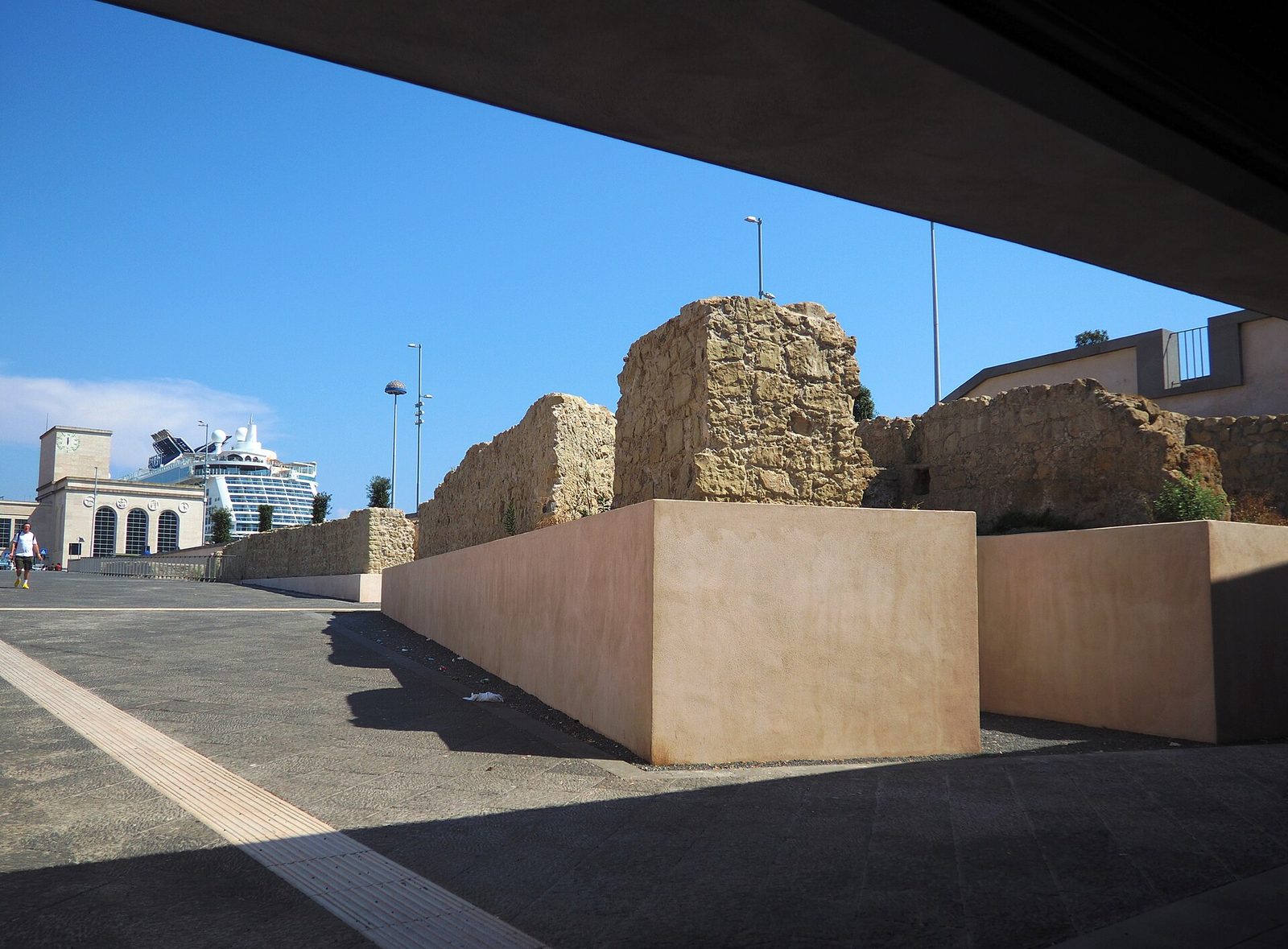
The islands and some coastal towns are reached by sea, and the ferry system deserves its own guide, so here’s only the part that belongs to getting around the city: which port you’re heading for.
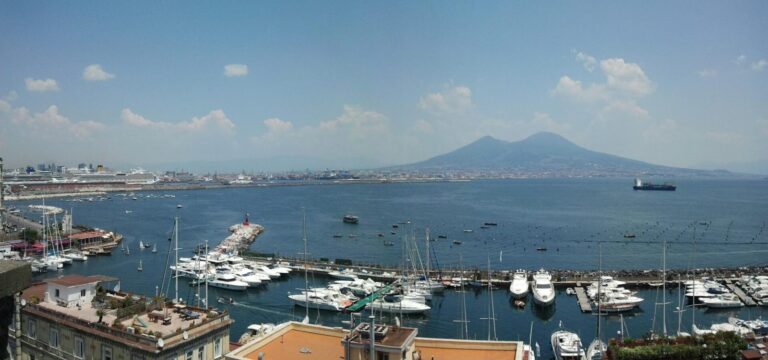
Molo Beverello, in front of Castel Nuovo, handles the fast hydrofoils and jets to Capri, Ischia, Procida and Sorrento. It’s a short walk from Municipio station on Line 1 and Line 6.
Calata Porta di Massa, about a kilometer east along the port, handles the slower car ferries. It’s the one people miss, because taxi drivers and signs sometimes just say “the port.” Check your ticket, allow time for the walk along the waterfront, and don’t assume that because you’re at the port you’re at the right pier.
For which island to pick and how to plan the day, see my guide to visiting Capri from Naples.
Getting to and from Naples airport
Capodichino airport is only a few kilometers northeast of the center, but there’s still no rail or metro link to it; the Line 1 extension isn’t open yet. Your options are the Alibus airport shuttle, which stops at Napoli Centrale and the port, an official fixed-fare taxi, or a pre-booked transfer. I’ll cover the choice properly in a dedicated airport guide, including which option suits which part of town.
Strikes, accessibility and staying safe
Strikes (scioperi)
Transport strikes in Italy are frequent, usually last a day or part of a day, and must be announced in advance. By law, a minimum service runs in guaranteed time bands, typically around the morning and evening commutes. Italy’s Ministry of Infrastructure and Transport publishes a strike calendar, and ANM and EAV post notices on their sites. If a strike lands on your Pompeii day, go early, inside the guaranteed band, or move the trip.
Accessibility
Newer Line 1 and Line 6 stations have lifts, though they aren’t always in service. The Circumvesuviana is much harder: older platforms, steps up into trains and, at Garibaldi, no lift down from the main station. Funiculars are step-free once you’re inside the station, but reaching some entrances involves stairs. Taxis are often the realistic choice for travelers with reduced mobility; ask for a larger vehicle when you book.
Pickpockets and common sense
Naples’ reputation is worse than its reality, but crowded trains and buses are where petty theft happens. Keep phones and wallets in front pockets or a zipped bag, be alert when doors open and close, and ignore anyone offering to “help” you buy a ticket at the machine.
Five common trips, and how I’d make them
| From → to | Best option | Ticket | Why |
|---|---|---|---|
| Napoli Centrale → Spaccanapoli | Walk, or Line 1 to Duomo | None, or ANM metro single | Walking is barely slower and more interesting |
| Via Toledo → Castel Sant’Elmo | Funicolare Centrale or Montesanto | ANM single | Saves a steep climb in minutes |
| Centrale → Molo Beverello (ferries) | Line 1 to Municipio | ANM metro single | Direct, and avoids port traffic |
| Centrale → Mergellina | Line 2 | TIC integrated | Fastest cross-city ride when it’s running |
| Naples → Pompeii ruins | Circumvesuviana, Sorrento line, to Pompei Scavi | EAV regional ticket | Cheap and direct; check the branch |
What to skip
- Renting a car for Naples itself. ZTL cameras, traffic and parking will cost you more time and money than any taxi.
- Buses through the historic center. Walk or take Line 1. The bus will sit in traffic while you’d have arrived.
- Taxis for short hops in the old town. Pedestrian streets mean the driver drops you a few blocks away anyway.
- Integrated daily tickets you won’t use. Two metro rides and a funicular cost about the same as the day ticket; buy singles unless you’re sure.
- Unofficial “tourist trains” to Pompeii sold after October 1, 2026. The Campania Express is suspended from that date; take the regular Circumvesuviana.
- Waiting for Line 1 to reach the airport. It isn’t open, and I wouldn’t book around a promised date.
Getting around Naples Italy: frequently asked questions
Is public transport in Naples easy to use?
Yes, once you know which operator runs what. Metro Line 1 and the funiculars are simple and cover most sights. The Circumvesuviana is less comfortable but straightforward if you check the branch. Buses are the hard part, and you can mostly avoid them.
How much is a metro ticket in Naples, Italy?
An ANM single for Metro Line 1 costs €1.50, a bus or funicular single €1.30, and the 90-minute integrated TIC ticket €1.80, checked September 2026. A rise of about ten cents was proposed in 2026, so check the machine.
Can I use a contactless card on Naples public transport?
On the Circumvesuviana, yes, at Tap&Go gates in the main stations, including Garibaldi, Ercolano Scavi, Pompei Scavi and Sorrento. On the ANM metro, contactless gates are spreading; look for the symbol, and buy a ticket if it isn’t there.
Does the Naples metro go to the airport?
Not yet. There’s no rail or metro link to Capodichino airport. The Line 1 extension is under construction, but for now use the Alibus shuttle, an official fixed-fare taxi or a transfer.
Is Naples walkable?
Very. The historic center, Via Toledo, the Quartieri Spagnoli and the seafront are all within walking distance of each other. Use the funiculars for the hills of Vomero and Posillipo, and wear shoes with grip.
Is Uber available in Naples, Italy?
Yes, but only with licensed professional drivers and taxis, so it costs about the same as a taxi or more. It’s convenient for English booking and card payment, not for saving money.
Do I need to validate my ticket in Naples?
Yes. Stamp paper tickets in the validating machine when you board a bus or tram, or at the gates and machines before the platform. Digital tickets must be activated before boarding. Inspectors do fine visitors.
Is the Circumvesuviana safe?
Generally yes. It’s crowded, old and sometimes late rather than dangerous. Keep valuables in front of you, stay aware when doors open, and board at Porta Nolana if you want a seat.
Should I rent a car in Naples?
Not for the city. Limited traffic zones, cameras, traffic and parking make a car a liability. If you need one for the coast or inland Campania, pick it up as you leave Naples.
For the tricks pickpocket teams use on crowded trains and buses, and the taxi and ticket-machine scams to watch for, see my Naples safety and travel tips.
Landing at Capodichino? The airport isn’t on the metro, so your choices are the €5 Alibus to Napoli Centrale and the port, or an official taxi at a fixed fare. I cover both, plus the onward connections to the ferries and Sorrento, in my guide to getting from Naples airport to the city center.
Ferries and hydrofoils are the only sensible way to the islands, and they come with their own rules. There are two city terminals and a third at Pozzuoli, different luggage limits on fast and slow boats, and a seasonal timetable that thins out sharply in winter. All of that lives in the Naples ferry guide. Line 1’s Municipio stop is the one for Molo Beverello.
Photo credits
- Toledo metro station: photo by Photo2023, Wikimedia Commons, CC BY 4.0.
- Montesanto funicular: photo by Mark Fischer, Wikimedia Commons, CC BY-SA 4.0.
- Funicolare Centrale at Piazza Fuga: photo by MOs810, Wikimedia Commons, CC BY-SA 4.0.
- The port from the Municipio metro exit: photo by Mattia Luigi Nappi, Wikimedia Commons, CC BY-SA 4.0.
- Napoli Centrale, Piazza Garibaldi entrance: photo by Mint0ri, Wikimedia Commons, CC0.
- ANM bus at Bagnoli: photo by Sludge G, Wikimedia Commons, CC BY-SA 2.0.
Sources: ANM and Unico fares and the 2026 fare proposal from Campania regional reporting (July 2026) and the operators’ ticket listings; Circumvesuviana fares, Tap&Go gates and the GoEav app from EAV’s 2026 app listings; Campania Express suspension from EAV; Line 2 and Cumana disruption from EAV, Trenitalia and Italy’s Civil Protection Department. All checked September 2026. Fares and service status change; confirm with ANM and EAV before you travel.